
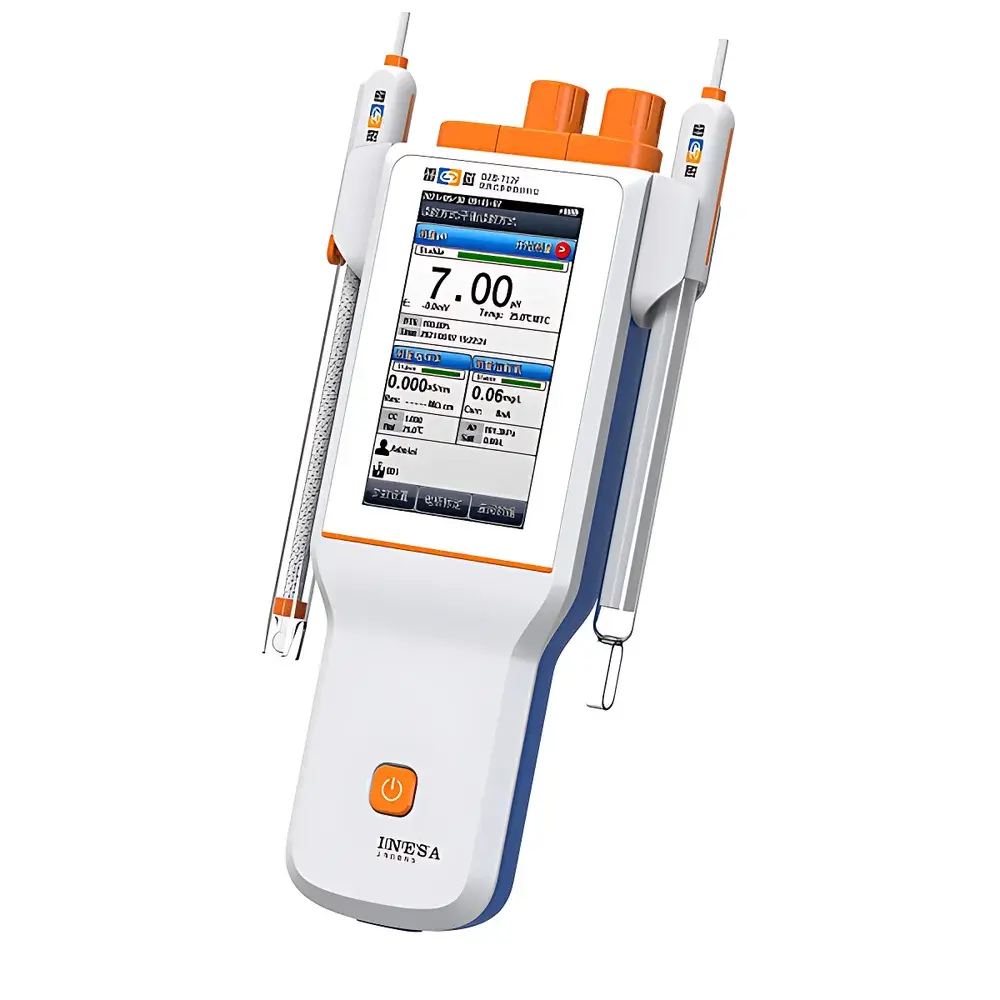
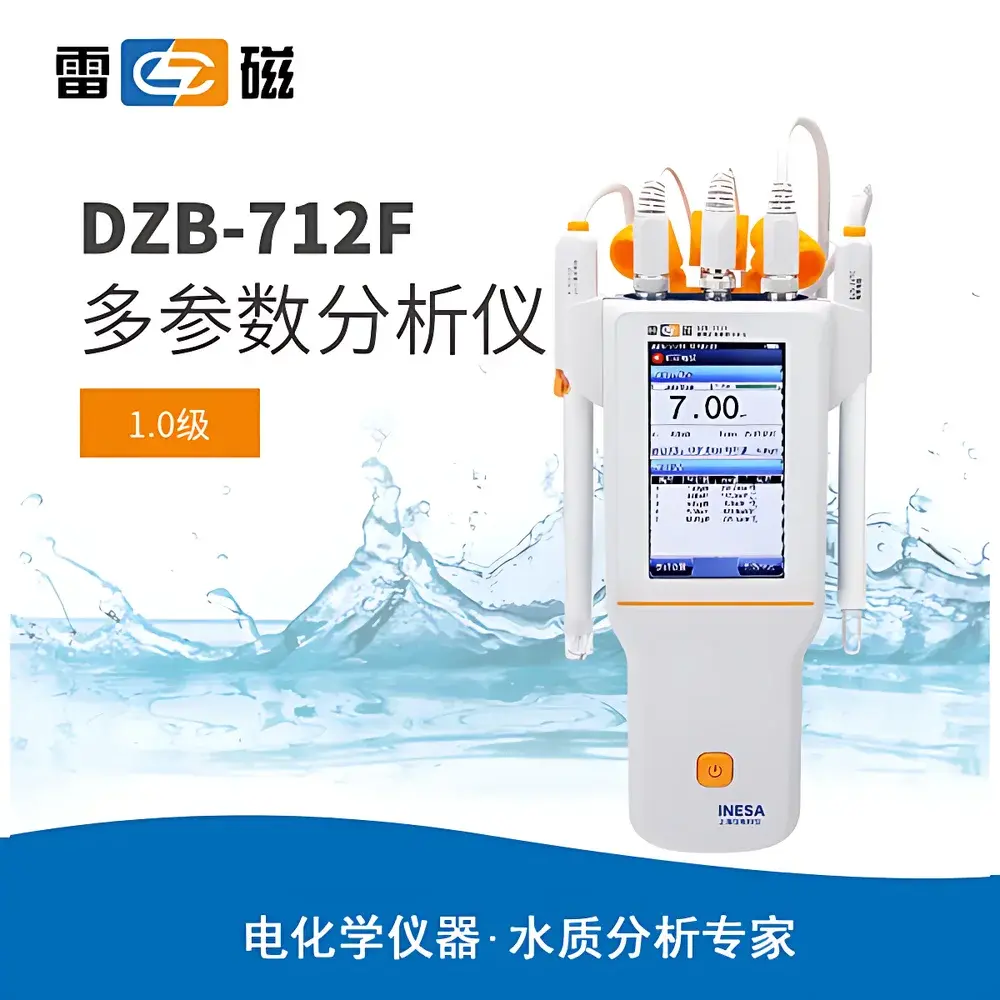
Leici DZB-712F Portable Multi-Parameter Water Quality Analyzer
| Brand | Leici |
|---|---|
| Origin | Shanghai, China |
| Manufacturer Type | Manufacturer |
| Product Origin | Domestic (China) |
| Model | DZB-712F |
| Instrument Type | Portable / Handheld Water Quality Analyzer |
| Measured Parameters | pH, Conductivity, Dissolved Oxygen (DO) |
| IP Rating | IP65 |
| Display | High-resolution color LCD touchscreen |
| Power | Rechargeable lithium battery (DC5V input via AC adapter) |
| Dimensions | 90 × 258 × 42 mm |
| Weight | 0.5 kg |
| Data Storage | 1000 datasets per parameter group |
| Compliance | GLP-compliant data logging with audit trail support |
| Connectivity | USB port for PC/LIMS integration |
Overview
The Leici DZB-712F Portable Multi-Parameter Water Quality Analyzer is an engineered field-deployable instrument designed for in-situ and laboratory-grade measurement of critical water quality parameters—pH/pX, electrical conductivity (EC), total dissolved solids (TDS), resistivity, salinity, dissolved oxygen (DO), DO saturation, and temperature—within a single compact platform. Built upon electrochemical sensing principles—including potentiometric pH/ion-selective electrode (ISE) detection, four-electrode or two-electrode conductometric measurement, and Clark-type polarographic DO sensing—the DZB-712F delivers metrologically traceable results aligned with international calibration frameworks. Its architecture supports primary environmental monitoring workflows across surface water, groundwater, wastewater effluent, aquaculture systems, and drinking water distribution networks. The analyzer operates under ISO/IEC 17025-aligned measurement conditions, with electronic unit accuracy certified to pH/pX: ±0.01, conductivity: ±1.0% FS, and DO: ±0.10 mg/L (≤20.00 mg/L), satisfying routine compliance requirements for regulatory sampling and QA/QC verification.
Key Features
- High-resolution color LCD touchscreen with intuitive icon-driven navigation and dual-language support (English/Chinese)
- IP65-rated enclosure ensuring dust-tight operation and resistance to low-pressure water jets—suitable for outdoor deployment in rain, humidity, or splashing environments
- Integrated triple-sensor measurement engine: pH/pX module with automatic buffer recognition (GB, DIN, NIST), conductivity module with auto-range switching and selectable reference temperature (20 °C or 25 °C), and polarographic DO module with atmospheric pressure compensation (kPa/mbar/Torr/atm)
- Intelligent endpoint detection algorithms supporting auto-read, timed-read, interval-read, and manual capture modes
- Comprehensive electrode diagnostics including impedance monitoring, slope evaluation, and offset validation for pH and conductivity sensors
- Multi-point calibration routines: up to 5-point pH/ISE calibration; 1–3-point conductivity standardization; zero-oxygen and saturated-oxygen DO calibration with manual salinity correction
- Extended ion measurement capability covering Na⁺, K⁺, NH₄⁺, Cl⁻, F⁻, and user-defined ions—with concentration units switchable among μg/L, mg/L, g/L, mol/L, mmol/L, and pX
- Configurable temperature compensation models: linear, non-linear, and pure-water-specific conductivity algorithms
Sample Compatibility & Compliance
The DZB-712F is validated for use with natural waters (freshwater, estuarine, seawater), treated effluents, process streams, and potable supplies. Its sensor suite accommodates samples with turbidity ≤ 500 NTU and suspended solids ≤ 100 mg/L without filtration. All measurements adhere to ASTM D1293 (pH of water), ASTM D5391 (conductivity of purified water), and ISO 5814 (electrochemical determination of dissolved oxygen). Data integrity conforms to GLP principles: each stored record includes timestamp, operator ID (optional), electrode serial numbers, calibration history, ambient temperature/pressure, and measurement metadata. Audit-trail functionality ensures full traceability for internal QA audits and external regulatory review (e.g., EPA Method 150.1, ISO/IEC 17025 Clause 7.7).
Software & Data Management
Data storage capacity supports ≥1000 entries per parameter group, with time-stamped records retrievable by date range, parameter type, or sample ID. On-device visualization includes trend curves for sequential measurements, enabling rapid interpretation of diurnal or spatial gradients. Export is supported via USB mass-storage mode or Leici’s proprietary communication software (compatible with Windows 10/11), facilitating CSV or Excel-formatted reports. Direct RS-232 output enables real-time printing to industry-standard thermal printers (e.g., Epson TM-T20II) with configurable print layouts—including header fields, units, and compliance statements. LIMS integration is achieved through ASCII-based serial protocols compliant with ASTM E1384 and HL7 standards, allowing seamless ingestion into enterprise laboratory information management systems.
Applications
- Field-based ambient water quality assessment per national monitoring programs (e.g., China’s “River Chief System”, USGS NWIS protocols)
- Wastewater treatment plant influent/effluent monitoring for discharge compliance (e.g., GB 8978–1996, EU Urban Wastewater Treatment Directive)
- Aquaculture pond management—tracking DO minima, pH shifts, and salinity drift during feeding cycles or algal blooms
- Drinking water safety verification at distribution points and household taps
- Educational laboratories requiring robust, multi-parameter instrumentation for environmental science curricula
- Emergency response teams conducting rapid post-event water screening after floods or industrial spills
FAQ
What calibration standards are supported for pH measurement?
The DZB-712F recognizes pre-programmed GB, DIN, and NIST pH buffer sets and allows custom buffer definition with user-entered nominal values and tolerances.
Can the instrument compensate for altitude when measuring dissolved oxygen?
Yes—barometric pressure compensation is performed automatically using integrated sensor input, with units selectable as kPa, mbar, Torr, or atm.
Is the device suitable for high-salinity seawater analysis?
It supports salinity compensation up to 8.00% and includes dedicated algorithms for marine DO correction; however, for extended marine deployments, use of a dedicated ruggedized DO probe with Teflon membrane is recommended.
Does the analyzer meet FDA 21 CFR Part 11 requirements?
While the DZB-712F provides GLP-compliant data logging with electronic signatures and audit trails, full 21 CFR Part 11 compliance requires implementation of validated third-party LIMS software with role-based access control and digital signature modules.
How often should conductivity electrodes be recalibrated in routine use?
Calibration frequency depends on usage intensity and matrix fouling risk; daily calibration is advised for regulatory reporting, while weekly verification suffices for internal monitoring where stability has been historically demonstrated.
Related Products







