
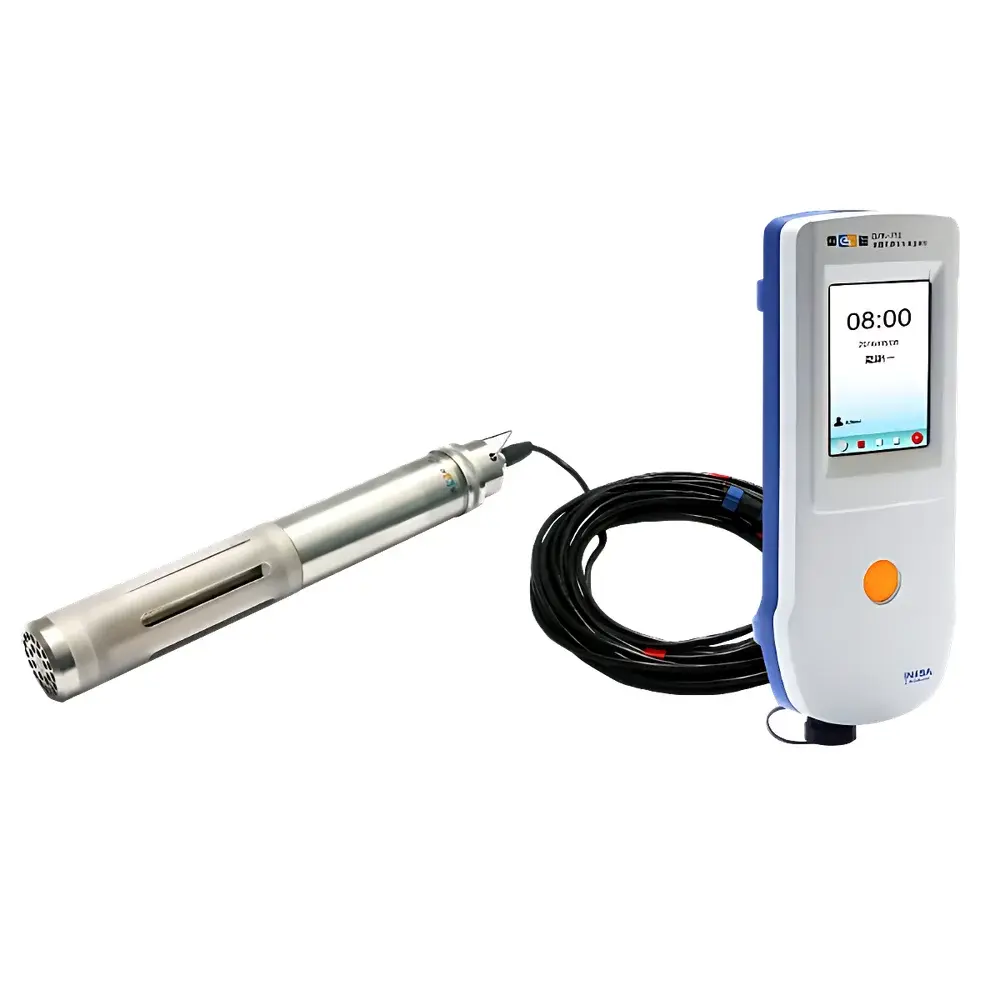
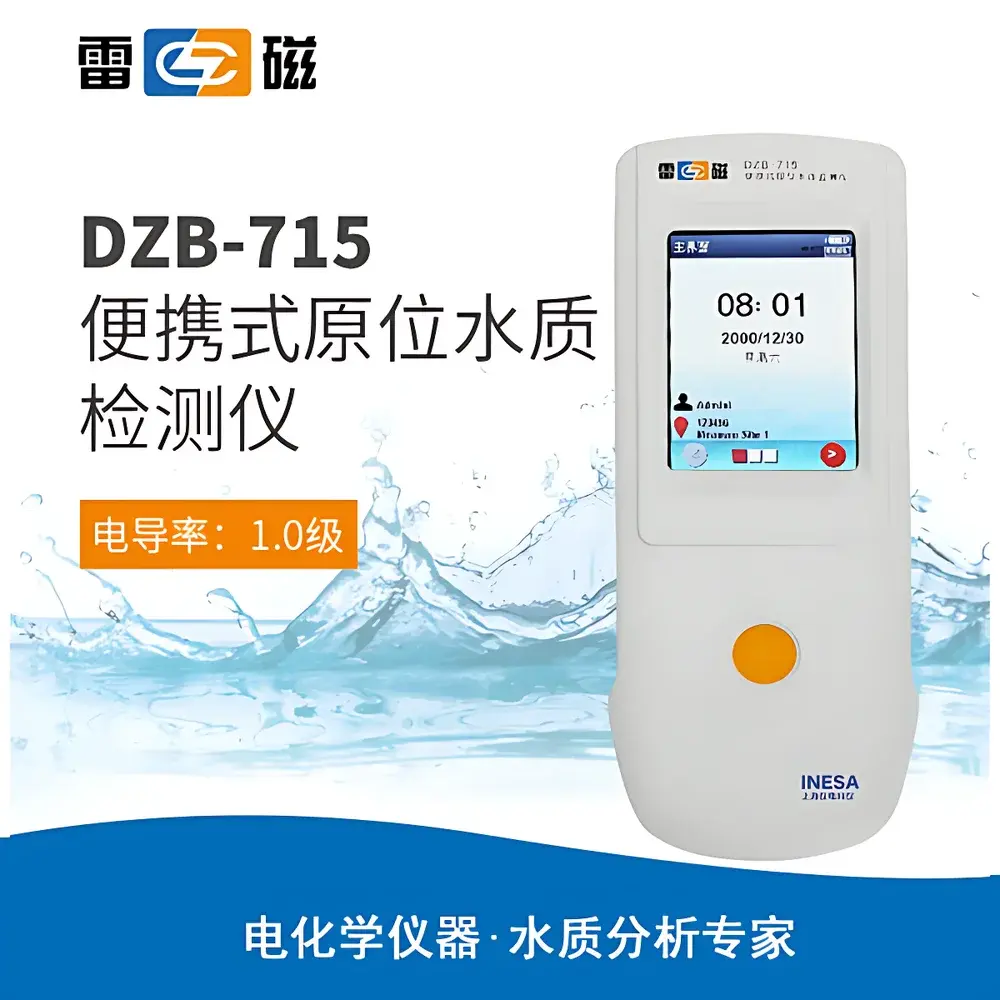
Leici DZB-715 Portable In-Situ Water Quality Analyzer
| Brand | Leici |
|---|---|
| Origin | Shanghai, China |
| Manufacturer Type | Manufacturer |
| Country of Origin | China |
| Model | DZB-715 |
| Instrument Type | Portable/Handheld Water Quality Analyzer |
| Measured Parameters | Water Temperature, pH/ORP, Conductivity/Salinity, Dissolved Oxygen, Depth |
| Display | 3.5" TFT Color Touchscreen |
| IP Rating | IP67 |
| Battery | Rechargeable Lithium-ion |
| Standard Cable Length | 10 m (customizable up to 100 m) |
| Data Storage | 5000 measurement sets |
| GPS | Optional |
| GPRS Transmission | Optional |
| Interface | USB, RS485 |
| Calibration | Single-point or multi-point, GLP-compliant |
| Operating Depth | Up to 10 m |
| Dimensions | 230 × 90 × 55 mm |
| Weight | 0.33 kg |
| Accuracy | pH ±0.10 pH |
Overview
The Leici DZB-715 Portable In-Situ Water Quality Analyzer is an engineered field instrument designed for real-time, on-site measurement of critical physicochemical parameters in surface water bodies—including rivers, lakes, reservoirs, and estuarine monitoring sections. It operates on the principle of direct in-situ electrochemical and optical sensing, eliminating sample transport artifacts and preserving measurement integrity for regulatory compliance. The system integrates a handheld control unit, ruggedized sensor cable, submersible probe assembly, and intelligent digital electrodes—each calibrated independently and communicating via standardized digital protocols to ensure traceable, high-reproducibility data acquisition. Its deployment aligns with national environmental monitoring frameworks such as China’s “Sampling-Measurement Separation” policy (implemented October 2017 across 2,050 national assessment sections), where in-situ determination of temperature, pH/ORP, conductivity/salinity, dissolved oxygen, and depth is mandated per GB 3838–2002 Table 1 requirements.
Key Features
- Multi-parameter digital sensor architecture supporting simultaneous measurement of pH, ORP, conductivity, salinity, dissolved oxygen (membrane-covered Clark-type electrode), temperature, depth, and pressure;
- Patented deep-water stirring electrode design enhances response kinetics and minimizes boundary layer effects in low-flow or stratified conditions;
- Modular electrode configuration allows selective integration of pH, ORP, or conductivity sensors based on mission-specific requirements;
- 3.5-inch TFT color touchscreen interface with sunlight-readable contrast, optimized for outdoor operation under variable ambient lighting;
- Auto-stabilization algorithm enables both single-point snapshot measurements and continuous logging modes with configurable intervals;
- Comprehensive calibration management: supports single-point and multi-point calibration routines with automatic slope/mV offset validation;
- Site ID tagging and cross-sectional metadata assignment ensure spatial context for every recorded dataset;
- IP67-rated enclosure provides dust-tight protection and immersion resistance up to 1 meter for 30 minutes—validated for field durability;
- Integrated rechargeable lithium-ion battery delivers >12 hours of continuous operation; USB and RS485 interfaces support firmware updates, data export, and PC-based analysis;
- Optional GPS module enables georeferenced data capture; optional GPRS module facilitates automated telemetry to centralized water quality management platforms.
Sample Compatibility & Compliance
The DZB-715 is validated for use in freshwater, brackish, and low-salinity estuarine environments. Its sensor suite meets metrological specifications outlined in GB/T 6920–1986 (pH), GB/T 11007–2008 (conductivity), and HJ 506–2009 (dissolved oxygen). While not certified to ISO/IEC 17025, its GLP-compliant data structure—including timestamped calibration records, operator ID fields, and full audit trail of measurement events—supports alignment with Good Laboratory Practice principles required for regulatory reporting. Depth and temperature compensation algorithms are embedded per IAPSO standard formulations for conductivity-to-salinity conversion. The instrument’s 10-meter operational depth rating conforms to ASTM D3370-21 guidelines for submersible field probes used in open-water profiling.
Software & Data Management
Data generated by the DZB-715 is stored internally in non-volatile memory (5,000 measurement sets), with each entry containing parameter values, raw sensor signals, calibration history, GPS coordinates (if enabled), and operator-defined site identifiers. Export is supported via USB mass storage mode or RS485 serial protocol using Leici’s proprietary desktop software—compatible with Windows 10/11 and capable of generating CSV, PDF, and XML outputs compliant with national environmental data exchange standards (e.g., HJ 212–2017). Firmware upgrades are performed via U-disk or PC connection without requiring hardware disassembly. All stored datasets include cryptographic timestamps and checksums to satisfy basic data integrity requirements for QA/QC workflows.
Applications
- Routine monthly monitoring of national surface water assessment sections under China’s Ministry of Ecology and Environment (MEE) framework;
- Field verification of automated station data during QA/QC audits;
- Emergency response assessments following chemical spills or algal bloom events;
- Baseline characterization of tributary inflows and outfall mixing zones;
- Academic research requiring high-temporal-resolution vertical profiling in shallow stratified systems;
- Regulatory compliance sampling for municipal wastewater discharge permits where in-situ DO and pH verification is required prior to effluent release.
FAQ
What is the maximum operational depth for the DZB-715 probe?
The probe is rated for continuous submersion at depths up to 10 meters, with pressure compensation integrated into the depth and conductivity modules.
Does the instrument support automatic temperature compensation for all measured parameters?
Yes—temperature is measured concurrently and applied in real time to pH, conductivity, salinity, and dissolved oxygen calculations per NIST-traceable algorithms.
Can calibration data be exported separately from measurement records?
Yes—calibration logs are stored as discrete entries with unique identifiers and can be filtered and exported independently via the desktop software.
Is the instrument compatible with international data management platforms such as WISKI or HydroOffice?
Raw CSV exports are structured to permit ingestion into third-party hydroinformatics platforms; however, native API integration requires custom middleware development.
How is measurement traceability ensured during field use?
Each measurement includes embedded metadata: device serial number, sensor calibration dates, operator ID, GPS coordinates (if active), and digital signature of the measurement event—enabling full chain-of-custody documentation.







