
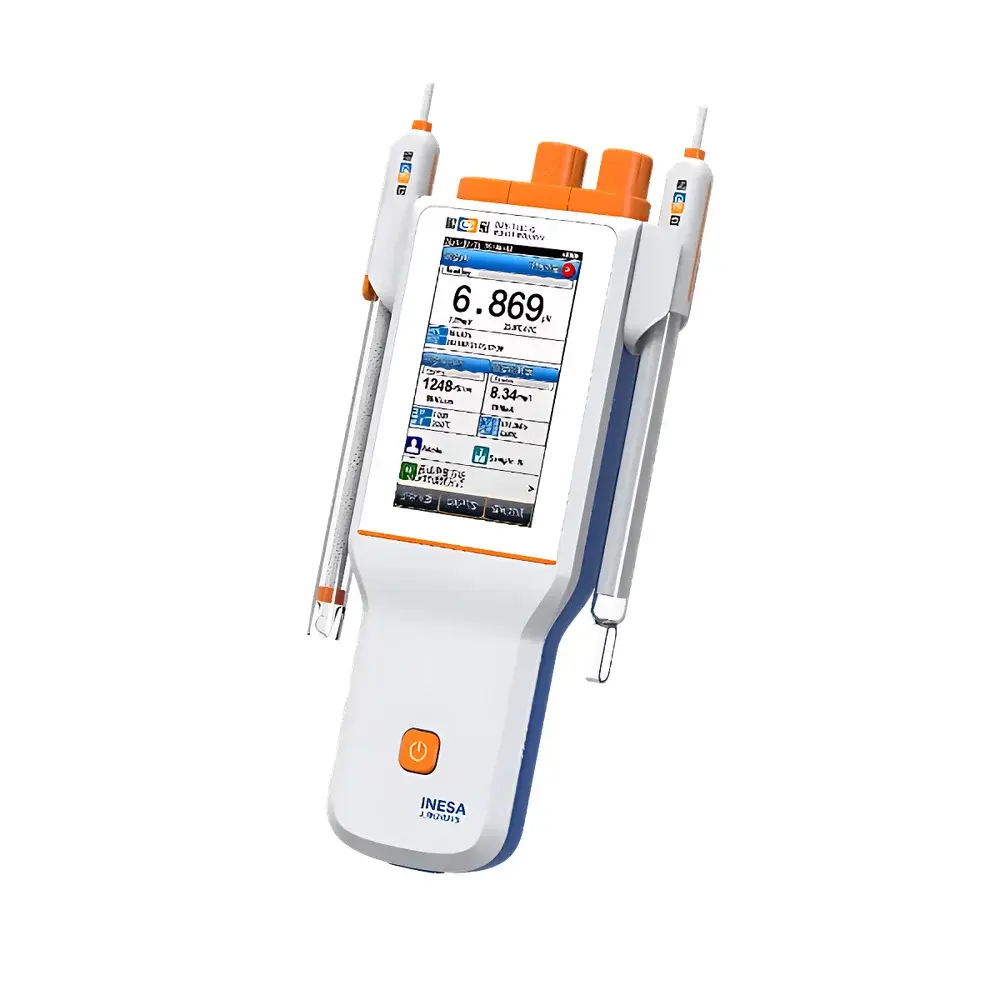
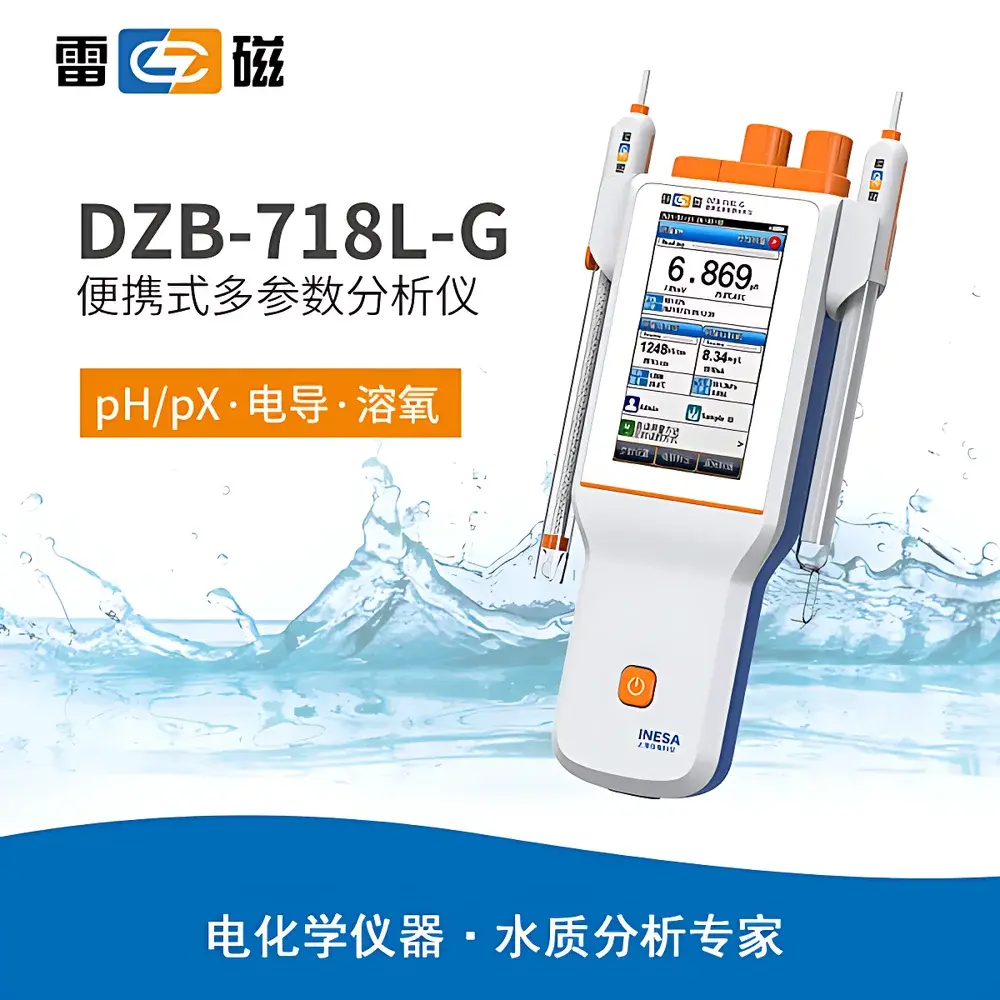
Leici DZB-718L-G Portable Multi-Parameter Water Quality Analyzer
| Brand | Leici |
|---|---|
| Origin | Shanghai, China |
| Manufacturer Type | Original Equipment Manufacturer (OEM) |
| Country of Origin | China |
| Model | DZB-718L-G |
| Instrument Type | Portable / Handheld Water Quality Analyzer |
| Measured Parameters | pH / pX, Ion Concentration, mV, Conductivity, Resistivity, TDS, Salinity, Ash Content, Dissolved Oxygen (DO), DO Saturation, Temperature |
Overview
The Leici DZB-718L-G is a field-deployable, multi-parameter water quality analyzer engineered for high-precision in-situ and laboratory-based environmental monitoring. Built upon a modular electrochemical measurement architecture, it integrates three independent analytical modules—pH/pX potentiometry, conductivity (including resistivity, TDS, and salinity), and dissolved oxygen (via both polarographic and optical fluorescence detection)—into a single ruggedized handheld platform. Its core measurement principles comply with internationally recognized electrochemical standards: pH and ion-selective measurements follow Nernstian response theory with automatic temperature compensation (ATC); conductivity employs four-electrode or two-electrode AC excitation with selectable reference temperatures (5.0–25.0 °C) and compensation models (linear, pure-water, non-compensated); dissolved oxygen quantification adheres to either Clark-type amperometric detection (ISO 5814) or luminescence-based quenching kinetics (ISO 17289), with integrated barometric and salinity correction per ASTM D888 and APHA 4500-O. Designed for regulatory-grade data integrity, the instrument meets GLP (Good Laboratory Practice) requirements through full audit-trail logging, user-level access control, and electronic signature-ready operation.
Key Features
- 4.3-inch high-resolution color TFT touchscreen with intuitive icon-driven interface supporting English and Chinese language selection
- IP65-rated enclosure ensuring dust-tightness and protection against low-pressure water jets—suitable for outdoor deployment in rain, humidity, or dusty environments
- Triple-sensor capability: pre-calibrated tri-combination pH electrode, composite conductivity cell, and dual-mode DO probe (polarographic and optical fluorescence compatible)
- Intelligent electrode recognition and auto-diagnostic startup sequence verifying sensor connectivity, calibration status, and battery health
- Multi-level user management (three-tier permission system) with password-protected configuration, method editing, and data export functions
- Advanced endpoint detection algorithms—including equilibrium reading, timed sampling, and continuous monitoring modes—with configurable stability thresholds
- Built-in firmware upgradability via USB or microSD card, enabling method expansion, protocol updates, and regulatory compliance alignment without hardware modification
- Extended battery life powered by rechargeable lithium-ion pack (≥12 h typical operation), with real-time charge-state indication and USB-C/DC 5 V charging compatibility
Sample Compatibility & Compliance
The DZB-718L-G is validated for aqueous matrices across environmental, municipal, industrial, and food-grade applications—including surface water, groundwater, wastewater effluent, drinking water distribution systems, aquaculture ponds, and sugar/HFCS process streams (per GB/T 10498 and AOAC 982.02 for ash determination). All electrochemical measurements conform to ISO/IEC 17025 traceability frameworks when used with certified reference materials (CRMs). The instrument supports full GLP data governance: each stored measurement record includes timestamp, operator ID, electrode serial number, calibration history, ambient temperature/pressure, and environmental metadata. It satisfies FDA 21 CFR Part 11 readiness through secure electronic signatures, immutable audit logs, and role-based access restrictions—enabling direct integration into regulated LIMS environments.
Software & Data Management
Data handling is implemented via embedded 128 MB flash memory supporting ≥1,000 datasets per parameter group (pH, conductivity, DO), each containing full measurement context and raw sensor outputs. Stored records are retrievable by date range, parameter type, or custom tag; results may be visualized as time-series plots or statistical summaries (mean, SD, min/max, trend lines). USB 2.0 host interface enables bidirectional communication with Windows-based Leici LabLink software for report generation (PDF/CSV/XLSX), spectral overlay analysis, and batch calibration validation. Optional UVC-compliant USB peripherals—including barcode scanners and Bluetooth-certified thermal printers—are natively supported. LIMS integration is achieved via HL7 v2.x or ASTM E1384-compliant message exchange over TCP/IP or serial protocols.
Applications
- Field-based compliance monitoring per EPA Method 150.1 (conductivity), 150.2 (pH), and 360.1 (dissolved oxygen)
- Wastewater treatment plant (WWTP) influent/effluent QA/QC with simultaneous DO, conductivity, and pH trending
- Drinking water safety verification across distribution networks—especially critical for corrosion potential assessment (Langelier Index calculation)
- Aquaculture and hydroponic system management requiring real-time DO saturation and salinity tracking
- Fruit juice, syrup, and refined sugar production where ash content (GB 10498) and electrolyte balance impact product consistency
- Educational laboratories conducting standardized potentiometric and conductometric titrations under ISO 9001-accredited curricula
FAQ
Does the DZB-718L-G support ASTM D1125 and ISO 7888 conductivity standard compliance?
Yes—the instrument implements automatic temperature compensation using the linear or pure-water models specified in both standards, and supports calibration with NIST-traceable KCl solutions at 0.01, 1.413, and 12.88 mS/cm.
Can the device store calibration curves for multiple ion-selective electrodes simultaneously?
Yes—up to eight independent calibration sets per ion mode (Na⁺, K⁺, NH₄⁺, Cl⁻, F⁻) can be saved, each with unique slope, intercept, and detection limit metadata.
Is Bluetooth Low Energy (BLE) connectivity available for wireless data streaming?
No—wireless functionality is limited to optional Bluetooth printing via Class 2 adapters; real-time telemetry requires wired USB or RS-232 interfaces.
What is the maximum allowable total dissolved solids (TDS) concentration for accurate conductivity-to-TDS conversion?
The algorithm applies industry-standard PPM conversion factors (0.5–0.7) across 0.000 mg/L to 1000 g/L; accuracy degrades above 200 g/L due to non-linear ionic activity effects.
How does the instrument handle electrode drift during extended field deployments?
It features adaptive recalibration prompting—triggered by elapsed time, temperature excursion >5 °C, or measured deviation exceeding ±0.02 pH/±2% conductivity from last valid calibration—ensuring metrological continuity.







