
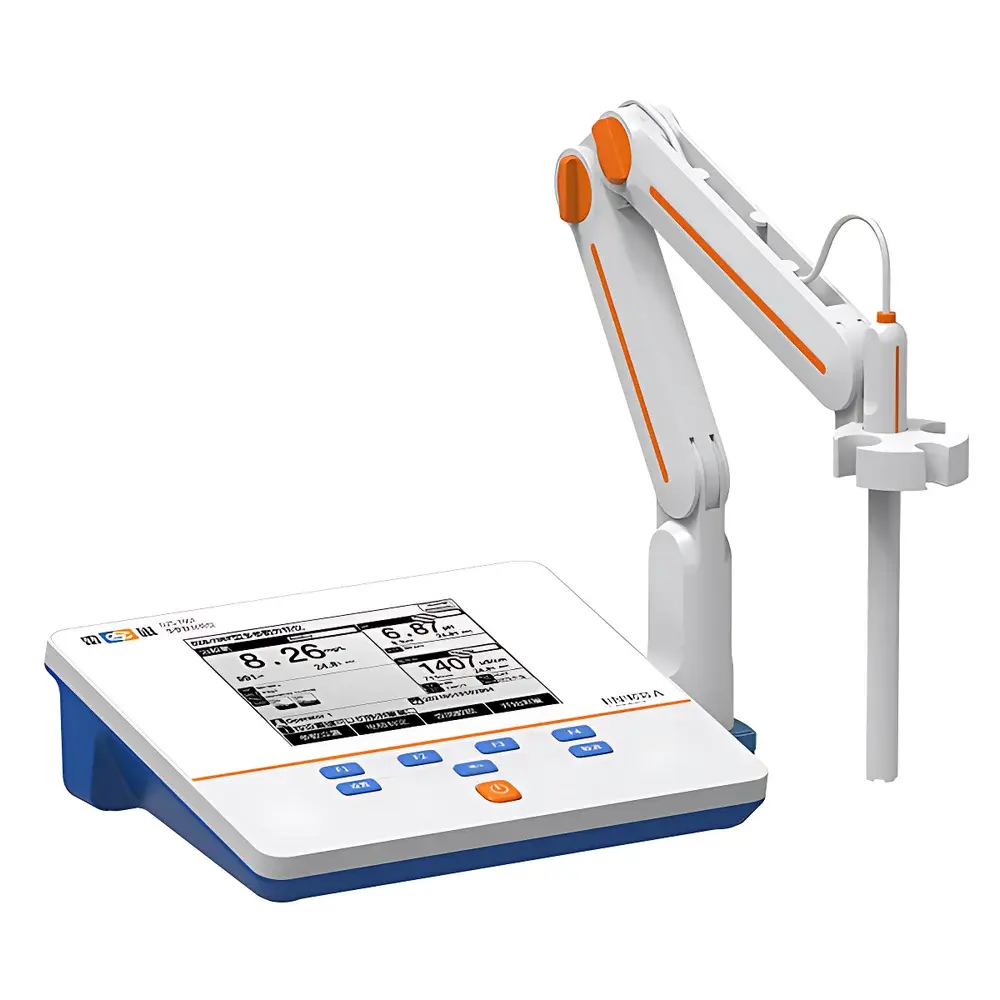
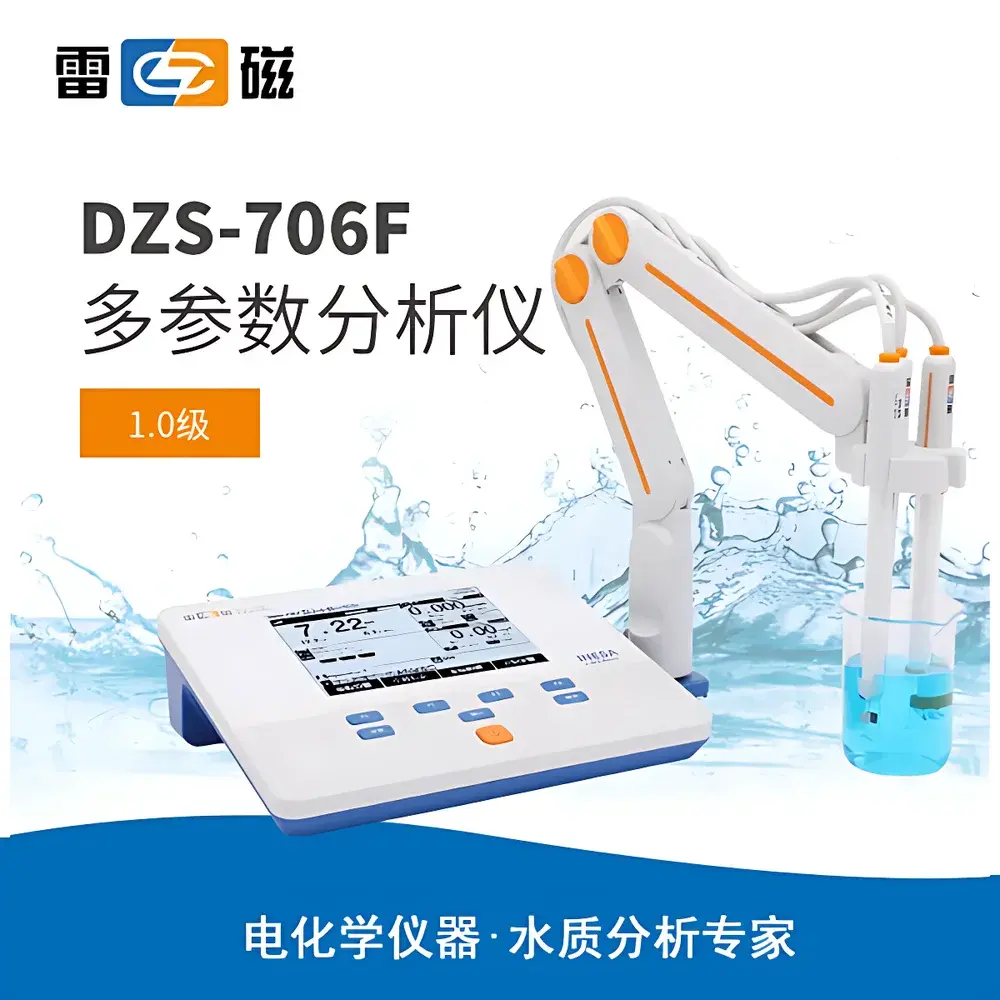
LeiCi DZS-706F Multi-Parameter Water Quality Analyzer
| [Brand | LeiCi |
|---|---|
| Origin | Shanghai, China |
| Manufacturer Type | Original Equipment Manufacturer (OEM) |
| Product Category | Laboratory-Based Water Quality Analyzer |
| Model | DZS-706F |
| Measurement Parameters | pH/pX, Redox Potential (mV), Conductivity, Resistivity, TDS, Salinity, Dissolved Oxygen (DO), DO Saturation, Temperature |
| Compliance | GLP-compliant data management with audit trail support |
| Connectivity | RS-232 serial port (printer-ready), USB 2.0 (PC communication) |
| IP Rating | IP54 |
| Display | Color high-resolution LCD |
| Data Storage | 500 datasets per parameter group |
| Calibration | Auto-recognition of GB/DIN/NIST buffers |
| Temperature Compensation | Automatic (pH, conductivity, DO), manual salinity compensation for DO |
| Electrode Support | Tri-combination pH electrode, composite conductivity cell (k = 1.0 cm⁻¹), polarographic DO sensor] |
Overview
The LeiCi DZS-706F Multi-Parameter Water Quality Analyzer is a benchtop laboratory instrument engineered for precise, simultaneous measurement of critical water quality parameters in environmental monitoring, municipal water treatment, academic research, and industrial process control laboratories. Built upon a modular electrochemical architecture, it integrates three independent measurement units—potentiometric (pH/pX/mV), conductimetric (conductivity/resistivity/TDS/salinity), and amperometric (dissolved oxygen)—within a single, unified platform. Its core measurement principles adhere to internationally recognized electrochemical standards: potentiometric response follows the Nernst equation for ion activity determination; conductivity measurements comply with ASTM D1125 and ISO 7888 protocols, incorporating automatic temperature compensation referenced to either 20 °C or 25 °C; dissolved oxygen quantification employs Clark-type polarographic detection with built-in atmospheric pressure compensation (kPa, mbar, Torr, or atm selectable) and dual-point (zero/full) calibration capability. Designed for regulatory traceability, the DZS-706F implements GLP-compliant data handling—including time-stamped entries, operator ID logging, and full calibration history—with no proprietary file formats or vendor-locked software dependencies.
Key Features
- Color high-resolution LCD interface with intuitive icon-driven navigation and real-time graphical display of measurement trends
- Triple-sensor integration: pre-calibrated tri-combination pH electrode, k = 1.0 cm⁻¹ composite conductivity cell, and factory-characterized polarographic DO probe—each with automatic recognition and diagnostics
- Intelligent endpoint detection: supports auto-read, timed-read, interval-read, and manual acquisition modes for adaptive workflow integration
- Comprehensive temperature handling: automatic compensation across all measurement domains; user-selectable units (°C/°F); ±0.3 °C accuracy from 0–60 °C
- Firmware-upgradable architecture enabling future protocol expansion (e.g., additional ion modes, custom compensation algorithms) without hardware modification
- Dual communication interfaces: RS-232 port compatible with standard ESC/P or PCL printers for direct report generation; USB 2.0 connection for bidirectional data exchange via LeiCi’s certified PC software (Windows 10/11 compatible)
- Robust mechanical design rated IP54 for dust resistance and limited water splashing protection—suitable for shared lab environments
- Power-fail resilience: built-in capacitor-based memory retention ensures unsaved data integrity during unexpected power loss
Sample Compatibility & Compliance
The DZS-706F accommodates aqueous samples across diverse matrices—including surface water, groundwater, wastewater effluent, drinking water, and saline estuarine systems—within defined operational limits. For conductivity, the 0.001 μS/cm to 1000 mS/cm range supports ultrapure water (≥5.00 Ω·cm) through saturated brine (≤20.00 MΩ·cm resistivity). The polarographic DO sensor delivers reliable performance from 0.00 to 20.00 mg/L (0–200.0% saturation), with response time ≤45 s at 20 °C (90% step response). All electrochemical measurements conform to IUPAC-recommended practices for electrode conditioning and calibration validation. Instrument-level compliance includes adherence to GLP documentation requirements (21 CFR Part 11–ready audit trails when used with validated software), ISO/IEC 17025 traceability pathways via NIST-traceable reference standards, and compatibility with regional regulatory frameworks such as EU Drinking Water Directive (98/83/EC) and US EPA Method 365.3 for phosphate (via indirect pX mode).
Software & Data Management
Data integrity is maintained through a hierarchical storage system: 500 datasets per parameter group (pH, conductivity, DO) are retained with full metadata—including date/time stamp, electrode ID, calibration coefficients, ambient temperature, atmospheric pressure (for DO), and operator code. Retrieval supports both tabular and time-series curve visualization directly on-device. Exported datasets follow CSV and TXT formats for seamless import into LIMS, Excel, or statistical analysis platforms (e.g., R, Python pandas). The included PC software provides advanced features: batch calibration report generation, comparative analysis across sample sets, customizable print templates (including lab letterhead), and electronic signature capture for QA/QC sign-off. All data modifications are logged with immutable timestamps and user attribution—enabling full forensic reconstruction during internal or external audits.
Applications
- Environmental field labs: routine monitoring of pH, conductivity, and DO in river, lake, and coastal sampling campaigns
- Drinking water facilities: verification of disinfection byproduct precursors (via alkalinity estimation from pH titration), TDS compliance against WHO guidelines (<1000 mg/L), and residual oxygen stability in distribution networks
- Academic teaching labs: hands-on instruction in electrochemical sensor theory, calibration uncertainty propagation, and matrix interference evaluation (e.g., ionic strength effects on activity coefficients)
- Pharmaceutical water systems: qualification of purified water (PW) and water for injection (WFI) per USP , including conductivity pass/fail assessment against temperature-compensated limits
- Industrial pretreatment verification: rapid screening of influent wastewater for salinity-induced corrosion risk (via resistivity mapping) and biodegradability indicators (BOD surrogate via DO depletion kinetics)
FAQ
Does the DZS-706F support FDA 21 CFR Part 11 compliance?
Yes—when operated with the validated LeiCi DataLink Pro software (v3.2+), the instrument generates ALCOA+ compliant records with electronic signatures, audit trails, and role-based access control.
Can the conductivity module measure ultrapure water accurately?
Yes—the resistivity mode extends to 20.00 MΩ·cm with automatic temperature compensation referenced to 25 °C, meeting ASTM D5127 requirements for semiconductor-grade water testing.
Is manual atmospheric pressure entry required for DO measurement?
No—the integrated barometric sensor auto-compensates; however, users may override with manual input if using external calibrated barometers.
What ion calibration standards are supported out-of-the-box?
Preloaded profiles include Na⁺, K⁺, NH₄⁺, Cl⁻, and F⁻; custom ions can be defined with user-entered slope and intercept values per ISE calibration curves.
How is electrode health monitored?
Real-time diagnostics assess slope (%Nernstian), offset (mV), and membrane resistance—alerting operators when values fall outside manufacturer-specified acceptance criteria.
Related Products







