
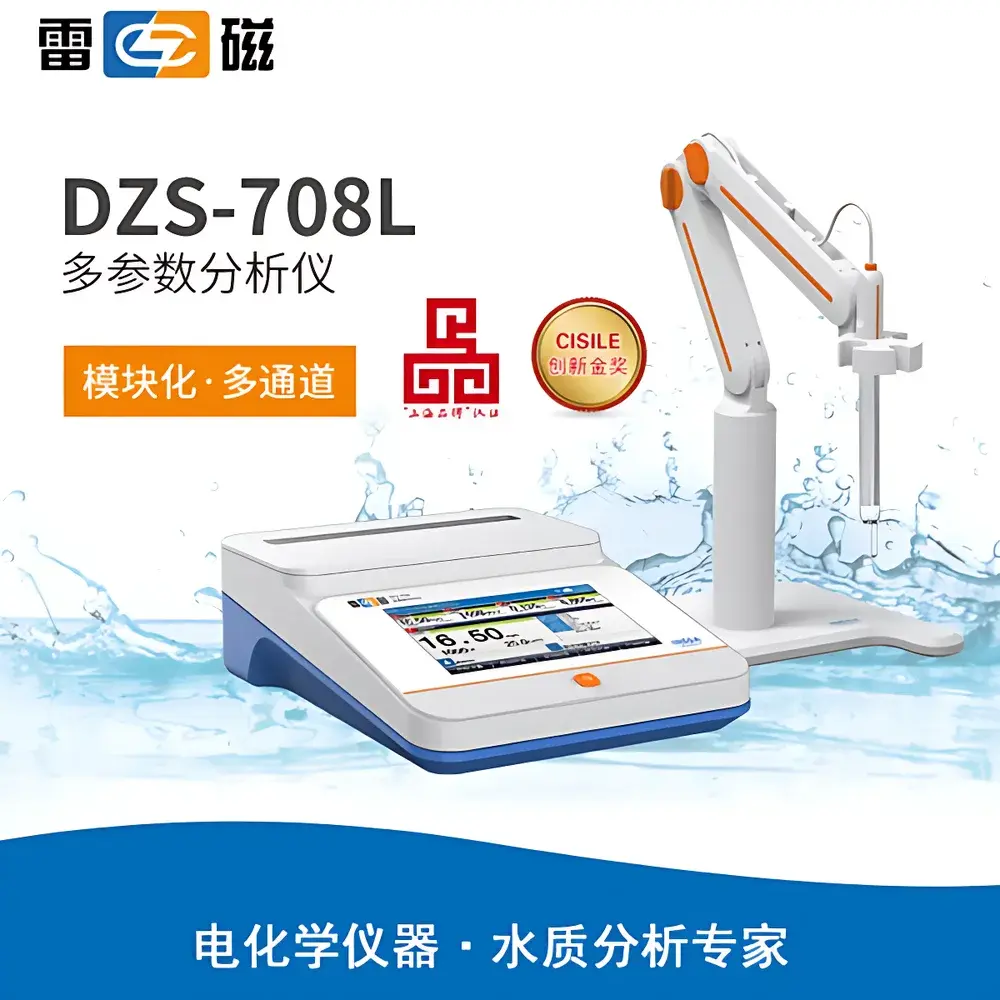
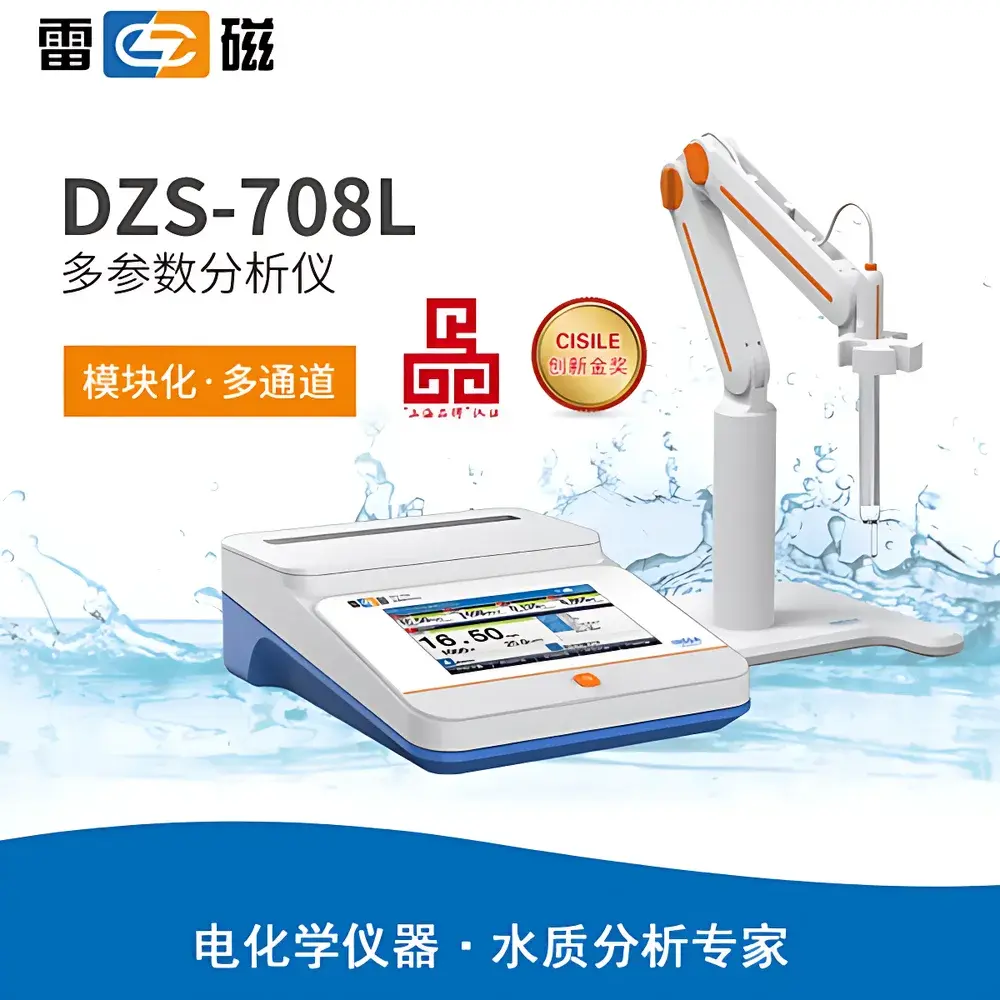
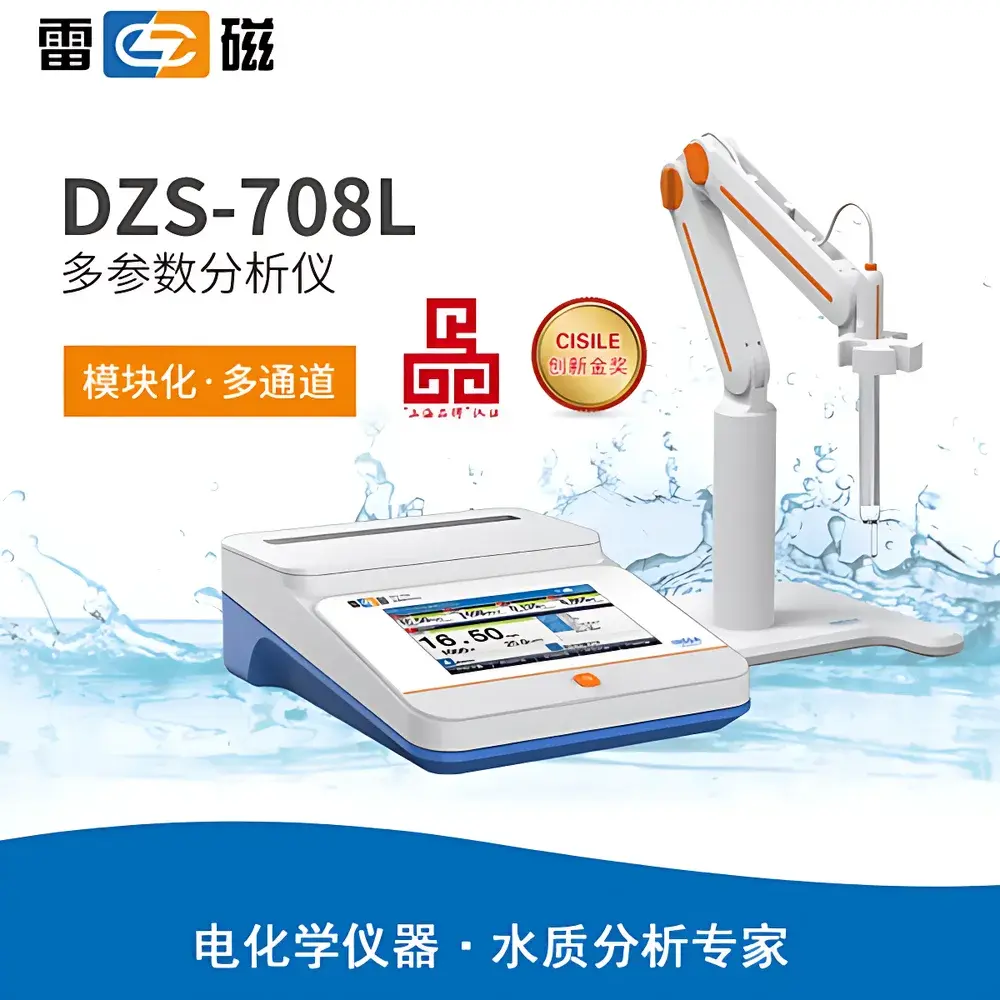
Leici DZS-708L Multi-Parameter Water Quality Analyzer
| Brand | Leici |
|---|---|
| Origin | Shanghai, China |
| Model | DZS-708L |
| Instrument Type | Laboratory Water Quality Analyzer |
| Detection Principle | Electrochemical Sensing |
| Measured Parameters | pH, ORP, mV, pX, Ion Concentration, Conductivity, Resistivity, TDS, Salinity, Ash Content, Dissolved Oxygen (DO) Concentration & Saturation, Temperature |
| Measurement Ranges | pH: −2.000–20.000 |
| pX | 0.000–14.000 |
| ORP | ±1999.99 mV |
| Ion Concentration | 0–19990 (units selectable: pX, mol/L, mmol/L, g/L, mg/L, µg/L) |
| Repeatability | pH/pX ≤ ±0.002 |
Overview
The Leici DZS-708L Multi-Parameter Water Quality Analyzer is a modular, high-precision laboratory instrument engineered for comprehensive electrochemical analysis of aqueous samples in environmental monitoring, municipal water treatment, academic research, and regulatory compliance laboratories. Built upon a dual-sensor architecture with four independent measurement channels, the DZS-708L implements standardized electrochemical detection principles—including potentiometric ion-selective electrode (ISE) response, galvanic and polarographic dissolved oxygen sensing, and conductometric cell-based conductivity measurement—to deliver traceable, reproducible data across 13 core water quality parameters. Its design adheres to fundamental metrological requirements for laboratory-grade instrumentation, supporting traceability through NIST-, DIN-, GB-, and JIS-traceable calibration standards and enabling full auditability under GLP and GMP frameworks.
Key Features
- 7-inch high-resolution color capacitive touchscreen with intuitive icon-driven interface supporting English and Chinese language selection
- IP54-rated enclosure for dust resistance and limited water ingress protection during routine lab handling
- Modular plug-and-play architecture with six interchangeable sensor modules: pH, pX (ion-selective), EC-T (two-electrode conductivity), EC-F (four-electrode conductivity), DO-F (fluorescence-based dissolved oxygen), and DO-P (Clark-type polarographic dissolved oxygen)
- Four parallel measurement channels enabling concurrent multi-parameter acquisition without cross-channel interference
- Intelligent endpoint recognition algorithms supporting auto-read, timed-read, interval-read, and manual-read modes
- Comprehensive electrode diagnostics including pH electrode health assessment, slope/offset validation, and ISE membrane integrity checks
- Configurable temperature units (°C or °F) and automatic temperature compensation across all electrochemical modules
- Onboard firmware upgradability via USB for future protocol expansion and method library updates
Sample Compatibility & Compliance
The DZS-708L accommodates standard laboratory sample formats—beakers, vials, flow cells, and custom immersion probes—with compatibility across freshwater, wastewater, seawater, and process streams. It supports calibration and verification against internationally recognized reference materials (e.g., NIST SRM 186, GBW(E)130002, DIN 19262) and conforms to key regulatory and technical standards including ISO 7888 (conductivity), ISO 5814 (electrochemical DO), ASTM D1293 (pH of water), and USP (pH measurement). Data integrity features—including user-level access control (three-tier authentication), electronic signatures, and immutable audit trails—meet FDA 21 CFR Part 11 requirements for regulated environments. All stored measurements include timestamp, operator ID, electrode serial number, calibration history, and environmental metadata (temperature, atmospheric pressure, salinity).
Software & Data Management
The analyzer integrates a built-in GLP-compliant data management system supporting storage of up to 1,000 complete measurement records per parameter type, plus 100 calibration sets and 1,000 standard solution verification logs. Data export is supported via USB mass storage (CSV and PDF formats), RS-232 serial connection to label or thermal printers (user-configurable print templates), and dedicated PC communication software for bidirectional method/data synchronization. The system enables batch processing via optional autosampler integration and supports barcode scanning for sample ID capture. GMP mode enforces mandatory field entry, prevents unauthorized deletion, and maintains a tamper-evident operational log detailing every user action, method change, calibration event, and data export.
Applications
- Regulatory compliance testing for drinking water (EPA Method 150.1, ISO 10523), wastewater effluent (ISO 11885), and surface water (ISO 5667 series)
- Process control in desalination plants, boiler feedwater systems, and pharmaceutical water loops (PW/WFI)
- Environmental impact assessments requiring simultaneous pH, conductivity, DO, and ion-specific monitoring (e.g., nitrate, fluoride, ammonium)
- Academic and method development labs performing ISE calibration studies, Gran plot analysis, standard addition quantification, and temperature-dependent conductivity modeling
- Calibration verification and inter-laboratory comparison programs requiring documented uncertainty propagation and repeatability validation
FAQ
Does the DZS-708L support FDA 21 CFR Part 11 compliance?
Yes—when operated in GMP mode with enabled user authentication, electronic signatures, and audit trail logging, it satisfies electronic record and signature requirements for regulated pharmaceutical and clinical laboratories.
Can the instrument perform simultaneous multi-parameter measurements?
Yes—its four-channel architecture allows concurrent acquisition from up to four sensor modules (e.g., pH + conductivity + DO-F + Na⁺ ISE), with synchronized timestamps and shared environmental compensation.
What calibration standards are pre-programmed?
The system includes embedded calibration groups for pH (NIST, DIN, GB, JIS, MERK, USA), conductivity (GB, ISO, ASTM), and DO (air-saturation, zero-oxygen), with automatic buffer recognition based on measured voltage and temperature.
Is external software required for data analysis?
No—onboard statistical tools provide mean, SD, RSD, min/max, linear regression, and Gran plot generation; however, advanced multivariate analysis can be performed after CSV export to third-party platforms.
How is sensor module identification handled?
Each module contains an embedded EEPROM chip storing model ID, serial number, calibration coefficients, and usage history—enabling automatic configuration and error-free channel assignment upon insertion.







