
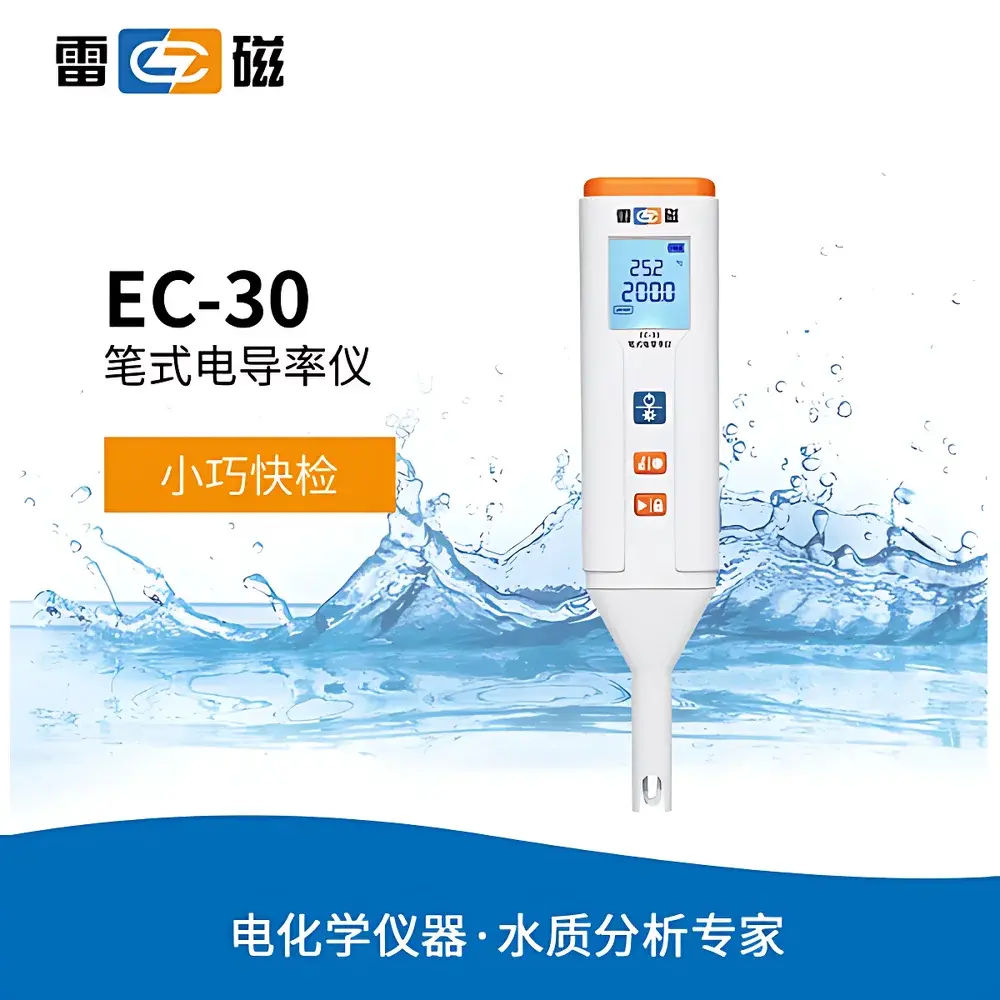
Leici EC-30 Pocket-Sized Conductivity Meter
| Brand | Leici |
|---|---|
| Origin | Shanghai, China |
| Manufacturer Type | Direct Manufacturer |
| Regional Origin | Domestic (China) |
| Model | EC-30 |
| Detection Parameters | Multi-Parameter (Conductivity, TDS, Salinity, Resistivity, Temperature) |
| Portability | Pen-Style |
| Intended Use | Laboratory & Field Applications |
| Conductivity Range | 0 μS/cm to 200.0 mS/cm (4 auto-ranging segments) |
| TDS Range | 0–50 ppt |
| Resistivity Range | 10 Ω·cm–99.99 kΩ·cm and 0.1 MΩ·cm–20 MΩ·cm |
| Salinity Range | 0–50 ppt |
| Temperature Range | (0.0–60.0) °C |
| Accuracy | ≤0.5% FS (full scale) |
| Minimum Resolution | 0.1 μS/cm |
| IP Rating | IP67 |
| Power Supply | 4 × AAA batteries (>200 h typical life) |
| Dimensions | 40 × 30 × 188 mm |
| Weight | ~0.15 kg |
| Display | High-contrast LCD with backlight |
| Auto-Temperature Compensation | 0.0–60.0 °C (default reference: 25 °C) |
| Calibration | 1–3 point, auto-identification of GB/US conductivity standards |
| TDS Conversion Factor | Adjustable (0.40–1.00) |
| Temperature Accuracy | ±0.3 °C |
| Temperature Resolution | 0.1 °C |
| Electrode Design | Replaceable sensor tip |
Overview
The Leici EC-30 Pocket-Sized Conductivity Meter is a rigorously engineered, multi-parameter electrochemical instrument designed for rapid, field-deployable, and laboratory-grade measurement of aqueous solution conductivity, total dissolved solids (TDS), salinity, resistivity, and temperature. Built upon standardized two-electrode conductometric principles—compliant with ISO 7888 and ASTM D1125—the EC-30 delivers traceable, reproducible results across four auto-switching conductivity ranges (0–200.0 μS/cm, 200–2000 μS/cm, 2–20 mS/cm, and 20–200 mS/cm), enabling precise characterization of ultrapure water, process streams, environmental samples, and saline media without manual range selection. Its compact pen-style form factor integrates a replaceable sensing tip, IP67-rated enclosure, and calibrated temperature compensation algorithm referenced to 25 °C—ensuring metrological integrity under variable ambient conditions from 0.0 to 60.0 °C.
Key Features
- High-contrast backlit LCD display with intuitive icon-driven interface and real-time unit switching (°C/°F)
- Replaceable electrode tip architecture—extends service life and reduces long-term cost of ownership
- IP67 ingress protection—fully dust-tight and submersible up to 1 m for 30 minutes—validated per IEC 60529
- Auto-ranging conductivity measurement with automatic temperature compensation (ATC) across full 0.0–60.0 °C operating span
- Multi-point calibration support (1–3 points) with automatic recognition of both Chinese GB and US NIST-traceable KCl standard solutions
- Configurable TDS conversion factor (0.40–1.00) and linear resistivity compensation for non-ideal electrolyte behavior
- Readout lock function—enables stable data capture during handheld operation or in turbulent flow environments
- User-adjustable auto-off delay (1–60 min), battery-level indicator, and factory reset capability
- Integrated wrist strap and rugged carry case—optimized for mobile QA/QC, education labs, and environmental monitoring teams
Sample Compatibility & Compliance
The EC-30 is validated for use with aqueous solutions exhibiting conductivity between 0 μS/cm and 200 mS/cm—including deionized water, tap water, seawater dilutions, nutrient solutions, and industrial cooling fluids. It conforms to core electrochemical measurement standards including ISO 7888 (conductivity of water), ASTM D1125 (electrical conductivity of water), and USP (water conductivity testing for pharmaceutical applications). While not FDA 21 CFR Part 11-compliant as a standalone device (lacking electronic audit trail and user authentication), its calibration records, measurement logs, and configuration settings meet GLP documentation requirements when used within controlled laboratory workflows. All internal firmware adheres to IEC 61000-4 electromagnetic compatibility directives.
Software & Data Management
The EC-30 operates as a self-contained, embedded-system instrument with no external software dependency. All measurements are displayed in real time; no onboard data logging or USB/Bluetooth connectivity is provided. However, its design supports seamless integration into documented quality systems: users may manually record values alongside timestamp, sample ID, and calibration status in lab notebooks or LIMS-compatible spreadsheets. The device stores last-used calibration coefficients and temperature compensation settings in non-volatile memory—retaining configuration across battery changes. For regulated environments, the EC-30 serves as a primary field verification tool prior to high-precision benchtop analysis, with calibration certificates traceable to national metrology institutes via supplied certified KCl standards.
Applications
- Pharmaceutical water system validation (PW, WFI pre-screening per USP )
- Environmental field surveys—estuarine salinity profiling, groundwater conductivity mapping, and wastewater discharge compliance checks
- Educational laboratories—student experiments in solution chemistry, electrolyte dissociation, and colligative properties
- Food & beverage QC—monitoring rinse water purity, brine concentration, and CIP solution conductivity
- Aquaculture and hydroponics—daily tracking of nutrient solution ionic strength and osmotic balance
- Industrial boiler feedwater and cooling tower management—early detection of scaling ion accumulation
FAQ
Does the EC-30 support GLP-compliant calibration documentation?
Yes—when used with certified reference standards (e.g., 1413 μS/cm and 12.88 mS/cm KCl solutions), users can generate calibration logs meeting GLP traceability requirements, including operator ID, date, standard lot number, and deviation from nominal value.
Can the EC-30 measure ultrapure water accurately?
It provides reliable screening down to 0.1 μS/cm (0–200 μS/cm range), but for sub-μS/cm applications such as semiconductor-grade water, a dedicated microsiemens-capable benchtop meter with cell constant correction is recommended.
Is the temperature sensor independently calibrated?
Yes—the integrated NTC thermistor is factory-calibrated to ±0.3 °C accuracy across 0.0–60.0 °C and automatically compensates all conductivity readings using the linear β-coefficient method per ISO 7888.
How often should the electrode tip be replaced?
Under normal use (≤50 measurements/day), replacement is recommended every 12–18 months—or immediately if physical damage, coating buildup, or calibration drift >±1% FS is observed.
What battery type does the EC-30 require, and how is low power indicated?
It uses four standard AAA alkaline cells. A flashing battery icon appears on the LCD when voltage drops below 4.2 V, providing ≥8 hours of residual operational time.





