
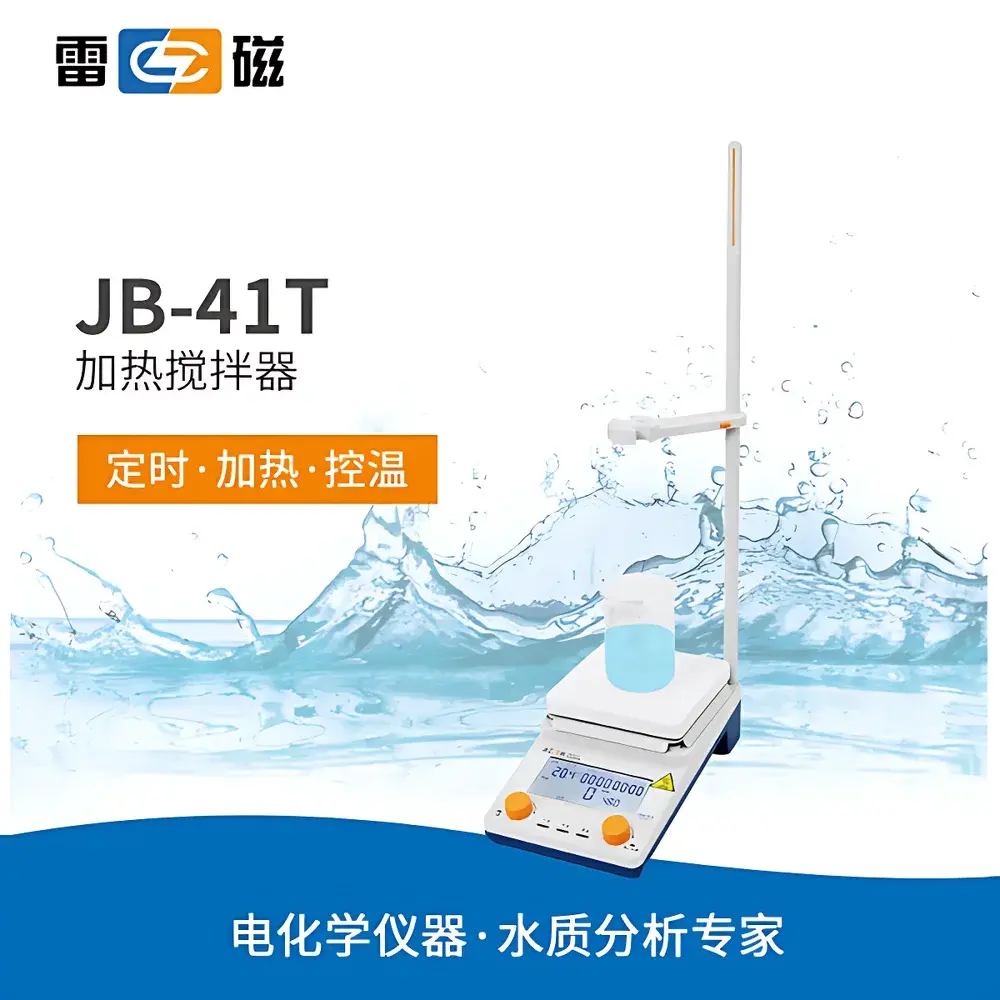
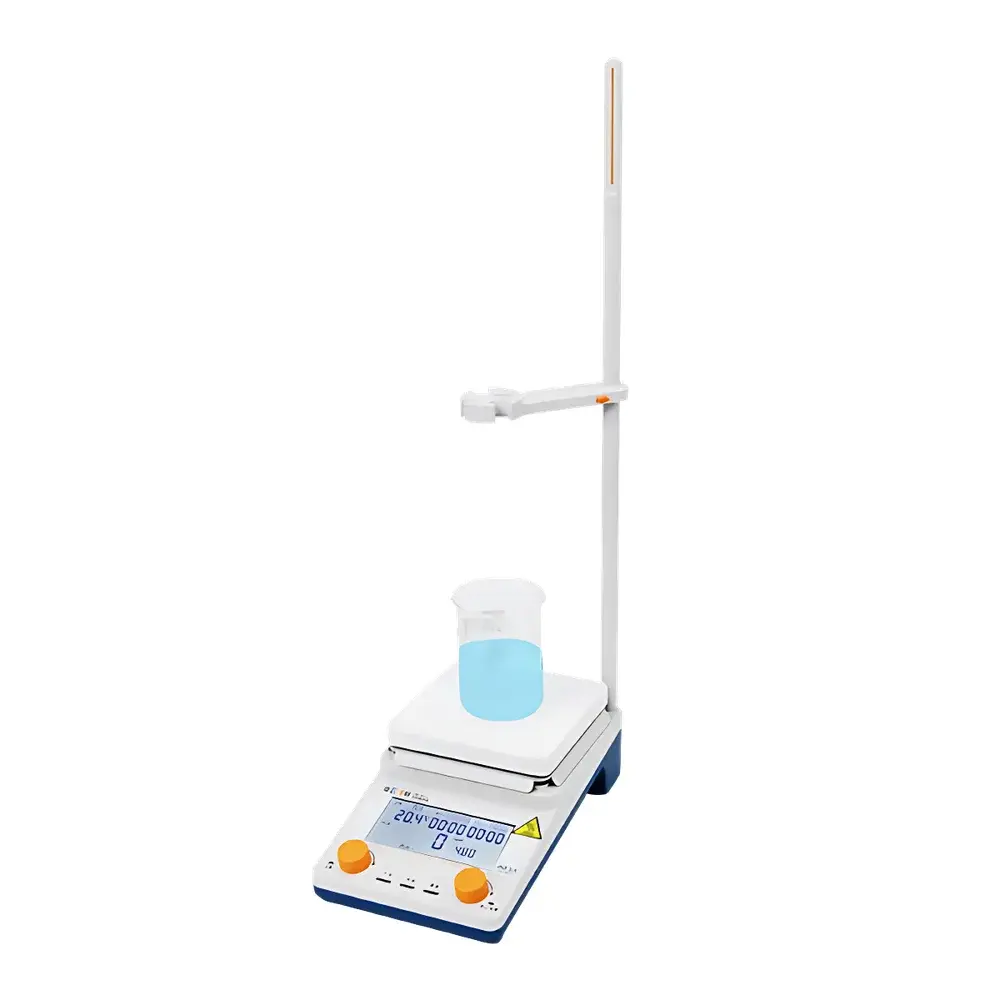
Leici JB-41T Precision Hotplate Magnetic Stirrer
| Brand | Leici |
|---|---|
| Origin | Shanghai, China |
| Manufacturer Type | Direct Manufacturer |
| Product Category | Domestic |
| Model | JB-41T |
| Instrument Type | Magnetic Stirrer |
| Maximum Stirring Volume | 5000 mL |
| Speed Range | 100–2000 rpm |
| Heating Plate Temperature Range | Ambient to 380 °C |
| Speed Display Accuracy | ±10 rpm |
| Speed Stability | ±10 rpm over 4 h |
| Timer Range | 0 min – 99 h 59 min |
| Timer Accuracy | ±1 min/h |
| Heating Power | 700 W |
| Working Surface | 145 mm × 145 mm Aluminum Alloy with Ceramic Coating |
| Dimensions | 160 × 280 × 95 mm |
| Weight | ~2.4 kg |
| Power Supply | AC 220 V ±10 %, 50 Hz ±2 % |
| Operating Environment | 0–40 °C, ≤85 % RH |
Overview
The Leici JB-41T Precision Hotplate Magnetic Stirrer integrates precise magnetic agitation with high-temperature plate heating in a compact, benchtop-ready design engineered for reproducible laboratory workflows. Based on the principle of rotating magnetic coupling—where a rotating permanent magnet beneath the ceramic-coated aluminum surface induces synchronous rotation of a magnetic stir bar immersed in the sample—the JB-41T delivers stable, contactless mixing across viscous and low-viscosity aqueous and organic media. Its integrated heating element enables direct thermal control of the working surface up to 380 °C, supporting applications ranging from dissolution kinetics and reagent synthesis to temperature-dependent electrochemical conditioning and titration pre-equilibration. Unlike basic stir-only units, the JB-41T implements dual-mode control logic (speed + plate temperature), allowing independent or coordinated operation for protocols requiring simultaneous thermal stabilization and mechanical homogenization.
Key Features
- High-resolution LCD display showing real-time speed (rpm) and plate temperature (°C) with intuitive dual-knob interface for independent adjustment of stirring rate and heating setpoint
- Wide speed range (100–2000 rpm) with ±10 rpm display accuracy and ≤±10 rpm drift over 4 hours—ensuring consistent shear input during extended experiments
- Ceramic-coated aluminum heating surface (145 × 145 mm) offering uniform thermal distribution, chemical resistance, and rapid heat-up response (700 W nominal power)
- Multi-directional rotation modes: forward, reverse, and alternating—enabling optimized mixing dynamics for heterogeneous suspensions or layered solutions
- Programmable timer (0–99 h 59 min) with ±1 min/h accuracy, supporting unattended operation for overnight reactions or standardized dissolution tests
- Dedicated electrode mounting bracket accommodating up to three analytical electrodes—facilitating in-situ potentiometric titrations, pH monitoring, or redox potential tracking during stirring
- Auto-memory function retains last-used speed and temperature settings upon power cycle, reducing setup time between sequential assays
- Comprehensive thermal status indicators: green (heating), yellow (reaching setpoint), red (high-temp warning)—enhancing operational safety and protocol transparency
Sample Compatibility & Compliance
The JB-41T is compatible with standard magnetic stir bars (supplied: Φ5×20 mm, Φ7×30 mm, Φ10×60 mm) and supports volumes from 10 mL to 5 L in glass, PTFE-lined, or stainless-steel vessels. Its non-reactive ceramic surface resists corrosion from common solvents (e.g., ethanol, acetone, dilute acids/bases) and withstands repeated thermal cycling without delamination. While not certified for IEC 61010-1 Class II or ATEX environments, the unit complies with GB/T 2894–2008 (Chinese safety signage standards) and meets electromagnetic compatibility (EMC) requirements per GB/T 18268.31–2017 for laboratory equipment. For GLP/GMP-aligned labs, its deterministic timer and stable speed output support traceable method execution—though full 21 CFR Part 11 compliance requires external data logging systems.
Software & Data Management
The JB-41T operates as a standalone instrument with no embedded firmware-based software or USB/Bluetooth connectivity. All operational parameters—including speed, temperature setpoint, timer duration, and rotation mode—are configured locally via physical controls and displayed in real time. No proprietary drivers, cloud services, or data export functions are included. Users seeking audit-trail capabilities must integrate external digital loggers or camera-based documentation systems. However, its deterministic behavior (e.g., fixed timer accuracy, repeatable speed stability) ensures method transferability across instruments within the same production batch—a key requirement for inter-laboratory validation under ISO/IEC 17025 frameworks.
Applications
- Preparation of homogeneous calibration standards and reference solutions in analytical chemistry labs
- Controlled-temperature dissolution testing per USP <711> for pharmaceutical dosage forms (when paired with validated vessel geometry)
- Electrochemical cell conditioning and electrolyte equilibration prior to cyclic voltammetry or conductometric titration
- Heating-assisted extraction protocols in environmental sample preparation (e.g., Soxhlet pre-concentration steps)
- Synthesis of metal-organic frameworks (MOFs) and nanoparticle colloids requiring prolonged, temperature-stabilized agitation
- Buffer equilibration and reagent aging studies where thermal history directly impacts reaction kinetics
FAQ
Does the JB-41T support solution temperature feedback control?
No—it provides only plate-surface temperature control (ambient to 380 °C). Solution temperature must be monitored externally using a calibrated probe.
Can the JB-41T be used with flammable solvents?
Use only with adequate ventilation and ignition source mitigation; the hotplate surface exceeds autoignition temperatures of many organics (e.g., diethyl ether: 160 °C). Not rated for Class I Division 1 hazardous locations.
What is the maximum recommended viscosity for stable stirring at 2000 rpm?
Optimal performance is achieved with viscosities below 1000 mPa·s (e.g., 30% glycerol/water at 25 °C); above this, torque limitation may cause stir bar slippage or motor overload.
Is the electrode holder compatible with all standard BNC or QD-style analytical probes?
Yes—the adjustable clamp accepts shaft diameters from 6 to 12 mm and accommodates common lab-grade pH, ORP, and ion-selective electrodes with threaded or slip-fit mounts.
Does Leici provide calibration certificates or service documentation?
Factory calibration reports are available upon request; on-site verification and traceable recalibration require third-party metrology providers per ISO/IEC 17025.



