
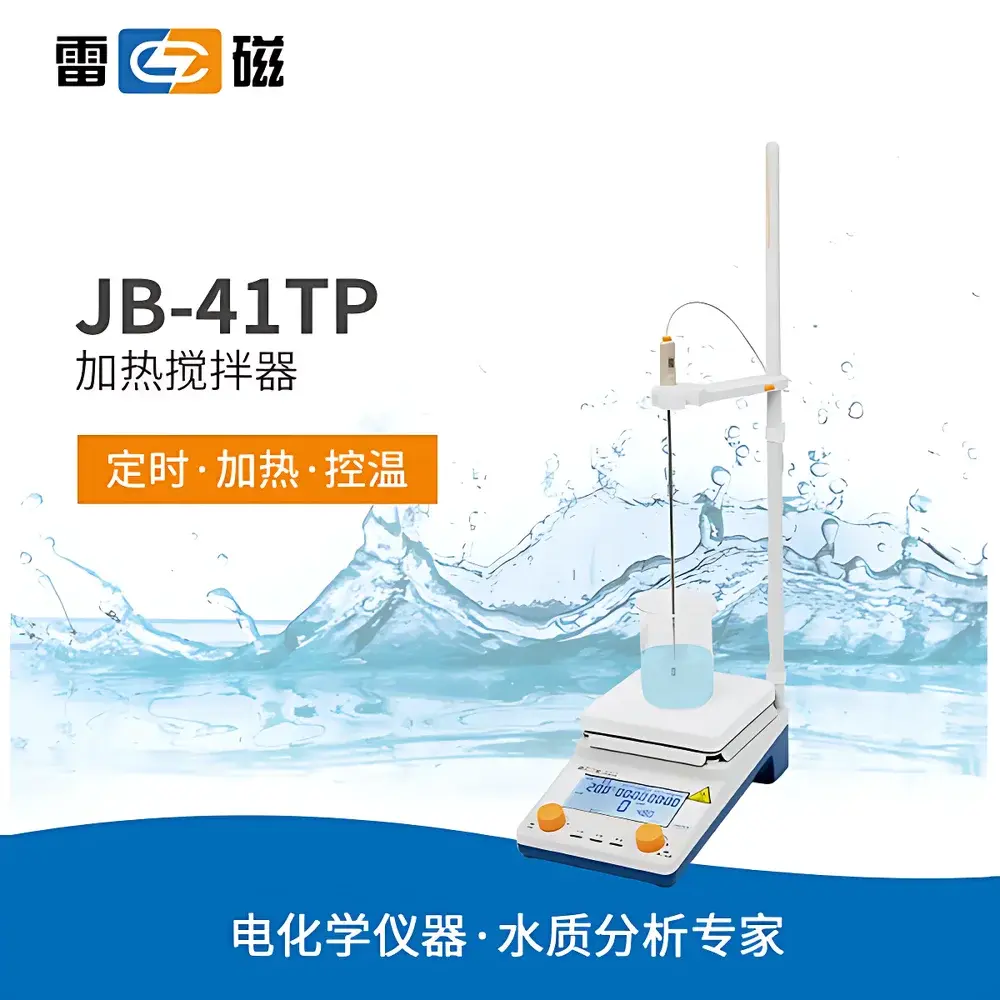
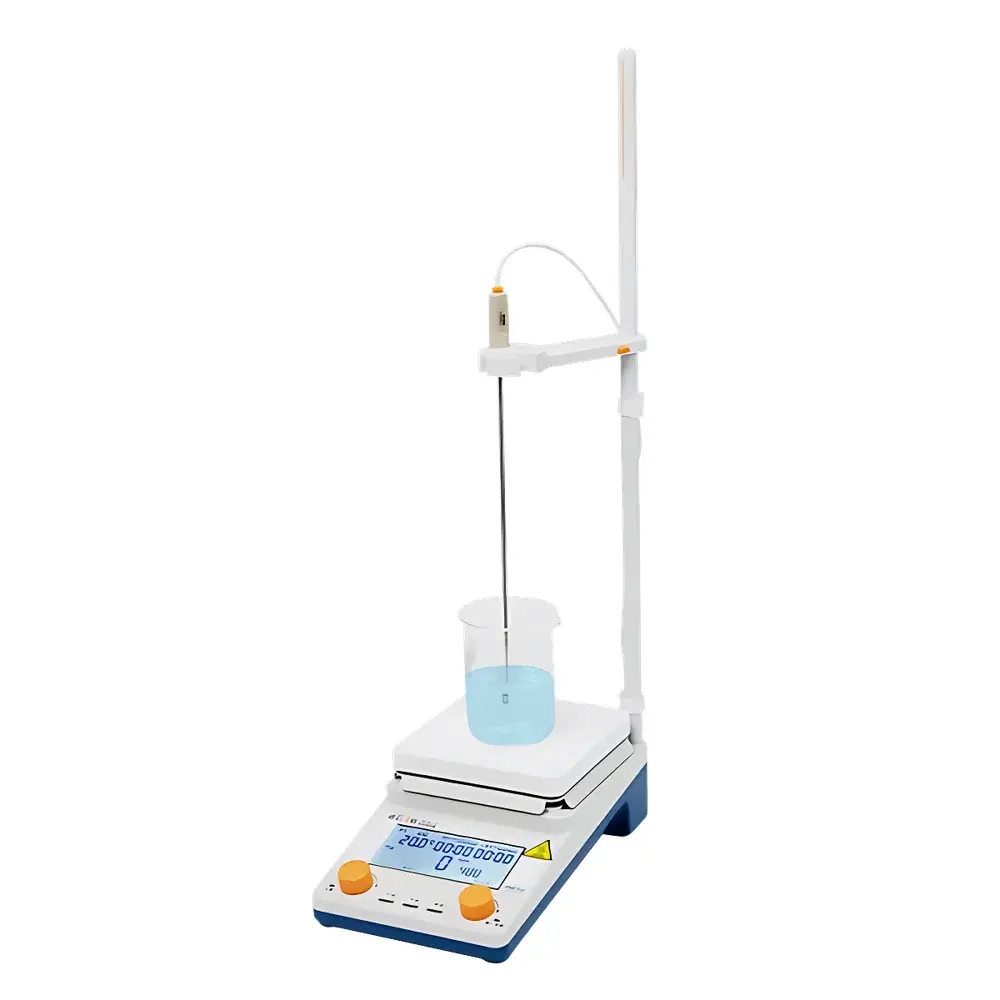
Leici JB-41TP Precision Magnetic Stirrer with Integrated Heating and Dual-Mode Temperature Control
| Brand | Leici |
|---|---|
| Origin | Shanghai, China |
| Manufacturer Type | Direct Manufacturer |
| Region of Origin | Domestic (China) |
| Model | JB-41TP |
| Instrument Type | Magnetic Stirrer |
| Max Stirring Volume | 5000 mL |
| Speed Range | 100–2000 rpm |
| Hotplate Temperature Range | Ambient to 380 °C |
| Solution Temperature Control Range | Ambient to 250 °C |
| Speed Accuracy | ±10 rpm |
| Speed Stability | ±10 rpm over 4 h |
| Temp. Display Accuracy (Hotplate) | ±0.5 °C |
| Temp. Display Accuracy (Solution) | ±1.0 °C |
| Solution Temp. Fluctuation | ≤1.0 °C per 10 min |
| Heating Power | 700 W |
| Work Surface | 145 mm × 145 mm, Aluminum Alloy with Ceramic Coating |
| Dimensions | 160 × 280 × 95 mm |
| Weight | 2.4 kg |
| Power Supply | AC 220 V ±10 %, 50 Hz |
| Operating Environment | 0–40 °C, RH ≤85 % non-condensing |
Overview
The Leici JB-41TP is a high-performance benchtop magnetic stirrer engineered for precision mixing and thermally controlled sample preparation in analytical, electrochemical, and quality control laboratories. It operates on the principle of rotating magnetic fields generated beneath a thermally stable ceramic-coated aluminum hotplate, inducing synchronous rotation of PTFE- or glass-coated magnetic stir bars immersed in conductive or low-viscosity liquids. Unlike basic stirrers, the JB-41TP integrates dual-mode temperature regulation—direct hotplate surface control (up to 380 °C) and real-time solution temperature feedback via an included T-820D-J platinum resistance thermometer (Pt100)—enabling accurate thermal management for applications requiring strict thermal reproducibility, such as titration endpoint stabilization, electrode conditioning, or solvent evaporation studies. Its robust mechanical architecture supports continuous operation under load, with speed and temperature parameters independently adjustable and digitally displayed on a high-resolution LCD interface.
Key Features
- Dual independent control system: separate rotary speed and temperature adjustment via intuitive dual-knob interface—supporting forward, reverse, and alternating rotation modes for optimized dispersion in heterogeneous systems.
- High-resolution LCD display showing real-time rpm, setpoint temperature, and actual measured temperature (via external probe), with visual status indicators for heating, constant-temperature hold, and over-temperature warning.
- Precision speed regulation across 100–2000 rpm range with ±10 rpm accuracy and long-term stability of ±10 rpm over 4 hours—critical for kinetic studies and viscosity-sensitive protocols.
- Ceramic-coated aluminum work surface (145 × 145 mm) offering uniform heat distribution, chemical resistance, and mechanical durability; compatible with standard stir bars (Φ5×20 mm, Φ7×30 mm, Φ10×60 mm) and scalable across volumes from 50 mL to 5 L.
- Integrated timer function (0–99 h 59 min) with ±1 min/h accuracy, enabling unattended operation for extended dissolution or reaction monitoring sequences.
- Dedicated electrode mounting bracket accommodating up to three electrodes—designed for potentiometric titrations, pH/ISE measurements, and multi-sensor electrochemical setups per ASTM D1129 and ISO 10523 standards.
- Auto-memory function retains last-used speed and temperature settings after power cycling, minimizing setup time between experiments.
Sample Compatibility & Compliance
The JB-41TP accommodates a wide range of aqueous, organic, and mildly corrosive solutions—including buffer systems, acid/base titrants, polymer solutions, and electrolyte media—provided appropriate stir bar coatings (e.g., PTFE, glass, or ETFE) are selected. Its solution temperature control mode requires direct immersion of the supplied Pt100 probe (T-820D-J), ensuring traceable calibration against NIST-traceable references. The instrument complies with IEC 61010-1:2010 safety requirements for laboratory electrical equipment and meets electromagnetic compatibility (EMC) criteria per EN 61326-1. While not certified for GMP manufacturing environments, its stable thermal output, data repeatability, and audit-ready parameter logging (via optional RS232/USB interface) support GLP-aligned workflows in QC labs performing USP , EP 2.2.47, or ISO/IEC 17025-compliant testing.
Software & Data Management
The JB-41TP operates as a standalone instrument with embedded firmware—no proprietary software required for core functionality. However, when connected via optional RS232 or USB-to-serial adapter, it supports ASCII-based command protocols for integration into LabVIEW, Python-controlled automation scripts, or LIMS-triggered batch protocols. All displayed parameters—including actual rpm, hotplate temperature, solution temperature, elapsed time, and timer status—are accessible in real time. For regulatory traceability, users may log timestamped operational records externally; while the device itself does not feature built-in 21 CFR Part 11-compliant electronic signatures or audit trails, its deterministic behavior and parameter reproducibility align with ALCOA+ data integrity principles when used within documented SOPs.
Applications
- Standardization and calibration of volumetric solutions in titrimetric analysis (e.g., EDTA, NaOH, HCl).
- Electrode equilibration and reference junction maintenance in potentiometric measurement systems.
- Controlled heating and stirring during Karl Fischer moisture determination sample preparation.
- Solvent-assisted dissolution testing of pharmaceutical excipients or active ingredients under defined thermal profiles.
- Preparation of homogeneous catalyst suspensions or nanoparticle dispersions prior to DLS or UV-Vis characterization.
- Supporting ASTM E2913 (standard practice for magnetic stirring in corrosion testing) and ISO 6425 (laboratory glassware cleaning validation) protocols.
FAQ
What is the maximum recommended viscosity for reliable stirring at 2000 rpm?
For optimal torque transmission and stir bar stability, use viscosities below 1000 mPa·s at full speed; above this threshold, reduce rpm proportionally and select larger-diameter stir bars.
Can the JB-41TP be used under inert atmosphere conditions?
Yes—provided the vessel is sealed with appropriate gas-tight fittings and the stir bar remains magnetically coupled; however, ensure ambient ventilation around the unit’s rear cooling vents remains unobstructed.
Is the T-820D-J temperature probe calibrated upon shipment?
Each probe undergoes factory verification at 0 °C and 100 °C; users should perform two-point calibration using certified reference baths before critical thermal applications.
Does the unit support external temperature controllers or PLC integration?
It features analog voltage output (0–5 V) corresponding to solution temperature, enabling connection to third-party PID controllers or SCADA systems for cascade thermal regulation.
How often should the ceramic coating be inspected for micro-cracking or delamination?
Visual inspection is recommended every 6 months under routine use; avoid thermal shock (e.g., cold liquid on hot surface) to preserve coating integrity over its rated service life (>5 years).



