
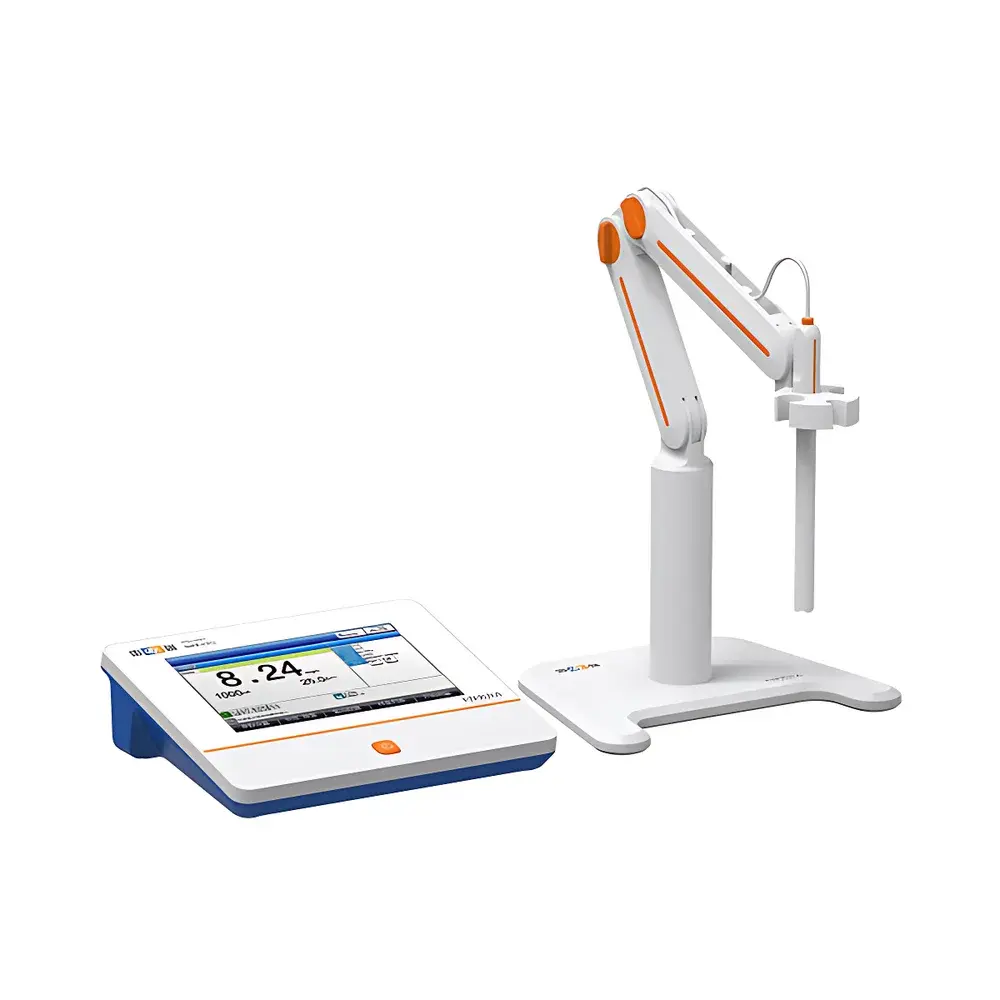
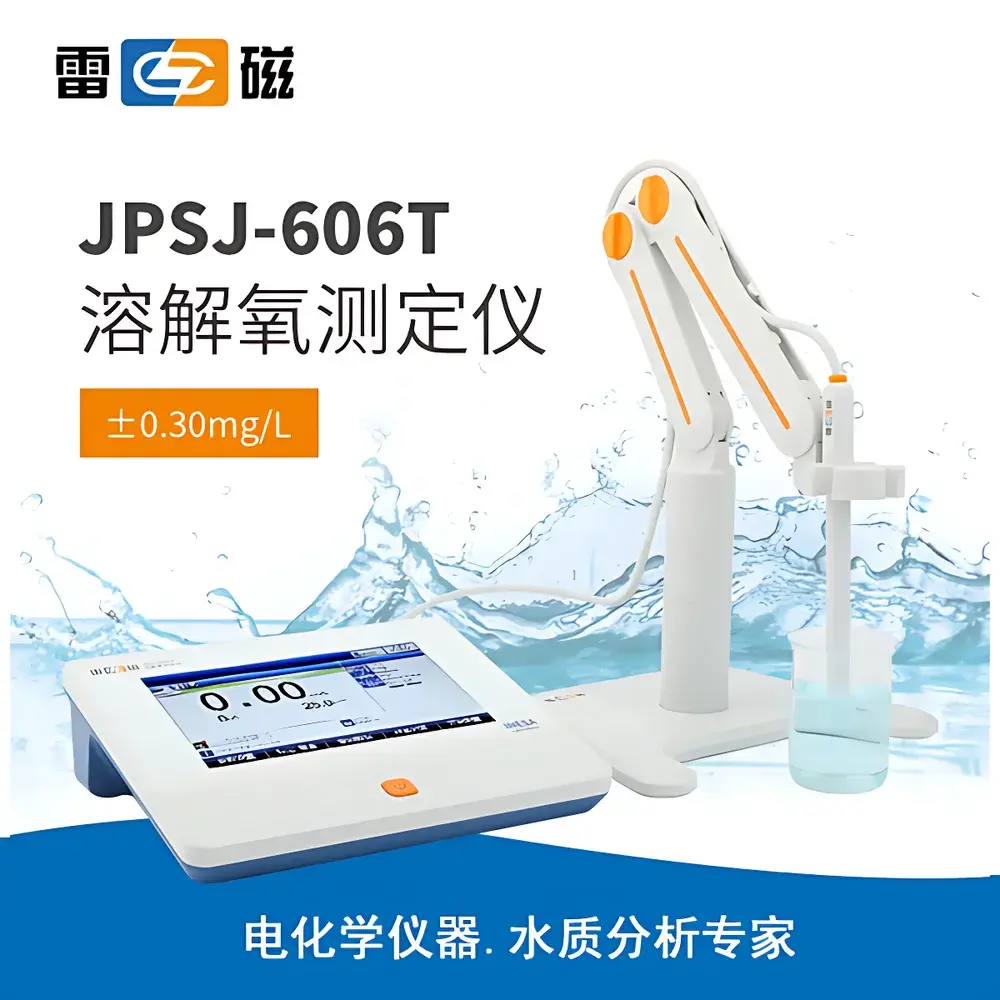
Leici JPSJ-606T Dissolved Oxygen Meter
| Brand | Leici |
|---|---|
| Origin | Shanghai, China |
| Manufacturer Type | Direct Manufacturer |
| Regional Classification | Domestic (China) |
| Model | JPSJ-606T |
| Price Range | USD 700–1,400 |
| Instrument Type | Laboratory Benchtop |
| Measurement Principle | Polarographic Electrochemical Probe |
| Dissolved Oxygen Range (Electronic Unit) | 0.00–99.99 mg/L |
| Accuracy | ±0.10 mg/L (0.00–50.00 mg/L) |
| Instrument Accuracy | ±0.30 mg/L (≤20.00 mg/L) |
| Repeatability | ±2.0% |
| Response Time | ≤45 s (90% response at 20.0 °C) |
| Temperature Compensation | Automatic |
| Atmospheric Pressure Compensation | Manual or Auto (kPa, mbar, Torr, atm) |
| Salinity Compensation | Manual |
| Saturation Range | 0.0–600.0 % |
| Temperature Range | −10.0–135.0 °C |
| Temperature Accuracy | ±0.3 °C (0.0–60.0 °C) |
| Data Storage Capacity | 1,000 datasets |
| Connectivity | RS-232, USB, optional LIMS integration |
| Compliance | GLP, GMP-ready audit trail support |
| IP Rating | IP54 |
| Power Supply | AC 100–240 V → DC 24 V adapter |
| Dimensions & Weight | 220 × 195 × 68 mm, 0.95 kg |
Overview
The Leici JPSJ-606T Dissolved Oxygen Meter is a high-precision, laboratory-grade benchtop analyzer engineered for accurate and reproducible measurement of dissolved oxygen (DO) concentration, saturation percentage, and temperature in aqueous samples. It operates on the polarographic electrochemical principle—utilizing a Clark-type membrane-covered electrode with a cathode-anode pair immersed in an electrolyte solution. Oxygen diffuses through a selective gas-permeable membrane and undergoes reduction at the cathode surface, generating a current linearly proportional to the partial pressure of dissolved oxygen. This signal is digitally processed with temperature-compensated algorithms to deliver concentration values in mg/L and saturation (%), conforming to standard electrochemical measurement protocols referenced in ASTM D888 and ISO 5814. Designed for routine water quality analysis in environmental monitoring labs, municipal wastewater facilities, academic research, and pharmaceutical process water validation, the JPSJ-606T delivers robust performance under variable salinity, pressure, and thermal conditions.
Key Features
- High-resolution 5.7-inch color TFT touchscreen interface with intuitive icon-driven navigation and dual-language support (English/Chinese)
- Integrated polarographic DO probe with built-in temperature sensor; includes dedicated electrode stand and dust cover
- Full automatic temperature compensation (ATC) and configurable atmospheric pressure compensation (in kPa, mbar, Torr, or atm)
- Manual salinity correction (0–100 g/L) to minimize ionic strength-induced measurement drift
- Smart endpoint detection with multiple read modes: auto-hold, timed reading, interval sampling, and manual trigger
- Comprehensive calibration management: zero-oxygen (sodium sulfite) and full-scale (air-saturated water or Winkler-standardized solution) calibration with forced recalibration alerts and verification checks
- IP54-rated enclosure for protection against dust ingress and water splashes during daily lab operation
- Onboard firmware upgradability via USB for future protocol expansion, regulatory alignment, or feature customization
- Configurable power management: auto-shutdown, brownout recovery, and factory reset safeguards
Sample Compatibility & Compliance
The JPSJ-606T supports aqueous samples across a broad operational matrix—including freshwater, seawater, activated sludge, effluent streams, ultrapure water (UPW), and bioreactor media—provided turbidity remains below 100 NTU and suspended solids do not mechanically obstruct the membrane. Its polarographic sensor design ensures stable readings in low-flow or static conditions where optical (luminescence-based) sensors may exhibit lag or fouling sensitivity. The instrument meets fundamental requirements for Good Laboratory Practice (GLP) and Good Manufacturing Practice (GMP) environments: each stored measurement record contains timestamp, operator ID, electrode serial number, calibration history, ambient pressure, temperature, and user-defined sample ID. Audit trails are immutable and exportable, supporting FDA 21 CFR Part 11 compliance when paired with validated PC software and controlled user access protocols.
Software & Data Management
Data handling is implemented through a structured internal database capable of storing up to 1,000 complete measurement records with full metadata. Retrieval supports both tabular and time-series graphical display (DO vs. time curves), statistical summary (mean, SD, min/max), and batch-wise comparative analysis. Export options include CSV via USB flash drive, direct printing via RS-232–compatible thermal or dot-matrix printers (configurable report templates), and secure PC transfer using Leici’s certified communication suite. Integration with Laboratory Information Management Systems (LIMS) is supported through standardized ASCII command sets over RS-232 or virtual COM port emulation via USB. Optional barcode scanning (via USB-connected scanner) enables rapid sample ID entry and traceability linkage in regulated workflows.
Applications
- Environmental monitoring: Surface water, groundwater, and wastewater DO profiling per EPA Method 360.1 and ISO 5815-1
- Drinking water treatment: Aeration basin optimization, distribution system integrity verification
- Pharmaceutical water systems: Purified Water (PW) and Water for Injection (WFI) qualification per USP and EU Annex 1
- Aquaculture and limnology: Diel oxygen cycling studies, eutrophication assessment, sediment oxygen demand (SOD) testing
- Bioprocess development: Fermentation broth monitoring, cell culture viability correlation, and aerobic respiration rate estimation
- Educational laboratories: Electrochemical sensor principles, calibration theory, and environmental parameter interdependence
FAQ
What calibration standards are required for routine operation?
Zero-oxygen solution (e.g., 0.5% w/v sodium sulfite) and air-saturated water (at known temperature and barometric pressure) are the primary calibrants. Certified Winkler titration standards may be used for verification.
Can the instrument compensate for varying salinity in marine samples?
Yes—manual salinity input (0–100 g/L) adjusts the oxygen solubility model per the Garcia & Gordon equation, improving accuracy in estuarine and seawater applications.
Is the polarographic probe field-serviceable?
The integrated probe features replaceable membranes and electrolyte fill solution; full refurbishment kits and OEM replacement electrodes are available directly from Leici authorized service centers.
Does the JPSJ-606T support multi-point calibration or linear regression fitting?
No—it implements two-point (zero/full-scale) calibration only, consistent with polarographic sensor physics and international standard practice for amperometric DO meters.
How is data integrity ensured during power interruption?
Non-volatile memory retains all calibration parameters, user settings, and measurement history. A capacitor-backed real-time clock maintains accurate timestamps across power cycles.
Related Products







