
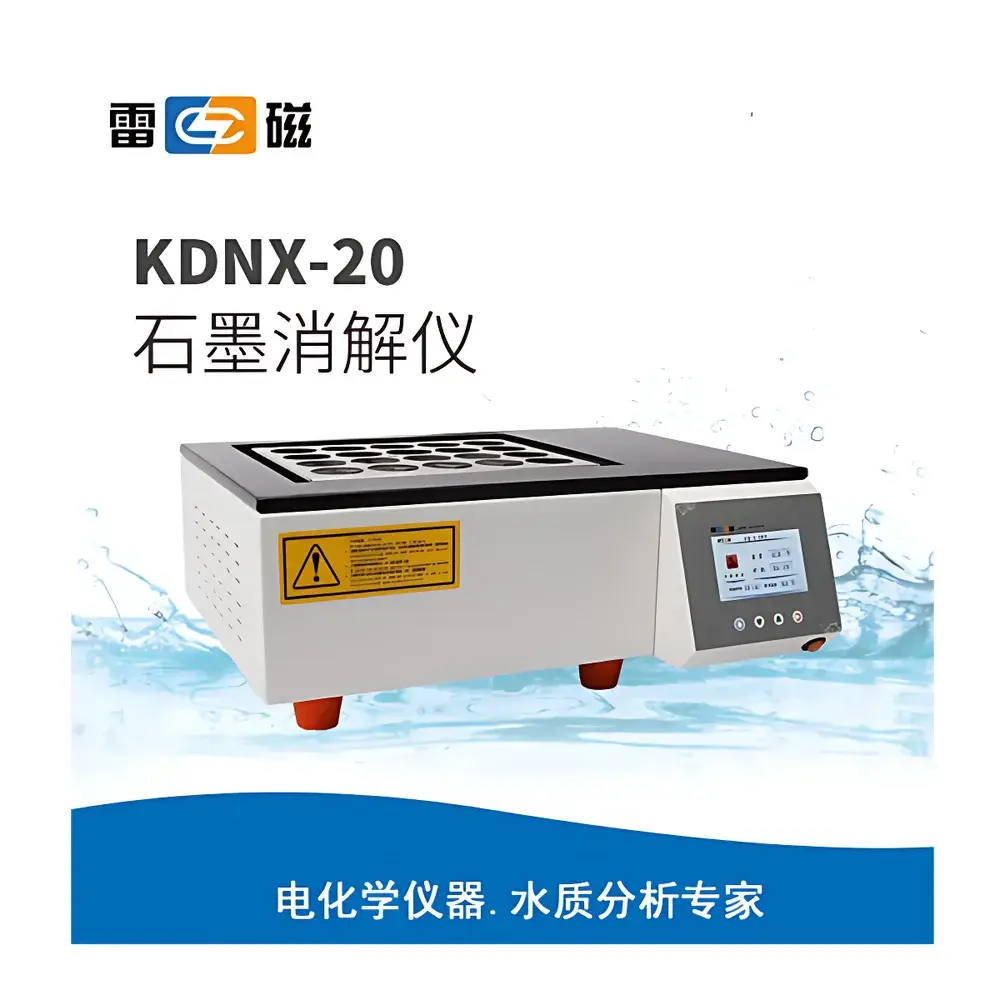
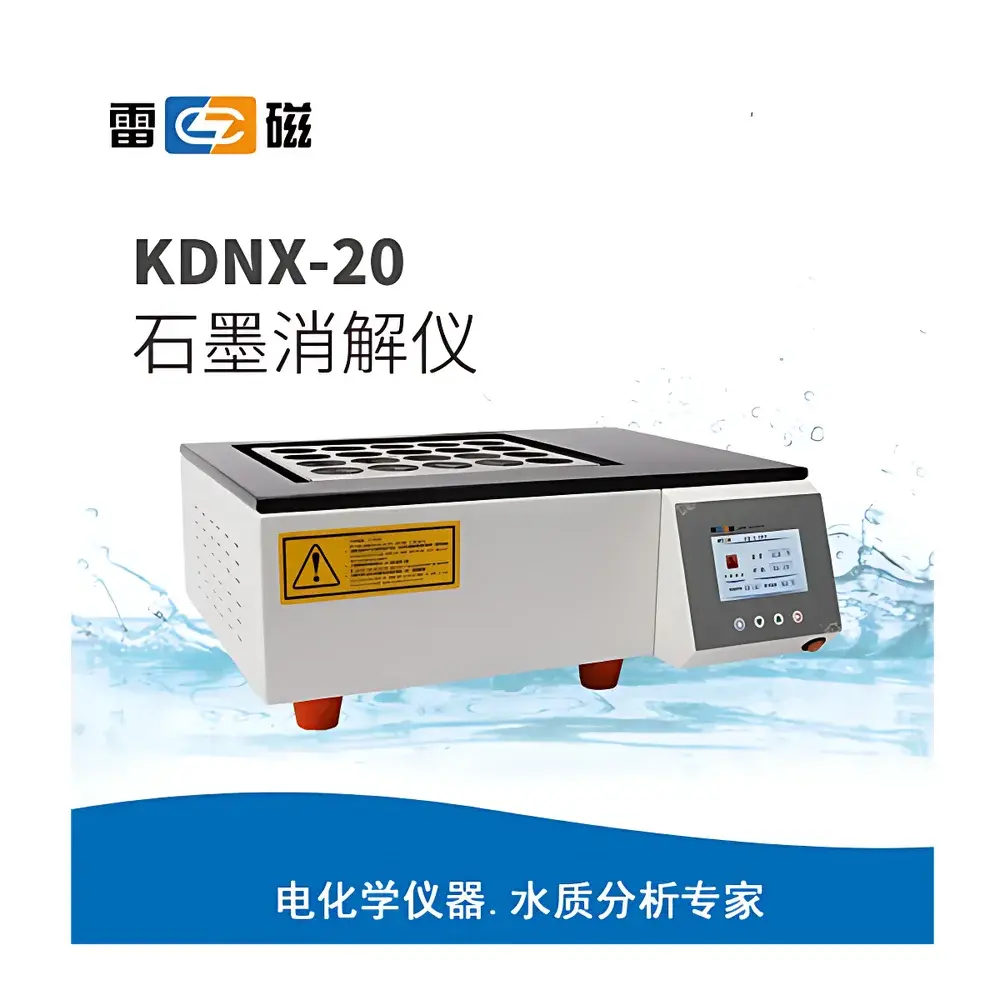
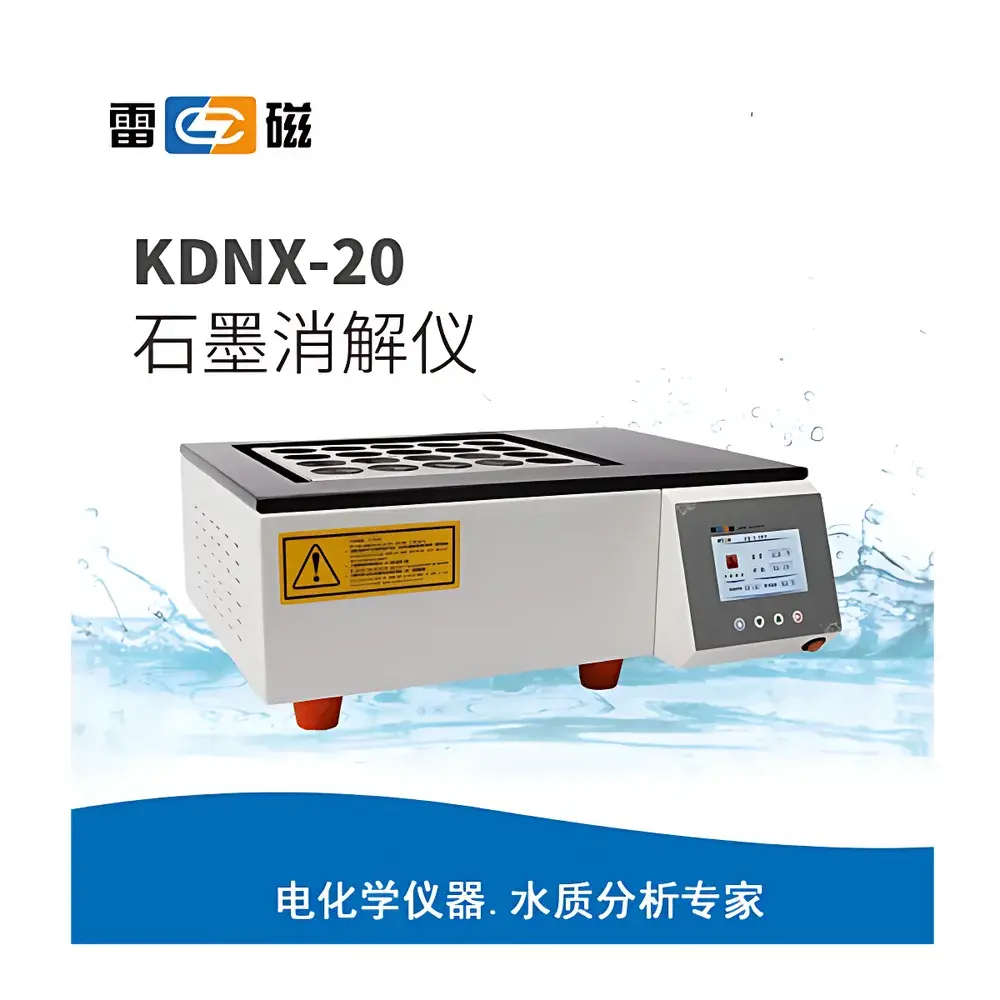
Leici KDNX-20 Graphite Block Digestion System
| Brand | Leici |
|---|---|
| Origin | Shanghai, China |
| Manufacturer Type | Authorized Distributor |
| Origin Category | Domestic (China) |
| Model | KDNX-20 |
| Pricing | Upon Request |
| Digestion Method | Rapid Digestion |
| Heating Module | Single Graphite Block |
| Batch Capacity | 20 Samples |
| Temperature Range | Ambient to 450 °C |
| Temperature Accuracy | ±1 °C |
| Sample Vessel Capacity | 20 mL |
| Timer Drift | ≤±1 s/h |
Overview
The Leici KDNX-20 Graphite Block Digestion System is a precision-controlled, high-temperature thermal digestion platform engineered for standardized sample preparation in regulatory and research-grade water quality, soil, and environmental matrix analysis. It operates on the principle of conductive heating via a monolithic, high-purity graphite block — a material selected for its exceptional thermal homogeneity, chemical inertness, and resistance to thermal shock. Unlike ceramic or metal-heated digesters, the KDNX-20 leverages graphite’s uniform volumetric heat distribution to minimize inter-hole temperature deviation (<2 °C across all 20 positions at 300 °C), ensuring reproducible decomposition kinetics essential for compliant COD (Chemical Oxygen Demand), total phosphorus, heavy metals (e.g., As, Cd, Pb, Hg), and nutrient assays per ISO 6060, EPA Method 410.4, and ASTM D1252. The system is designed for walk-away operation under controlled laboratory conditions and integrates seamlessly into workflows aligned with GLP and ISO/IEC 17025-accredited laboratories.
Key Features
- Monolithic high-purity graphite heating block, surface-treated with proprietary oxidation-resistant coating to extend service life beyond 5,000 operational cycles at ≤400 °C.
- Precise PID temperature control with real-time feedback loop, delivering ±1 °C accuracy across the full 20–450 °C range — validated per IEC 61000-4-30 Class A instrumentation standards.
- Simultaneous processing of 20 × 20 mL digestion tubes (standard borosilicate or quartz), optimized for HNO₃/H₂SO₄/HF-based protocols used in EPA 3050B, 3051A, and 3052.
- Dual-stage safety architecture: hardware-level overtemperature cutoff (460 °C hard limit), independent current/voltage monitoring, and automatic power shutoff upon timer completion.
- Corrosion-resistant chassis with PTFE-coated chamber lining and acid-resistant stainless-steel fasteners — rated for continuous exposure to concentrated HCl, HNO₃, HF, and aqua regia vapors.
- Low thermal mass design enables ramp rates up to 15 °C/min from ambient to 300 °C, reducing total digestion cycle time by ≥30% versus conventional hot plates or sand baths.
Sample Compatibility & Compliance
The KDNX-20 accommodates standard 20 mL digestion vessels (16 mm OD × 150 mm L), compatible with closed-vessel microwave pre-digestion workflows and open-vessel reflux systems. It supports solid, semi-solid, and liquid matrices including wastewater sludge, agricultural soils, plant tissues, food composites, and geological samples. All thermal profiles comply with the heating ramp and hold requirements defined in ISO 8467 (COD determination), USP (heavy metals), and China’s HJ 828–2017 (water quality – COD by dichromate method). The instrument’s traceable calibration certificate (NIST-traceable RTD sensor) satisfies audit requirements for FDA 21 CFR Part 11–compliant data integrity when paired with external logging software.
Software & Data Management
While the KDNX-20 operates via an integrated membrane keypad interface with digital LED display, it supports optional RS-485/Modbus RTU output for integration into centralized LIMS or SCADA environments. Time-stamped temperature logs (with resolution of 0.1 °C and 1 s interval) can be exported via USB to CSV for post-run validation. Audit trails include operator ID entry (via alphanumeric code), start/stop timestamps, target temperature setpoints, and deviation alerts — fulfilling minimum ALCOA+ (Attributable, Legible, Contemporaneous, Original, Accurate, Complete, Consistent, Enduring, Available) data governance criteria for regulated labs.
Applications
- Routine COD analysis in municipal and industrial wastewater treatment plants per ISO 6060 and HJ 828–2017.
- Preparation of soil and sediment extracts for ICP-OES/MS quantification of trace metals under EPA 6010D and 6020B.
- Digestion of biological tissues (e.g., fish muscle, leaf matter) for nutritional profiling and contaminant screening.
- Acid leaching of catalysts, ores, and industrial residues prior to XRF or titrimetric analysis.
- Method development and validation studies requiring strict thermal reproducibility across multi-day batch runs.
FAQ
Is the KDNX-20 suitable for HF-based digestions?
Yes — the graphite block and chamber lining are chemically stable under HF concentrations up to 40% v/v at temperatures ≤220 °C; use only PTFE- or quartz-lined vessels.
Can the instrument be calibrated in-house?
Yes — built-in calibration mode accepts external reference thermometers (Class A Pt100) for field verification; certificate of calibration is provided with each unit.
What maintenance is required for long-term stability?
Annual inspection of graphite block surface integrity and cleaning of vent channels with deionized water; no lubrication or consumable replacement is needed.
Does the system meet CE or UL safety certification?
The KDNX-20 complies with IEC 61010-1:2010 for laboratory electrical equipment and carries CCC certification (China Compulsory Certification); CE marking is available upon request for EU-distributed units.
How is temperature uniformity verified across all 20 positions?
Leici performs 20-point thermal mapping using NIST-traceable miniature thermocouples during final QA; deviation reports are included in the delivery documentation.
Related Products







