
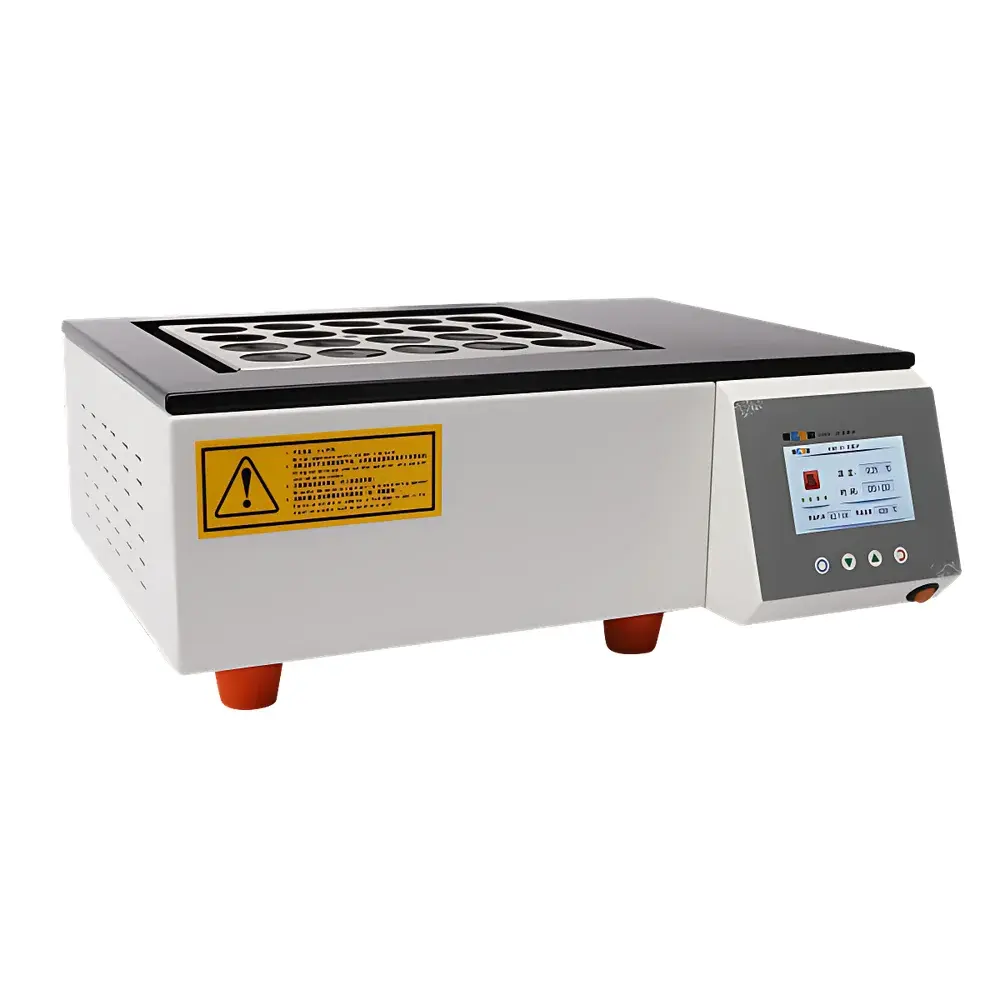
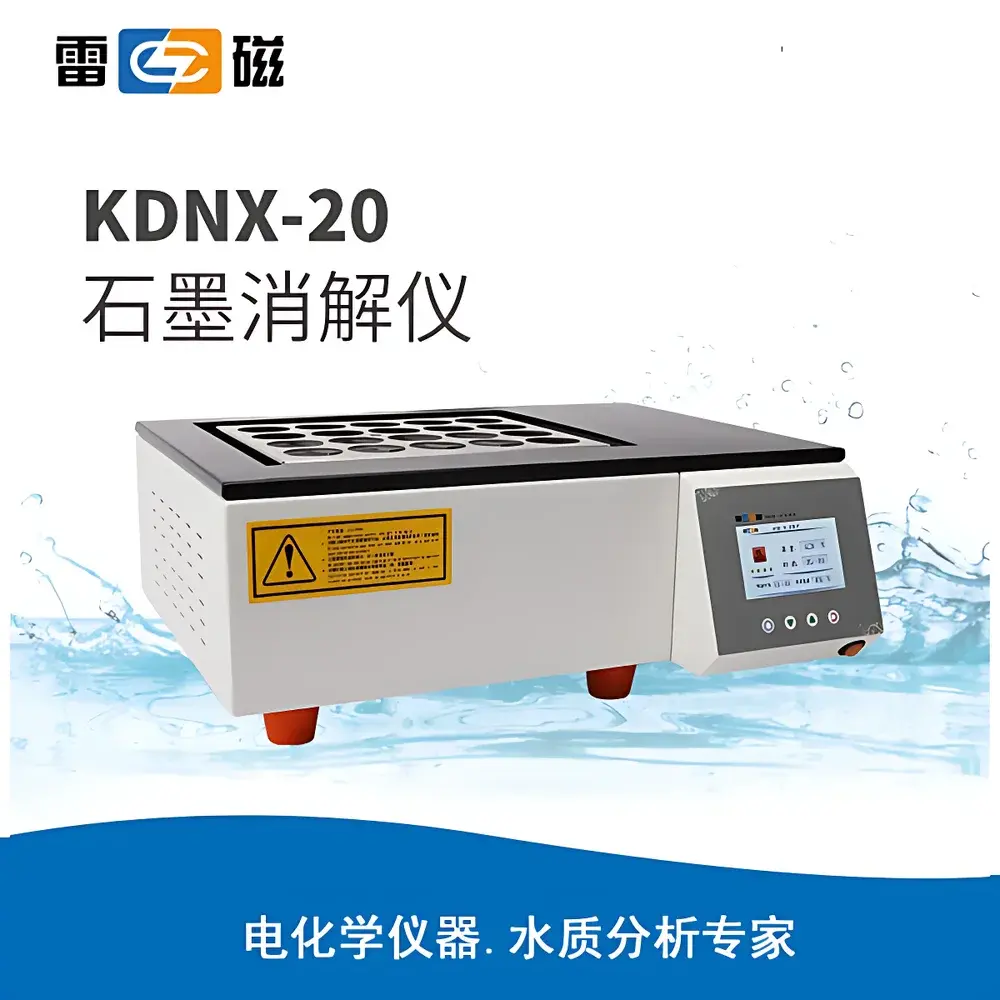
Leici KDNX-20 Graphite Block Digestion System
| Brand | Leici |
|---|---|
| Origin | Shanghai, China |
| Manufacturer Type | Direct Manufacturer |
| Country of Origin | China |
| Model | KDNX-20 |
| Quotation | Upon Request |
| Temperature Control Range | Room Temperature +5 °C to 450 °C |
| Temperature Accuracy | ±1 °C |
| Digestion Vessel Capacity | 280 mL (water volume at 20 °C) |
| Sample Throughput | 20 samples per run |
| Power Supply | 220 VAC ±10%, 50 Hz |
| Dimensions (W×D×H) | 515 mm × 421 mm × 211 mm |
| Weight | 25 kg |
Overview
The Leici KDNX-20 Graphite Block Digestion System is a precision-engineered sample preparation instrument designed for open-vessel acid digestion in analytical laboratories. It operates on the principle of conductive heating via a high-purity, isotropically molded graphite block—engineered for uniform thermal mass distribution and exceptional chemical inertness. Unlike ceramic or aluminum heating blocks, the KDNX-20’s graphite core delivers rapid thermal response (typical ramp rate ≥15 °C/min from ambient to 300 °C), minimal inter-hole temperature deviation (<±1.5 °C at 350 °C across all 20 positions), and sustained stability under prolonged exposure to concentrated HNO₃, HCl, HF, and H₂O₂ mixtures. This architecture supports standardized wet digestion protocols aligned with EPA Method 3050B, ISO 11466, ASTM D5175, and GB/T 17134–2017 for trace metal analysis by ICP-OES, ICP-MS, AAS, and HG-AFS. The system is intended for routine use in environmental monitoring labs, agricultural testing centers, food safety QA/QC departments, and university research facilities performing elemental quantification in complex organic and mineral matrices.
Key Features
- High-density, ultra-pure graphite block (≥99.9% carbon) with proprietary anti-oxidation surface treatment—extends operational life beyond 5,000 h at ≤400 °C under cyclic acid exposure.
- Precise PID-controlled digital temperature regulation (range: RT+5 °C to 450 °C; accuracy: ±1 °C), with dual-sensor feedback (block surface + ambient reference) ensuring long-term drift <0.3 °C/100 h.
- Simultaneous processing of 20 samples using standard 280 mL borosilicate or quartz digestion tubes—optimized well geometry maximizes tube contact area (>85% sidewall coverage) and minimizes convective heat loss.
- Corrosion-resistant housing constructed from PTFE-coated stainless steel (AISI 316L base) and chemically stabilized phenolic resin panels—validated for continuous operation in fume hoods with >10 ppm HNO₃ vapor concentration.
- Integrated safety architecture including over-temperature cutoff (hardware-independent thermofuse at 480 °C), current surge protection (IEC 61000-4-5 compliant), and automatic power termination upon timer completion—no manual intervention required.
- Real-time status display with intuitive membrane keypad interface; programmable multi-step ramp-soak profiles stored in non-volatile memory (up to 10 methods).
Sample Compatibility & Compliance
The KDNX-20 accommodates a broad range of solid and semi-solid samples—including soil, sediment, plant tissue, animal feed, pharmaceutical excipients, geological digests, and food composites—when paired with appropriate digestion vessels (e.g., borosilicate glass, quartz, or PFA-lined tubes). Its thermal homogeneity ensures compliance with GLP documentation requirements for method validation (e.g., %RSD of recovery ≤5% across replicate digestions per ISO/IEC 17025:2017 Annex B). The system meets CE marking directives (2014/30/EU EMC, 2014/35/EU LVD) and conforms to IEC 61010-1:2010 safety standards for laboratory electrical equipment. While not FDA 21 CFR Part 11–certified out-of-the-box, audit-ready electronic logs (via optional RS-232/USB data export) support GMP-aligned record retention when integrated into validated laboratory information management systems (LIMS).
Software & Data Management
The KDNX-20 operates as a standalone instrument with embedded firmware supporting time-stamped method execution logging (start time, setpoint history, final temperature, duration). Optional PC connectivity enables export of CSV-formatted thermal profiles and event logs for traceability. No proprietary software installation is required; exported files are compatible with common analytical data review tools (e.g., Microsoft Excel, LabArchives, Empower). All parameter changes are recorded with user ID (if enabled via external authentication), supporting ALCOA+ principles (Attributable, Legible, Contemporaneous, Original, Accurate, Complete, Consistent, Enduring, Available) in regulated environments.
Applications
- Determination of heavy metals (Pb, Cd, As, Hg, Cr) in contaminated soils per EPA SW-846 Method 3050B and EN 13657.
- Nutrient element profiling (K, Ca, Mg, Zn, Cu, Mn) in cereal grains and forage crops for agronomic assessment.
- Residual catalyst metal analysis (Pd, Pt, Rh) in pharmaceutical intermediates following USP /.
- Digestion of biological tissues (liver, muscle, bone ash) prior to selenium and iodine speciation studies.
- Preparation of certified reference materials (CRMs) such as NIST SRM 2710a and GBW 07401 for inter-laboratory calibration verification.
FAQ
What digestion vessel types are compatible with the KDNX-20?
Standard 280 mL borosilicate glass tubes (e.g., Kimax® or Duran®) are recommended for routine HNO₃/H₂O₂ digestion. Quartz and PFA-lined vessels may be used for HF-containing protocols—ensure vessel height does not exceed 180 mm to maintain optimal thermal coupling.
Is the graphite block replaceable, and what is its expected service life?
Yes—the graphite block is a field-replaceable module. Under typical usage (2–4 digestions/day at ≤350 °C with proper acid rinsing), service life exceeds 3 years or 5,000 operational hours. Anti-oxidation treatment significantly reduces surface pitting in oxidizing atmospheres.
Does the system support programmable multi-step temperature ramps?
Yes—up to 5 independent ramp-and-soak segments can be defined per method, with dwell times adjustable from 1 to 999 minutes and ramp rates from 1 to 30 °C/min.
Can the KDNX-20 be integrated into an automated sample prep workflow?
While it lacks native robotic arm interfaces, the unit provides TTL-level dry-contact outputs (timer complete, fault alarm) and RS-232 serial commands for synchronization with autosamplers or PLC-controlled fume hood interlocks.
What maintenance is required to ensure long-term temperature accuracy?
Annual verification using a NIST-traceable immersion thermometer (±0.1 °C) in a central digestion well is recommended. Clean graphite wells weekly with dilute NaOH followed by deionized water rinse to prevent salt crust formation.



