
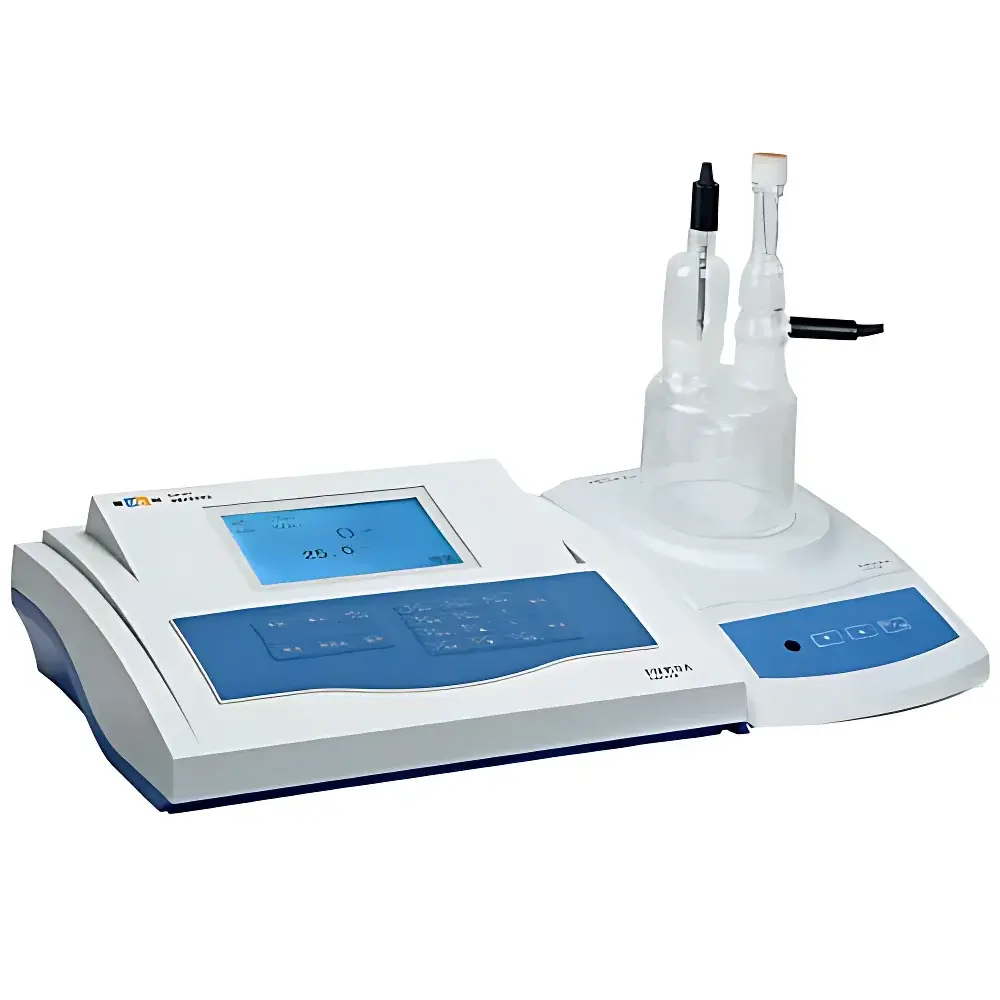
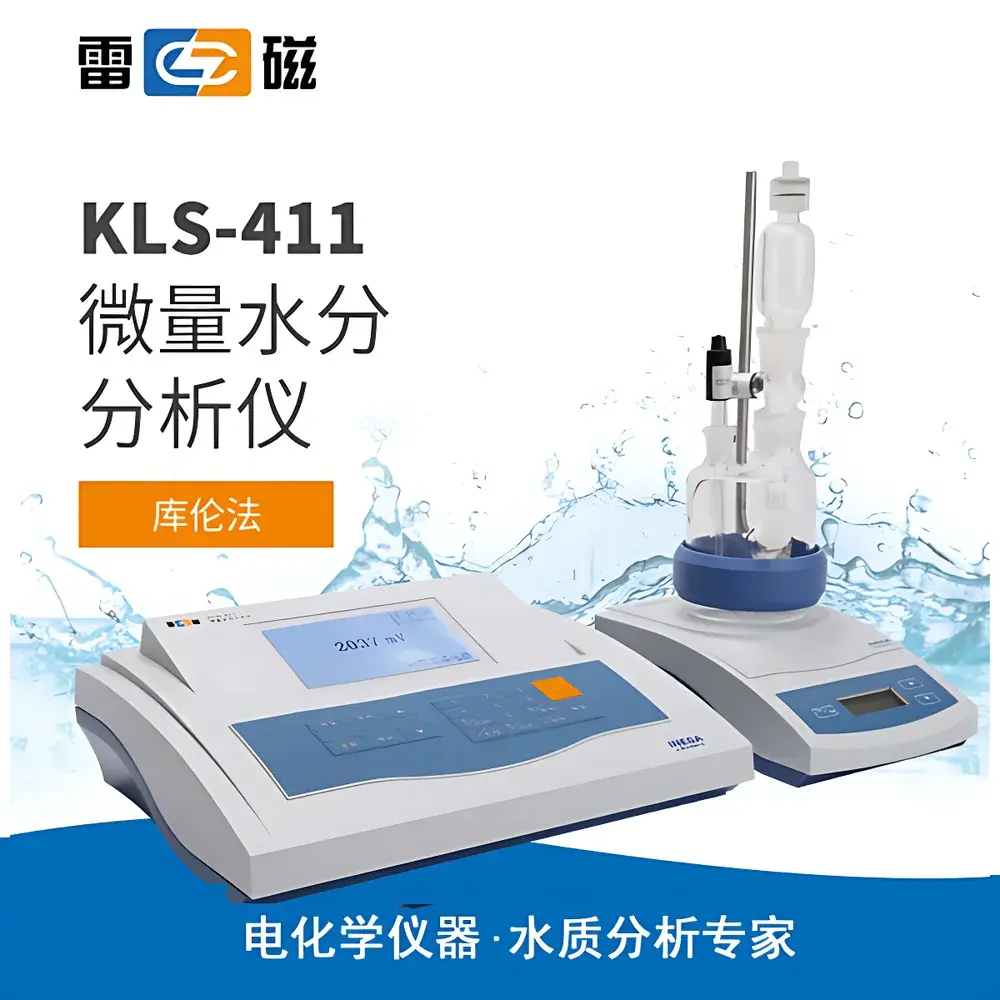
Leici KLS-411 Karl Fischer Coulometric Moisture Analyzer
| Brand | Leici |
|---|---|
| Origin | Shanghai, China |
| Manufacturer Type | Direct Manufacturer |
| Regional Category | Domestic (China) |
| Model | KLS-411 |
| Pricing Range | USD 570 – 2,850 (based on current exchange rate ~¥4000–¥20,000) |
| Titration Mode | Fully Automated Coulometric Titration |
| Instrument Type | Coulometric Karl Fischer Moisture Analyzer |
| Moisture Measurement Range | 10 µg to 20 mg |
| Measurement Accuracy | ≤ ±3% RSD |
| Electrolysis Current Settings | 10 mA, 20 mA, 50 mA, 100 mA |
| Polarization Current Error | ±0.2 µA |
| Electrolysis Current Basic Error | ±0.5% of reading |
| Indication Error | ±(5% of calibration point + 3) µg |
| Repeatability | ≤3% RSD |
| Power Supply | (220 ± 22) V AC, (50 ± 1) Hz |
| Dimensions (L×W×H) | 300 × 235 × 100 mm |
| Net Weight | 3 kg |
| Interface | RS-232 serial port for printer connectivity |
| Electrode Configuration | Membrane-type dual-platinum electrode |
| Reagent Compatibility | Leici low-toxicity, low-odor, reusable KF reagent (coulometric anolyte/catholyte system) |
| Reagent Standardization | Not required (pre-calibrated reagent system) |
Overview
The Leici KLS-411 Karl Fischer Coulometric Moisture Analyzer is a dedicated coulometric titration instrument engineered for high-sensitivity quantitative determination of trace water content in non-aqueous matrices. Unlike volumetric KF systems, the KLS-411 employs controlled-current electrolysis to generate iodine in situ at the anode, enabling precise stoichiometric reaction with water according to the classic Karl Fischer reaction: I₂ + SO₂ + H₂O + 3RN + CH₃OH → 2RN·HI + RN·HSO₄CH₃. This coulometric architecture eliminates volumetric dispensing errors and delivers superior resolution for samples containing 10 µg to 20 mg of water—making it especially suitable for pharmaceutical excipients, lubricating oils, organic solvents, polymers, and battery-grade electrolytes where residual moisture must be quantified below 10 ppm.
Key Features
- True coulometric operation with selectable electrolysis currents (10/20/50/100 mA), enabling dynamic range adaptation without manual reagent dilution or method reconfiguration.
- Membrane-separated dual-platinum electrode assembly minimizes cross-contamination and ensures stable endpoint detection across diverse solvent systems—including chlorinated hydrocarbons, ketones, and high-viscosity oils.
- Pre-validated, low-toxicity Leici KF reagent formulation eliminates routine standardization; reagent stability supports ≥500 analyses per batch under controlled storage conditions.
- Integrated 5.7-inch monochrome LCD interface with intuitive menu navigation, real-time titration curve display, and on-board data management—no external PC required for routine operation.
- Compliance-ready design: All measurement events—including start time, endpoint detection, current profile, and final water mass—are timestamped and stored internally with automatic checksum validation.
- RS-232 serial interface enables direct thermal printer output for GLP-compliant hardcopy records; optional ASCII data export for LIMS integration.
Sample Compatibility & Compliance
The KLS-411 accommodates liquid, solid, and viscous samples via standardized sample injection ports compatible with 1–5 mL syringes or automated samplers (optional). It meets core performance criteria outlined in ASTM D6304, ISO 760, and USP , supporting validated methods for raw material release testing in GMP environments. While not pre-certified to FDA 21 CFR Part 11, its audit trail functionality—including immutable timestamps, operator ID prompts, and uneditable result logs—provides foundational traceability required for internal quality audits and regulatory inspections. The instrument operates within Class II electrical safety standards (IEC 61010-1) and complies with RoHS Directive 2011/65/EU for hazardous substance restriction.
Software & Data Management
Data handling is performed entirely onboard via embedded firmware (v3.2+). Up to 200 complete analysis records—including water mass (µg), calculated % moisture, titration time, current profile summary, and operator ID—are retained in non-volatile memory. Users may review, export (via RS-232), or delete entries individually or in batches. No proprietary software installation is required; exported files conform to plain-text CSV format for direct import into Excel, LabWare LIMS, or Empower CDS. Audit trails record all critical actions: method parameter changes, reagent lot entry, calibration verification, and result finalization—each with date/time stamp and user confirmation.
Applications
- Pharmaceuticals: Quantification of residual moisture in lyophilized APIs, tablet granules, and silicone-coated stoppers per ICH Q5C guidelines.
- Petrochemicals: Water content verification in transformer oils (IEC 60814), jet fuels (ASTM D6304), and synthetic lubricants.
- Electronics: Moisture assessment in Li-ion battery electrolytes and cathode precursors where H₂O > 20 ppm induces HF formation.
- Polymers & Plastics: Pre-drying validation for engineering resins (e.g., PA6, PET) prior to extrusion or injection molding.
- Agrochemicals: Stability testing of wettable powders and suspension concentrates where hydrolysis drives active ingredient degradation.
FAQ
Does the KLS-411 require daily reagent standardization?
No. The Leici coulometric reagent system is factory-pre-calibrated and certified for stoichiometric iodine generation efficiency; routine standardization is not necessary unless long-term storage (>6 months) or exposure to ambient humidity is suspected.
Can the KLS-411 measure water in viscous samples like silicone oil?
Yes—provided the sample is dissolved or homogenized in KF-compatible solvent (e.g., chloroform/methanol mixtures) and introduced via heated syringe to prevent crystallization at the injection port.
Is GLP-compliant electronic record retention supported?
The device maintains tamper-evident local logs with timestamps and operator attribution. For full 21 CFR Part 11 compliance, pairing with validated third-party data acquisition software is recommended.
What maintenance is required for the membrane electrode?
The electrode membrane should be inspected weekly for discoloration or clogging; cleaning with anhydrous methanol followed by air-drying restores performance in >90% of cases. Replacement is advised after ~2,000 analyses or if baseline drift exceeds ±0.5 µA.
How does the KLS-411 handle samples that react with KF reagent?
Substances releasing water upon decomposition (e.g., hydrates, certain salts) or consuming iodine non-stoichiometrically (e.g., strong reductants) require method-specific validation. Application notes for acetone, acetic acid, and formic acid are available from Leici Technical Support.




