
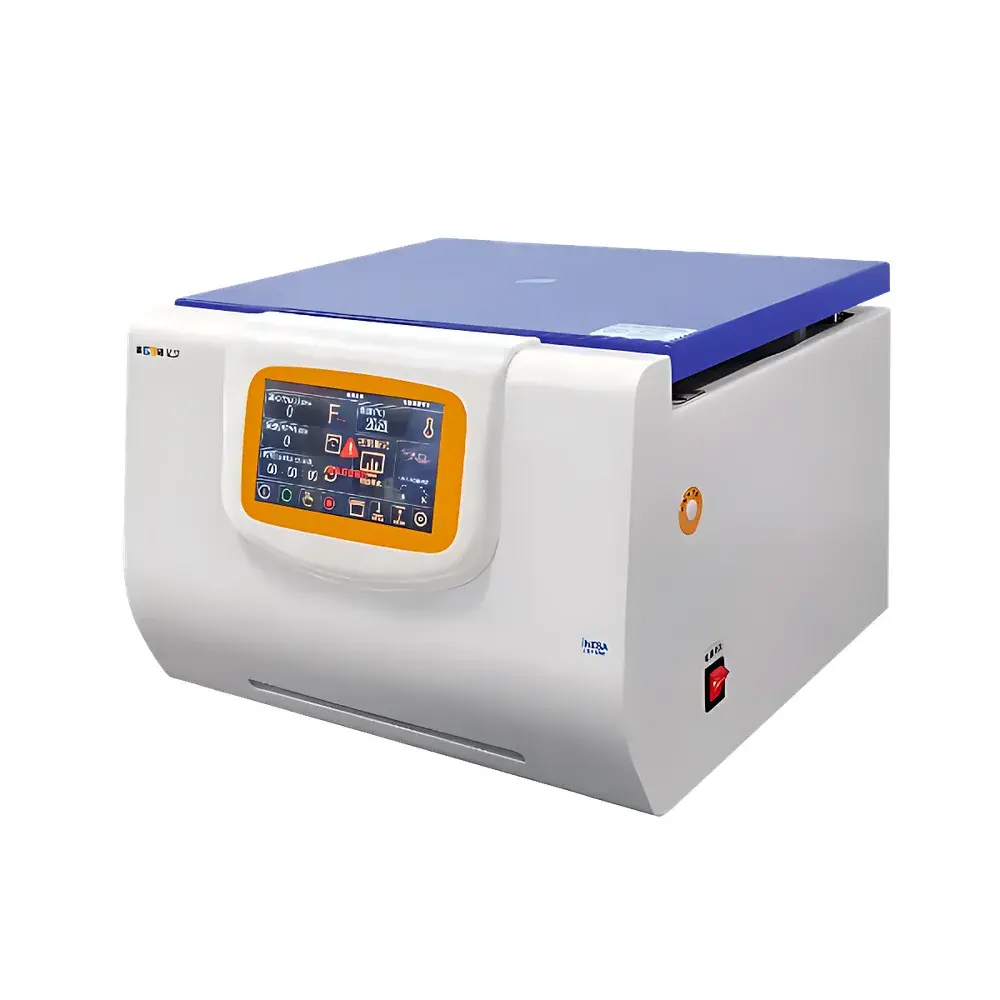
Leici LX-105 Benchtop Low-Speed Centrifuge
| Brand | Leici |
|---|---|
| Origin | Shanghai, China |
| Manufacturer Type | Direct Manufacturer |
| Product Category | Domestic |
| Model | LX-105 |
| Instrument Type | Benchtop Centrifuge |
| Speed Class | Low-Speed Centrifuge (≤ 6,000 rpm) |
| Function | General-Purpose Centrifuge |
| Configuration | Horizontal Rotor Centrifuge |
| Maximum Capacity | 4 × 250 mL |
| Maximum Speed | 5,500 rpm |
| Maximum RCF | 4,800 × g |
| Speed Accuracy | ±20 rpm |
| Timer Range | 1 s – 99 h 59 min 59 s (including continuous and short-spin modes) |
| Drive System | High-Torque Brushless DC Inverter Motor |
| Control Interface | 7-inch LCD Touchscreen |
| Rotor Recognition | Not Supported |
| Acceleration/Deceleration | Programmable Ramp Rates |
| Vibration Damping | Integrated Passive Damping System |
| Noise Level | ≤60 dB(A) |
| Power Supply | AC 220 V, 50 Hz |
| Total Power Consumption | 0.45 kW |
| Net Weight | 40.5 kg |
| Dimensions (L×W×H) | 450 × 565 × 365 mm |
Overview
The Leici LX-105 is a microprocessor-controlled benchtop low-speed centrifuge engineered for routine separation tasks in clinical diagnostics, life science research, and quality control laboratories. It operates on the principle of sedimentation under centrifugal force—accelerating particle separation based on density, size, and shape differences in heterogeneous liquid samples. Designed for reliability and operational safety, the LX-105 delivers consistent performance at rotational speeds up to 5,500 rpm and generates a maximum relative centrifugal force (RCF) of 4,800 × g. Its robust mechanical architecture, combined with a brushless DC inverter motor and precision PWM speed regulation, ensures stable rotor dynamics across extended operation cycles. The unit complies with IEC 61010-1:2010 safety standards for laboratory electrical equipment and incorporates fail-safe interlocks aligned with ISO 13485–informed design practices for medical device–adjacent applications.
Key Features
- 7-inch high-resolution capacitive touchscreen interface with intuitive icon-based navigation and real-time parameter feedback
- Programmable acceleration and deceleration profiles—enabling user-defined ramp times to minimize sample disturbance during spin-up and braking
- Integrated mechanical door lock mechanism: motor remains de-energized until lid is fully latched and verified by dual-position sensing
- Passive vibration-damping system using elastomeric isolators and optimized mass distribution to maintain stability at rated load conditions
- Brushless DC inverter motor eliminates carbon brush wear, reducing maintenance intervals and eliminating conductive carbon dust contamination—a critical advantage in cleanroom-adjacent workflows
- 100 programmable method storage slots supporting recall, editing, and timestamped execution history (non-auditable; no electronic signature or 21 CFR Part 11 compliance)
- Wide timer range (1 second to 99 hours, 59 minutes, 59 seconds), supporting both timed runs and continuous operation modes
Sample Compatibility & Compliance
The LX-105 accommodates standard horizontal swing-out rotors compatible with common tube formats including 15 mL, 50 mL conical tubes, and 250 mL bottles—supporting maximum configurations of 4 × 250 mL per run. Rotor compatibility extends to optional adapters for smaller-volume vessels (e.g., 5–10 mL test tubes), though rotor identification is not automated; users must manually confirm rotor type and load symmetry prior to initiation. The centrifuge meets CE marking requirements under the EU Machinery Directive 2006/42/EC and electromagnetic compatibility (EMC) standards per EN 61326-1. While not certified for GLP/GMP environments requiring full audit trails, its mechanical safety features—including imbalance detection via current draw monitoring and automatic shutdown at ≥10% load asymmetry—align with general laboratory risk mitigation protocols outlined in CLSI EP25-A.
Software & Data Management
The LX-105 operates via embedded firmware without external PC connectivity or proprietary software dependencies. All settings—including speed, time, acceleration/deceleration rate, and program name—are configured and stored locally on the instrument’s internal flash memory. Data retention persists through power cycles; however, no export functionality (USB, Ethernet, or RS-232) is provided. Timestamped run logs are viewable on-screen but not retrievable externally. For laboratories requiring regulatory-compliant data handling, integration with third-party LIMS or ELN systems must be achieved via manual entry or external process documentation—not instrument-level automation.
Applications
- Cell pellet harvesting from suspension cultures (e.g., mammalian, bacterial, yeast) at low-force conditions preserving membrane integrity
- Clarification of serum, plasma, urine, and cerebrospinal fluid specimens prior to immunoassay or electrophoresis
- Phase separation in extraction protocols involving aqueous-organic solvent systems (e.g., phenol-chloroform DNA isolation)
- Sedimentation of particulates in environmental water samples for turbidity or heavy metal analysis
- Preparative isolation of organelles (e.g., nuclei, mitochondria) using differential centrifugation steps below 10,000 × g
- Routine quality assurance checks in pharmaceutical manufacturing—such as excipient homogeneity verification or suspension stability assessment
FAQ
What rotor types are compatible with the LX-105?
The LX-105 supports horizontal swing-out rotors only; fixed-angle rotors are not mechanically or electrically compatible. Standard configurations include 4-place carriers for 250 mL bottles and interchangeable adapters for 15–50 mL tubes.
Does the LX-105 support automatic rotor recognition?
No. Users must manually select rotor type and verify load balance before initiating a run. No RFID or optical rotor ID capability is integrated.
Is the LX-105 suitable for biosafety level 2 (BSL-2) applications?
Yes—when used with sealed buckets and aerosol-tight tube caps. However, the unit lacks a certified biocontainment rotor chamber or HEPA filtration; containment relies entirely on proper sample vessel selection and procedural controls.
Can run data be exported to a computer?
No. The LX-105 does not feature USB, network, or serial interfaces. All operational records remain confined to the onboard display and non-exportable memory.
What maintenance is required for long-term reliability?
Annual inspection of damping mounts and door latch integrity is recommended. The brushless motor requires no scheduled brush replacement; periodic cleaning of air intake vents and condensate drainage paths (if installed in high-humidity environments) supports thermal management.



