
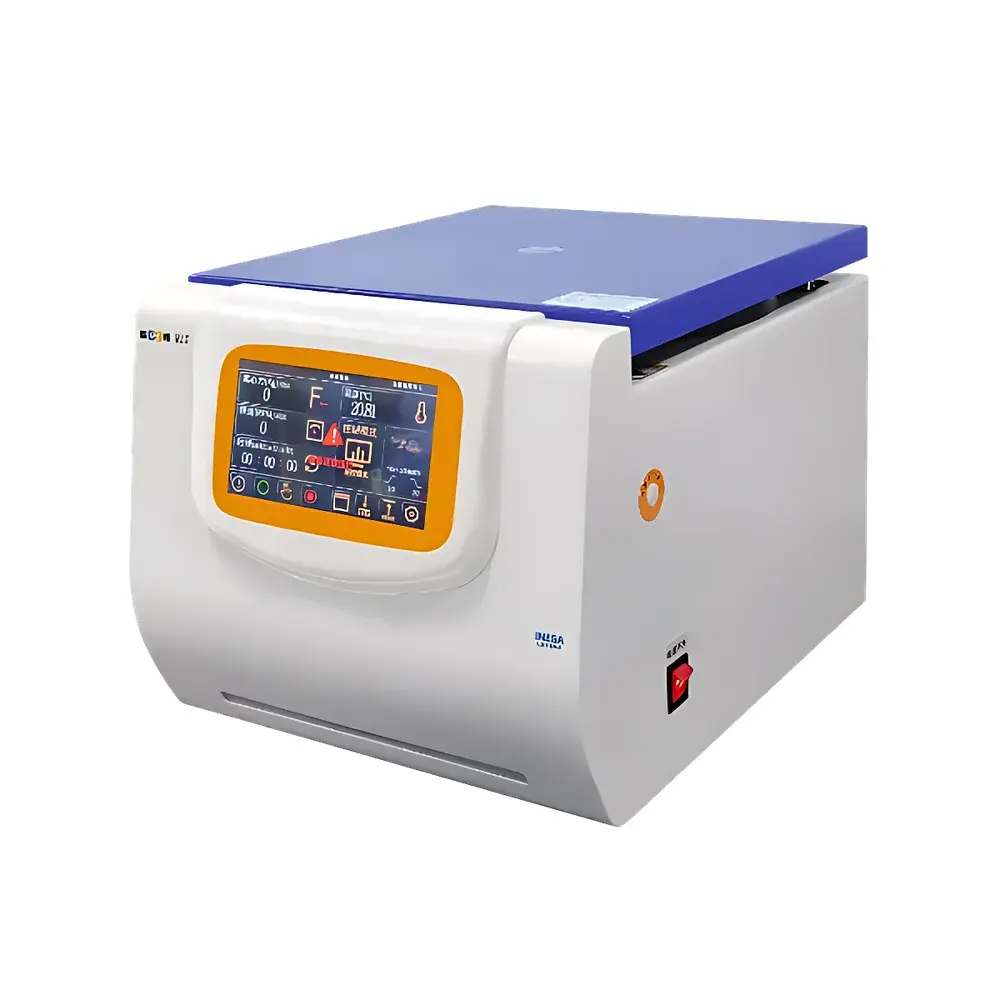
Leici LX-116 Benchtop High-Speed Centrifuge
| Brand | Leici |
|---|---|
| Origin | Shanghai, China |
| Manufacturer Type | Direct Manufacturer |
| Product Category | Domestic |
| Model | LX-116 |
| Instrument Type | Benchtop Centrifuge |
| Speed Range | High-Speed (10,000–30,000 rpm) |
| Configuration | Fixed-Angle Rotor Centrifuge |
| Maximum Capacity | 4 × 100 mL |
| Maximum Speed | 16,500 rpm |
| Maximum RCF | 22,500 × g |
| Speed Accuracy | ±20 rpm |
| Timer Range | 1 s – 99 h 59 min 59 s (including continuous and short-spin modes) |
| Drive System | High-Torque Brushless DC Inverter Motor |
| Control System | Microprocessor-Based PWM Speed Control |
| Display | 7-inch Wide-View IPS LCD Touchscreen |
| Door Safety | Mechanical Interlock Lock |
| Vibration Damping | Specialized Passive Damping System |
| Noise Level | ≤60 dB(A) |
| Power Supply | AC 220 V, 50 Hz |
| Total Power Consumption | 0.38 kW |
| Net Weight | 27.5 kg |
| Dimensions (L×W×H) | 360 × 460 × 335 mm |
Overview
The Leici LX-116 is a microprocessor-controlled benchtop high-speed centrifuge engineered for precision separation in academic, clinical, and industrial laboratory environments. It operates on the principle of sedimentation under controlled centrifugal force—generating up to 22,500 × g at its maximum rotational speed of 16,500 rpm—to separate particles based on density, size, and shape within liquid suspensions. Designed for routine and demanding applications including cell pelleting, nucleic acid isolation, protein purification, and subcellular fractionation, the LX-116 delivers consistent performance with minimal operator intervention. Its compact footprint (360 × 460 × 335 mm) and low-noise operation (≤60 dB[A]) make it suitable for shared lab spaces where acoustic comfort and spatial efficiency are critical.
Key Features
- 7-inch wide-view IPS LCD touchscreen interface with intuitive touch navigation and real-time parameter visualization
- High-torque brushless DC inverter motor—eliminates carbon brush wear, reduces maintenance requirements, and prevents carbon dust contamination in sensitive sample environments
- PWM-based speed control architecture ensuring stable rotor acceleration/deceleration and ±20 rpm speed accuracy across the full operational range
- Programmable memory supporting up to 100 user-defined protocols—including time, speed, RCF, and ramp/brake profiles—for repeatable experimental conditions
- Mechanical door interlock system that physically prevents rotor rotation unless the lid is fully latched, complying with IEC 61010-2-020 safety standards for centrifugal equipment
- Optimized passive vibration damping system integrated into the chassis and rotor assembly to minimize transmission of mechanical oscillations during high-speed runs
- Flexible rotor compatibility—designed for standard fixed-angle rotors accommodating up to four 100 mL tubes per run, with optional rotor configurations available upon request
Sample Compatibility & Compliance
The LX-116 accommodates common laboratory tube formats including polypropylene and polycarbonate conical tubes (15 mL, 50 mL), centrifuge bottles (up to 100 mL), and microcentrifuge tubes (0.2–2.0 mL) when used with appropriate adapters. It supports both aqueous and organic solvent-based samples, though users must verify chemical resistance of tube materials prior to use. The instrument conforms to essential electrical and mechanical safety requirements outlined in IEC 61010-1 (Safety of Electrical Equipment for Measurement, Control, and Laboratory Use) and IEC 61010-2-020 (Particular Requirements for Centrifuges). While not certified for GMP or GLP environments out-of-the-box, its programmable audit trail (via external data logging) and reproducible protocol execution support alignment with ISO/IEC 17025 quality management systems when integrated into validated workflows.
Software & Data Management
The LX-116 features embedded firmware with local storage for 100 method programs, each retaining complete runtime metadata: start time, final speed, elapsed duration, RCF achieved, and rotor identification status (manual entry required). Though it lacks native USB or Ethernet connectivity, all parameters and run logs can be manually documented via the touchscreen interface. For laboratories requiring electronic records compliance (e.g., FDA 21 CFR Part 11), integration with third-party LIMS or ELN platforms is achievable through serial output (RS-232, optional) or manual export of run summaries. Firmware updates are performed locally using a USB flash drive—ensuring continuity in regulated settings without dependency on cloud infrastructure.
Applications
- Routine cell harvesting from mammalian, bacterial, and yeast cultures
- Clarification of crude lysates prior to chromatography or electrophoresis
- Isolation of extracellular vesicles and exosomes from biofluids
- Preparative separation of plasma lipoprotein fractions
- Concentration of viral vectors and nanoparticles in bioprocessing development
- Removal of precipitates in reagent preparation and quality control testing
The LX-116’s balance of speed, capacity, and thermal stability (no active refrigeration) positions it as a robust solution for ambient-temperature separations where rapid turnaround and long-term reliability are prioritized over cryogenic operation.
FAQ
Does the LX-116 include refrigeration capability?
No—the LX-116 is a non-refrigerated centrifuge optimized for room-temperature applications. Users requiring temperature-sensitive sample handling should consider complementary cooling solutions or alternative refrigerated models.
Is rotor auto-recognition supported?
Rotor identification is not automated; users must manually select the installed rotor type and maximum rated speed prior to initiating a run to ensure safe operation.
Can the LX-116 be used for clinical diagnostics under CLIA or CAP guidelines?
While the device meets general laboratory safety standards, formal CLIA/CAP validation requires site-specific installation qualification (IQ), operational qualification (OQ), and performance verification per test-specific SOPs—none of which are pre-certified by the manufacturer.
What maintenance intervals are recommended for the brushless motor?
The brushless DC inverter motor requires no scheduled brush replacement or lubrication. Routine inspection of rotor threads, lid seal integrity, and vibration behavior every 6 months is advised for sustained performance.
Is the touchscreen interface compatible with gloved operation?
Yes—the capacitive IPS display supports responsive input with standard nitrile or latex laboratory gloves, maintaining usability in biosafety cabinets and cleanroom environments.



