
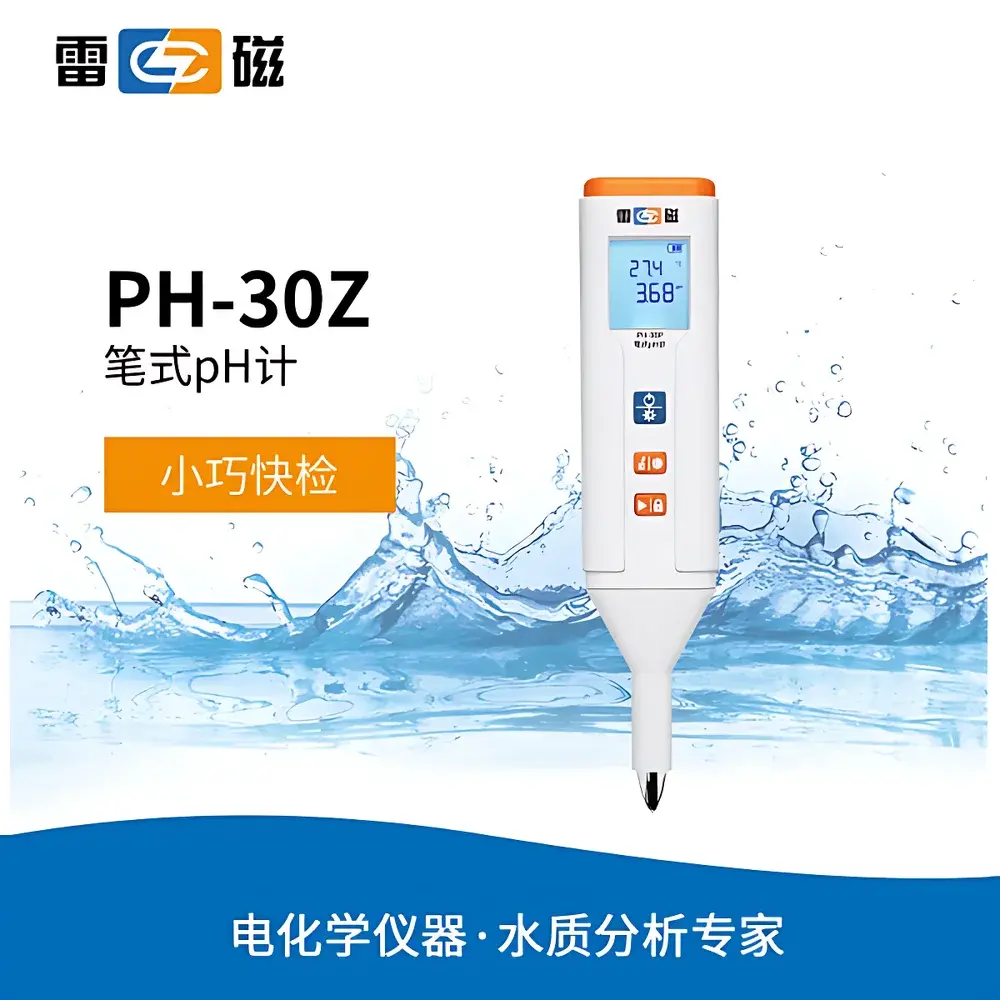
Leici PH-30Z Portable Pen-Style pH Meter
| Brand | Leici |
|---|---|
| Origin | Shanghai, China |
| Manufacturer Type | Direct Manufacturer |
| Product Origin | Domestic (China) |
| Model | PH-30Z |
| Instrument Type | Pen-Style pH Meter |
| Parameter Types | Multi-Parameter (pH, mV, Temperature) |
| pH Measurement Range | (-2.00 to 16.00) pH |
| pH Resolution | 0.01 pH |
| pH Accuracy | ±0.02 pH |
| pH Repeatability | ≤0.01 pH |
| mV Range | -1000 to +1000 mV |
| mV Resolution | 1 mV |
| Temperature Range | (0.0 to 60.0) °C |
| Temperature Resolution | 0.1 °C |
| Temperature Accuracy | ±0.3 °C |
| Automatic Temperature Compensation (ATC) | 0.0–60.0 °C |
| Calibration Points | 1–3 point with auto-buffer recognition (GB and US standard buffers) |
| Display | High-contrast LCD with backlight |
| IP Rating | IP67 |
| Electrode Options | Replaceable spherical, flat-surface, or conical pH sensing tips |
| Power | 4 × AAA batteries (>200 h battery life) |
| Dimensions | 40 × 30 × 188 mm |
| Weight | ~0.15 kg |
| Housing Material | ABS polymer |
| Included Accessories | Wrist strap, portable carrying case, calibration vials, pre-filled GB/US buffer solutions (pH 4.01, 7.00, 10.01), and batteries |
Overview
The Leici PH-30Z is a compact, field-deployable pen-style pH meter engineered for reliable electrochemical measurement in demanding environments—ranging from water quality monitoring and aquaculture to educational labs and industrial process spot-checks. Built on potentiometric principle, it measures the hydrogen ion activity of aqueous solutions via a glass pH electrode generating a Nernstian potential relative to a stable reference system. Its extended pH range of –2.00 to 16.00 enables accurate assessment of highly acidic or alkaline media, including cleaning agents, etchants, and wastewater effluents where conventional meters may saturate or drift. The integrated ATC sensor (0.0–60.0 °C) ensures real-time compensation without manual input, while the replaceable electrode tip architecture decouples sensor wear from instrument obsolescence—extending total cost-of-ownership and supporting modular maintenance per ISO/IEC 17025 traceability requirements.
Key Features
- High-contrast backlit LCD with dual-unit temperature display (°C/°F) and intuitive icon-based status indicators
- Auto-buffer recognition for both Chinese GB (GB/T 604–2002) and U.S. NIST-traceable standard buffers (pH 4.01, 7.00, 10.01), reducing calibration errors during field use
- Three interchangeable electrode configurations: spherical bulb (standard aqueous), flat-surface (for semi-solid or surface pH), and conical tip (for narrow containers or gel matrices)
- Programmable auto-hold with adjustable locking interval (5–20 s) plus manual hold mode for transient or low-conductivity samples
- IP67-rated enclosure certified for dust-tight operation and immersion up to 1 m for 30 minutes—validated per IEC 60529
- Configurable auto-power-off (1–60 min) and battery-level indicator to ensure uninterrupted field operation
- ABS housing optimized for ergonomic grip, chemical resistance, and drop resilience per MIL-STD-810G shock testing guidelines
Sample Compatibility & Compliance
The PH-30Z accommodates diverse sample matrices—including drinking water, seawater, soil extracts, food slurries, and industrial coolants—without requiring dilution or conditioning in most cases. Its low-input-impedance circuitry minimizes polarization effects in low-ionic-strength solutions (<100 µS/cm). All calibration and measurement protocols align with ASTM D1293 (Standard Test Methods for pH of Water) and ISO 10523 (Water Quality — Determination of pH). The device supports GLP-compliant data integrity through timestamped calibration logs stored in non-volatile memory. While not FDA 21 CFR Part 11–certified out-of-box, its audit trail capability (calibration date/time, buffer IDs, slope/mV offset) meets baseline documentation requirements for ISO 9001 and ISO/IEC 17025 accredited laboratories.
Software & Data Management
As a standalone handheld instrument, the PH-30Z does not require PC connectivity or proprietary software. All operational parameters—including calibration history, ATC activation status, and unit preferences—are retained in EEPROM across battery changes. No firmware updates are field-serviceable; however, factory recalibration services are available through Leici’s Shanghai service center under ISO/IEC 17025 scope. For integration into LIMS or QA/QC workflows, users may manually log readings using standardized templates aligned with Annex 11 (EU GMP) or 21 CFR Part 11 Subpart B record-keeping conventions.
Applications
- Environmental field surveys: Stream, pond, and groundwater pH profiling under variable ambient temperatures
- Aquaculture management: Real-time monitoring of hatchery tanks and recirculating aquaculture systems (RAS)
- Food & beverage QC: Spot-checking rinse water, brine solutions, and fermentation broth acidity
- Educational laboratories: Teaching core electrochemical concepts including Nernst equation, liquid junction potential, and buffer capacity
- Facility maintenance: Verifying neutralization efficiency of acid/base waste treatment units
- Swimming pool & spa management: Rapid verification of sanitizer efficacy via pH stability tracking
FAQ
What calibration standards are supported?
The PH-30Z automatically detects and applies correction factors for GB-standard (pH 4.01, 6.86, 9.18) and US/NIST-traceable (pH 4.01, 7.00, 10.01) buffers. Manual entry of custom buffer values is not supported.
Can the electrode be replaced without sending the unit for service?
Yes—the sensing tip is user-replaceable via a threaded cap mechanism. Replacement kits (spherical, flat, conical) are sold separately under Leici part numbers EL-PH30Z-S, EL-PH30Z-F, and EL-PH30Z-C.
Is temperature compensation mandatory during pH measurement?
ATC is enabled by default and cannot be disabled; the built-in thermistor ensures compliance with ISO 10523’s requirement for temperature-corrected reporting.
How is measurement uncertainty quantified for this instrument?
Total system uncertainty at 25 °C is ±0.02 pH (k=2), derived from combined contributions of electrode slope error (±0.5%), asymmetry potential drift (±0.005 pH), and ATC sensor tolerance (±0.3 °C equivalent to ±0.005 pH at pH 7).
Does the device meet any international EMC or safety standards?
It complies with GB/T 18268.1–2010 (equivalent to IEC 61326-1:2012) for electromagnetic compatibility in laboratory environments and GB 4793.1–2007 (IEC 61010-1:2010) for electrical safety.



