
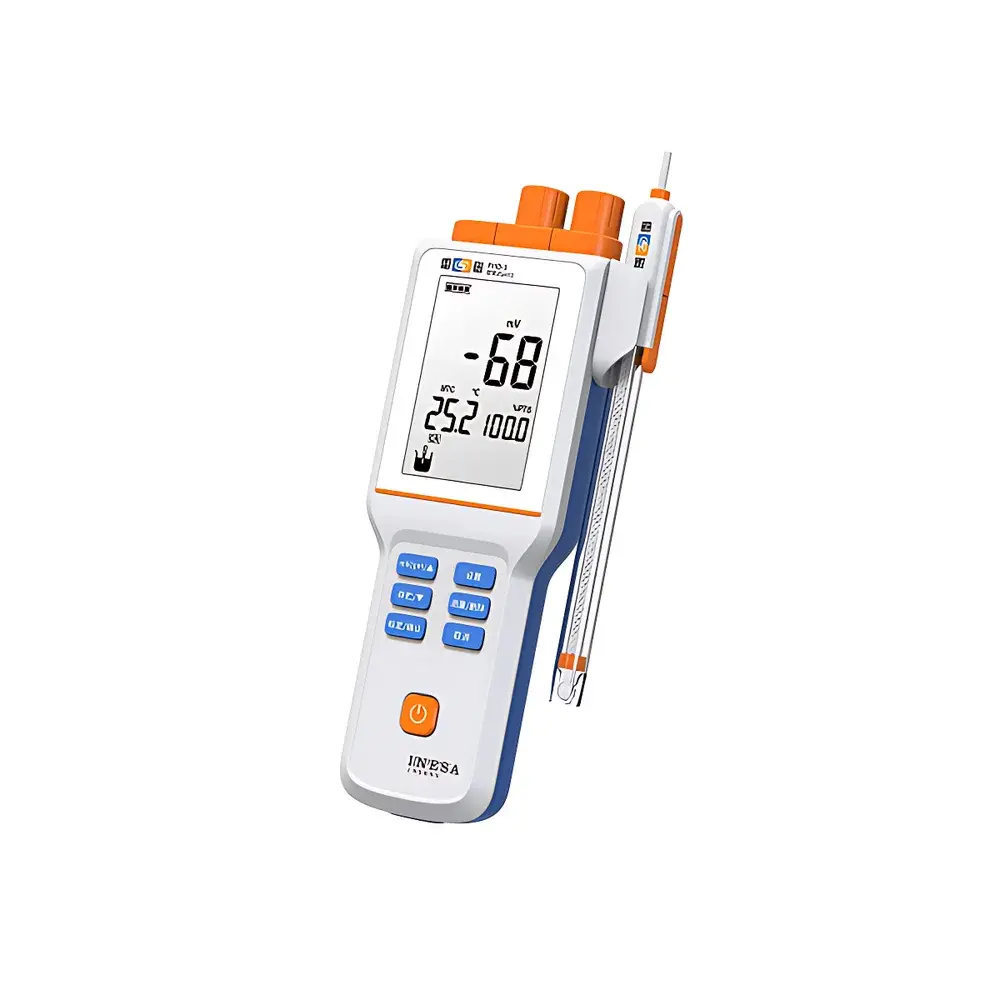
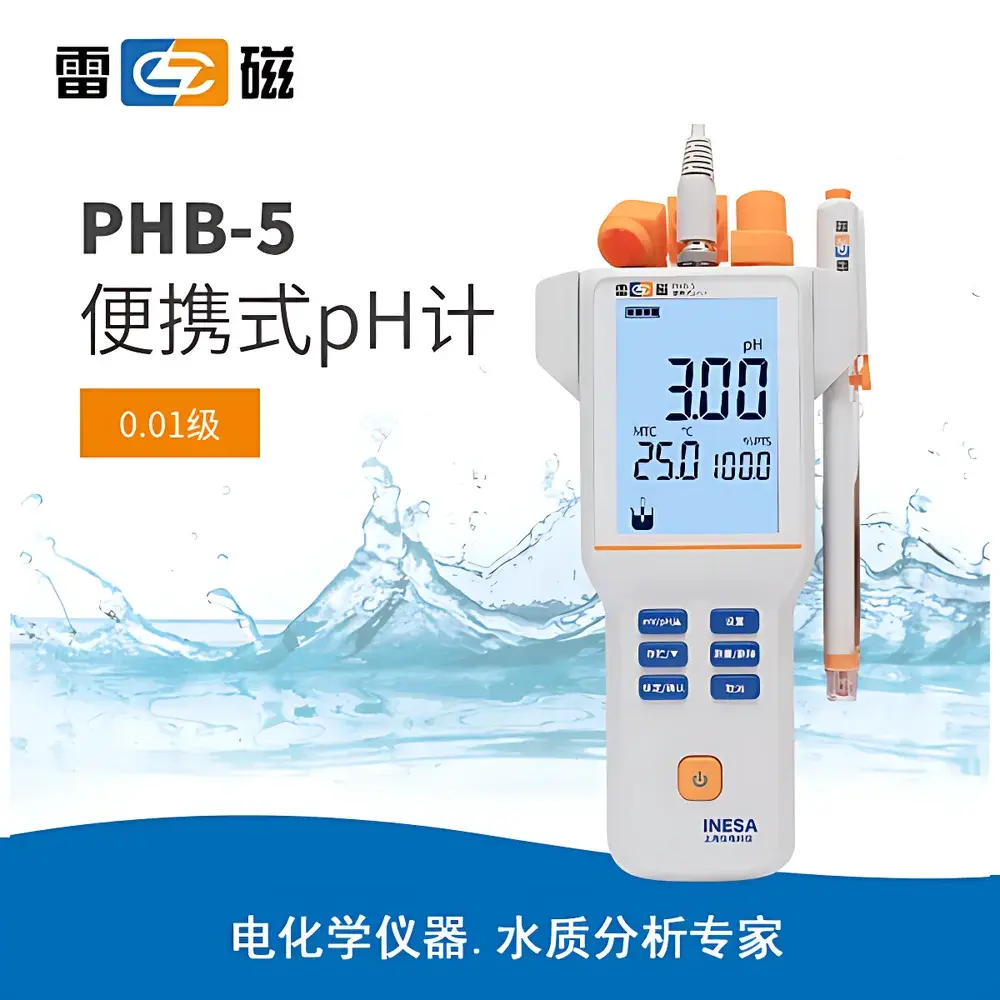
Leici PHB-5 Portable pH Meter
| Brand | Leici |
|---|---|
| Origin | Shanghai, China |
| Manufacturer Type | Direct Manufacturer |
| Regional Origin | Domestic (China) |
| Model | PHB-5 |
| Instrument Type | Portable |
| Parameter Types | Multi-parameter |
| pH Accuracy | ±0.01 pH |
| pH Range | (-2.00 to 18.00) pH |
| Resolution | 0.01 pH |
| mV Range | (-1999 to 1999) mV |
| mV Resolution | 1 mV |
| mV Accuracy | ±0.1% FS |
| Temperature Range | (-5.0 to 110.0) °C |
| Temperature Resolution | 0.1 °C |
| Temperature Accuracy | ±0.2 °C |
| Calibration Buffers | GB Standard Solutions at pH 4.00, 6.86, and 9.18 |
| Power Supply | Rechargeable Li-ion Battery + AC/DC Adapter (Input: AC 100–240 V, Output: DC 5 V) |
| Dimensions | 80 × 225 × 35 mm |
| Weight | 0.4 kg |
Overview
The Leici PHB-5 Portable pH Meter is a field-deployable, multi-parameter electrochemical instrument engineered for high-reproducibility pH, mV, and temperature measurements in diverse laboratory, industrial, environmental, and educational settings. Built upon a potentiometric measurement principle, the PHB-5 determines hydrogen ion activity via a glass electrode coupled with a reference electrode—generating a voltage differential proportional to pH according to the Nernst equation. Its extended pH range of –2.00 to 18.00 accommodates highly acidic or alkaline samples common in wastewater treatment, electroplating baths, chemical synthesis, and cleaning validation protocols. The meter complies with GB/T 20777–2006 (General Requirements for Electrochemical Analyzers) and supports traceable calibration using certified national standard buffer solutions (pH 4.00, 6.86, and 9.18), enabling alignment with ISO/IEC 17025-compliant quality systems where documented metrological traceability is required.
Key Features
- High-contrast LCD display with intuitive button navigation—optimized for glove-compatible operation in field or production environments
- Auto-diagnostic startup sequence verifying electrode connection integrity, battery status, and sensor signal stability prior to measurement
- Configurable auto-power-off (10/30/60 min or disabled) and low-power mode to extend battery life; built-in power-loss memory retains last calibration and configuration settings
- Firmware-upgradable architecture—enabling future compatibility with new calibration algorithms, language packs, or regulatory reporting templates without hardware replacement
- Integrated temperature compensation (ATC/ MTC) using either a built-in thermistor or optional external Pt1000 probe—ensuring accurate pH readings across wide thermal gradients (–5.0 to 110.0 °C)
- Rugged, IP67-rated enclosure design (when sealed) with ergonomic form factor (80 × 225 × 35 mm, 0.4 kg) for handheld use in humid, dusty, or mobile applications
Sample Compatibility & Compliance
The PHB-5 is compatible with all standard combination pH electrodes featuring BNC connectors and integrated temperature sensors. It supports both aqueous and non-aqueous media—provided electrode compatibility is verified per manufacturer specifications (e.g., low-ionic-strength samples require double-junction or refillable electrodes). Calibration follows standardized two- or three-point procedures aligned with ASTM D1293 (Standard Test Method for pH of Water) and USP (pH Measurement). While not pre-certified for FDA 21 CFR Part 11, the device supports audit-ready manual documentation practices—including timestamped calibration logs, operator ID entry (via user-defined label), and physical record retention—facilitating GLP/GMP-aligned workflows in regulated QC laboratories.
Software & Data Management
The PHB-5 operates as a standalone instrument with no proprietary software dependency. All measurement data—including pH, mV, temperature, date/time stamp, and calibration history—are viewable on-device and can be manually transcribed or exported via optional RS232/USB interface (adapter sold separately). For laboratories requiring electronic record integration, the meter’s stable analog output and consistent ASCII-based serial protocol enable seamless ingestion into LIMS or ELN platforms using generic COM port drivers. Calibration events are stored with buffer IDs, slope (%), offset (mV), and temperature—supporting retrospective review per ISO 17025 clause 7.7 (Ensuring Validity of Results).
Applications
- Field monitoring of surface water, groundwater, and effluent streams per EPA Method 150.1 and China’s HJ 1147–2020 (Water Quality – Determination of pH)
- In-process pH control during pharmaceutical buffer preparation, bioreactor harvesting, and cleaning-in-place (CIP) cycle verification
- Quality assurance testing of food & beverage products, cosmetics, and agricultural inputs where pH directly impacts stability, safety, or regulatory compliance
- Educational laboratories teaching fundamental electrochemistry concepts, including electrode kinetics, liquid junction potential, and temperature-dependent Nernst behavior
- Maintenance of calibration standards in metrology labs supporting secondary reference electrode verification against primary buffers
FAQ
Does the PHB-5 support automatic temperature compensation (ATC)?
Yes—the instrument automatically applies NIST-traceable temperature compensation when a compatible ATC probe is connected, or allows manual temperature entry (MTC) if no probe is used.
What calibration standards are required for routine use?
GB-standard pH 4.00, 6.86, and 9.18 buffer solutions are recommended for two- or three-point calibration; single-point verification may be performed using pH 6.86 for daily checks.
Is the rechargeable battery replaceable by the end user?
The internal Li-ion battery is serviceable by authorized Leici technical centers; field replacement is not supported due to safety and sealing requirements.
Can the PHB-5 measure ORP (oxidation-reduction potential)?
Yes—it provides direct mV readout across ±1999 mV with 1 mV resolution, suitable for relative ORP assessment when paired with a platinum or redox electrode.
How often should calibration be performed?
Calibration frequency depends on application criticality: daily for regulated QC, before each analytical batch in research, or per ASTM D1293 guidelines (prior to sample analysis and after every 2 hours of continuous use).






