
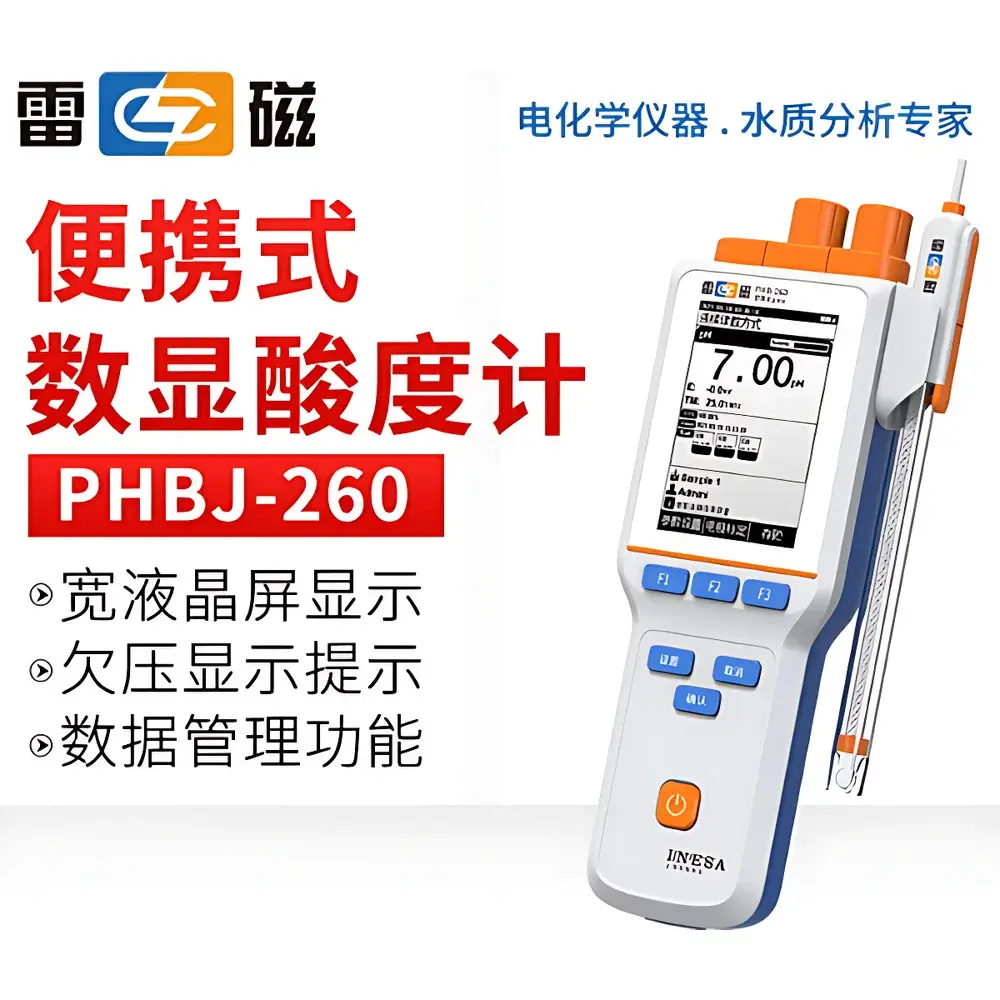
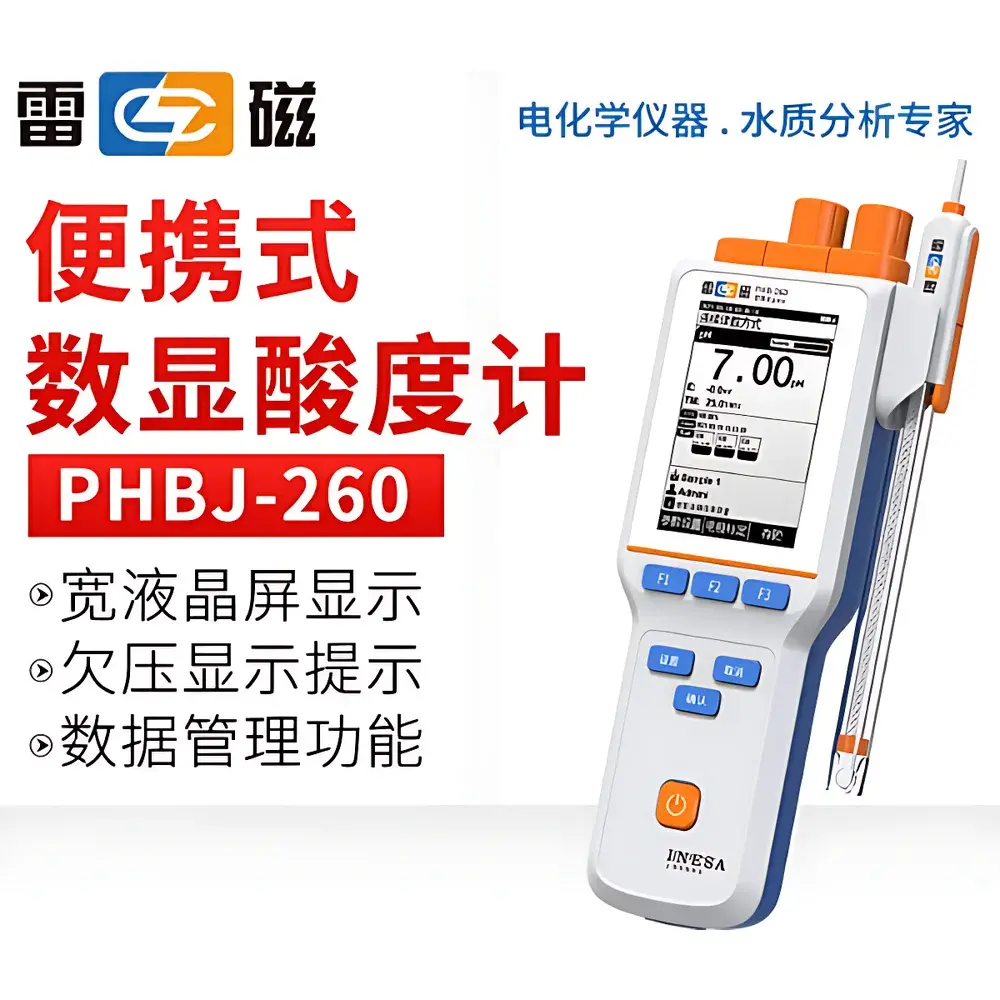
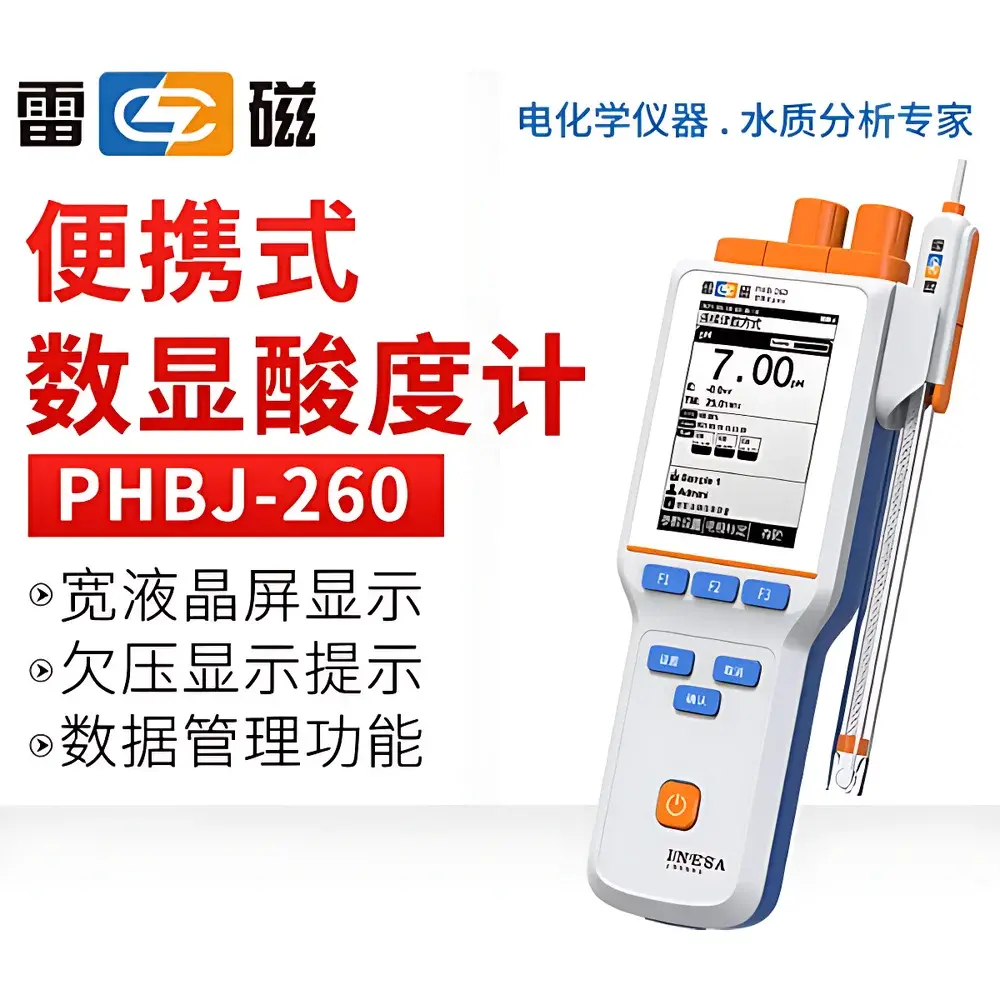
Leici PHBJ-260 Portable pH Meter
| Brand | Leici |
|---|---|
| Origin | Shanghai, China |
| Manufacturer Type | Authorized Distributor |
| Product Origin | Domestic (China) |
| Model | PHBJ-260 |
| Instrument Type | Portable |
| Parameter Type | Single-Parameter (pH only) |
| Measurement Range | −2.00 to 20.00 pH |
| Resolution | 0.01 pH |
| Accuracy | ±0.01 pH |
| Calibration Standards | NIST-traceable Chinese national buffer solutions (pH 4.01, 6.86, 7.00, 9.18, 10.01) |
| Temperature Compensation | Automatic and Manual |
| Display | Backlit LCD (adjustable blue backlight) |
| Data Storage | Internal memory for calibration records and measurement logs |
| Connectivity | RS-232 serial interface (compatible with TP-16 printer and REX data acquisition software) |
| Protection Rating | IP65 |
| Power Supply | Battery-operated with low-battery indicator and auto-power-off function |
| Electrode Compatibility | Standard BNC connector |
Overview
The Leici PHBJ-260 Portable pH Meter is a field-deployable, single-parameter electrochemical instrument engineered for high-reproducibility pH measurements across diverse aqueous environments—from aggressive industrial process streams to ultra-low-conductivity samples such as pharmaceutical-grade water and steam-cycle condensates. Based on potentiometric measurement principles, the PHBJ-260 detects the hydrogen ion activity difference between a reference electrode and a glass-sensing electrode via the Nernst equation (E = E⁰ − (RT/F)·ln(10)·pH), delivering traceable results aligned with international metrological frameworks. Its compact, rugged housing and IP65-rated enclosure ensure reliable operation in humid, dusty, or splash-prone settings—including wastewater treatment plants, biopharmaceutical cleanrooms, university teaching labs, and food processing facilities where portable, on-site verification is required under ISO/IEC 17025 or ASTM D1293-compliant workflows.
Key Features
- High-resolution 0.01 pH display with user-adjustable blue-backlit LCD for optimal readability under variable ambient lighting conditions
- Automated calibration routines supporting one-point or two-point calibration using five pre-programmed NIST-traceable Chinese national standard buffers (pH 4.01, 6.86, 7.00, 9.18, and 10.01)
- Integrated temperature compensation system offering both automatic (via integrated ATC probe) and manual input modes to correct for thermal drift per ISO 7888 and USP
- Configurable isoelectric point adjustment to minimize liquid junction potential errors—critical for accurate pH determination in ultrapure water (conductivity < 1 µS/cm) and boiler feedwater systems
- Battery-powered operation with intelligent power management: low-voltage warning, programmable auto-shutdown (15–60 min), and extended operational life (>200 hours on alkaline batteries)
- Robust mechanical design certified to IP65 ingress protection—dust-tight and resistant to low-pressure water jets from any direction
Sample Compatibility & Compliance
The PHBJ-260 accommodates a broad spectrum of sample matrices, including municipal and industrial effluents, fermentation broths, buffer solutions, cleaning-in-place (CIP) rinsates, and high-purity water used in semiconductor fabrication or parenteral drug manufacturing. When paired with optional low-resistance, double-junction electrodes (e.g., Leici E-201-C or RE-211), it meets the performance criteria outlined in ASTM D5127 for ultrapure water pH measurement and complies with regulatory expectations for GLP/GMP documentation integrity. All calibration and measurement events are timestamped and stored internally, supporting audit readiness for FDA 21 CFR Part 11–aligned quality systems when used with REX software-enabled electronic records.
Software & Data Management
Equipped with an RS-232 serial port, the PHBJ-260 interfaces directly with the Leici REX Data Acquisition Software (Windows-compatible), enabling real-time data streaming, batch export to CSV/Excel formats, and secure archiving of calibration histories, measurement logs, and electrode diagnostics. The device also supports direct hardcopy output via the TP-16 thermal printer—facilitating immediate documentation during field inspections or routine QC checks. All exported datasets retain metadata including operator ID, location tag, temperature reading, calibration status, and electrode serial number—essential for traceability in regulated environments.
Applications
- Environmental monitoring: On-site pH verification of surface water, groundwater, and leachate per EPA Method 150.1
- Pharmaceutical water systems: Routine testing of purified water (PW) and water for injection (WFI) per USP and EU GMP Annex 1
- Chemical process control: Batch pH validation in fine chemical synthesis and catalyst regeneration loops
- Food safety laboratories: Rapid screening of acidified foods, dairy products, and beverage formulations per AOAC 973.41
- Educational use: Undergraduate analytical chemistry labs requiring stable, intuitive instrumentation for fundamental electrochemistry experiments
FAQ
What calibration standards are supported by the PHBJ-260?
The meter is preconfigured for five Chinese national standard buffer solutions traceable to NIST reference materials: pH 4.01, 6.86, 7.00, 9.18, and 10.01.
Can the PHBJ-260 measure pH in ultrapure water?
Yes—when used with a dedicated low-conductivity electrode and isoelectric point optimization, it delivers stable readings in water with conductivity below 0.1 µS/cm.
Is the instrument compliant with FDA 21 CFR Part 11 requirements?
While the standalone meter does not provide electronic signature capability, its integration with REX software enables audit-trail generation, user access controls, and immutable record storage—supporting Part 11 compliance in validated laboratory systems.
Does the PHBJ-260 support automatic temperature compensation?
Yes—it includes an integrated ATC sensor input and allows manual temperature entry when external probes are unavailable.
What is the battery life and replacement procedure?
Using four AA alkaline cells, typical operation exceeds 200 hours; batteries are field-replaceable without tools and monitored continuously for voltage decay.





