
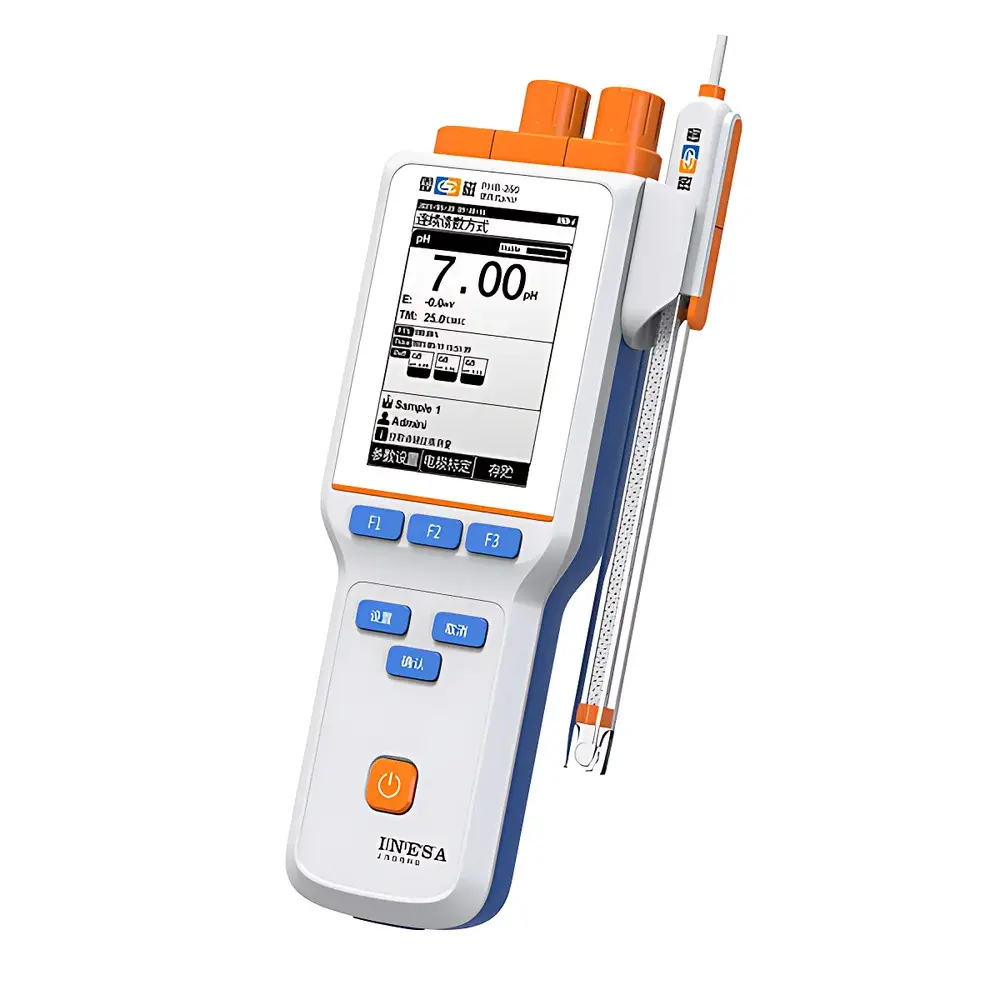
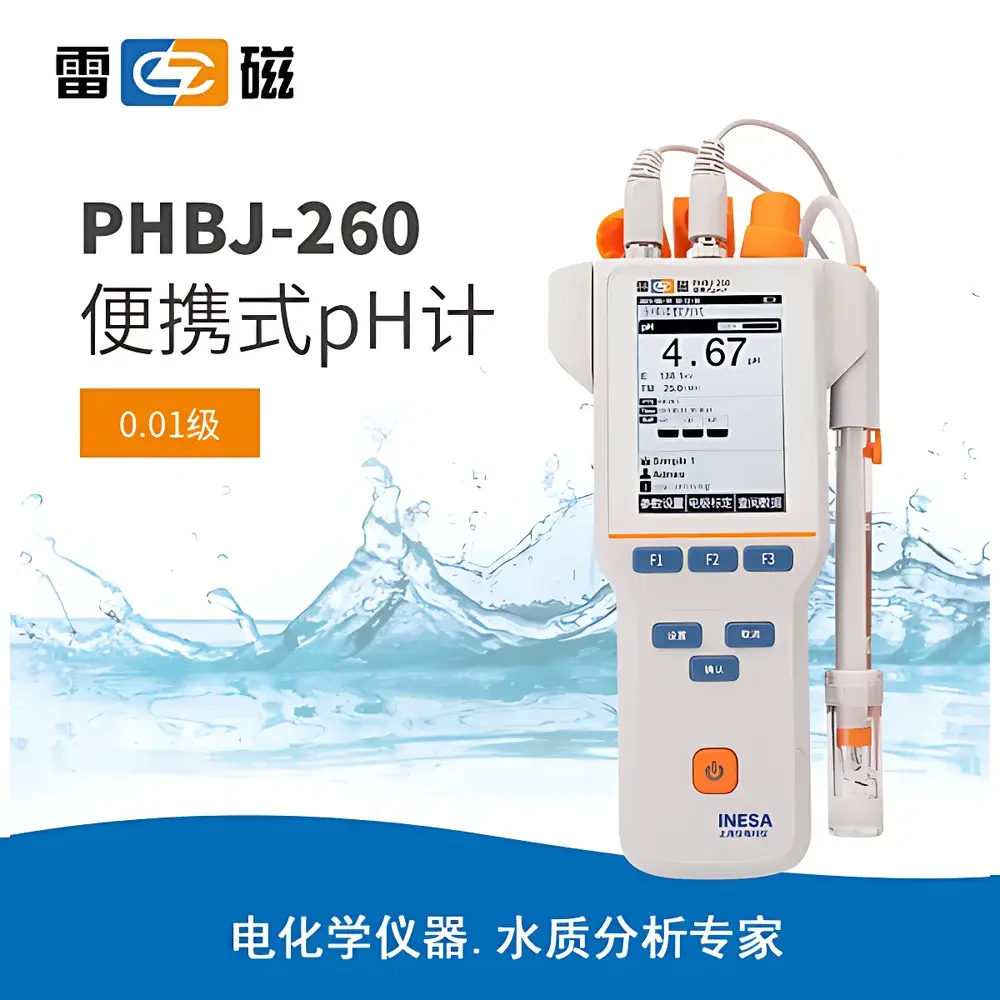
Leici PHBJ-260 Portable pH Meter
| Brand | Leici |
|---|---|
| Origin | Shanghai, China |
| Manufacturer Type | Direct Manufacturer |
| Regional Origin | Domestic (China) |
| Model | PHBJ-260 |
| Instrument Type | Portable |
| Parameter Types | Multi-parameter (pH, mV, Temperature) |
| pH Resolution | 0.01 pH |
| pH Range | –2.00 to 20.00 pH |
| Accuracy | ±0.01 pH |
| mV Range | –2000.0 to 2000.0 mV |
| mV Resolution | 0.1 mV |
| mV Accuracy | ±0.1% FS or ±0.3 mV |
| Temperature Range | –5.0 to 110.0 °C (23.0 to 230.0 °F) |
| Temp. Resolution | 0.1 °C/°F |
| Temp. Accuracy | ±0.2 °C |
| Calibration Standards | GB, DIN, NIST |
| Calibration Points | 1–5-point pH calibration |
| Data Storage Capacity | 500 datasets |
| Protection Rating | IP65 |
| Power Supply | Rechargeable Li-ion battery (DC5V input via AC adapter, USB-compatible charging) |
| Dimensions | 80 × 255 × 35 mm |
| Weight | 0.4 kg |
Overview
The Leici PHBJ-260 Portable pH Meter is a high-precision, field-deployable electrochemical instrument engineered for reliable pH, mV, and temperature measurements in diverse environmental, industrial, and educational settings. Built upon a potentiometric measurement principle, it determines hydrogen ion activity in aqueous solutions using a glass membrane pH electrode and reference junction system. Its extended pH range of –2.00 to 20.00 enables accurate analysis of highly acidic or alkaline samples—such as industrial cleaning agents, electroplating baths, or wastewater effluents—where conventional meters may fail. With 0.01 pH resolution and ±0.01 pH accuracy at 25 °C, the PHBJ-260 meets the performance criteria of Class 0.01 pH instruments per Chinese national standard JJG 119–2018 and aligns with international metrological expectations for portable electrochemical analyzers used in routine QC and field monitoring.
Key Features
- High-contrast LCD display with adjustable backlight for optimal readability under variable lighting conditions—including outdoor daylight and low-light laboratory environments.
- Selectable resolution modes: pH (0.01 or 0.1), mV (0.1 or 1), and temperature (0.1 °C/°F), allowing users to balance precision with operational efficiency.
- Intelligent endpoint detection with multiple reading modes: auto-read, timed-read, interval-read, and manual-hold—ensuring consistent data capture across heterogeneous sample matrices.
- Auto-recognition of three internationally standardized buffer groups (GB, DIN, NIST), supporting both preconfigured and user-defined calibration protocols with full traceability of buffer lot numbers, dates, and calibration history.
- IP65-rated enclosure providing dust-tight protection and resistance to low-pressure water jets—suitable for use in humid laboratories, outdoor sampling sites, and production floor environments.
- Integrated lithium-ion power system with real-time battery status feedback, low-voltage warning, and dual charging options: via PC USB port or external 5 V DC adapter—enabling uninterrupted operation during extended field campaigns.
- Comprehensive data management architecture including on-device storage of up to 500 complete measurement records, each timestamped and associated with calibration metadata and temperature compensation values.
Sample Compatibility & Compliance
The PHBJ-260 is optimized for aqueous and mildly conductive liquid samples, including process water, soil extracts, food slurries, pharmaceutical buffers, and environmental surface waters. It accommodates standard 12 mm diameter combination pH electrodes (included) with integrated temperature sensors, ensuring simultaneous pH and temperature acquisition without manual correction. The instrument complies with Good Laboratory Practice (GLP) requirements through mandatory data logging features: unique dataset identifiers, operator ID fields (via optional configuration), audit-trail-capable calibration logs, and immutable timestamps. While not certified to FDA 21 CFR Part 11 out-of-the-box, its structured data export format (CSV via USB) supports integration into validated LIMS or ELN systems where electronic signature and change control are implemented at the enterprise level.
Software & Data Management
Data transfer is supported via standard USB interface using Leici’s proprietary communication software (Windows-compatible), enabling bidirectional synchronization of calibration parameters, firmware updates, and batch export of measurement archives. Exported files contain ISO 8601-formatted timestamps, electrode serial numbers, calibration slopes/offsets, and raw sensor outputs—facilitating retrospective verification and regulatory reporting. On-device data review includes tabular and graphical (time-series curve) visualization modes, with support for selective deletion and password-protected archive locking. Printer output via RS-232 interface adheres to ANSI/ISO character encoding standards and allows configurable formatting (e.g., header inclusion, units, calibration status flag).
Applications
- Environmental field testing: pH profiling of rivers, lakes, and groundwater wells; compliance monitoring per EPA Method 150.1 and ISO 10523.
- Quality control in food & beverage production: verification of rinse water neutrality, acid wash validation, and brine solution consistency.
- Educational laboratories: teaching core electrochemical concepts including Nernst equation derivation, electrode response kinetics, and temperature compensation theory.
- Pharmaceutical water systems: periodic checks of purified water (PW) and water for injection (WFI) distribution loops per USP and EU GMP Annex 1.
- Industrial maintenance: corrosion inhibitor efficacy assessment in cooling towers and boiler feedwater systems.
FAQ
Does the PHBJ-260 support automatic temperature compensation (ATC)?
Yes—it accepts input from the integrated temperature sensor in the supplied triple-junction pH electrode and applies Nernstian correction across the full operating range of –5.0 to 110.0 °C.
Can calibration data be exported for audit purposes?
All calibration events—including date/time, buffer IDs, slope, offset, and asymmetry potential—are stored internally and exportable as part of the full dataset CSV file.
Is the instrument compatible with non-Leici electrodes?
It supports any BNC-input pH/mV electrode with standard reference potential (Ag/AgCl, 3 M KCl), though optimal ATC performance requires a built-in thermistor matching the meter’s resistance-temperature algorithm.
What is the expected battery life under typical usage?
With backlight disabled and average measurement frequency (one reading every 2 minutes), the rechargeable Li-ion battery delivers ≥12 hours of continuous operation.
Does the device meet international electrical safety standards?
It conforms to IEC 61010-1:2010 for electrical safety in laboratory equipment and carries CE marking for EMC and low-voltage directive compliance (as supplied by authorized EU distributors).
Related Products






