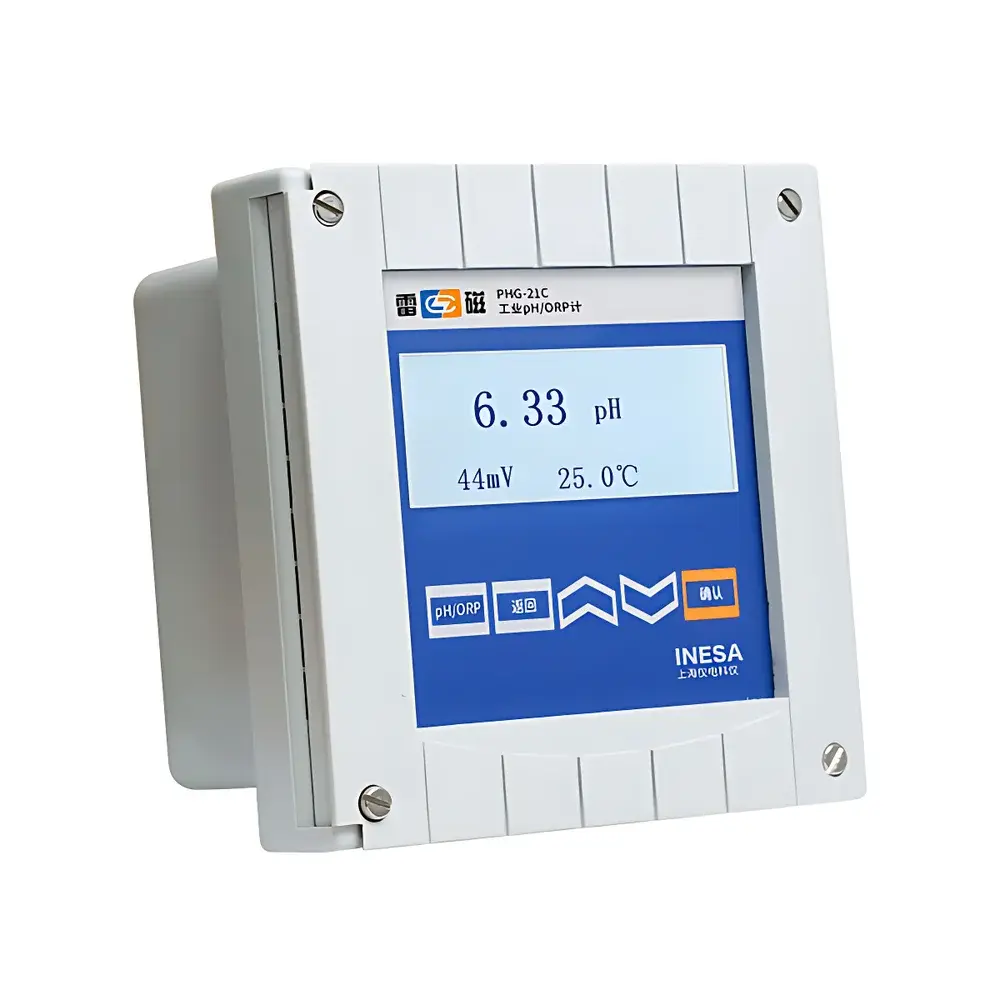
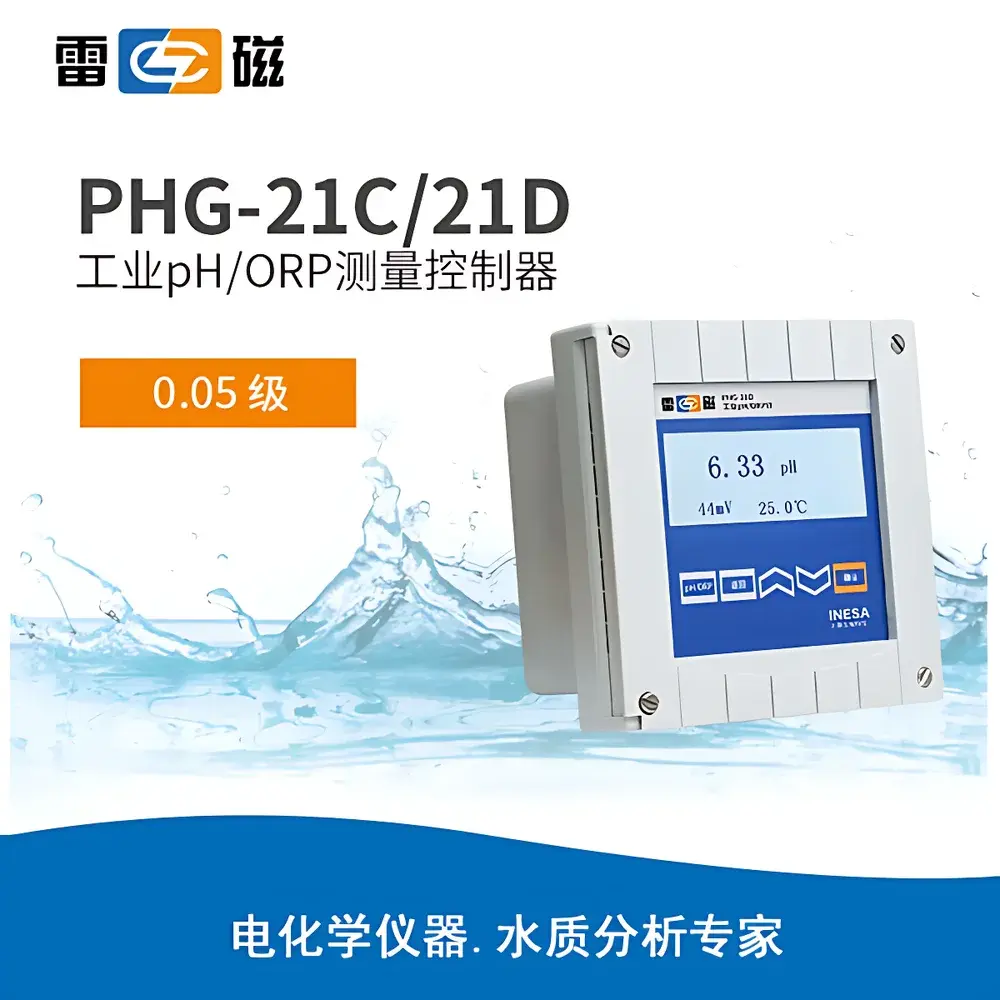
Leici PHG-21C / PHG-21D Industrial pH/ORP Transmitter and Controller
| Brand | Leici |
|---|---|
| Origin | Shanghai, China |
| Manufacturer Type | Direct Manufacturer |
| Country of Origin | China |
| Model | PHG-21C, PHG-21D |
| Price | ¥2600 |
| pH Range | (0.00–14.00) pH |
| ORP Range | (−1800–+1800) mV |
| Temperature Range | (−10.0–120.0) °C |
| Resolution | 0.01 pH / 1 mV / 0.1 °C |
| Accuracy | ±0.05 pH / ±10 mV / ±1 °C |
| Repeatability | ≤0.02 pH / 3 mV |
| Electronic Unit Error | ±0.03 pH ±1 digit / ±1 mV ±1 digit / ±0.3 °C |
| Stability | ≤±0.02 pH/24 h |
| Input Impedance | ≥1×10¹² Ω |
| Input Current | ≤2×10⁻¹² A |
| Enclosure Rating | IP65 |
| Power Supply | AC (220±22) V, (50±1) Hz or DC 24 V |
| Dimensions | 144×144×163 mm |
| Weight | 2.5 kg |
Overview
The Leici PHG-21C and PHG-21D are industrial-grade, panel-mount pH/ORP transmitters engineered for continuous, real-time monitoring and control in demanding process environments. Designed around a dual-channel analog measurement architecture, these instruments perform simultaneous high-impedance potentiometric measurement of hydrogen ion activity (pH) and redox potential (ORP), with integrated Pt100 or thermistor-based temperature sensing for automatic temperature compensation (ATC). The core measurement principle adheres to the Nernst equation, where electrode potential is converted into calibrated digital values via precision low-noise amplification, 24-bit ADC conversion, and linearization algorithms optimized for aqueous electrolyte systems. Unlike laboratory benchtop meters, the PHG-21 series features hardened signal conditioning circuitry, galvanically isolated current outputs, and robust enclosure design—making it suitable for deployment in chemical processing lines, boiler feedwater circuits, wastewater treatment basins, pharmaceutical clean utilities, and power plant condensate monitoring loops.
Key Features
- Intuitive Chinese-language graphical LCD with backlighting—optimized for visibility under low-light or high-glare industrial conditions
- Dual-mode operation: seamless toggle between pH and ORP display without recalibration or hardware reconfiguration
- Auto-buffer recognition for standard calibration points at pH 4.00, 6.86, and 9.18—supporting both single-point and two-point calibration routines per IUPAC-recommended protocols
- Programmable high/low limit alarms with relay dry-contact outputs (SPDT) and configurable hysteresis to prevent chatter in noisy process streams
- Galvanically isolated 4–20 mA analog output with fully adjustable span (e.g., 0–14 pH mapped to 4–20 mA) and zero offset—compliant with ISA-50.00.01 analog signaling standards
- IP65-rated polycarbonate enclosure—dust-tight and protected against water jets from any direction, enabling wall or panel mounting in non-hazardous classified areas
- Power flexibility: supports either 220 V AC (±10%) / 50 Hz or 24 V DC input—facilitating integration into both mains-powered control rooms and intrinsically safe DC distribution systems
Sample Compatibility & Compliance
The PHG-21C and PHG-21D are intended exclusively for aqueous-phase measurements in conductive solutions (typically >20 µS/cm). They are compatible with all industry-standard combination pH electrodes (e.g., glass membrane + Ag/AgCl reference) and ORP electrodes featuring platinum or gold sensing elements. The instruments meet electromagnetic compatibility (EMC) requirements per GB/T 18268.1–2010 (equivalent to IEC 61326-1:2012) and safety specifications per GB 4793.1–2007 (IEC 61010-1:2010). While not certified for SIL or ATEX use, their architecture supports integration into larger safety instrumented systems (SIS) when deployed with appropriate barrier modules and documented validation protocols. Calibration traceability aligns with ISO/IEC 17025 practices when performed using NIST-traceable buffer standards and documented logbooks.
Software & Data Management
These are standalone analog transmitters with no embedded firmware update capability or USB/Ethernet connectivity. All configuration—including calibration constants, alarm thresholds, output scaling, and temperature sensor type—is performed locally via membrane keypad navigation. The device maintains non-volatile memory for calibration data and system settings, ensuring retention during power interruption (built-in EEPROM backup). While lacking native digital communication (e.g., Modbus RTU or HART), optional external gateways can interface the 4–20 mA output with DCS/SCADA platforms for trend logging and alarm aggregation. Audit trail functionality is achieved through manual calibration logs and external historian systems that record timestamped analog output values—supporting GLP-aligned documentation when paired with validated data acquisition software.
Applications
- Chemical manufacturing: pH control in neutralization reactors, scrubber effluent monitoring, and catalyst bath stability verification
- Power generation: condensate polishing loop pH supervision, feedwater alkalinity control, and hydrazine residual tracking
- Pharmaceutical water systems: purified water (PW) and water for injection (WFI) conductivity-coupled pH trending per USP and EU Annex 1
- Municipal and industrial wastewater: activated sludge basin ORP profiling for denitrification control, and final effluent pH compliance reporting per EPA 40 CFR Part 136
- Metallurgical leaching circuits: real-time acid concentration monitoring in heap leach pads and solvent extraction raffinate streams
FAQ
What is the difference between PHG-21C and PHG-21D?
The PHG-21C integrates a built-in preamplifier board and accepts pH/ORP electrodes directly—ideal for installations where the sensor is mounted within 1–3 meters of the transmitter. The PHG-21D omits the internal preamp and requires an external transmitter (e.g., PHGF-27B, PHGF-28B, or PHGF-43) with remote preamplification—used when electrode cable runs exceed 10 meters or when intrinsic safety barriers are needed.
Does this instrument support automatic temperature compensation?
Yes—ATC is implemented using either Pt100 RTD or NTC thermistor inputs. The compensation algorithm applies the standard pH vs. temperature slope (−0.00301 pH/°C at 25°C) per ISO 7027 and is user-selectable between fixed and variable coefficient modes.
Can the 4–20 mA output be assigned to ORP instead of pH?
Yes—the output channel is fully configurable via menu navigation to represent either pH, ORP, or temperature as the primary process variable, with independent upper/lower range values.
Is calibration data retained after power loss?
Yes—calibration coefficients, alarm setpoints, and output scaling parameters are stored in write-protected EEPROM and persist across power cycles and battery-free operation.
Related Products