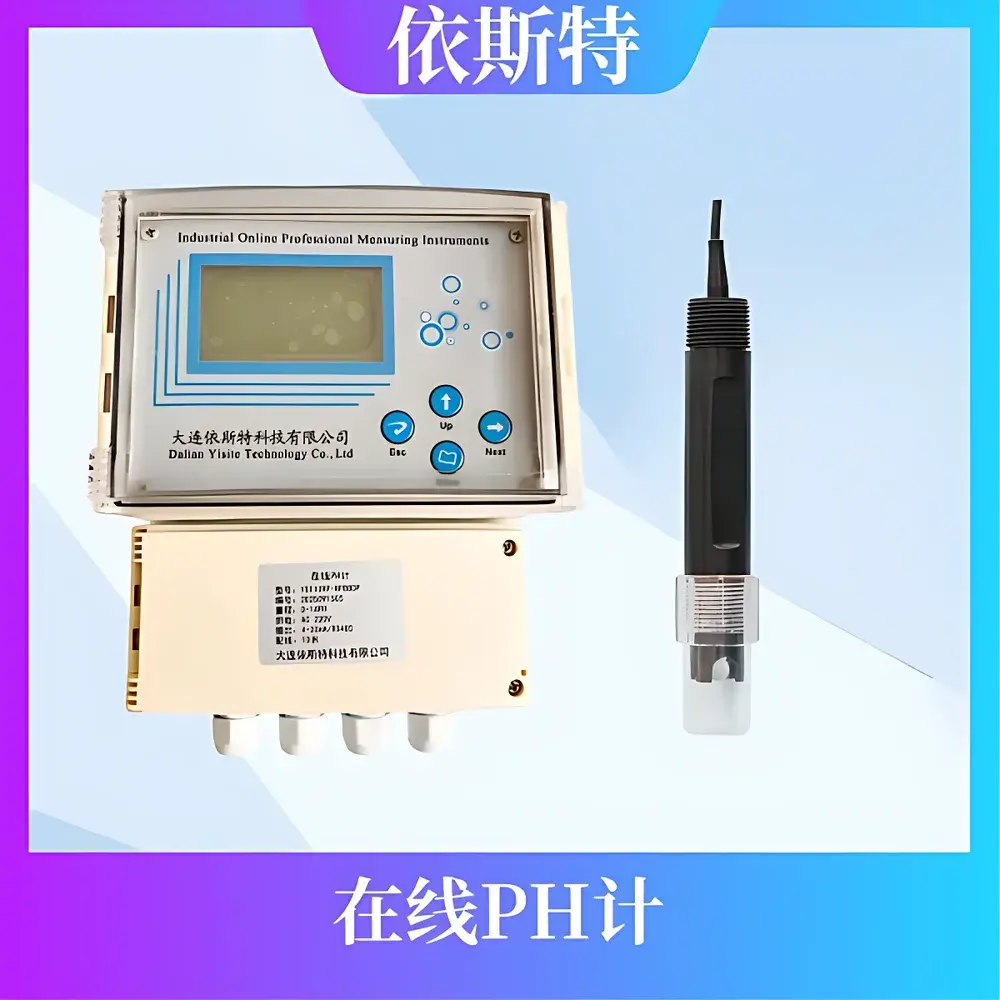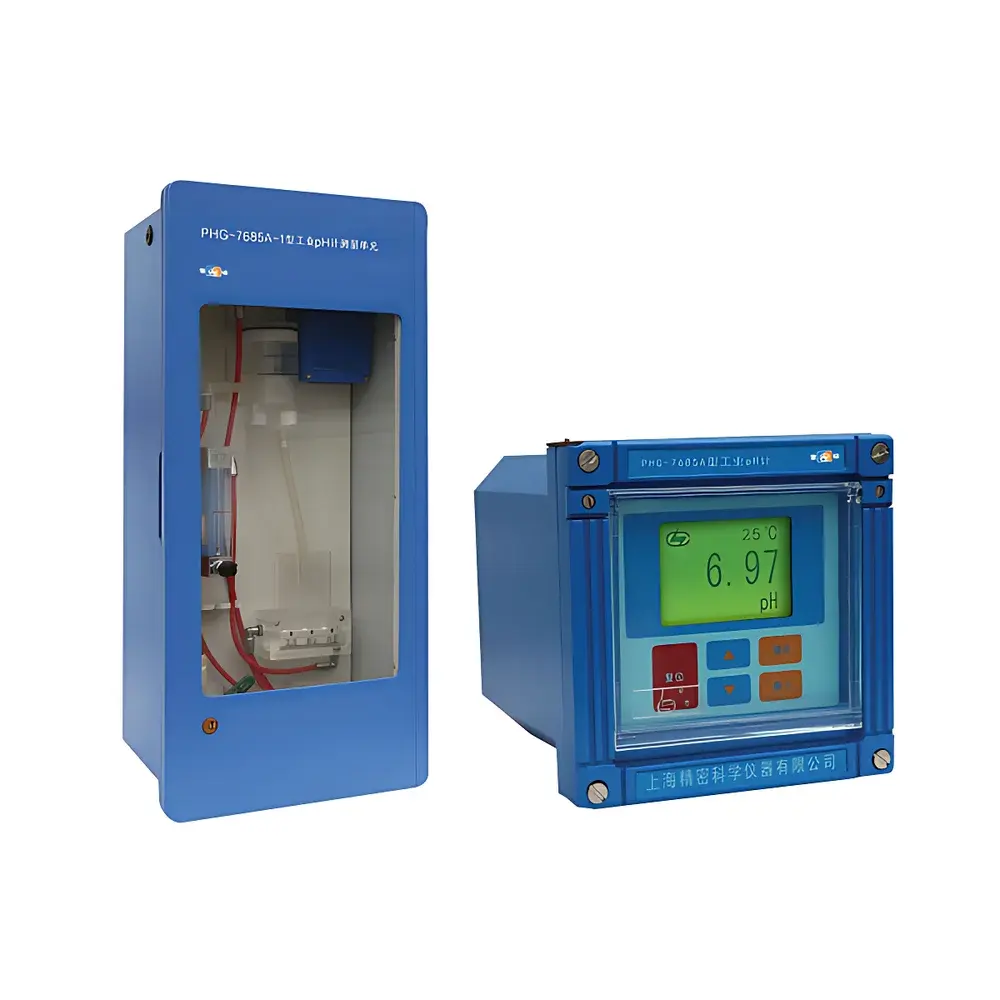
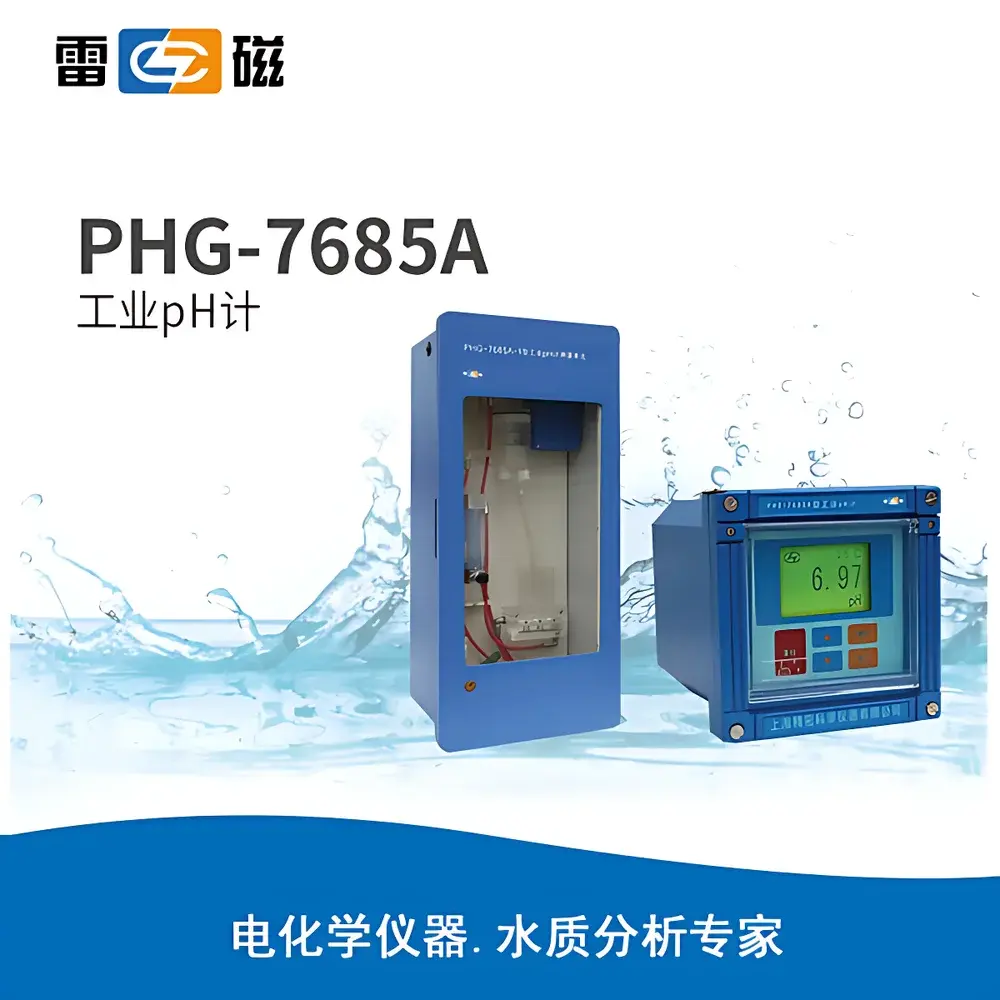
Leici PHG-7685A Online pH Meter for Ultra-Pure Water Applications
| Brand | Leici |
|---|---|
| Origin | Shanghai, China |
| Manufacturer Type | Direct Manufacturer |
| Country of Origin | China |
| Model | PHG-7685A |
| Price Range | USD 1,400 – 4,200 (FOB) |
| Measurement Range | (0.00–14.00) pH |
| Resolution | 0.01 pH |
| Accuracy | ±0.05 pH ±1 digit |
| Dimensions | 628 × 288 × 224 mm |
| Weight | 10 kg |
| Temperature Range | −10.0 to 120.0 °C |
| Temp. Resolution | 0.1 °C |
| Temp. Accuracy | ±0.5 °C (0.0–60.0 °C), ±1.0 °C (other) |
| Repeatability | 0.02 pH |
| Electronic Unit Accuracy | ±0.03 pH ±1 digit |
| Drift Stability | ≤±0.02 pH / 24 h |
| Input Impedance | ≥1 × 10¹² Ω |
| Input Current | ≤2 × 10⁻¹² A |
| Enclosure Rating | IP65 |
| Power Supply | AC (220 ± 22) V, (50 ± 0.5) Hz |
| Output | Isolated 4–20 mA DC (configurable pH span), RS-232 or RS-485 (user-selectable) |
Overview
The Leici PHG-7685A is a high-stability, industrial-grade online pH meter engineered specifically for continuous monitoring of ultra-pure water systems where low conductivity (<10 µS/cm) introduces significant measurement challenges. Unlike general-purpose pH analyzers, the PHG-7685A employs a dual-mode electrode compensation architecture—supporting both pure water and ammonia-containing water configurations—to correct for liquid junction potential drift and asymmetric reference electrode behavior under low-ionic-strength conditions. Its measurement principle relies on potentiometric detection via high-impedance differential amplification (input impedance ≥1 × 10¹² Ω), enabling reliable signal acquisition from glass electrodes even in sub-µS/cm environments such as boiler feedwater, condensate, saturated steam, and nuclear primary coolant loops. Designed for integration into distributed control systems (DCS) and programmable logic controllers (PLC), the instrument meets the long-term stability and traceability requirements of power generation, semiconductor ultrapure water (UPW) distribution, and pharmaceutical purified water (PW) systems compliant with USP <1231>, EP 2.2.3, and ASTM D1129.
Key Features
- Ultra-low-conductivity optimization: Configurable pure water and ammoniated water modes automatically adjust reference potential offset and temperature compensation algorithms per IAPWS guidelines for steam-water cycles.
- High-precision analog electronics: Electronic unit accuracy of ±0.03 pH ±1 digit with ≤0.02 pH/24 h drift ensures compliance with GLP data integrity expectations for critical process validation.
- Dual calibration flexibility: Supports both static (single-point, two-point) and dynamic (flow-through) calibration protocols—essential for maintaining accuracy during continuous operation in high-purity loops.
- Robust industrial interface: Isolated 4–20 mA output with user-defined pH span (e.g., 4 mA = 5.00 pH, 20 mA = 7.00 pH); RS-232 or RS-485 Modbus RTU communication (field-selectable) for SCADA integration.
- Environmental resilience: IP65-rated NEMA 4X-equivalent enclosure withstands washdown, humidity, and ambient temperature fluctuations from −10 °C to 50 °C operating range.
- Operational safeguards: Programmable high/low pH alarms with latching relay outputs; power-fail memory retention preserves calibration coefficients and configuration settings for >72 hours without backup power.
Sample Compatibility & Compliance
The PHG-7685A is validated for use with standard pH glass electrodes (e.g., Leici E-201-C, Thornton 9500 series) and refillable double-junction reference electrodes optimized for low-conductivity media. It complies with electromagnetic compatibility (EMC) per IEC 61326-1:2020 (industrial environment), safety per IEC 61010-1:2010, and is suitable for installation in Zone 2 hazardous locations when paired with approved intrinsically safe barriers. While not certified for SIL applications, its design supports failure mode and effects analysis (FMEA) documentation required for ISO 9001 and ASME BPE-2023-compliant water system qualification. Calibration traceability aligns with NIST-traceable pH buffer standards (DIN 19266, ISO 3696 Class 1).
Software & Data Management
The PHG-7685A operates autonomously without embedded firmware-based data logging; instead, it delivers real-time analog and digital outputs for centralized acquisition via third-party historian platforms (e.g., Siemens Desigo CC, Emerson DeltaV, or OSIsoft PI System). All configuration parameters—including calibration history timestamps, temperature compensation coefficients, and alarm setpoints—are accessible and modifiable via ASCII command protocol over serial interface. The device supports audit trail-ready operations when integrated with FDA 21 CFR Part 11-compliant DCS environments that enforce electronic signature, change control, and event logging at the system level.
Applications
- Thermal power plants: Continuous monitoring of deaerator outlet, economizer inlet, and turbine condensate return lines.
- Nuclear facilities: pH surveillance in reactor primary coolant purification systems and spent fuel pool makeup water.
- Semiconductor fabs: Real-time control of UPW polishing loop resistivity and amine dosing feedback.
- Pharmaceutical manufacturing: PW and WFI loop monitoring per EU GMP Annex 1 and WHO TRS 970 requirements.
- Desalination and zero-liquid-discharge (ZLD) plants: Feedwater pH stabilization prior to reverse osmosis membrane arrays.
FAQ
What electrode types are recommended for use with the PHG-7685A in ultra-pure water applications?
Use double-junction, low-resistance reference electrodes with KCl gel or polymer electrolyte (e.g., Leici E-201F or Hamilton Arc 222) to minimize junction clogging and diffusion potential errors.
Does the PHG-7685A support automatic temperature compensation (ATC) across its full operating range?
Yes—integrated Pt1000 RTD input enables ATC from −10.0 to 120.0 °C with accuracy ±0.5 °C (0–60 °C) and ±1.0 °C elsewhere.
Can the 4–20 mA output be scaled to non-linear pH ranges (e.g., 6.8–7.2)?
No—the analog output is linear within user-defined min/max pH limits; nonlinear scaling requires external PLC or DCS interpolation.
Is firmware upgrade capability available via serial interface?
No—firmware is factory-programmed and immutable; functional updates require hardware revision per Leici’s product lifecycle policy.
What is the maximum allowable cable length between the transmitter and pH sensor?
For optimal noise immunity, limit shielded twisted-pair cable to ≤15 m; beyond this, install a local signal conditioner or use a pH transmitter with built-in preamplifier.