
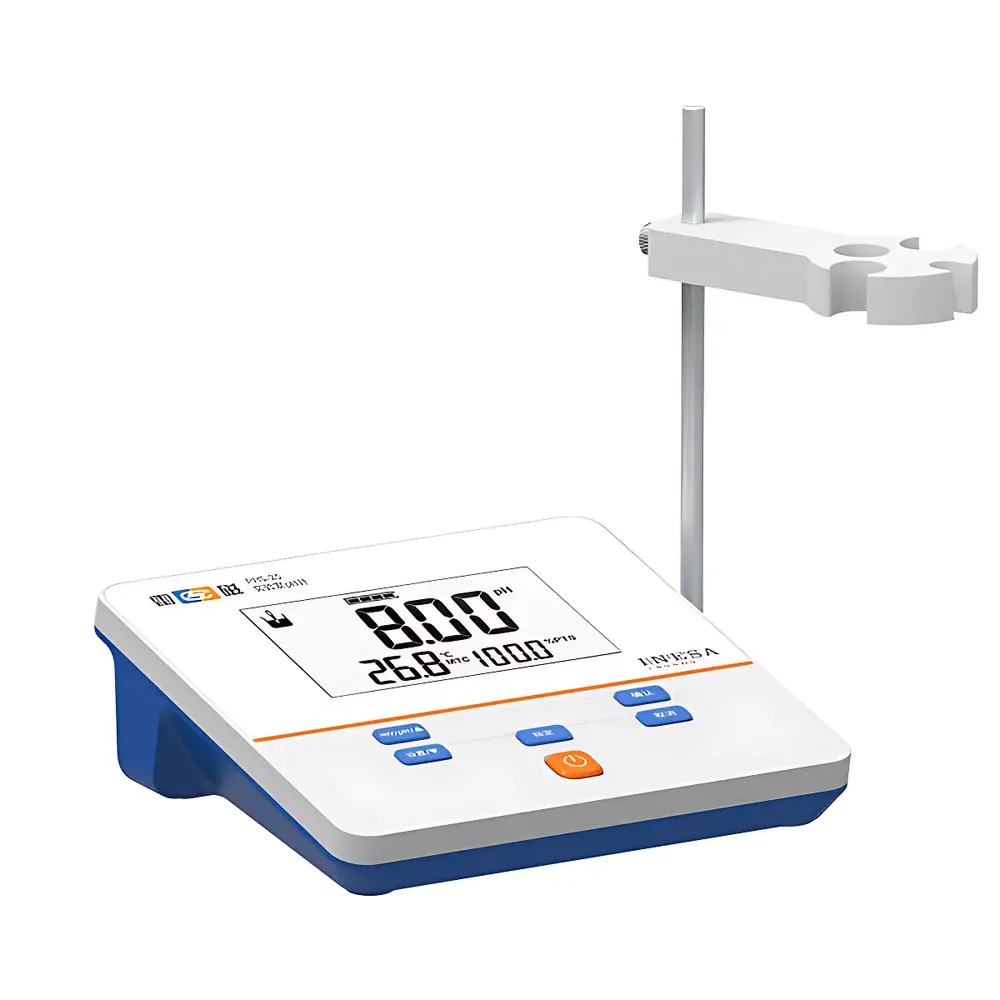
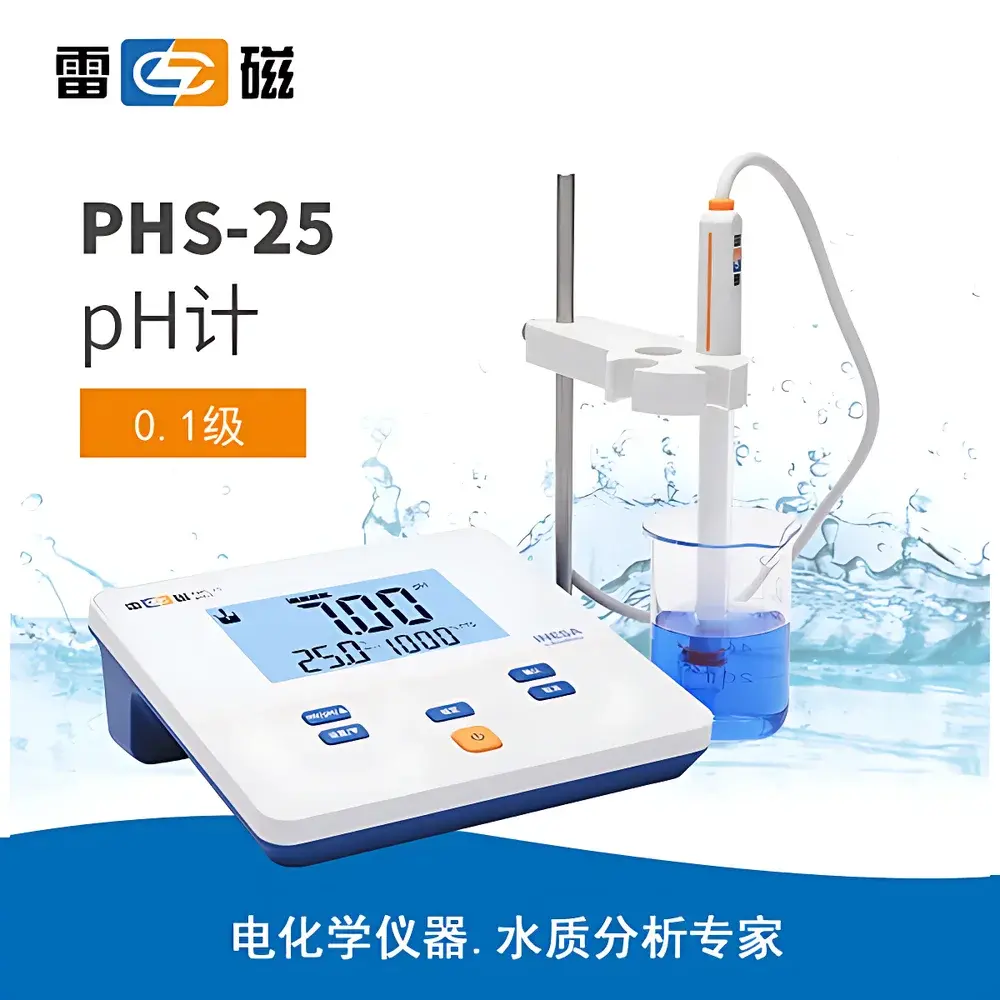
Leici PHS-25 Benchtop pH Meter
| Brand | Leici |
|---|---|
| Origin | Shanghai, China |
| Manufacturer Type | Original Equipment Manufacturer (OEM) |
| Product Origin | Domestic (China) |
| Model | PHS-25 |
| Price Range | USD 70–140 |
| Instrument Type | Benchtop |
| Parameter Types | Dual (pH and mV) |
| pH Accuracy | ±0.05 pH |
| pH Range | 0.00–14.00 pH |
| pH Resolution | 0.01 pH |
| mV Range | −1400 to +1400 mV |
| mV Resolution | 1 mV |
| mV Accuracy | ±1% FS |
| Temperature Compensation | Manual |
| Calibration Buffers | GB Standard Solutions at pH 4.00, 6.86, and 9.18 |
| Calibration Points | 1–2 point |
| Display | LCD with stability indicator |
| Enclosure Rating | IP54 |
| Power Supply | AC 100–240 V input, DC 20 V / 1500 mA output |
| Dimensions (L×W×H) | 200 × 160 × 63 mm |
| Weight | 0.6 kg |
Overview
The Leici PHS-25 is a benchtop dual-parameter electrochemical analyzer engineered for routine pH and millivolt (mV) measurements in academic laboratories, quality control environments, and industrial process support settings. It operates on the principle of potentiometric measurement: a glass pH electrode generates a voltage proportional to hydrogen ion activity in solution, referenced against a stable Ag/AgCl internal reference system. The instrument’s analog-to-digital conversion circuitry digitizes this potential difference, applies temperature-compensated Nernst equation correction, and displays calibrated pH or raw mV values with traceable resolution. Designed to meet national metrological verification requirements per JJG 119–2018 (Chinese Verification Regulation for pH Meters), the PHS-25 complies with general-purpose laboratory performance expectations for Class 0.1 instruments under ISO 7027 and ASTM D1293. Its architecture prioritizes operational robustness over advanced connectivity, making it suitable for environments where reliability, ease of calibration, and low maintenance are primary requirements.
Key Features
- Benchtop form factor with compact footprint (200 × 160 × 63 mm) and lightweight chassis (0.6 kg), optimized for shared lab benches and mobile QC stations.
- High-contrast monochrome LCD display featuring real-time stability indication—flashing “✓” icon confirms signal convergence within ±0.01 pH over 3 seconds.
- Integrated dual-parameter functionality: simultaneous pH and mV readout with independent range selection and unit toggling.
- IP54-rated enclosure provides protection against dust ingress and water splashes from any direction, supporting use in humid or non-sterile wet labs.
- Intelligent buffer recognition algorithm automatically detects and labels GB-standard calibration solutions (pH 4.00, 6.86, 9.18) via measured slope and offset; also supports user-defined buffer entry for non-standard media.
- Configurable power management: auto-off after 10 minutes of inactivity, EEPROM-backed parameter retention during power loss, and factory reset option accessible via key sequence.
- Built-in electrode diagnostics: continuous monitoring of asymmetry potential and slope deviation during calibration; alerts if slope falls outside 90–105% of theoretical (−59.16 mV/pH at 25 °C).
Sample Compatibility & Compliance
The PHS-25 is validated for aqueous and mildly buffered samples with total dissolved solids (TDS) < 10,000 ppm and conductivity < 20 mS/cm. It accommodates standard BNC-compatible pH electrodes—including combination glass electrodes with integrated reference junctions—and accepts optional ORP probes for redox potential assessment. Calibration follows standardized protocols aligned with GB/T 20775–2006 (General Requirements for Electrochemical Analyzers) and supports documentation traceability for GLP-aligned workflows. While not certified to IEC 61326-1 (EMC) or ISO/IEC 17025 for accredited testing, its measurement uncertainty budget (±0.05 pH at 25 °C, k=2) meets typical acceptance criteria for in-process checks, environmental monitoring, and educational experiments.
Software & Data Management
The PHS-25 operates as a standalone instrument without proprietary software or PC interface. All configuration, calibration history, and measurement logging occur locally via front-panel controls. Calibration data—including date/time stamp, buffer IDs, measured mV values, calculated slope (%), and asymmetry potential—is retained in non-volatile memory for up to 50 sessions. No audit trail, electronic signature, or 21 CFR Part 11 compliance features are implemented; users requiring regulatory-grade data integrity must implement manual logbook procedures or integrate external recording systems.
Applications
- Academic teaching labs: Demonstrating acid-base titration endpoints, buffer capacity analysis, and temperature dependence of pH.
- Food & beverage QA: Monitoring pH stability during fermentation, pasteurization validation, and shelf-life studies.
- Water treatment facilities: Routine checks of influent/effluent pH in municipal and industrial wastewater streams.
- Pharmaceutical excipient testing: Verifying pH conformity of saline solutions, buffer stocks, and cleaning agent preparations.
- Agricultural soil extract analysis: Paired with extraction protocols (e.g., 1:2 soil:water suspension), supporting nutrient availability assessments.
FAQ
Does the PHS-25 support automatic temperature compensation (ATC)?
No—it requires manual temperature entry prior to measurement. An external Pt100 or thermistor probe is not supported.
Can the instrument store calibration data across power cycles?
Yes—calibration coefficients and session metadata persist in EEPROM memory without battery backup.
Is the supplied composite electrode compatible with non-aqueous solvents?
Not recommended. The standard gel-filled electrode is optimized for aqueous matrices; use specialized electrodes (e.g., double-junction, ethanol-tolerant) for organic media.
What is the maximum allowable sample temperature during measurement?
Electrode operation is rated to 60 °C; prolonged exposure above 50 °C may accelerate reference electrolyte depletion.
How often should the pH electrode be recalibrated?
Daily calibration is advised for critical applications; otherwise, verify before each analytical batch using at least one check standard (e.g., pH 7.00).



