
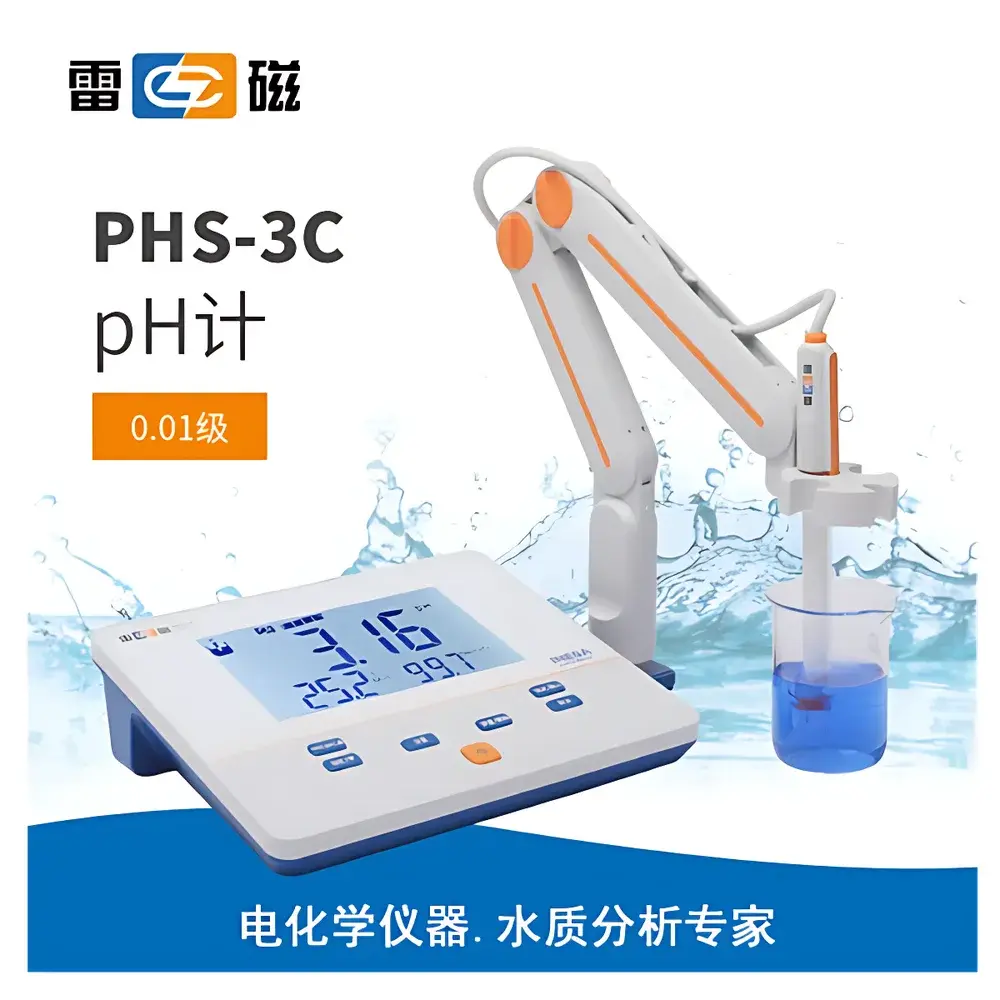
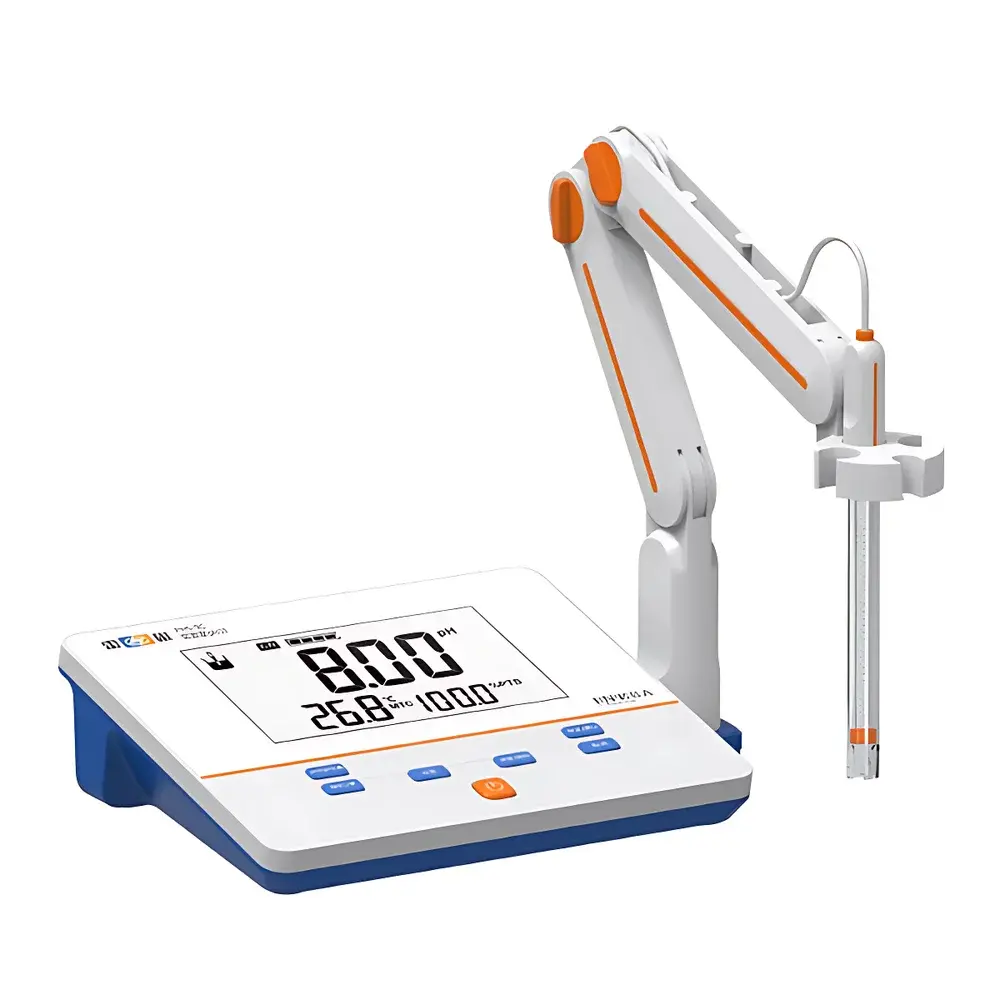
Leici PHS-3C Benchtop pH Meter
| Brand | Leici |
|---|---|
| Origin | Shanghai, China |
| Instrument Type | Benchtop |
| Measurement Mode | Multi-parameter |
| pH Range | –2.00 to 18.00 pH |
| Resolution | 0.01 pH |
| Accuracy | ±0.01 pH |
| Calibration Points | 1–3 point manual calibration |
| Buffer Recognition | Automatic identification of GB standard buffers (pH 4.00, 6.86, 9.18) |
| Temperature Compensation | Manual |
| Data Storage | 50 measurement sets |
| Display | High-definition LCD |
| Protection Rating | IP54 |
| Included Accessories | Composite pH electrode, electrode stand, dust cover, and powdered buffer kits |
| Power Management | Auto-off, power-loss data retention, factory reset |
Overview
The Leici PHS-3C is a precision benchtop pH meter engineered for routine laboratory and quality control applications requiring reliable, traceable, and reproducible pH measurements across aqueous and mildly aggressive chemical environments. Based on potentiometric measurement principles—specifically the Nernst equation—the instrument measures the electromotive force (EMF) generated between a glass pH sensing electrode and a stable reference electrode immersed in the sample solution. The resulting voltage is converted into a pH value using temperature-corrected calibration curves. Designed for compliance with fundamental electrochemical metrology practices, the PHS-3C supports manual temperature compensation and adheres to Chinese national standards (GB/T 20777–2006 and JJG 119–2018) for pH meter verification. Its extended measurement range (–2.00 to 18.00 pH) enables characterization of strongly acidic or alkaline process streams, electroplating baths, and cleaning formulations where conventional meters may saturate or drift.
Key Features
- High-contrast LCD display with intuitive key-based navigation for rapid parameter selection and real-time reading confirmation
- IP54-rated enclosure providing protection against dust ingress and incidental water splashes—suitable for shared lab benches and production QC areas
- Intelligent endpoint detection algorithm that stabilizes readings under variable ionic strength or low-conductivity conditions, supporting both equilibrium (stable-signal) and continuous (dynamic-monitoring) measurement modes
- Three-point calibration capability with automatic recognition of GB-certified buffer solutions (pH 4.00, 6.86, and 9.18), reducing operator error and ensuring alignment with domestic regulatory expectations
- Manual temperature compensation via numeric input (0–100 °C), compatible with standard Pt1000 or thermistor-based temperature probes (not included)
- Built-in data management system storing up to 50 complete measurement records—including pH value, temperature, date/time stamp, and calibration status—for audit-ready documentation
- Power integrity safeguards: auto-shutdown after 10 minutes of inactivity; non-volatile memory preserves calibration coefficients and stored data during unexpected power loss
Sample Compatibility & Compliance
The PHS-3C is validated for use with aqueous solutions, buffered standards, and low-viscosity industrial fluids (e.g., rinse waters, titration endpoints, fermentation broths). It is not intended for non-aqueous solvents, high-salinity brines (>5 mol/L NaCl), or viscous suspensions without dilution or specialized electrodes. While the instrument itself does not carry CE, UKCA, or FDA 510(k) certification, its operational logic and calibration traceability align with ISO/IEC 17025 requirements for testing laboratories performing pH as a supporting parameter. Users deploying the PHS-3C in GLP or GMP environments must establish documented procedures for electrode maintenance, calibration frequency (e.g., prior to each analytical batch), and verification using secondary standards—practices consistent with USP and EP 2.2.3 guidelines.
Software & Data Management
No external software or USB connectivity is integrated into the PHS-3C; data handling remains local and tactile. Each stored record includes pH reading, manually entered temperature, calibration date, and active buffer ID. Records can be reviewed sequentially or deleted individually via the front-panel interface. For laboratories requiring electronic data capture, users may manually transcribe values into LIMS or Excel-based templates—ensuring full human-readable audit trails. The absence of wireless transmission or cloud synchronization eliminates cybersecurity concerns while maintaining full control over raw measurement integrity—a design choice aligned with ICH GCP Annex 11 risk-based validation principles for low-complexity instruments.
Applications
- Environmental monitoring: Surface water, wastewater effluent, and soil extract pH profiling per HJ 1147–2020
- Pharmaceutical manufacturing: Final rinse water verification, excipient slurry pH checks, and stability study buffer preparation
- Food & beverage QA: Fermentation tank monitoring, acidulant titration endpoints, and shelf-life model formulation
- Academic teaching labs: Electrochemistry fundamentals, buffer capacity experiments, and calibration curve development
- Electroplating and metal finishing: Acid pickling bath control and passivation solution verification
FAQ
Does the PHS-3C support automatic temperature compensation (ATC)?
No—it requires manual temperature entry. An ATC probe is not supported by hardware design.
Can custom buffer values be programmed into the meter?
Yes—users may define up to three non-GB buffer pH values (e.g., pH 7.413 at 25 °C) for specialized calibration protocols.
Is the included composite electrode refillable or serviceable?
The standard supplied electrode features a gel-filled, maintenance-free reference system; no electrolyte refilling is required, but periodic cleaning and storage in 3 mol/L KCl solution are recommended.
What is the battery life under typical usage?
Using four AA alkaline cells, the unit operates for approximately 2,000 hours in standby mode and supports ~300 hours of active measurement time before replacement.
How frequently should calibration be performed?
Per ISO 5725-2, calibration should precede each measurement session or every 2 hours during continuous operation—whichever occurs first—to maintain stated ±0.01 pH accuracy.
Related Products





