
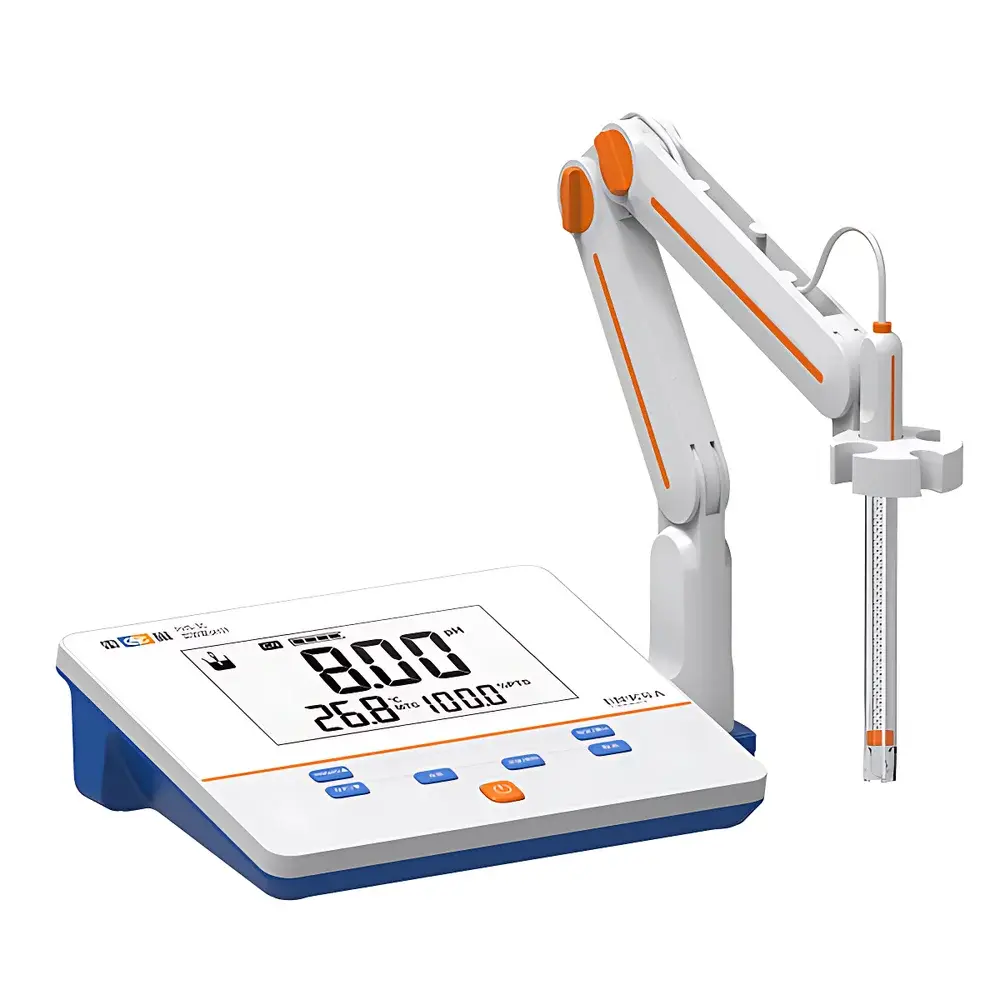
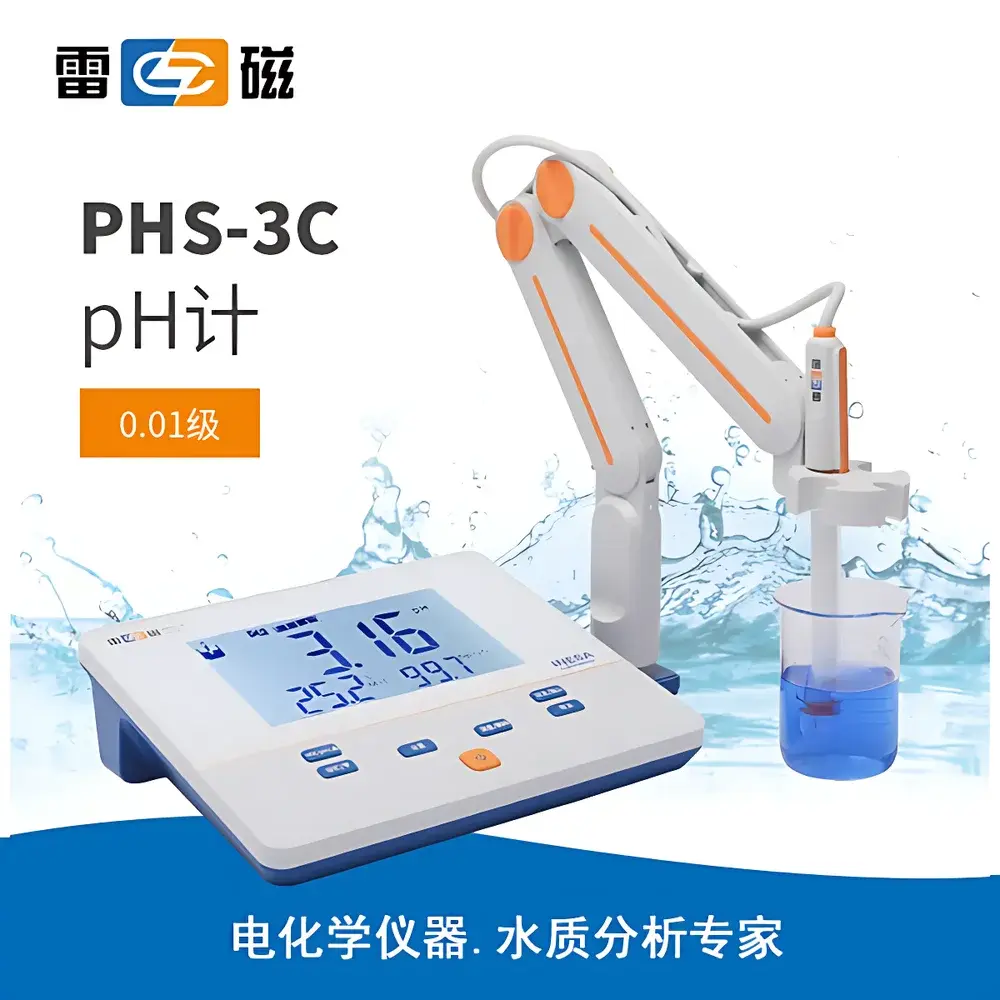
Leici PHS-3C Benchtop pH Meter
| Brand | Leici |
|---|---|
| Origin | Shanghai, China |
| Manufacturer Type | Manufacturer |
| Product Origin | Domestic (China) |
| Model | PHS-3C |
| Instrument Type | Benchtop |
| Parameter Type | Dual-parameter (pH/mV) |
| pH Accuracy | ±0.01 pH |
| pH Range | –2.00 to 18.00 pH |
| Resolution | 0.01 pH |
| mV Range | –1999 to +1999 mV |
| mV Resolution | 1 mV |
| mV Accuracy | ±0.1% FS |
| Temperature Compensation | Manual |
| Calibration Points | 1–3 point pH calibration |
| Buffer Recognition | Automatic identification of GB standard buffers (pH 4.00, 6.86, 9.18) |
| Data Storage | 50 measurement sets |
| Display | LCD with backlight |
| Protection Rating | IP54 |
| Power Supply | AC 100–240 V input, DC 20 V / 1500 mA output |
| Dimensions (W×D×H) | 242 × 195 × 68 mm |
| Weight | 0.9 kg |
Overview
The Leici PHS-3C is a precision benchtop pH/mV meter engineered for routine laboratory and quality control applications requiring reliable electrochemical measurement of aqueous solutions. Based on potentiometric principle, it measures the potential difference between a pH-sensitive glass electrode and a stable reference electrode, converting the resulting electromotive force (EMF) into pH or millivolt values using the Nernst equation. Designed to meet the performance requirements of ISO 8655-5, ASTM E70, and Chinese national standard GB/T 20777—2006 for pH meters, the PHS-3C delivers Class 0.01 accuracy per JJG 119–2018 verification regulation—making it suitable for academic teaching labs, pharmaceutical QC environments, environmental monitoring stations, and industrial process support where traceable, repeatable pH data are essential.
Key Features
- High-contrast backlit LCD display with intuitive key-based navigation and real-time status indicators
- Auto-endpoint detection algorithm that identifies stable readings in both equilibrium and continuous measurement modes
- Manual temperature compensation (MTC) with adjustable coefficient (0.0 to 10.0 %/°C), compatible with standard RTD or thermistor probes (not included)
- Three-point calibration capability with automatic recognition of GB-certified buffer solutions (pH 4.00, 6.86, 9.18) and support for user-defined calibration standards
- IP54-rated enclosure providing protection against dust ingress and water splashes during typical lab handling
- Built-in power management: auto-shutdown after 10 minutes of inactivity; non-volatile memory retains calibration and configuration settings during power loss
- Factory-reset function accessible via menu for rapid system recovery without hardware intervention
Sample Compatibility & Compliance
The PHS-3C is optimized for aqueous samples with conductivity ≥50 µS/cm and total dissolved solids (TDS) ≤5000 ppm. It supports measurements in buffered solutions, tap water, wastewater effluents, food extracts, and mild chemical reagents—excluding strongly oxidizing, highly viscous, or non-aqueous solvents unless paired with specialized electrodes. All electrical safety design complies with IEC 61010-1:2010 (Edition 3.1) for laboratory equipment. While not inherently 21 CFR Part 11 compliant due to lack of audit trail and electronic signature functionality, the instrument can be integrated into GLP/GMP workflows when used with documented SOPs, manual calibration logs, and periodic verification against traceable NIST-traceable reference materials.
Software & Data Management
Data acquisition and review are managed locally via the onboard interface. The meter stores up to 50 complete measurement records—including date/time stamp, pH value, mV reading, temperature, calibration status, and electrode slope (%). Each entry is sequentially indexed and viewable in chronological order. Users may scroll through stored results, delete individual entries, or clear all memory with confirmation. No proprietary software or USB connectivity is provided; however, values may be manually transcribed into LIMS or Excel-based QA databases. For laboratories requiring automated data export, third-party RS-232-to-USB adapters (with appropriate terminal emulation) may be used to capture serial output—though no official driver or validation package is supplied by Leici.
Applications
- Academic instruction in analytical chemistry and general science laboratories
- Raw material and finished product testing in food & beverage manufacturing (e.g., juice acidity, dairy titratable acidity)
- Environmental water quality assessment per EPA Method 150.1 and GB 3838–2002
- pH verification during buffer preparation for HPLC mobile phase formulation
- Monitoring neutralization reactions in small-scale chemical synthesis
- Calibration verification of inline pH sensors in pilot-scale bioreactors
FAQ
What buffer solutions are recognized automatically by the PHS-3C?
The meter automatically detects and labels GB-standard pH 4.00, 6.86, and 9.18 buffer solutions based on measured potential and temperature. Custom buffers require manual entry of nominal pH value.
Is temperature compensation mandatory for accurate pH readings?
Yes—temperature affects both electrode response and solution activity. Manual temperature input is required before measurement; failure to enter correct sample temperature introduces systematic error exceeding ±0.03 pH per 10°C deviation.
Can the PHS-3C measure ORP (oxidation-reduction potential)?
Yes—the instrument provides full-range mV measurement (–1999 to +1999 mV) with 1 mV resolution, suitable for redox titrations and disinfectant residual monitoring when used with a platinum or ORP-specific combination electrode.
Does the unit include a certificate of calibration or traceability?
No factory-issued calibration certificate is bundled. Users must perform initial calibration using certified reference standards and maintain internal calibration records per ISO/IEC 17025 or internal QA policy.
What is the expected service life of the included composite pH electrode?
Under normal use (≤8 hrs/day, proper storage in 3 M KCl solution), the electrode typically remains functional for 12–18 months. Performance degradation is indicated by slow response (>30 s), drift >0.05 pH/hour, or slope <85% during calibration.
Related Products




