
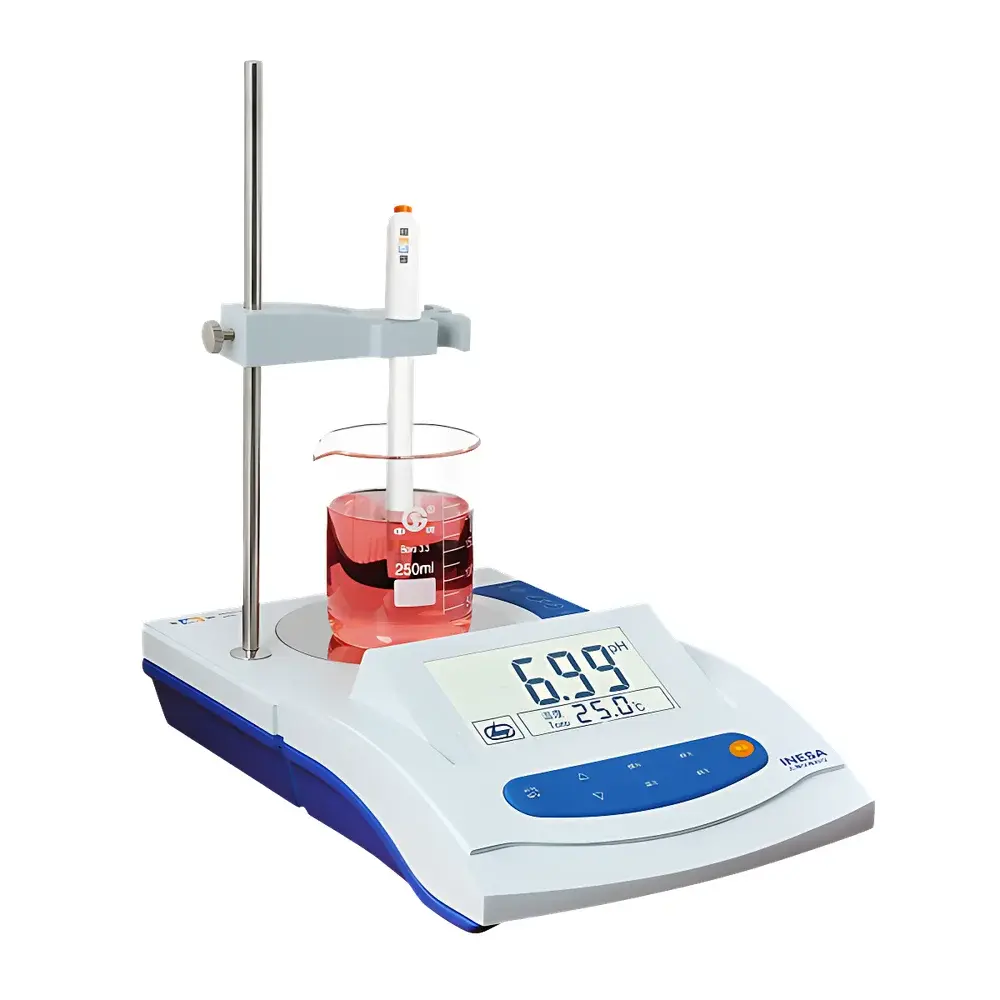
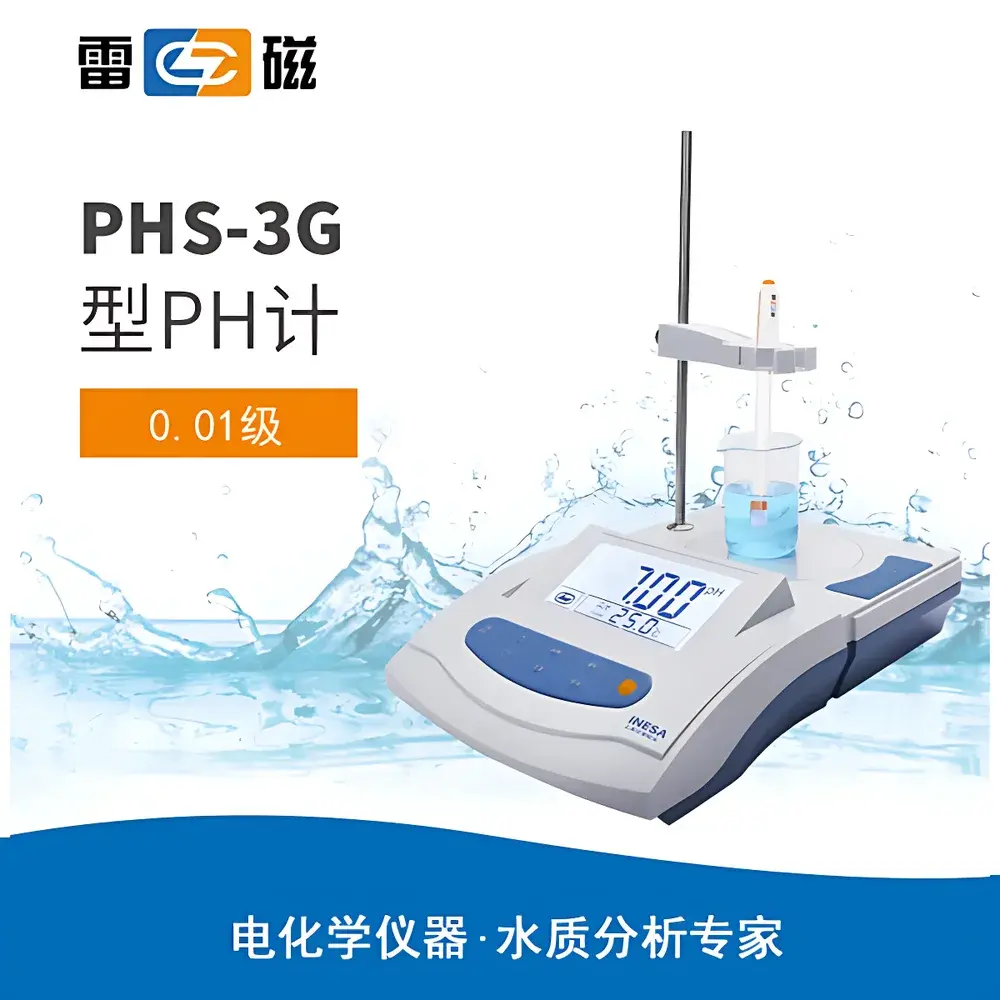
Leici PHS-3G Benchtop pH Meter
| Brand | Leici |
|---|---|
| Origin | Shanghai, China |
| Manufacturer Type | Direct Manufacturer |
| Regional Classification | Domestic (China) |
| Model | PHS-3G |
| Price Range | USD 420 – 690 |
| Instrument Type | Benchtop |
| Parameter Types | Dual (pH and mV) |
| Measurement Accuracy | ±0.01 pH |
| pH Range | −2.00 to 19.99 pH |
| mV Range | −1999 to +1999 mV |
| pH Resolution | 0.01 pH |
| mV Resolution | 1 mV |
| Accuracy | ±0.01 pH, ±0.1% FS (mV) |
| Calibration Buffers | pH 4.00, 6.86, and 9.18 standard solutions |
| Temperature Compensation | Manual, 0.0–60.0 °C |
| Power Supply | AC 220 V ±10%, 50 Hz ±1 Hz |
| Dimensions (W×D×H) | 210 × 310 × 95 mm |
| Weight | 2 kg |
Overview
The Leici PHS-3G is a benchtop dual-parameter electrochemical meter engineered for routine pH and oxidation-reduction potential (ORP/mV) measurements in quality control laboratories, educational institutions, and industrial process support environments. It operates on the principle of potentiometric measurement using a glass pH electrode and reference electrode assembly, generating a voltage proportional to hydrogen ion activity in aqueous solutions. The instrument conforms to IUPAC-recommended pH measurement methodology and supports traceable calibration against NIST-traceable standard buffer solutions (pH 4.00, 6.86, and 9.18). Designed to meet ISO/IEC 17025-compliant laboratory practices, the PHS-3G delivers stable, reproducible readings with 0.01 pH resolution and ≤±0.01 pH basic error—suitable for applications requiring compliance with ASTM D1293 (pH of water), USP , and general QC protocols under GLP frameworks.
Key Features
- Benchtop form factor with compact footprint (210 × 310 × 95 mm) and low mass (2 kg), optimized for space-constrained lab benches and teaching labs;
- Backlit LCD display with high-contrast alphanumeric readout supporting simultaneous pH and mV values, temperature indication, and calibration status;
- Automatic recognition of three internationally standardized pH buffers (4.00, 6.86, 9.18) during calibration—enabling 1-point or 2-point slope calibration with real-time slope calculation (% efficiency) and offset diagnostics;
- Manual temperature compensation (0.0–60.0 °C) via front-panel keypad input, compatible with common glass electrodes equipped with integrated or external temperature sensors;
- Integrated magnetic stirrer control circuitry—allows direct connection and speed regulation of external magnetic stirrers without additional controllers, ensuring homogeneous sample conditions during titration or equilibrium measurements;
- Rugged ABS housing with chemical-resistant surface finish; CE-marked power supply compliant with IEC 61010-1 safety standards for laboratory electrical equipment.
Sample Compatibility & Compliance
The PHS-3G is validated for use with standard combination pH electrodes (e.g., Leici E-201-C, or equivalent BNC-input electrodes from Metrohm, Thermo Fisher, or Hach). It supports aqueous samples across a broad pH range (−2.00 to 19.99), including mildly aggressive media such as diluted acids, alkaline cleaning solutions, and buffered biological preparations. While not rated for continuous use in non-aqueous or highly viscous solvents, it performs reliably in standard pharmaceutical, environmental, and food testing matrices per EPA Method 150.1 and APHA Standard Methods 4500-H+. All calibration and measurement data adhere to ALCOA+ principles when recorded manually; for full auditability, integration with external LIMS or electronic lab notebooks (ELN) is supported via RS-232 output (optional cable).
Software & Data Management
The PHS-3G operates as a standalone instrument without proprietary software dependency. Measurement data—including pH, mV, temperature, date/time stamp, and calibration history—are displayed in real time but are not stored internally. Users are expected to record results manually or interface the unit with third-party data acquisition systems via its TTL-level RS-232 serial port (baud rate: 9600, 8-N-1). No firmware updates or cloud connectivity are provided; however, the device’s fixed calibration algorithm ensures long-term metrological consistency without drift-related recalibration cycles beyond standard interval requirements (e.g., pre-use verification per ISO 17025 clause 7.7). The absence of internal memory aligns with simplified validation pathways for regulated environments where data integrity is maintained externally.
Applications
- Academic instruction in analytical chemistry and environmental science laboratories;
- Raw material and finished product testing in food & beverage, cosmetics, and detergent manufacturing;
- Wastewater effluent monitoring and drinking water quality verification (per WHO Guidelines and local regulatory thresholds);
- Buffer preparation and verification in molecular biology and cell culture workflows;
- Electroplating bath control and semiconductor wet-process chemistry monitoring;
- Calibration verification of field-portable pH meters in metrology support roles.
FAQ
Does the PHS-3G support automatic temperature compensation (ATC)?
No—it requires manual temperature entry prior to measurement. ATC functionality is not integrated; users must input ambient or sample temperature using the numeric keypad.
Can the instrument store calibration records or measurement history?
No internal memory is included. All calibration parameters and readings must be documented externally.
Is the RS-232 interface standard or optional?
The RS-232 port is built-in but requires a dedicated DB9-to-USB adapter and terminal emulation software (e.g., Tera Term) for data capture.
What electrode types are compatible with the PHS-3G?
Any BNC-output pH electrode with standard millivolt output (−1999 to +1999 mV) and compatible temperature element (for manual TC input) may be used.
Does the unit comply with FDA 21 CFR Part 11 requirements?
No—its lack of electronic signature capability, audit trail, and user access controls excludes it from Part 11–regulated workflows unless paired with validated third-party data capture systems.
Related Products





