
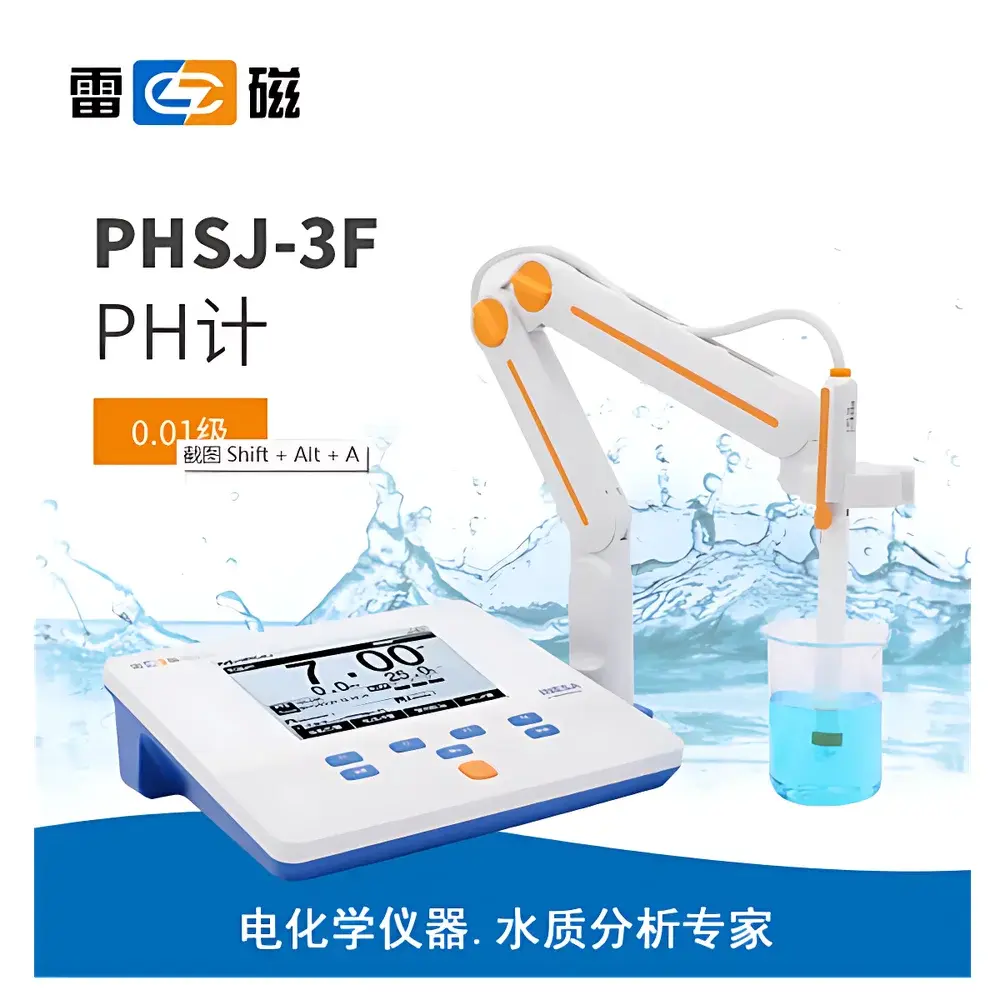
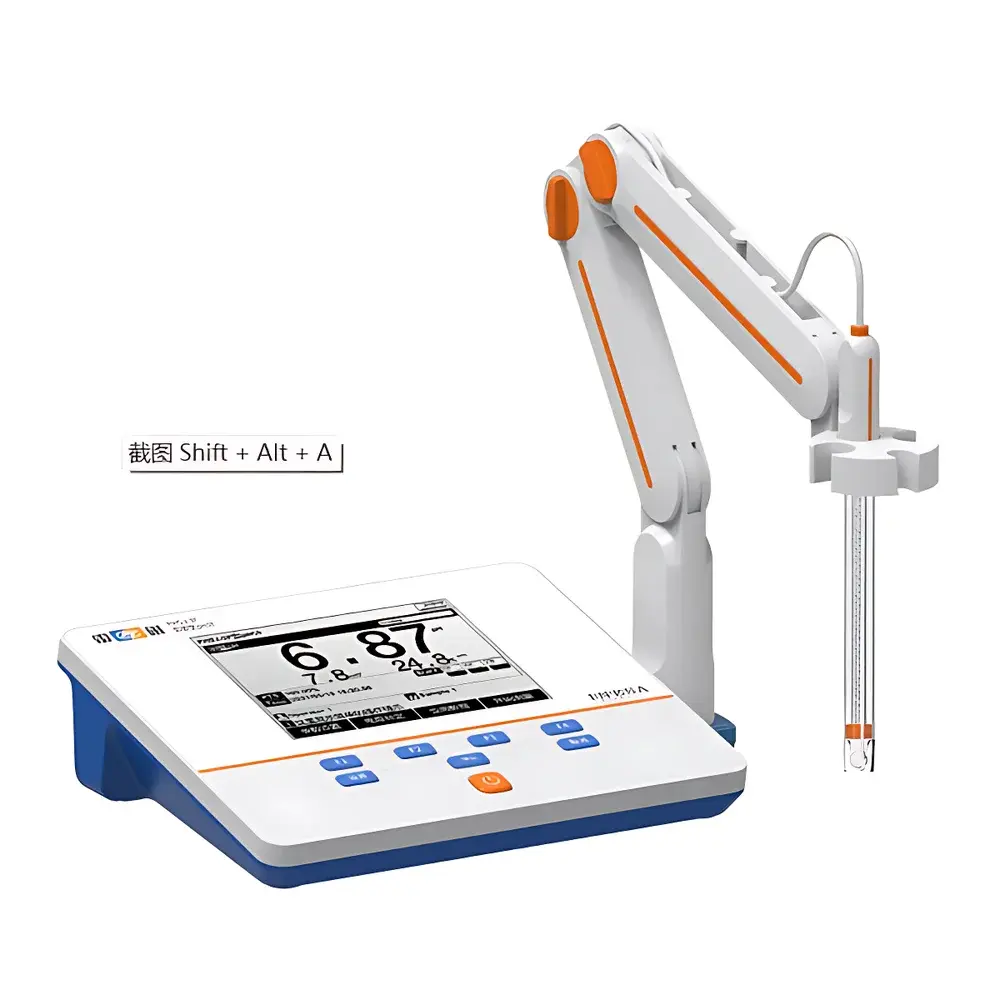
Leici PHSJ-3F Benchtop pH Meter
| Brand | Leici |
|---|---|
| Origin | Shanghai, China |
| Instrument Type | Benchtop |
| Parameter Types | Multi-parameter (pH, mV, Temperature) |
| Measurement Range | (−2.00 to 20.00) pH |
| Resolution | 0.01 pH (selectable to 0.1 pH) |
| Accuracy | ±0.01 pH |
| Temperature Compensation | Automatic and Manual |
| Calibration Points | 1–5-point pH calibration |
| Buffer Recognition | Auto-identification of GB, DIN, and NIST standard buffer sets |
| Data Storage Capacity | 500 measurement records |
| Compliance | GLP-compliant data management |
| Connectivity | RS-232 (for serial printers), USB (for PC communication) |
| Protection Rating | IP54 |
| Standard Accessories | Tri-combination pH electrode, electrode stand, dust cover, calibration buffer solutions |
Overview
The Leici PHSJ-3F is a precision benchtop pH meter engineered for routine and quality-critical electrochemical measurements in academic laboratories, pharmaceutical QC labs, environmental monitoring centers, and industrial process control environments. It operates on the fundamental principle of potentiometric measurement—detecting the potential difference between a glass pH-sensitive electrode and a stable reference electrode immersed in an aqueous sample—converted into pH values using the Nernst equation. Designed for high reproducibility and long-term stability, the PHSJ-3F delivers traceable, GLP-aligned results across its extended pH range of −2.00 to 20.00, accommodating highly acidic, neutral, and strongly alkaline samples encountered in battery electrolyte analysis, caustic cleaning validation, or semiconductor wet processing.
Key Features
- High-contrast LCD display with dual-resolution selection: 0.01 pH / 0.1 mV (standard) or 0.1 pH / 1 mV (coarse mode) for optimized readability under varied lighting conditions.
- Configurable temperature units (°C or °F) and integrated automatic/manual temperature compensation (ATC/MTT) using either built-in sensor or external Pt1000 probe.
- Intelligent endpoint detection algorithms enable reliable auto-read functionality, eliminating subjective judgment in endpoint determination; supports timed reading, interval logging, and manual capture modes.
- Five-point calibration capability with full buffer set management—automatically recognizes and validates GB (Chinese National Standard), DIN (German Institute for Standardization), and NIST-traceable buffer solutions.
- Robust mechanical architecture compliant with IP54 rating—dust-resistant and protected against low-pressure water splashes—suitable for shared lab benches and non-sterile production support areas.
- Firmware-upgradable platform ensures future compatibility with new calibration protocols, regulatory requirements, or expanded parameter support without hardware replacement.
Sample Compatibility & Compliance
The PHSJ-3F accommodates a broad spectrum of aqueous and semi-aqueous matrices, including buffer solutions, cell culture media, wastewater effluents, food extracts, and aggressive alkaline cleaners. Its tri-combination pH electrode—integrated reference, pH-sensing, and temperature elements in a single shaft—minimizes junction potential drift and improves response time in low-ionic-strength or viscous samples. All measurement data are timestamped, operator-ID tagged (where configured), and stored with full metadata (calibration history, electrode ID, ambient temperature, buffer IDs used), satisfying core GLP documentation requirements. While not certified for FDA 21 CFR Part 11 out-of-the-box, audit trails generated via USB export meet preliminary data integrity criteria for internal QA review and ISO/IEC 17025-accredited testing laboratories.
Software & Data Management
Equipped with 500-entry internal memory, the instrument logs pH, mV, temperature, date/time, calibration status, and electrode identification. Data export is supported via RS-232 serial interface (compatible with industry-standard dot-matrix or thermal label printers) and USB port (using Leici’s dedicated PC communication software). Exported files are structured in CSV format for direct import into LIMS, Excel, or statistical analysis platforms. Print templates include customizable headers, unit labels, and pass/fail thresholds—enabling immediate hardcopy generation for batch release documentation or regulatory audits. All stored records retain immutable sequence identifiers and cannot be edited post-acquisition, preserving evidential integrity.
Applications
- Pharmaceutical manufacturing: Monitoring pH of dissolution media (USP ), cleaning validation swab extracts, and API crystallization slurries.
- Environmental testing: Field-deployable verification of wastewater pH prior to discharge (EPA Method 9040B), soil extract analysis, and drinking water compliance checks.
- Food & beverage QC: Acidification control in dairy fermentation, vinegar titration endpoints, and shelf-life stability studies.
- Academic research: Teaching potentiometry fundamentals, calibrating custom electrode arrays, and validating buffer preparation protocols.
- Chemical production: In-process control of neutralization reactions, catalyst slurry pH, and corrosion inhibitor formulation.
FAQ
Does the PHSJ-3F support ISO/IEC 17025-compliant calibration reporting?
Yes—when paired with documented calibration buffers (NIST-traceable or GB-certified), the instrument records full calibration metadata, enabling generation of compliant calibration certificates via exported data.
Can the device store multiple electrode profiles for different applications?
No—the PHSJ-3F does not support user-defined electrode profiles, but it retains individual calibration histories per session and allows re-use of previously validated buffer sets.
Is the tri-combination electrode compatible with non-aqueous solvents?
It is designed primarily for aqueous systems; use in organic solvents requires specialized electrodes and may compromise accuracy and longevity.
What is the typical service life of the included pH electrode under standard lab conditions?
With proper storage (in 3 M KCl solution), regular cleaning, and avoidance of protein fouling or HF exposure, the electrode typically maintains specification performance for 12–18 months.
Does the USB interface support real-time data streaming to third-party software?
No—it supports batch transfer only; real-time acquisition requires optional analog output modules not included with the base configuration.
Related Products






