
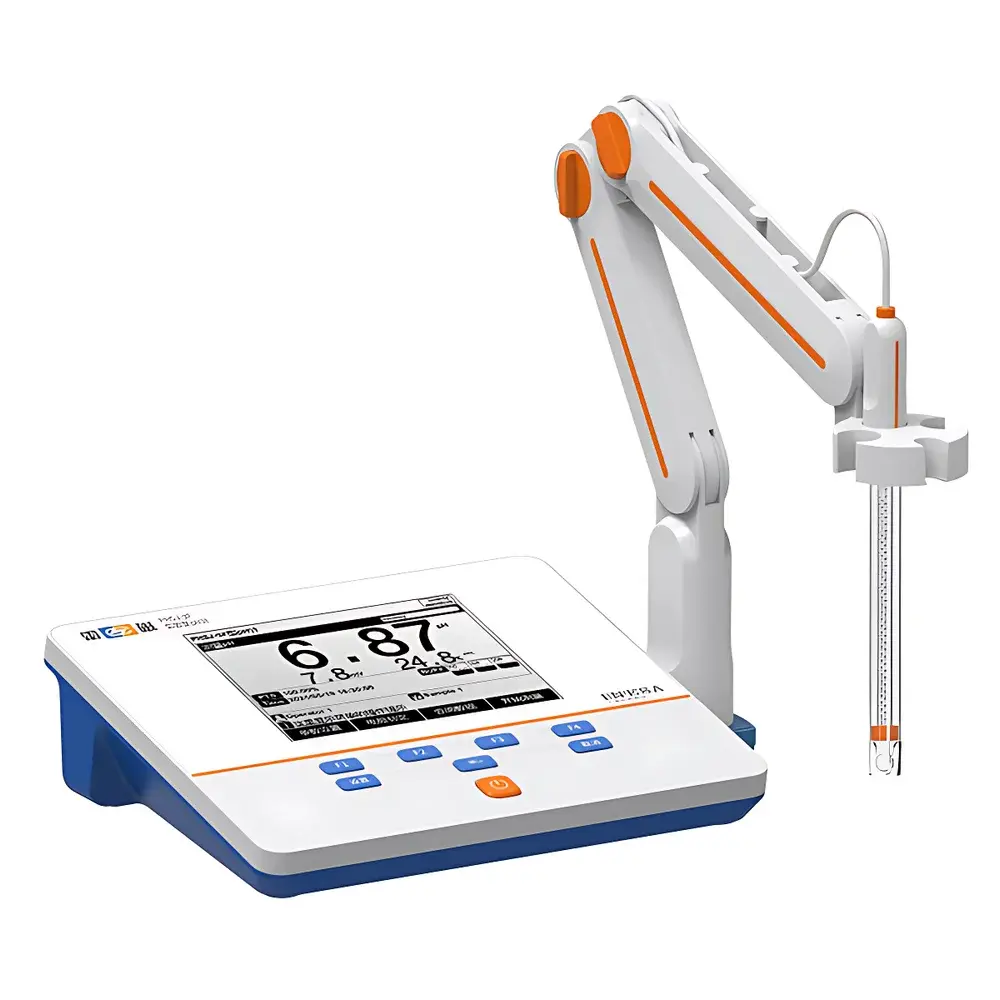
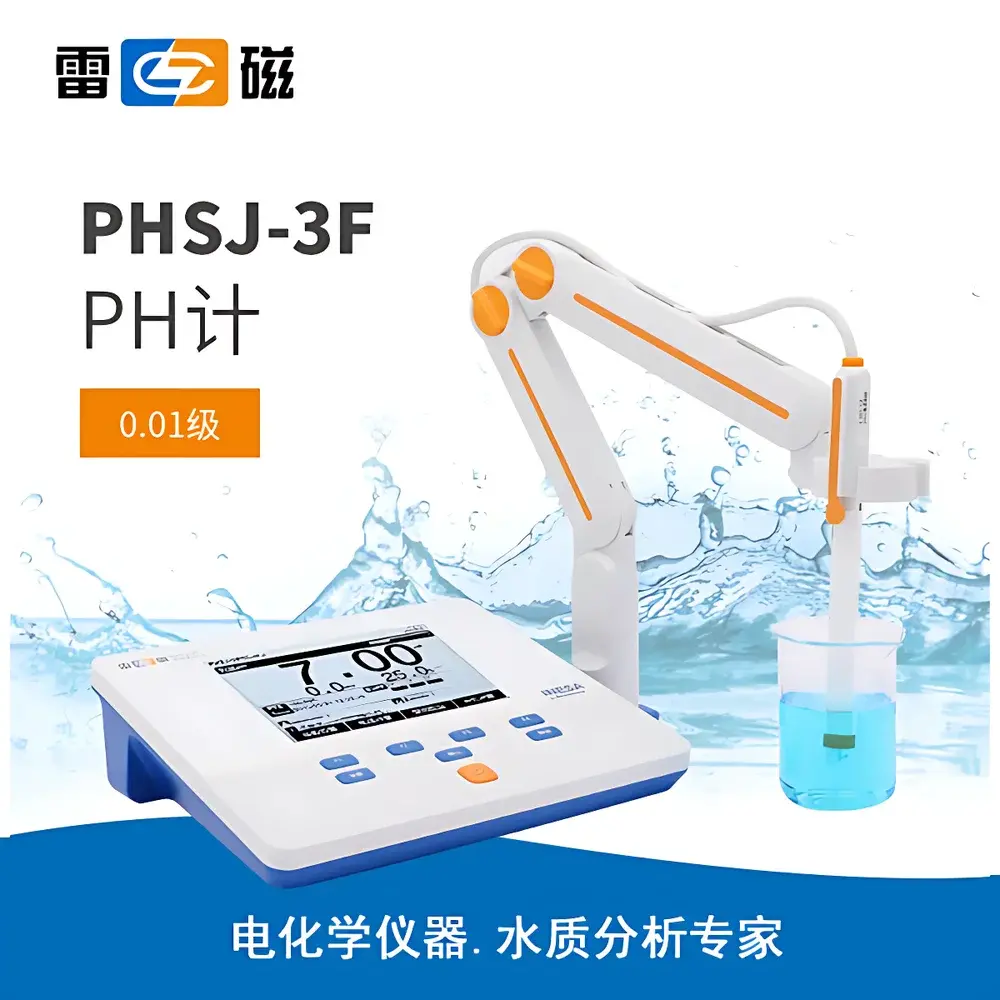
Leici PHSJ-3F Benchtop pH Meter
| Brand | Leici |
|---|---|
| Origin | Shanghai, China |
| Manufacturer Type | Manufacturer |
| Origin Category | Domestic (China) |
| Model | PHSJ-3F |
| Price Range | USD 420–690 |
| Instrument Type | Benchtop |
| Parameter Types | Multi-parameter (pH, mV, Temperature) |
| Measurement Accuracy | ±0.01 pH |
| pH Range | (−2.00 to 20.00) pH |
| Resolution | 0.01 pH |
| mV Range | (−2000.0 to 2000.0) mV |
| mV Resolution | 0.1 mV |
| Temperature Range | (−5.0 to 110.0) °C / (23.0 to 230.0) °F |
| Temperature Resolution | 0.1 °C / 0.1 °F |
| Temperature Accuracy | ±0.2 °C |
| Calibration Standards Supported | GB, DIN, NIST |
| IP Rating | IP54 |
| Data Storage Capacity | 500 datasets |
| Interface | RS-232, USB |
| Power Supply | AC 100–240 V input, DC 9 V output |
| Dimensions (L×W×H) | 242 × 195 × 68 mm |
| Weight | 0.9 kg |
Overview
The Leici PHSJ-3F is a high-precision benchtop pH meter engineered for routine and quality-critical electrochemical measurements in academic laboratories, pharmaceutical QC labs, environmental testing facilities, and industrial process control environments. It operates on the fundamental principle of potentiometric measurement: detecting the potential difference between a pH-sensitive glass electrode and a stable reference electrode immersed in an aqueous sample, converting this voltage into a pH value via the Nernst equation. With a certified accuracy of ±0.01 pH across its extended range of −2.00 to 20.00 pH, the instrument meets the requirements of ISO 7888, ASTM D1293, and USP for pH determination in purified water, buffers, and aggressive chemical solutions. Its robust architecture includes a sealed electronic unit with integrated temperature compensation circuitry and dual-mode analog/digital signal processing to minimize drift and ensure long-term stability under variable ambient conditions.
Key Features
- High-resolution 3.5-inch LCD display with adjustable contrast and backlight for clear visibility under diverse lighting conditions
- Selectable resolution modes: pH (0.01 or 0.1 pH), mV (0.1 or 1 mV), and temperature (0.1 °C/°F)
- Intelligent endpoint detection algorithm enabling auto-read, timed-read, interval-read, and manual read modes
- Automatic temperature compensation (ATC) with optional manual override; supports Pt1000 and thermistor probes
- Up to five-point pH calibration with slope and offset validation; real-time calibration report generation
- Automatic recognition of three standardized buffer groups (GB, DIN, NIST); user-definable buffer sets with editable pH values and temperatures
- IP54-rated enclosure providing protection against dust ingress and water splashes—suitable for shared lab benches and humid environments
- Firmware-upgradable architecture via USB, enabling future protocol support and regulatory-compliant feature enhancements
Sample Compatibility & Compliance
The PHSJ-3F accommodates a wide range of sample matrices—including aqueous buffers, organic-aqueous mixtures, low-ionic-strength deionized water, and mildly corrosive solutions—when used with compatible electrodes (e.g., triple-junction pH electrodes with KCl gel electrolyte). It complies with GLP (Good Laboratory Practice) data integrity requirements through mandatory audit trail logging: each measurement record includes timestamp, operator ID (if configured), electrode serial number, calibration history, temperature reading, and environmental conditions at time of acquisition. The device supports traceable calibration using certified reference materials compliant with ISO/IEC 17025-accredited standards. While not intrinsically safe, it is suitable for non-hazardous laboratory zones per IEC 61010-1 safety classification.
Software & Data Management
Data handling conforms to regulatory expectations for analytical instrumentation. All 500 stored measurements are timestamped and tagged with metadata including calibration status, electrode ID, ambient temperature, and user-defined sample IDs. Data can be reviewed in tabular or graphical format (pH vs. time trend plots), exported as CSV or PDF via USB-connected PC using Leici’s proprietary communication software (Windows-compatible, digitally signed installer). RS-232 output enables direct printing to industry-standard serial printers (ESC/P or PCL protocols); print templates include customizable headers, footers, and compliance footnotes (e.g., “Calibrated per SOP-QC-023, verified 2024-06-15”). Audit logs are immutable and exportable—supporting FDA 21 CFR Part 11 readiness when paired with appropriate institutional IT controls.
Applications
- Pharmaceutical: pH verification of injectables, dissolution media, and cleaning validation swab extracts per USP monographs
- Environmental: Monitoring of wastewater effluents, surface water, and soil leachates in accordance with EPA Method 150.1
- Food & Beverage: Acidification control in dairy fermentation, juice blending, and vinegar production
- Academic Research: Teaching potentiometry fundamentals, calibrating custom electrode systems, and validating buffer preparation protocols
- Chemical Manufacturing: In-process pH monitoring during neutralization reactions and catalyst activation steps
FAQ
Does the PHSJ-3F support automatic electrode diagnostics?
Yes—it performs continuous impedance monitoring during calibration and measurement, alerts users to high-resistance electrodes (>1 GΩ), and flags unstable reference junction potentials.
Can the instrument store calibration curves separately for multiple electrodes?
Yes—up to five independent electrode profiles can be saved, each retaining slope, offset, date, and buffer set used.
Is the USB interface compatible with modern operating systems?
It supports Windows 10/11 (x64) and macOS 12+ via CDC ACM class drivers; no additional hardware drivers required.
What happens during power interruption?
Built-in EEPROM retains calibration data, configuration settings, and last 20 measurements—even after complete power loss.
How is traceability ensured for regulated environments?
Each exported dataset contains embedded digital signatures, unique instrument ID, firmware version, and full calibration chain metadata—enabling full reconstruction of measurement conditions per ALCOA+ principles.
Related Products



