
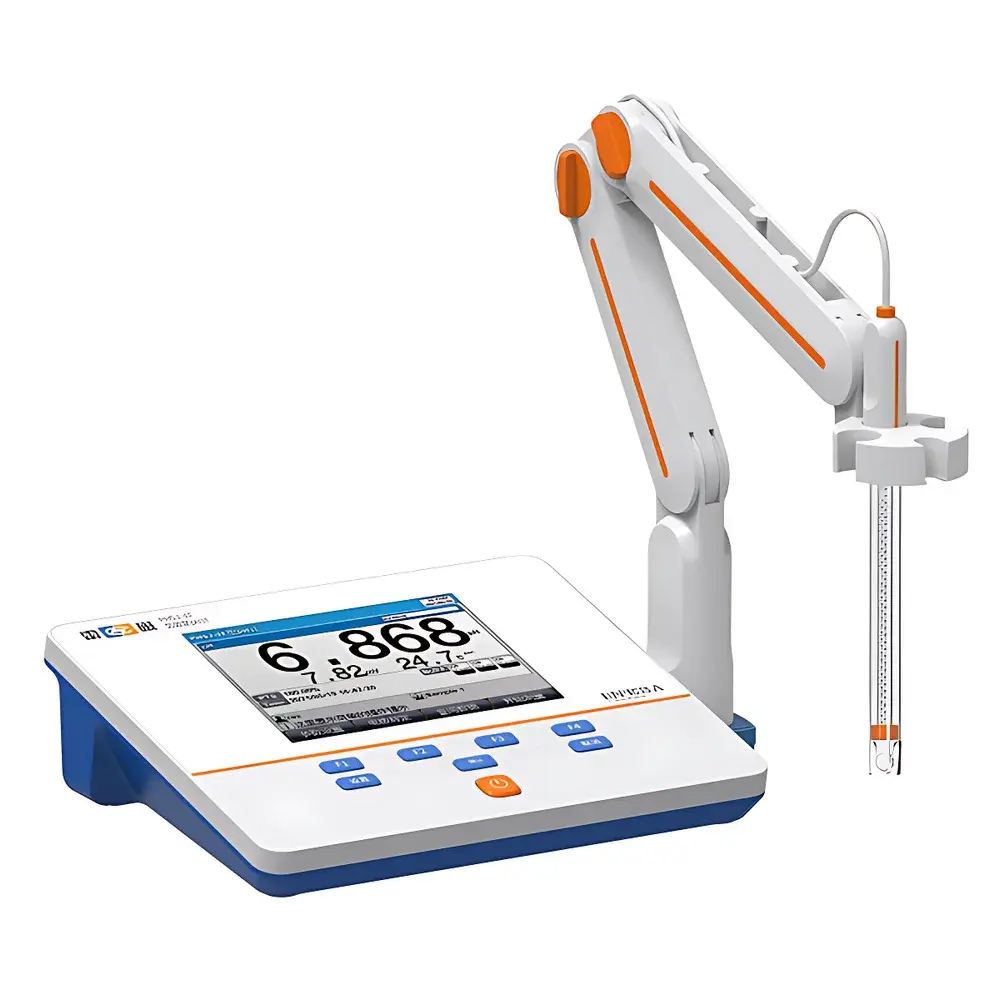
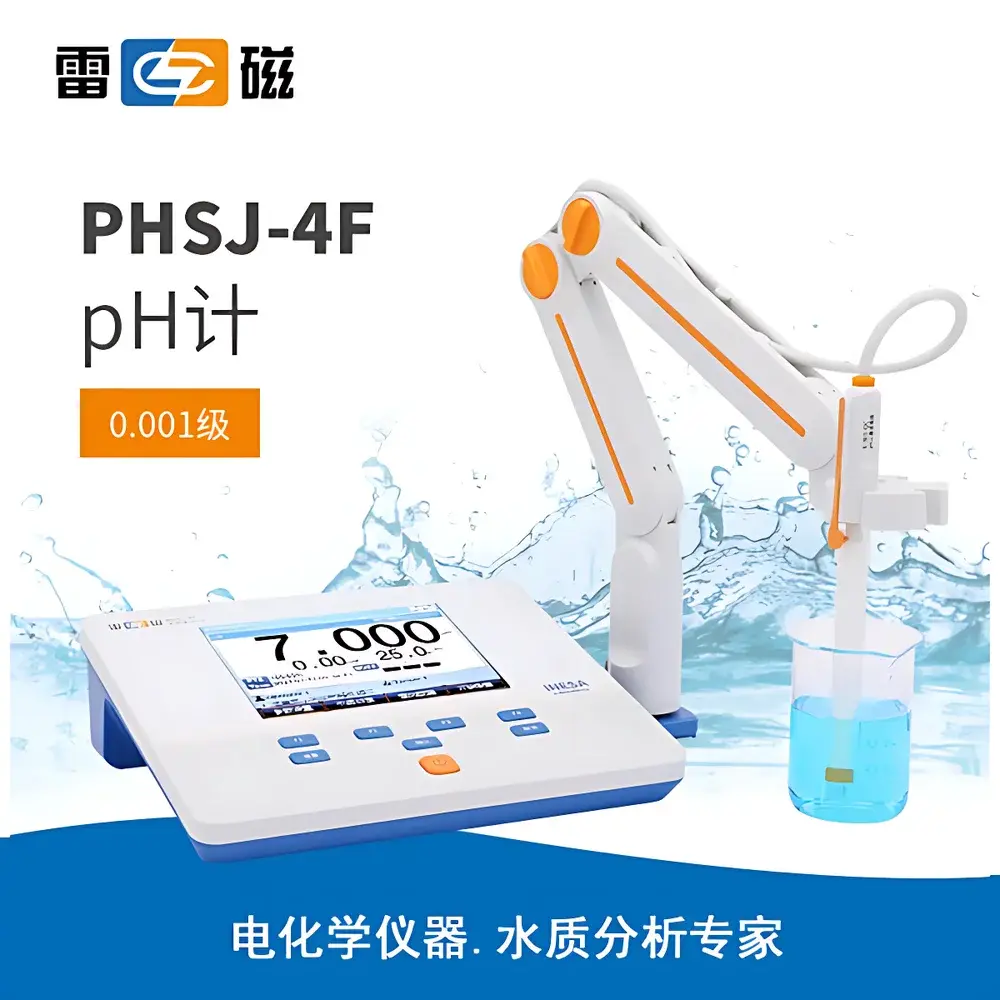
Leici PHSJ-4F Benchtop pH Meter
| Brand | Leici |
|---|---|
| Origin | Shanghai, China |
| Manufacturer Type | Direct Manufacturer |
| Regional Classification | Domestic (China) |
| Model | PHSJ-4F |
| Price Range | USD 420–690 |
| Instrument Type | Benchtop |
| Parameter Type | Single-Parameter (pH/mV/Temp) |
| Measurement Accuracy | ±0.002 pH |
| pH Range | −2.000 to 20.000 pH |
| Resolution | 0.001 pH / 0.01 mV / 0.1 °C |
| Temperature Compensation | Automatic & Manual |
| Calibration Points | 1–5-point pH calibration |
| Buffer Recognition | GB, DIN, NIST, USA, MERK standard buffer sets |
| IP Rating | IP54 |
| Data Storage | 500 measurement records |
| Interface | RS-232 (printer), USB (PC connectivity) |
| Compliance | GLP-compliant data management |
| Power Supply | AC 100–240 V input, DC 9 V output |
| Dimensions (L×W×H) | 242 × 195 × 68 mm |
| Weight | 0.9 kg |
Overview
The Leici PHSJ-4F is a high-precision benchtop pH meter engineered for routine and quality-critical electrochemical measurements in academic laboratories, pharmaceutical QC labs, environmental monitoring stations, and industrial process control environments. Based on potentiometric measurement principles, it determines hydrogen ion activity via a glass electrode–reference electrode assembly, converting the resulting electromotive force (EMF) into calibrated pH values with traceable accuracy. Its 0.001-level classification per Chinese JJG 119–2018 (equivalent to ISO 7027-1:2016 metrological framework for pH instrumentation) ensures compliance with stringent analytical requirements where reproducibility and long-term stability are essential. Designed for robust daily operation, the instrument features a sealed front panel, integrated electrode holder, and dust cover—supporting cleanroom-adjacent workflows without compromising accessibility.
Key Features
- High-resolution color LCD display with adjustable contrast for optimal readability under varied ambient lighting conditions.
- Selectable resolution modes: pH (0.001 / 0.01 / 0.1), mV (0.01 / 0.1 / 1), and temperature (0.1 °C or 0.1 °F).
- Intelligent endpoint detection algorithms enable automatic reading stabilization, eliminating subjective judgment during titration or equilibrium-based assays.
- Five pre-programmed buffer recognition protocols (GB, DIN, NIST, USA, MERK) with user-definable buffer groups and custom pH standard assignment.
- Comprehensive calibration flexibility: 1–5 point pH calibration with slope and offset diagnostics; simultaneous mV and temperature calibration verification.
- IP54-rated enclosure provides protection against dust ingress and water splashes—suitable for shared lab benches and humid environments such as fermentation monitoring or wastewater analysis zones.
- Built-in power management: auto-shutdown after configurable idle time, battery-free operation via external DC adapter, and non-volatile memory retention during power interruption.
Sample Compatibility & Compliance
The PHSJ-4F accommodates standard 12-mm diameter combination pH electrodes (including supplied triple-junction electrode), making it compatible with aqueous, low-ionic-strength, and mildly aggressive samples (e.g., dilute acids/bases, buffer solutions, biological media). It supports manual and automatic temperature compensation using either built-in thermistor or external Pt100 sensor input (optional). All measurement metadata—including date/time stamp, calibration history, electrode ID (if encoded), operator ID, and environmental temperature—is stored with immutable timestamps, satisfying GLP documentation requirements for audit readiness. While not certified to FDA 21 CFR Part 11 out-of-the-box, its structured data export format (CSV via USB) enables integration into validated LIMS or ELN systems supporting electronic signature workflows.
Software & Data Management
Data handling is implemented through dual-channel I/O architecture: RS-232 interface supports direct connection to serial printers (ESC/P or Epson-compatible) with configurable print templates (raw values, calibration reports, timestamped logs). USB port enables bidirectional communication with Windows-based Leici LabLink software (v3.2+), allowing batch export, graphical trend visualization (pH vs. time curves), statistical summary (mean, SD, min/max), and secure archiving. Each record includes full context: calibration parameters, electrode status flags, ambient temperature, and user-defined sample IDs. Internal memory retains up to 500 entries with overwrite protection enabled by default—ensuring integrity of critical calibration and validation datasets.
Applications
- Pharmaceutical: USP pH verification of injectables, dissolution media, and excipient solutions.
- Food & Beverage: Acidification monitoring in dairy fermentation, juice pH profiling, and shelf-life stability testing.
- Environmental: Field-deployable bench verification of surface water, effluent, and soil extract pH per ISO 10523 and ASTM D1293.
- Academic Research: Teaching labs requiring NIST-traceable pH instruction, electrode characterization studies, and buffer preparation validation.
- Chemical Manufacturing: In-process control of neutralization reactions, catalyst slurry pH adjustment, and corrosion inhibitor formulation QA.
FAQ
What calibration standards does the PHSJ-4F recognize automatically?
It identifies five internationally referenced buffer groups (GB, DIN, NIST, USA, MERK) based on measured EMF and temperature—no manual selection required during calibration setup.
Can the instrument store calibration data separately from measurement records?
Yes—calibration events are logged independently with full metadata (buffer IDs, slopes, asymmetry potentials, date/time), enabling retrospective performance evaluation.
Is the USB interface compatible with modern operating systems?
The device enumerates as a CDC ACM-class virtual COM port; drivers are included for Windows 10/11 and macOS 12+, with Linux kernel ≥5.4 support confirmed via standard ttyACM interface.
Does the instrument support electrode diagnostics beyond slope calculation?
It reports zero-point deviation (asymmetry potential) and detects open-circuit or short-circuit conditions during self-test, providing actionable troubleshooting indicators.
How is GLP compliance enforced in data export?
All exported CSV files contain embedded hash-verified headers, uneditable timestamps, and sequential record numbering—preventing post-acquisition modification without detection.





