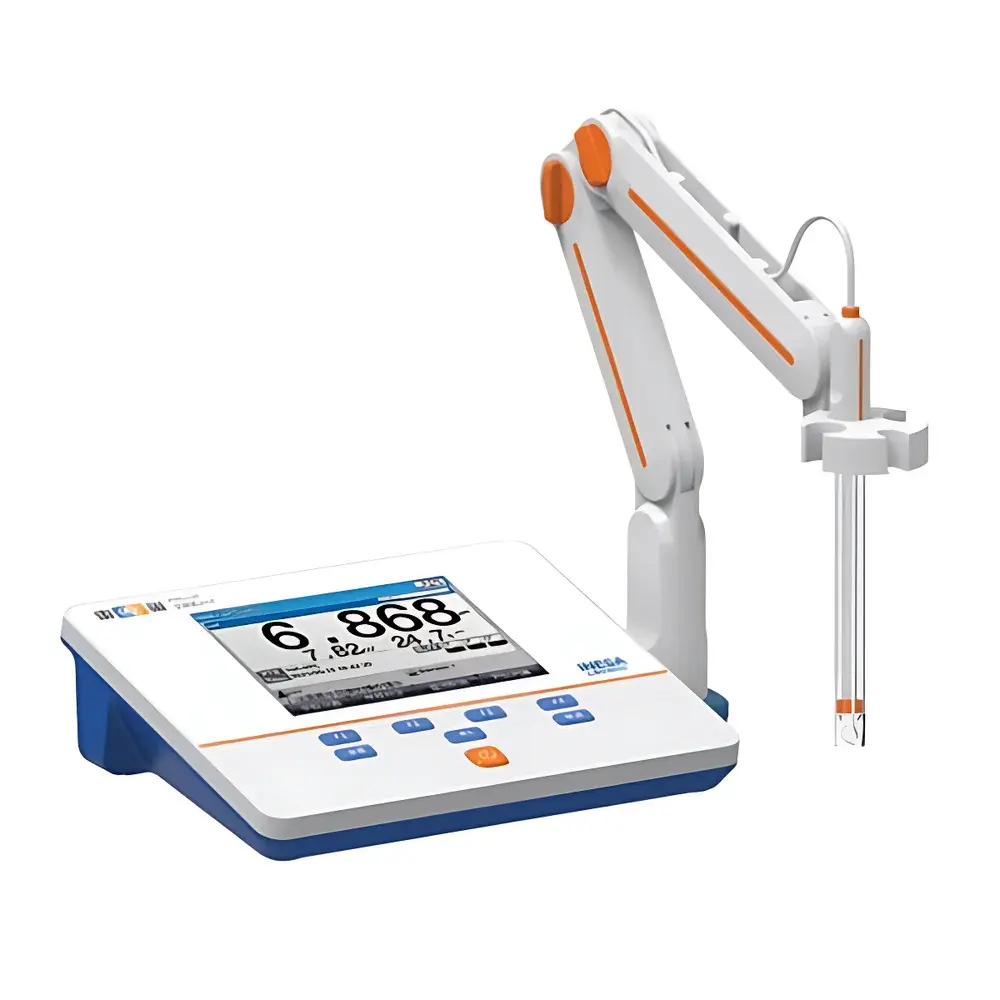
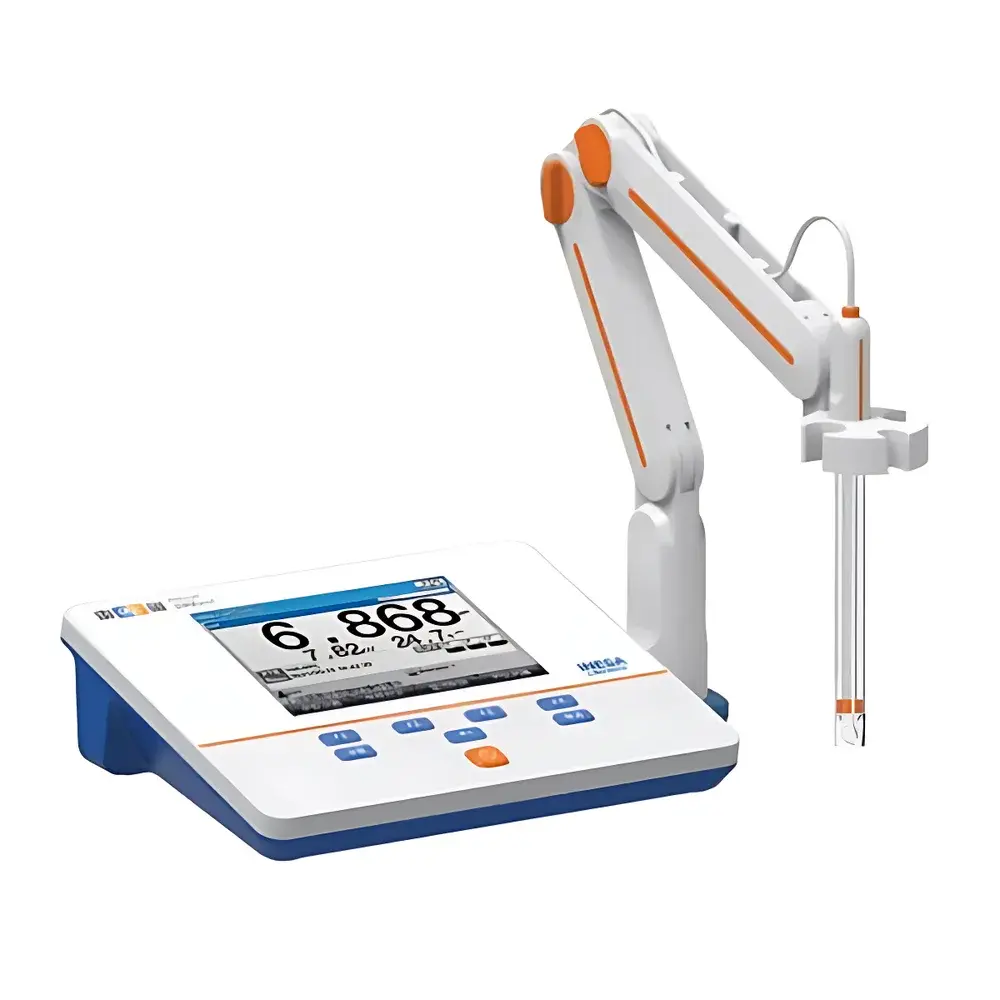
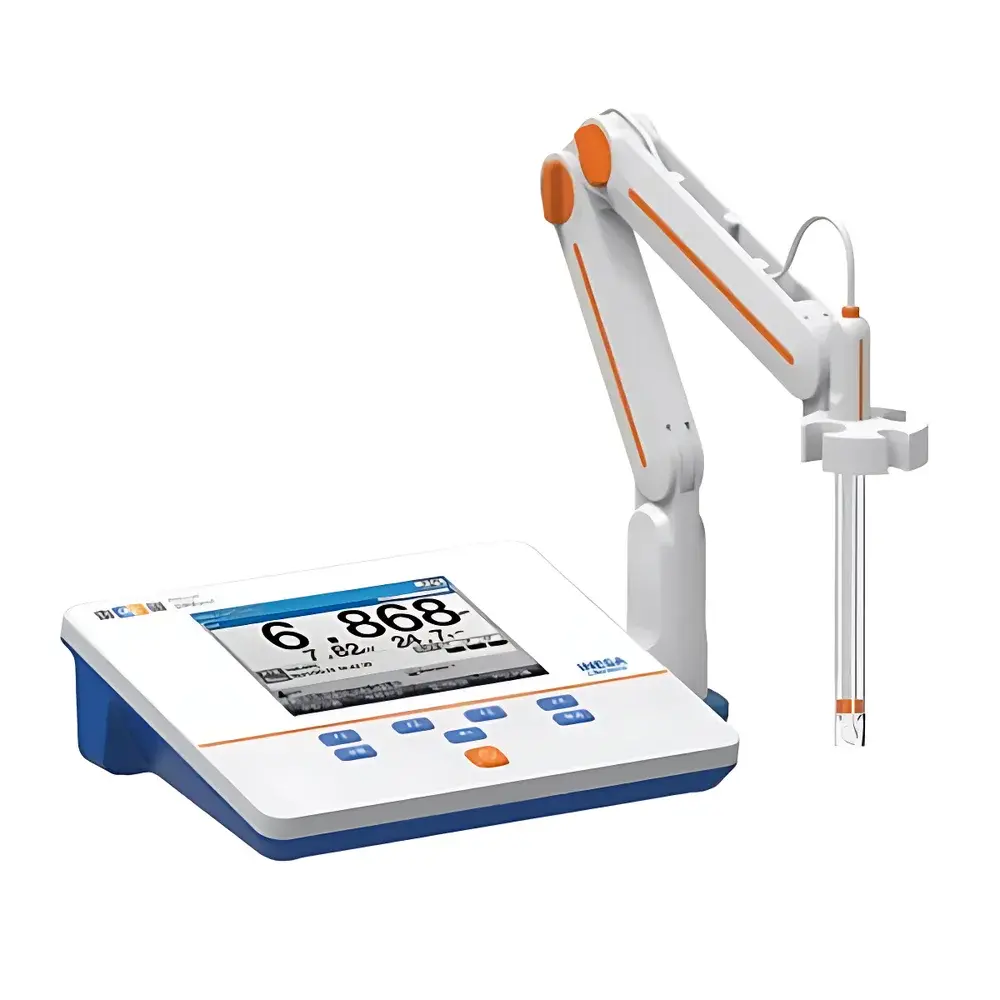
Leici PHSJ-4F Benchtop pH Meter with Temperature Compensation
| Brand | Leici |
|---|---|
| Model | PHSJ-4F |
| Measurement Range | pH (−2.000 to 20.000), mV (−2000.00 to 2000.00), Temperature (−10.0 to 135.0 °C / 14.0 to 275.0 °F) |
| Resolution | pH (0.001/0.01/0.1), mV (0.01/0.1/1), Temp (0.1 °C/0.1 °F) |
| Accuracy | pH ±0.002, mV ±0.03% or ±0.1 mV, Temp ±0.1 °C (electronic unit), ±0.3 °C (0.0–60.0 °C), ±1.0 °C (other ranges) |
| Calibration | 1–5 point pH auto-calibration with buffer recognition (GB, DIN, NIST, USA, MERK) and custom buffer support |
| Data Storage | 500 sets with time stamping, filtering, export via USB/RS-232, GLP-compliant audit trail |
| Display | 7-inch HD color LCD |
| Interface | RS-232 (printer compatible), USB-B (PC communication) |
| Power | AC 100–240 V input, DC 20 V output adapter |
| Dimensions | 242 × 195 × 68 mm |
| Weight | ~0.9 kg |
| IP Rating | IP54 |
| Compliance | GB/T 11165–2005, JJG 119–2018, HJ 1396–2024 |
Overview
The Leici PHSJ-4F is a high-precision benchtop pH meter engineered for rigorous laboratory and quality control environments where traceable, reproducible electrochemical measurements are critical. It operates on the potentiometric principle—measuring the potential difference between a pH-sensitive glass electrode and a stable reference electrode in aqueous solution—to determine hydrogen ion activity across an extended range of −2.000 to 20.000 pH units. Integrated temperature compensation ensures accurate pH readings under variable thermal conditions, using either automatic (ATC) or manual (MTC) modes. The instrument supports dual-parameter measurement—simultaneous acquisition of pH, mV (redox potential), and temperature—with resolution down to 0.001 pH and 0.01 mV. Its architecture conforms to fundamental metrological requirements defined in JJG 119–2018 (Verification Regulation for Laboratory pH Meters) and aligns with international best practices for analytical instrumentation validation.
Key Features
- Seven-inch high-resolution color TFT-LCD display with intuitive icon-based navigation and three selectable language options (English, Chinese, and bilingual interface mode)
- Intelligent endpoint detection algorithms supporting continuous reading, equilibrium-based stabilization, and programmable timed measurement intervals
- Comprehensive calibration suite: 1–5 point pH calibration with automatic recognition of five standardized buffer groups (GB, DIN, NIST, USA, MERK) and user-defined buffer configuration
- Electrode diagnostics and health monitoring—including slope calculation, asymmetry potential assessment, and response time evaluation—to ensure sensor integrity prior to analysis
- GLP-compliant data management system with timestamped storage of up to 500 measurement records, including operator ID, calibration history, electrode ID, and environmental metadata
- Dual communication interfaces: RS-232 port for direct connection to serial printers (with customizable print layout), and USB-B port for secure PC synchronization using dedicated Leici communication software
- Robust mechanical design rated IP54 for dust resistance and limited water ingress protection—suitable for shared lab benches and regulated QC areas
Sample Compatibility & Compliance
The PHSJ-4F is validated for use with standard aqueous and mildly buffered solutions encountered in environmental testing, pharmaceutical process development, food safety laboratories, and academic research. It accommodates common combination pH electrodes—including the included triple-junction pH electrode—and supports both refillable and gel-filled reference systems. All measurement protocols comply with national standards GB/T 11165–2005 (Laboratory pH Meters—General Technical Requirements), JJG 119–2018 (Verification Regulation), and HJ 1396–2024 (Determination of Water Temperature by Sensor Method). While not certified for FDA 21 CFR Part 11 out-of-the-box, its audit-trail functionality, password-protected settings, and immutable data logging meet foundational GLP/GMP documentation expectations for non-critical release testing.
Software & Data Management
Data generated by the PHSJ-4F is structured to support full traceability throughout the analytical lifecycle. Each stored record includes date/time stamp, measured values (pH/mV/°C), calibration parameters (slope, offset, buffer IDs), electrode identification, and operator code. Users may filter datasets by time range or parameter thresholds and export results in CSV format for integration into LIMS or statistical analysis platforms. The USB interface enables firmware updates and configuration backup/restore operations. Optional Leici PC software provides visualization tools—including dynamic trend curves and tabular summaries—as well as batch reporting templates compliant with internal SOPs. All exported files retain embedded metadata required for regulatory review.
Applications
- Environmental monitoring: pH and redox potential analysis of surface water, wastewater effluents, and soil leachates per HJ 1396–2024 and ISO 10523
- Pharmaceutical manufacturing: In-process verification of buffer preparation, cleaning validation rinse water, and stability study solutions
- Food and beverage QA: Monitoring acidity in dairy products, fermented beverages, fruit juices, and canned goods during production and shelf-life testing
- Academic research: Teaching electrochemistry fundamentals, calibrating sensor arrays, and validating new electrode materials under controlled thermal conditions
- Chemical synthesis labs: Tracking reaction progress in hydrolysis, neutralization, and catalyst activation experiments requiring real-time pH feedback
FAQ
Does the PHSJ-4F support automatic temperature compensation (ATC)?
Yes—it accepts input from integrated or external Pt1000 temperature probes and applies Nernstian correction in real time.
Can I import custom pH buffer definitions into the instrument?
Yes—the device allows creation and storage of up to five user-defined buffer sets with specified nominal pH and temperature coefficients.
Is the instrument suitable for non-aqueous or high-ionic-strength samples?
It is optimized for aqueous media; measurements in organic solvents or concentrated brines require specialized electrodes and empirical correction factors.
What data security features does it offer for regulated environments?
It provides password-protected access levels, immutable timestamps, electronic signatures via operator ID, and full calibration history logging—all essential for GLP audits.
How often should the built-in pH electrode be recalibrated?
Calibration frequency depends on usage intensity and sample matrix; daily verification is recommended for routine QC work, with full multi-point calibration performed at start-of-shift or after electrode replacement.