
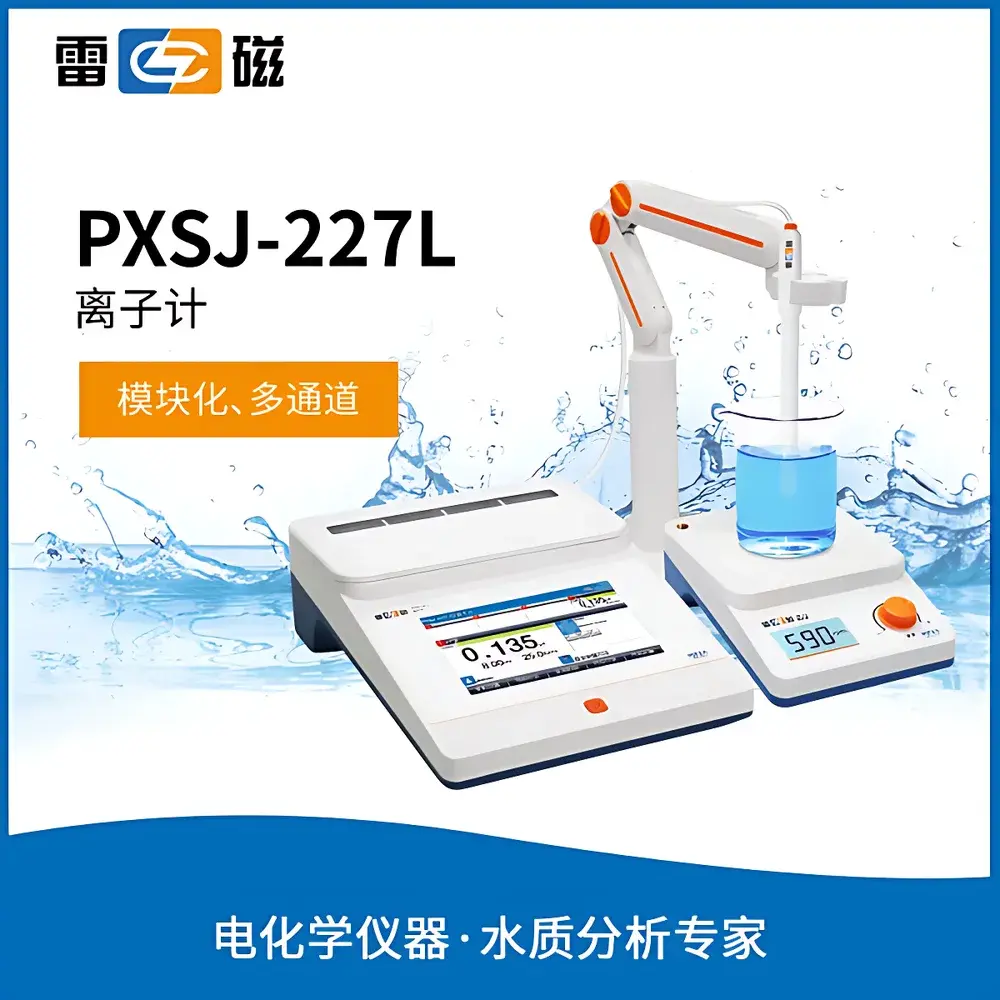
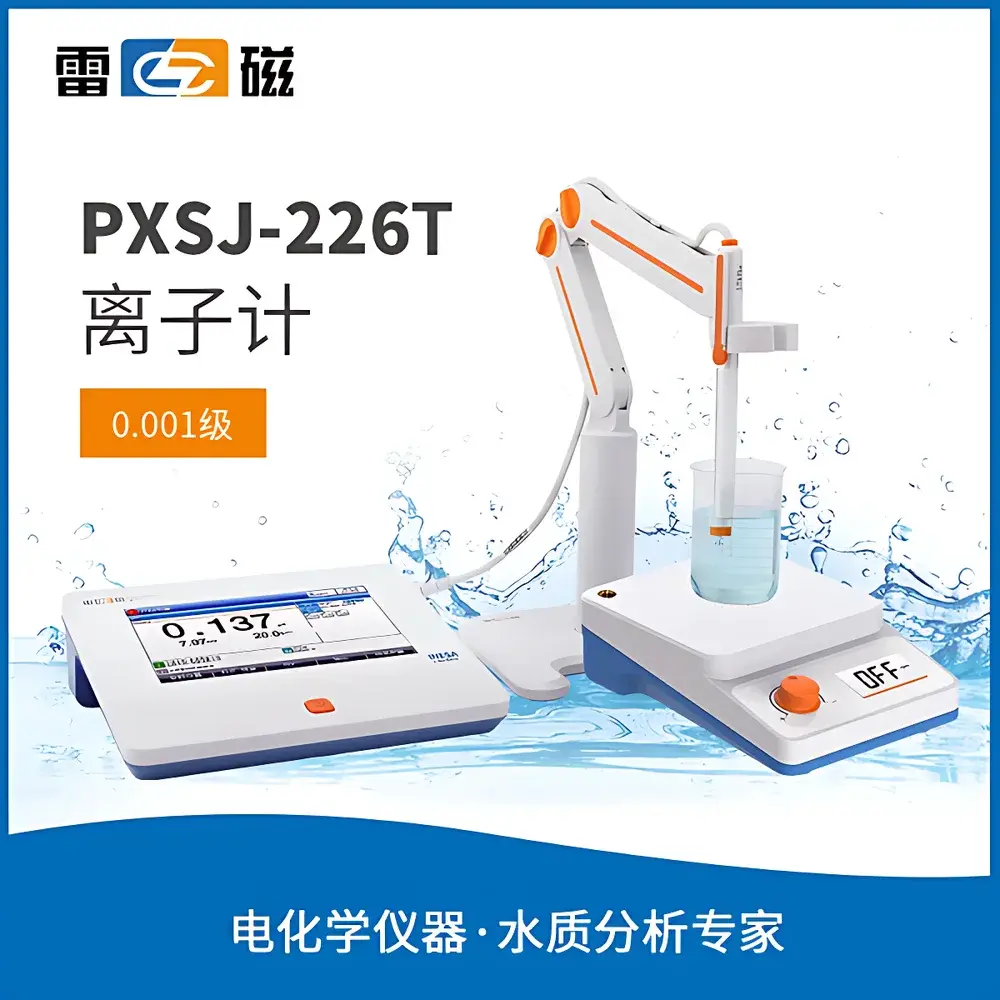
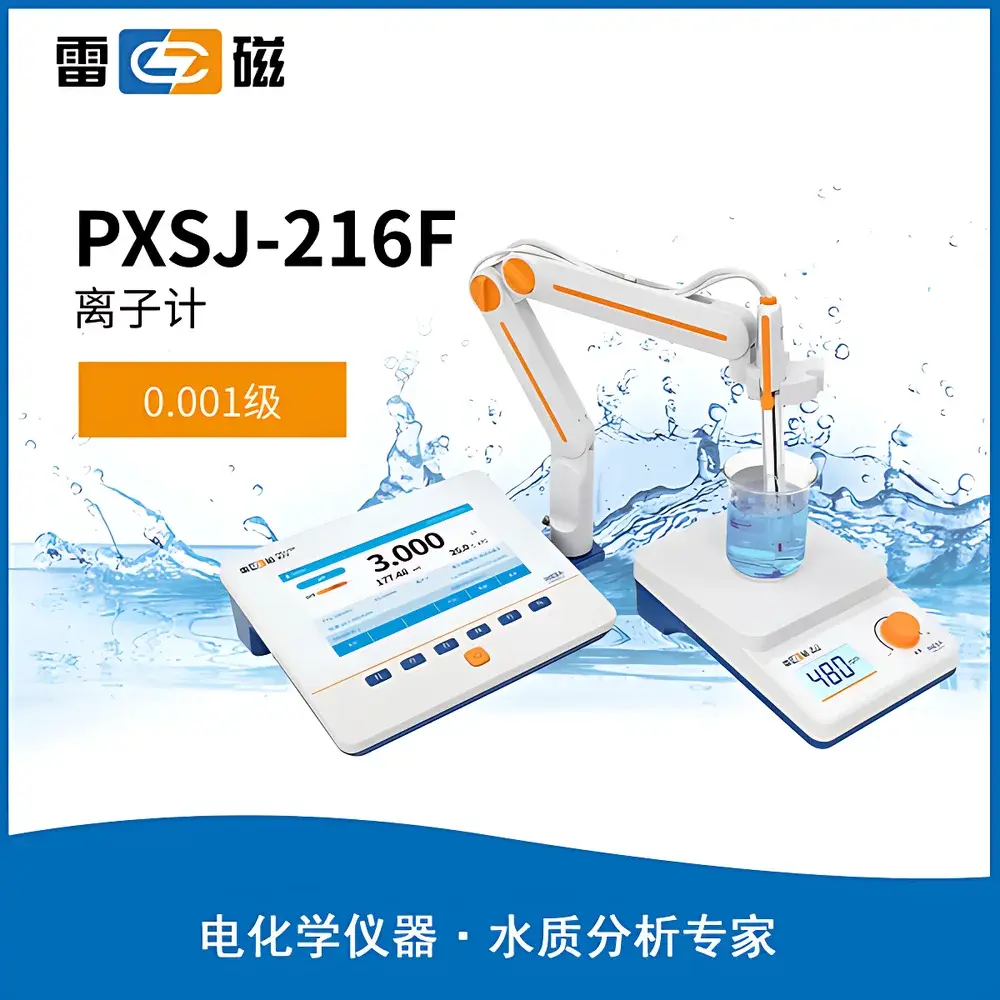
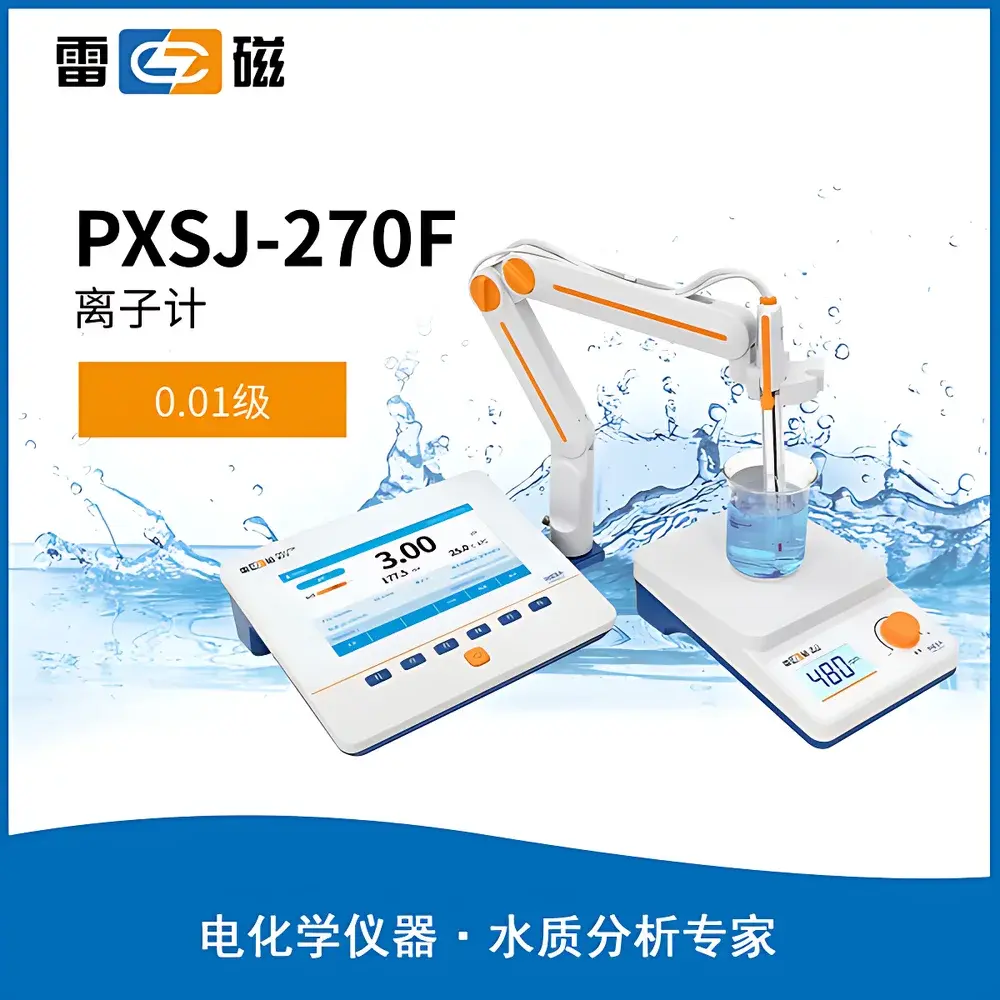
Leici PXSJ-227L / PXSJ-226T / PXSJ-216F / PXSJ-270F Ion Meters
| Brand | Leici |
|---|---|
| Origin | Shanghai, China |
| Model Series | PXSJ-227L, PXSJ-226T, PXSJ-216F, PXSJ-270F |
| Sample Introduction | Direct immersion |
| Category | Ion Meters (Potentiometric Ion-Selective Electrode Analyzers) |
Overview
The Leici PXSJ series ion meters are a family of benchtop and portable potentiometric analyzers engineered for precise, reliable measurement of ionic activity in aqueous solutions using ion-selective electrodes (ISEs). These instruments operate on the principle of Nernstian potential response—measuring the voltage difference between an ISE and a reference electrode to determine the logarithmic concentration (activity) of target ions such as F⁻, Cl⁻, NO₃⁻, K⁺, Na⁺, Ca²⁺, and others. Unlike mass-spectrometry or chromatographic techniques, ISE-based analysis provides rapid, reagent-free, non-destructive quantification with minimal sample preparation—making it ideal for routine quality control, environmental monitoring, pharmaceutical validation, and academic research. Each model in the PXSJ series is purpose-built: the PXSJ-227L emphasizes rugged portability and field-ready operation; the PXSJ-226T delivers laboratory-grade accuracy and full GLP/GMP compliance; the PXSJ-216F balances performance and operational simplicity for mid-tier labs; and the PXSJ-270F offers modular expandability for multi-ion, multi-parameter workflows. All models simultaneously measure pH, ORP (redox potential), and temperature, with automatic temperature compensation (ATC) algorithms conforming to ISO 7027 and ASTM D1293 standards.
Key Features
- Multi-parameter capability: Simultaneous real-time measurement of ion concentration (mV or ppm), pH, ORP, and temperature
- Advanced electrode interface: Gold-plated, IP-rated (PXSJ-226T: IP54; PXSJ-227L: IP65) connectors with anti-leak, dust-resistant design for long-term electrode stability
- Intelligent calibration: Multi-point (2–5 point) calibration with auto-standard recognition, user-definable standard concentrations, and slope/offset validation per electrode
- Robust data integrity: Built-in audit trail (PXSJ-226T), electronic signature support, and user-level access control (Admin/Operator/Viewer)
- Flexible connectivity: Dual communication interfaces (RS-232 + USB host/device); optional Bluetooth/Wi-Fi modules (PXSJ-227L/PXSJ-270F) for wireless data transfer to LIMS or cloud platforms
- Comprehensive diagnostics: Real-time electrode status monitoring—including slope calculation, asymmetry potential, and membrane resistance estimation—aligned with USP <797> and EP 2.2.16 guidance
- Power resilience: Internal rechargeable Li-ion battery (PXSJ-227L: up to 16 h continuous use); auto-save on power loss; cold-start recovery without data corruption
Sample Compatibility & Compliance
All PXSJ models accept standard BNC or DIN-type ion-selective electrodes and reference electrodes compatible with ASTM D6919 (determination of fluoride in water), ISO 10304-1 (anion analysis by ISE), and EPA Method 300.1 (determination of common anions). Sample introduction is via direct immersion—no autosampler integration required, though the PXSJ-226T supports optional robotic arm synchronization for high-throughput batch analysis. The instruments comply with electromagnetic compatibility (EMC) per IEC 61326-1 and electrical safety per IEC 61010-1. For regulated environments, the PXSJ-226T meets FDA 21 CFR Part 11 requirements for electronic records and signatures when configured with time-stamped, encrypted log export and role-based authentication. Calibration traceability aligns with ISO/IEC 17025:2017 Annex A.5 for measurement uncertainty estimation.
Software & Data Management
Data handling architecture varies across models but maintains consistent export fidelity: CSV, TXT, and PDF report formats are universally supported. The PXSJ-226T includes embedded software compliant with GLP audit requirements—retaining raw mV readings, calibration history, operator ID, timestamped events, and instrument configuration snapshots for ≥10,000 measurements. The PXSJ-270F and PXSJ-227L support firmware-over-the-air (FOTA) updates via USB or network, enabling future protocol expansion (e.g., custom ion equations, multi-slope interpolation). PC software (Leici LabLink Pro, Windows/macOS) enables advanced curve fitting, statistical outlier detection (Dixon’s Q-test), and trend visualization across batches. All models store ≥2,000 measurement records locally with date/time stamping and automatic file naming conventions (e.g., “ION_F_20240522_143218.csv”).
Applications
- Environmental field testing: On-site determination of fluoride in groundwater (EPA 300.1), chloride in wastewater effluent, and nitrate in agricultural runoff
- Pharmaceutical QC: Quantification of residual sodium in lyophilized APIs, potassium in oral rehydration salts, and chloride in parenteral solutions per USP <1231>
- Food & beverage safety: Monitoring sodium in processed meats, fluoride in bottled water, and calcium in fortified dairy products per AOAC 975.04
- Academic research: Teaching potentiometric principles in analytical chemistry labs; validating ion transport kinetics in membrane studies
- Industrial process control: Real-time tracking of etchant bath composition (e.g., HF in semiconductor cleaning), boiler water alkalinity, and desalination brine monitoring
FAQ
What ion-selective electrodes are compatible with the PXSJ series?
Standard BNC-terminated ISEs from Leici, Orion (Thermo Fisher), and Metrohm—covering F⁻, Cl⁻, Br⁻, I⁻, NO₃⁻, NH₄⁺, K⁺, Na⁺, Ca²⁺, and CN⁻—are fully supported. Electrode compatibility is verified per ISO 15197:2013 Annex B.
Does the PXSJ-226T support 21 CFR Part 11 compliance out-of-the-box?
Yes—when deployed with password-protected user roles, electronic signature capture, and encrypted audit log export enabled. Full validation documentation (IQ/OQ/PQ templates) is available upon request.
Can the PXSJ-270F be upgraded to support additional ion modules after purchase?
Yes—the instrument features a modular firmware architecture and expansion slots for future ISE-specific calibration kits and algorithm packs, purchasable as licensed software upgrades.
Is temperature compensation applied automatically during ion measurement?
Yes—ATC uses either built-in Pt1000 sensor input or external thermistor probes (0.1 °C resolution), applying Nernst equation correction per ISO 17034:2016 Annex C.
How is electrode performance validated during routine use?
Each measurement cycle includes slope verification against stored calibration data; deviation >5% triggers visual alert and optional lockout until recalibration or electrode replacement.






