
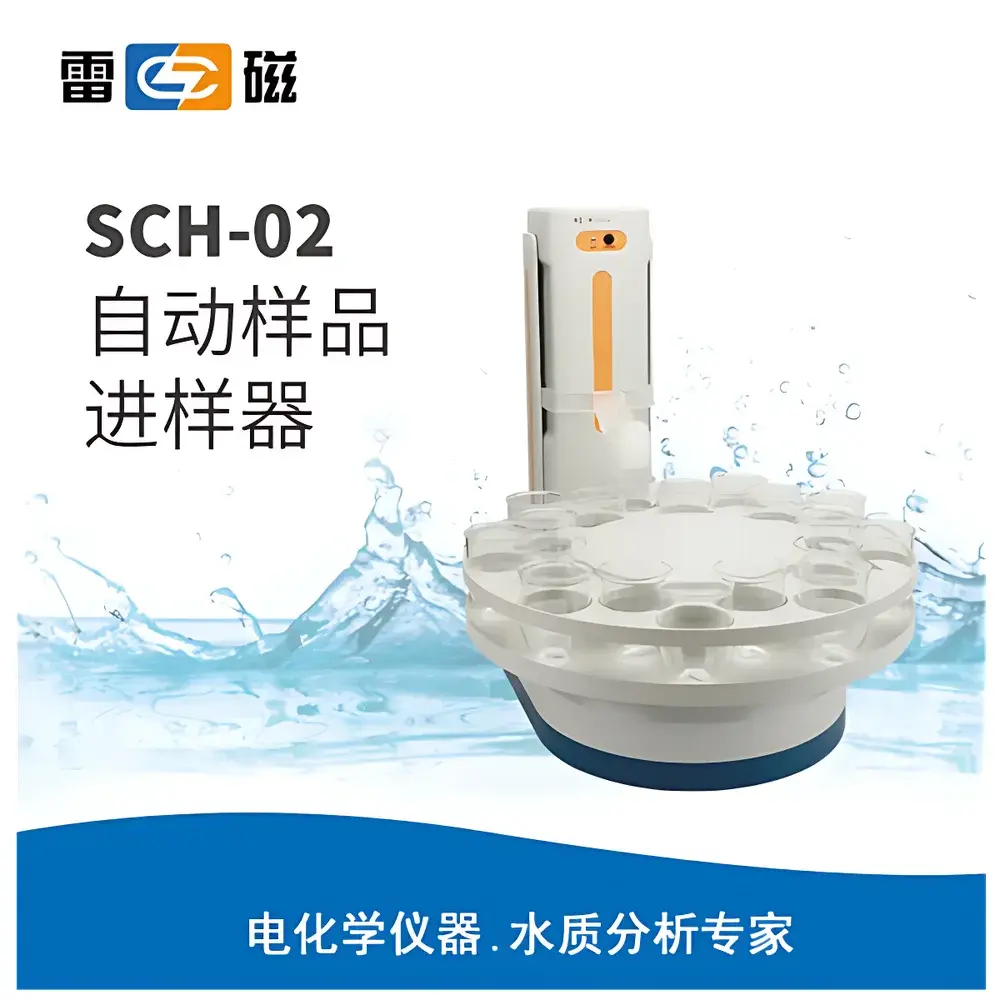
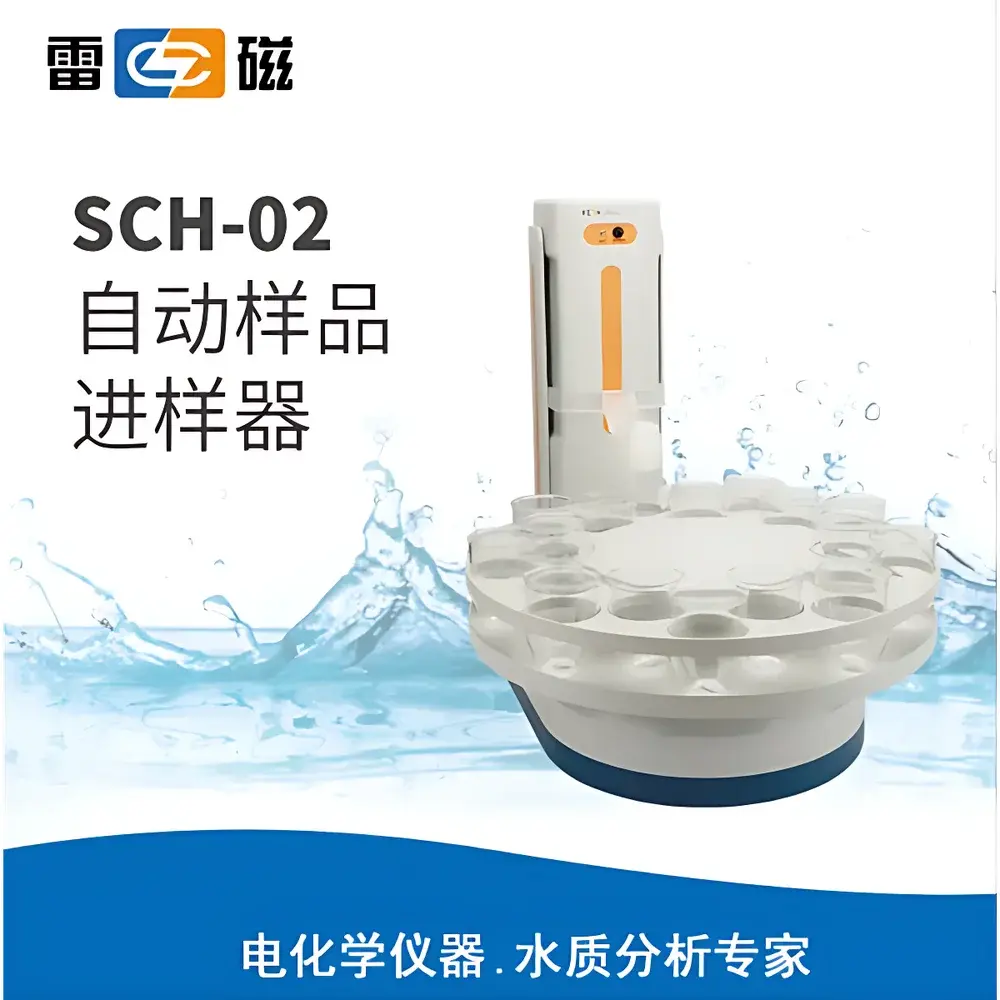
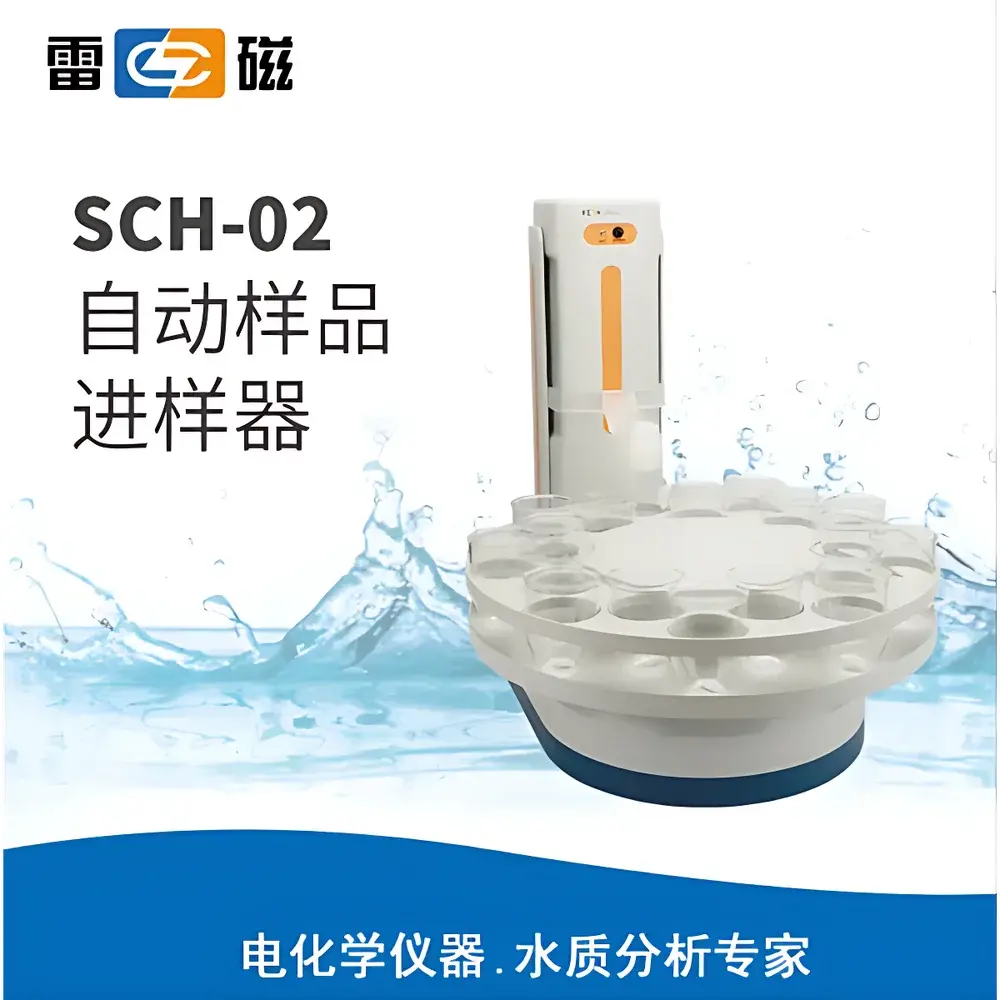
Leici SCH-02 Multifunctional Autosampler
| Brand | Leici |
|---|---|
| Origin | Shanghai, China |
| Manufacturer Type | Authorized Distributor |
| Product Category | Domestic |
| Model | SCH-02 |
| Instrument Type | Multifunctional Autosampler |
| Maximum Sample Capacity | 24 positions |
| Minimum Injection Volume | 50 µL |
| Positioning Accuracy | ±0.1 mm |
| Actuation Method | Robotic Arm Drive |
| Needle Wash Mode | Automated Solvent Rinse (Integrated Wash Station with Dual-Solvent Capability) |
| Repeat Injection Cycles | 1–99 (Programmable) |
| Post-Injection Purge | Yes (Automatic Residue Blow-Off) |
| Compatible Sample Tray Configurations | 32-position × 50 mL |
| Stirring Function | Optional Top or Bottom Magnetic Stirring |
| Interface Options | USB + RS-232 |
| Communication Protocol | ASCII-based Command Set (Documented for Third-Party Integration) |
Overview
The Leici SCH-02 Multifunctional Autosampler is an engineered sample-handling module designed to integrate seamlessly with benchtop electrochemical analyzers—including titrators (e.g., ZDJ-5B), potentiometric systems (L-series and T-series instruments), and PC-controlled analytical platforms. It operates on a precision robotic arm architecture, enabling deterministic spatial positioning of sample vials and electrodes within defined tray geometries. Unlike fixed-loop or syringe-pump-based autosamplers used in HPLC or GC workflows, the SCH-02 implements a modular, tray-based sampling paradigm optimized for aqueous-phase electrochemical measurements where sample integrity, electrode conditioning, and contamination control are critical. Its core function is not chromatographic separation but rather high-reproducibility sequential handling—enabling unattended batch analysis, method validation via repeated injections, and rigorous electrode activation protocols across heterogeneous sample sets.
Key Features
- Precision robotic arm with ±0.1 mm positional repeatability ensures consistent electrode immersion depth and pipetting alignment across all tray formats.
- Triple-tray compatibility: supports 32-position (50 mL vials), 24-position (100 mL vials), and 18-position (200 mL vials) configurations—allowing flexibility for dilution series, standard calibration sets, or large-volume environmental samples.
- Dual-mode needle cleaning: automated solvent rinse using programmable dwell time and flow rate, with dedicated wash station accommodating two solvents (e.g., water followed by ethanol) to prevent cross-contamination between polar and nonpolar matrices.
- Integrated stirring capability—selectable top-mounted magnetic stirrer or bottom-positioned stir bar actuation—ensures homogeneous solution conditions prior to measurement, critical for pH, ion-selective electrode (ISE), or redox titration applications.
- Post-injection purge cycle activates compressed air or inert gas to evacuate residual liquid from the needle tip, minimizing carryover and improving inter-sample reproducibility (RSD < 0.8% typical for 100 µL injections).
- Robust communication stack: ASCII command protocol over RS-232 or USB enables bidirectional handshake with host instruments, supporting status polling, error reporting, and real-time position feedback—essential for GLP-compliant audit trails.
Sample Compatibility & Compliance
The SCH-02 is validated for use with aqueous, buffered, and mildly organic solvent-based samples (up to 20% v/v methanol or acetonitrile). Its fluid path materials—chemically resistant PTFE tubing, ceramic needle tips, and stainless-steel wash station components—are compatible with common titration reagents (e.g., AgNO₃, EDTA, NaOH) and electrode conditioning solutions (KCl, HNO₃, saturated KNO₃). While not certified to IEC 61000-6-3 or ISO/IEC 17025 as a standalone instrument, its operational logic adheres to principles outlined in ISO 17025:2017 Clause 7.2.2 (method validation) and ASTM D1193 (reagent water specifications) when deployed in accredited laboratories. The self-diagnostic firmware logs hardware faults (e.g., motor stall, sensor timeout) with timestamps, supporting traceability under FDA 21 CFR Part 11 when paired with compliant host software.
Software & Data Management
The SCH-02 does not include embedded GUI or local storage. Instead, it functions as a peripheral device controlled exclusively through external command sets. Leici provides a documented ASCII protocol specification (v2.1), including checksum validation, timeout thresholds, and error code mapping (e.g., “ERR-07” = wash solvent depletion). Integration with third-party LIMS or ELN platforms is achieved via serial-to-TCP bridges or Python/Node.js drivers developed using the open command schema. All motion events, injection counts, and cleaning cycles are relayed as discrete telemetry strings—enabling full integration into electronic lab notebooks with timestamped metadata. No proprietary runtime or license is required; configuration resides entirely in the host controller’s script environment.
Applications
- Unattended multi-point calibration of ion-selective electrodes (e.g., F⁻, Cl⁻, NH₄⁺) across concentration gradients.
- Repeatability assessment per ISO 5725-2:2019—executing ≥10 replicate injections of identical standards to quantify within-run precision.
- Automated electrode regeneration: sequential immersion in activation solutions (e.g., 0.1 M HNO₃ → deionized water → 3 M KCl) with timed stirring and rinse steps.
- Bulk titration of wastewater samples (COD, alkalinity, chloride) where manual handling introduces operator variability.
- Method development workflows requiring variable injection volumes (50–500 µL), staggered stirring durations, and conditional branching based on prior measurement outcomes.
FAQ
Does the SCH-02 operate independently?
No. It requires continuous command input from a host controller (e.g., ZDJ-5B titrator, custom PC application) and has no onboard display, keypad, or autonomous scheduling capability.
Can it be used with non-Leici instruments?
Yes—provided the host system supports RS-232/USB serial communication and can issue ASCII commands per the publicly available protocol specification.
What maintenance intervals are recommended?
Needle tip inspection every 500 injections; wash station solvent reservoir refill before each 24-sample batch; annual verification of robotic arm backlash using calibrated gauge blocks.
Is the stirring function compatible with all sample vial sizes?
Top stirring is universally supported; bottom stirring requires vial geometry permitting stir bar rotation—verified for 100 mL and 200 mL trays with standard flat-bottom polypropylene vials.
How is carryover quantified during validation?
Using a bracketing standard approach: inject high-concentration standard, followed by blank, then repeat; carryover is calculated as (blank response / high-standard response) × 100%, with acceptance ≤ 0.5% for regulatory submissions.






