
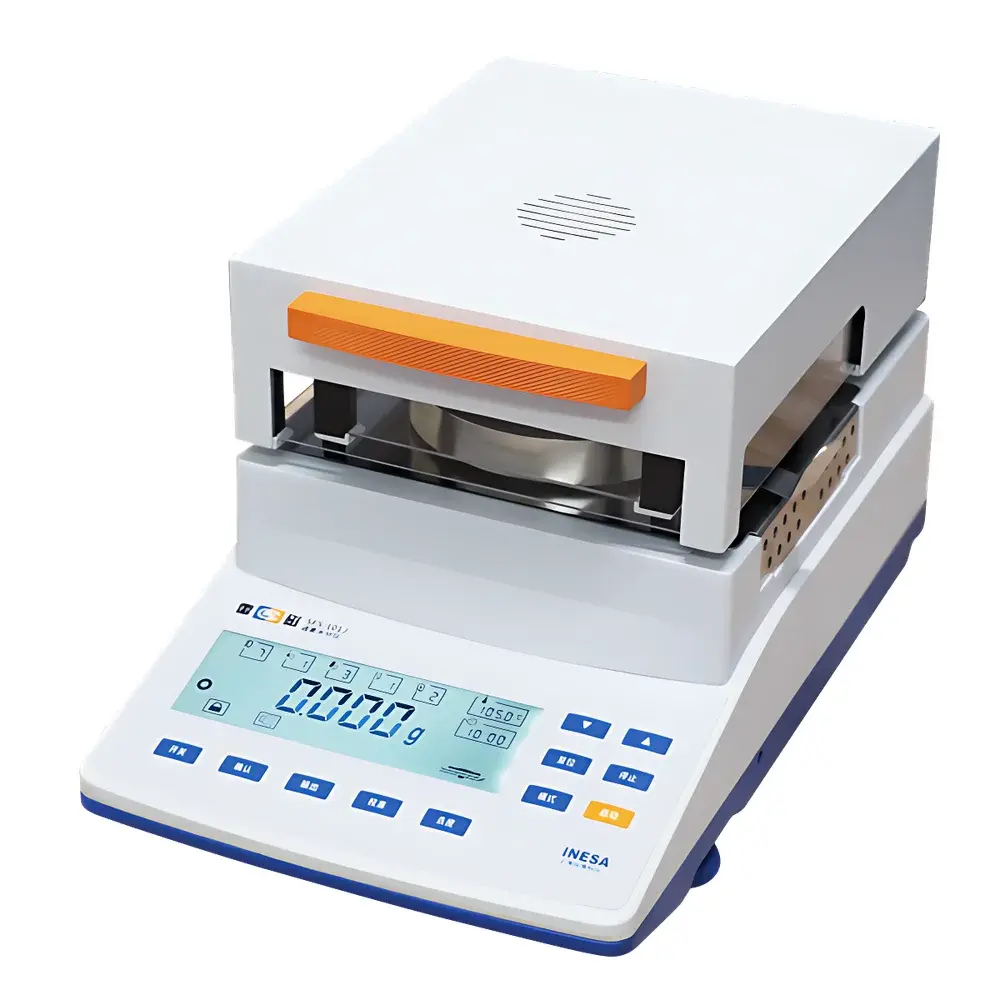
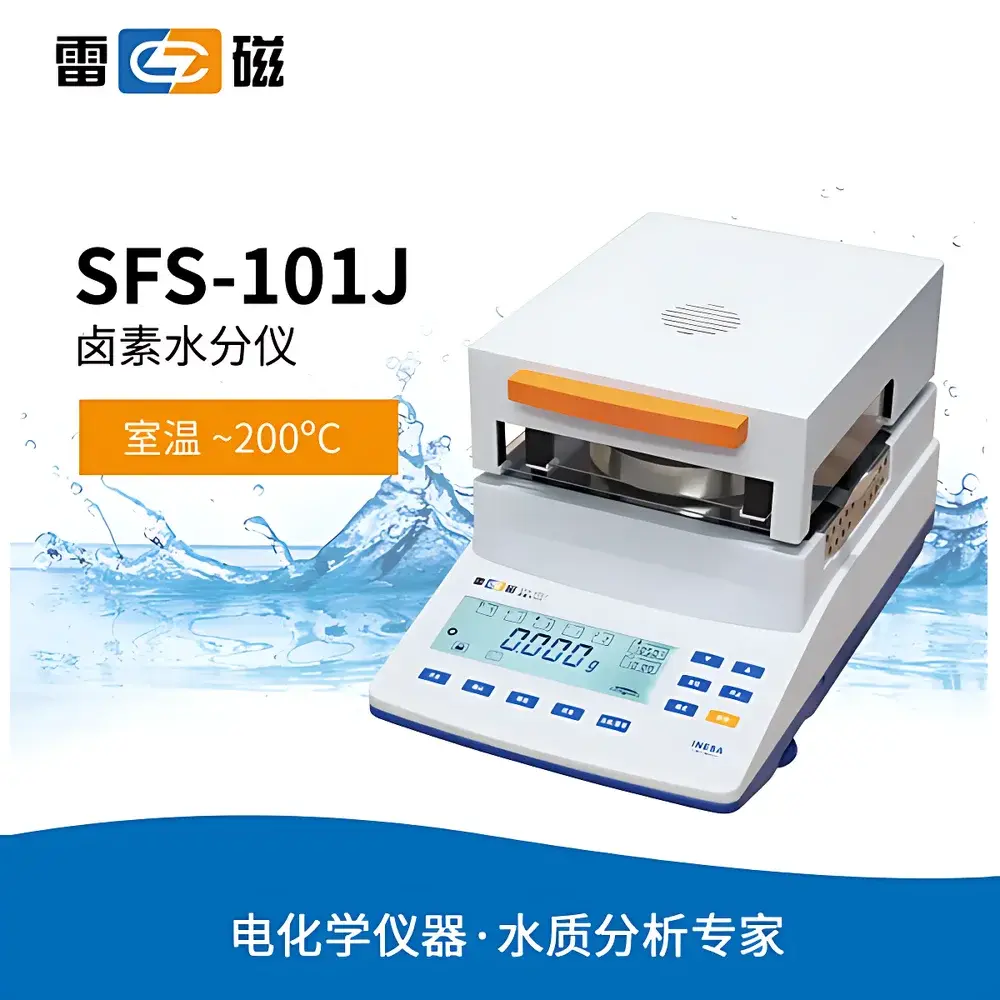
Leici SFS-101J Halogen Moisture Analyzer
| Brand | Leici |
|---|---|
| Origin | Shanghai, China |
| Manufacturer Type | Direct Manufacturer |
| Country of Origin | China |
| Model | SFS-101J Halogen Moisture Analyzer |
| Price Range | USD 720 – 1,430 (FOB) |
| Weighing Range | 0.2 g to 110 g |
| Readability | 1 mg (d), 10 mg (e) |
| Moisture Readability | 0.01% |
| Accuracy Class | Class II (per OIML R76) |
| Minimum Sample Mass | 1 g |
| Heating Source | Circular Halogen Lamp |
| Temperature Control Range | Ambient to 200 °C |
| Heating Chamber Material | Stainless Steel |
| Sample Pan Diameter | 90 mm |
| Measurement Endpoints | Auto, Manual, and Semi-Automatic Modes |
| Displayed Parameters | Moisture %, Dry Matter %, ATRO Dry Basis %, ATRO Wet Basis % |
| Drying Programs | Standard, Fast, and Slow Drying |
| Timer Range | 0–90 min |
| Real-time Display | Current Temperature, Elapsed Time, Instantaneous Moisture % |
| Interface | RS-232 Serial Port for Printer Output |
| Power Supply | 220 V ±10%, 50/60 Hz |
| Dimensions (W×D×H) | 330 × 200 × 200 mm |
| Net Weight | 5.8 kg |
Overview
The Leici SFS-101J Halogen Moisture Analyzer is a precision laboratory instrument engineered for rapid, gravimetric determination of moisture content in solid and semi-solid materials. It operates on the loss-on-drying (LOD) principle: a pre-weighed sample is heated under controlled halogen radiation, and the mass loss—attributed to volatilization of water and other volatile components—is measured in real time using a high-resolution analytical balance integrated into the instrument’s robust thermal enclosure. Unlike infrared or convection-based systems, the circular halogen lamp delivers uniform, directional heating with fast thermal response and minimal thermal inertia, enabling consistent drying profiles across heterogeneous samples. Designed for routine QC/QA workflows in food, pharmaceutical, chemical, and agricultural laboratories, the SFS-101J meets fundamental metrological requirements defined in ISO 18810:2017 (Moisture analyzers — Performance criteria and verification procedures) and supports traceable operation under GLP and GMP environments when paired with documented calibration and maintenance protocols.
Key Features
- High-contrast LCD interface with intuitive navigation and multilingual support (English default), optimized for glove-compatible operation in production labs.
- Circular halogen heating system ensuring radial thermal symmetry and reproducible surface energy distribution—critical for minimizing case-hardening in hygroscopic or particulate samples.
- Integrated safety interlocks: automatic heater shutdown upon lid opening, real-time temperature monitoring with overheat warning, and sample mass stability alert prior to result finalization.
- Three programmable drying modes—Standard (balanced speed/accuracy), Fast (high-power ramp for low-moisture matrices), and Slow (gentle ramp for thermally sensitive or porous materials)—each fully customizable in temperature setpoint and duration.
- Flexible endpoint detection: Auto mode terminates measurement when mass change falls below user-defined threshold (e.g., 0.1 mg/5 s); Manual mode allows fixed-duration runs; Semi-Auto combines time limit with dynamic stability criteria.
- Real-time display of current temperature, elapsed heating time, instantaneous moisture %, and intermediate dry matter values—enabling immediate process diagnostics without data export.
Sample Compatibility & Compliance
The SFS-101J accommodates a broad range of sample types including powders (e.g., lactose, starch), granules (fertilizers, feed pellets), pastes (pharmaceutical ointments), and thin films (polymer sheets), provided minimum mass (≥1 g) ensures statistical representativeness and balances signal-to-noise ratio. The stainless-steel heating chamber resists corrosion from acidic or saline residues and permits easy cleaning between analyses. While not certified to ASTM E1447 or USP , the instrument supports method development aligned with these standards through adjustable parameters and audit-ready output logs. Its Class II accuracy rating per OIML R76 confirms suitability for non-automatic weighing applications where regulatory tolerance thresholds are ≤0.1% relative error at full scale.
Software & Data Management
Data output is supported exclusively via RS-232 serial interface, compatible with standard ESC/P or PCL command-set printers for immediate hardcopy reporting—including date/time stamp, sample ID, method name, initial/final mass, moisture %, and operator ID (if entered manually). No proprietary software or USB connectivity is included; however, third-party Lab Information Management Systems (LIMS) with serial input capability can ingest ASCII-formatted results via terminal emulation. All measurements retain embedded timestamps and thermal history metadata, satisfying basic FDA 21 CFR Part 11 expectations for electronic records when combined with procedural controls (e.g., password-protected method editing, logbook-style manual entry of sample IDs).
Applications
- Food industry: Moisture validation in flour, coffee beans, spices, and dried fruits per AOAC 950.46 and ISO 665.
- Pharmaceutical manufacturing: In-process control of active pharmaceutical ingredient (API) drying cycles and excipient qualification per ICH Q5C guidelines.
- Agricultural testing: Grain moisture certification for storage compliance (ISO 712) and feed formulation consistency.
- Chemical QA: Verification of desiccant efficacy, polymer resin drying endpoints, and catalyst hydration state.
- Academic research: Method optimization studies comparing halogen LOD against Karl Fischer titration for matrix-specific bias assessment.
FAQ
What calibration standards are recommended for routine verification?
NIST-traceable stainless-steel weights (10 g and 100 g) for balance verification, and certified moisture reference materials (e.g., sodium tartrate dihydrate, ~15.66% H₂O) for thermal performance checks.
Can the SFS-101J be used for volatile organic compound (VOC) quantification?
No—it measures total volatile loss as “moisture” by default. Differentiation requires complementary techniques (e.g., GC-MS) or validated correction factors derived from comparative studies.
Is the halogen lamp replaceable by the user?
Yes—the lamp module is field-replaceable using standard Torx tools; replacement interval is typically 5,000–8,000 hours depending on average operating temperature and duty cycle.
Does the instrument support GLP-compliant audit trails?
Not natively—audit trail functionality requires external logging via RS-232 capture software or integration into a validated LIMS platform with timestamped record retention.
What environmental conditions are required for optimal performance?
Stable ambient temperature (15–30 °C), relative humidity <80% RH non-condensing, and vibration-isolated benchtop placement away from drafts or direct sunlight.




