
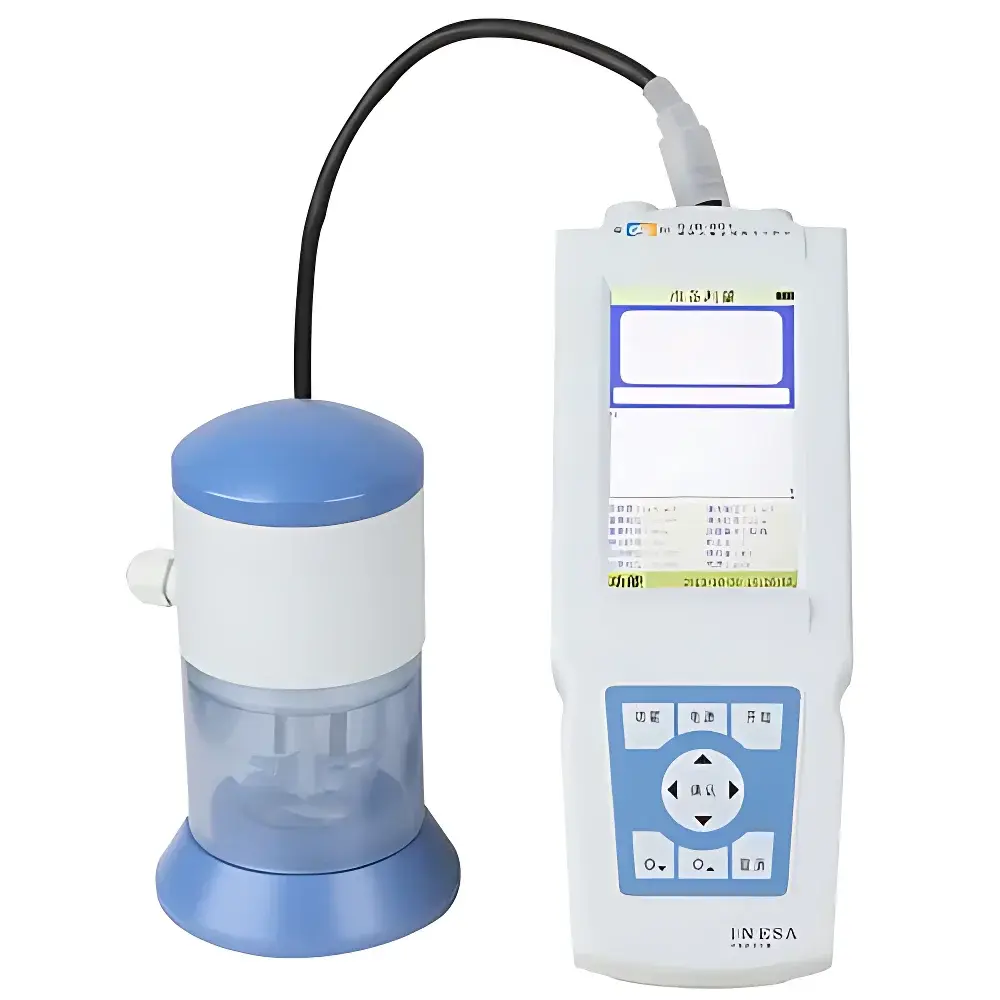
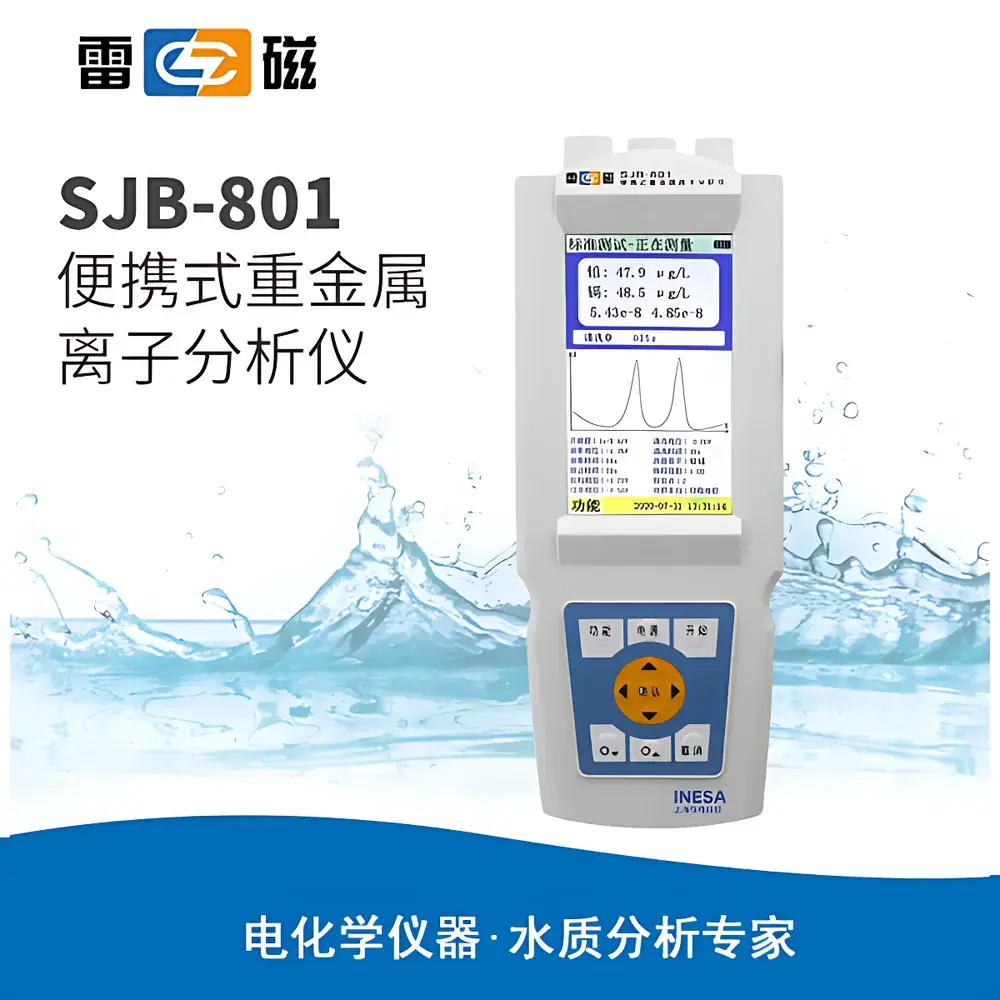
LeiCi SJB-801 Portable Heavy Metals Analyzer for Water Quality
| Brand | LeiCi |
|---|---|
| Origin | Shanghai, China |
| Manufacturer Type | Direct Manufacturer |
| Instrument Type | Portable |
| Detection Principle | Anodic Stripping Voltammetry (ASV) |
| Detectable Metals | Pb, Cd, Cu, As, Hg, Zn, Se, Mn, Ni, Cr (10 ions) |
| Measurement Time | ≤3 min per ion |
| Accuracy | ±5% or ±5.0 µg/L (for Pb, Cd, Cu, As, Zn, Se, Mn, Ni ≤100 µg/L) |
| Resolution | 0.1 µg/L |
| Detection Limits | Pb, Cd, Cu, As ≤0.5 µg/L |
| Repeatability | RSD ≤3% |
| IP Rating | IP65 |
| Power Options | 4×AA Ni-MH rechargeable batteries, USB power supply, external mobile power bank, or automotive USB adapter |
Overview
The LeiCi SJB-801 Portable Heavy Metals Analyzer is an electrochemical field instrument engineered for rapid, on-site quantification of priority toxic metals in aqueous environmental matrices. It operates on the principle of Anodic Stripping Voltammetry (ASV), a well-established trace electroanalytical technique that combines pre-concentration of metal ions onto a working electrode surface under controlled potential, followed by oxidative stripping and current measurement. This method delivers laboratory-grade sensitivity—detection limits down to 0.1 µg/L for mercury and ≤0.5 µg/L for lead, cadmium, copper, and arsenic—without requiring centralized lab infrastructure. Designed specifically for regulatory monitoring workflows, the SJB-801 meets the performance expectations of field-deployed screening tools used in compliance verification, emergency response, and source water surveillance. Its compact form factor, ruggedized housing, and battery-operated architecture enable uninterrupted operation in remote sampling locations, wastewater outfalls, drinking water distribution points, and industrial effluent discharge zones.
Key Features
- 4.3-inch high-resolution color TFT display with intuitive menu-driven interface and real-time graphical visualization of voltammetric scan curves
- Integrated three-electrode system (working, reference, and counter electrodes) with built-in magnetic stirring for uniform mass transport and reproducible deposition kinetics
- Automated calibration, electrode cleaning, and blank subtraction routines—minimizing operator dependency and inter-user variability
- Multiple pre-programmed analysis modes: Rapid Test (3-step workflow), Standard ASV, and Standard Addition—each optimized for matrix complexity and regulatory reporting requirements
- Pre-loaded analytical methods for 10 heavy metal ions: Pb, Cd, Cu, As, Hg, Zn, Se, Mn, Ni, and Cr—with firmware-upgradable capability for future ion expansion
- GLP-compliant data handling: timestamped measurements, audit-trail-enabled storage (up to 2000 records), SD card export, and optional RexHM desktop software integration
- IP65-rated enclosure ensuring dust-tightness and resistance to low-pressure water jets—suitable for outdoor deployment in rain, humidity, or dusty conditions
Sample Compatibility & Compliance
The SJB-801 is validated for direct analysis of filtered natural waters, treated drinking water, surface runoff, and municipal wastewater effluents. Sample preparation is minimal: filtration through 0.45 µm membrane filters is recommended to remove particulates; pH adjustment (to 4.0–5.5) and addition of supporting electrolyte (e.g., acetate buffer) are performed in-field using supplied reagent kits. The instrument complies with core principles outlined in ASTM D3559 (lead in water), ISO 8692 (freshwater toxicity testing), and EPA Method 7000B (anodic stripping voltammetry for metals). While not certified as a primary reference method, its performance aligns with Tier 1 screening criteria defined in WHO Guidelines for Drinking-water Quality and EU Directive 2020/2184. All stored data retain full traceability—including electrode ID, calibration history, user logins, and environmental ambient readings—for internal QA/QC audits and GLP/GMP-aligned laboratories.
Software & Data Management
Data acquisition, processing, and reporting are supported via the proprietary RexHM Heavy Metals Analysis Software (Windows-compatible). The software enables batch calibration curve generation, multi-ion simultaneous quantification, interference correction modeling (e.g., Cu–As overlap compensation), and automated report generation compliant with ISO/IEC 17025 documentation standards. Communication occurs via Mini-USB interface with full bidirectional control—allowing remote firmware updates, method synchronization, and secure encrypted data transfer. Audit logs record every critical action (e.g., calibration initiation, method selection, result deletion), satisfying FDA 21 CFR Part 11 requirements for electronic records when deployed in regulated environments. Export formats include CSV, PDF, and XML for LIMS integration.
Applications
- Regulatory field screening for EPA Clean Water Act and EU Water Framework Directive compliance
- Rapid assessment of contaminated sites during environmental emergency response (e.g., mine tailings breaches, industrial spills)
- Point-of-use verification in decentralized water treatment systems and rural community wells
- QA/QC support for municipal water utilities performing routine distribution system monitoring
- Academic and research applications in aquatic ecotoxicology, sediment porewater profiling, and bioavailability studies
- Industrial pretreatment program verification for electroplating, semiconductor fabrication, and battery manufacturing facilities
FAQ
What sample volume is required for a single measurement?
A typical analysis requires 10–20 mL of filtered, buffered sample—optimized for sensitivity while minimizing reagent consumption.
Can the instrument detect metals in seawater or high-salinity samples?
Yes, with appropriate matrix-matched calibration and chloride interference mitigation protocols; however, detection limits may increase by up to 30% in salinities >10 ppt.
Is electrode replacement required after each test?
No—the integrated screen-printed carbon electrode (SPCE) supports ≥50 consecutive measurements when used with supplied cleaning cycles and proper storage.
Does the device meet international shipping and safety standards?
Yes: certified to IEC 61010-1 (electrical safety), UN 38.3 (lithium battery transport), and CE marking for EMC and RoHS compliance.
How is method validation documented for regulatory submissions?
Each unit ships with a Factory Performance Verification Report including LOD/LOQ verification, linearity (R² ≥0.995), spike recovery (85–115%), and inter-day precision (RSD ≤4.2%) across all 10 target metals.







