
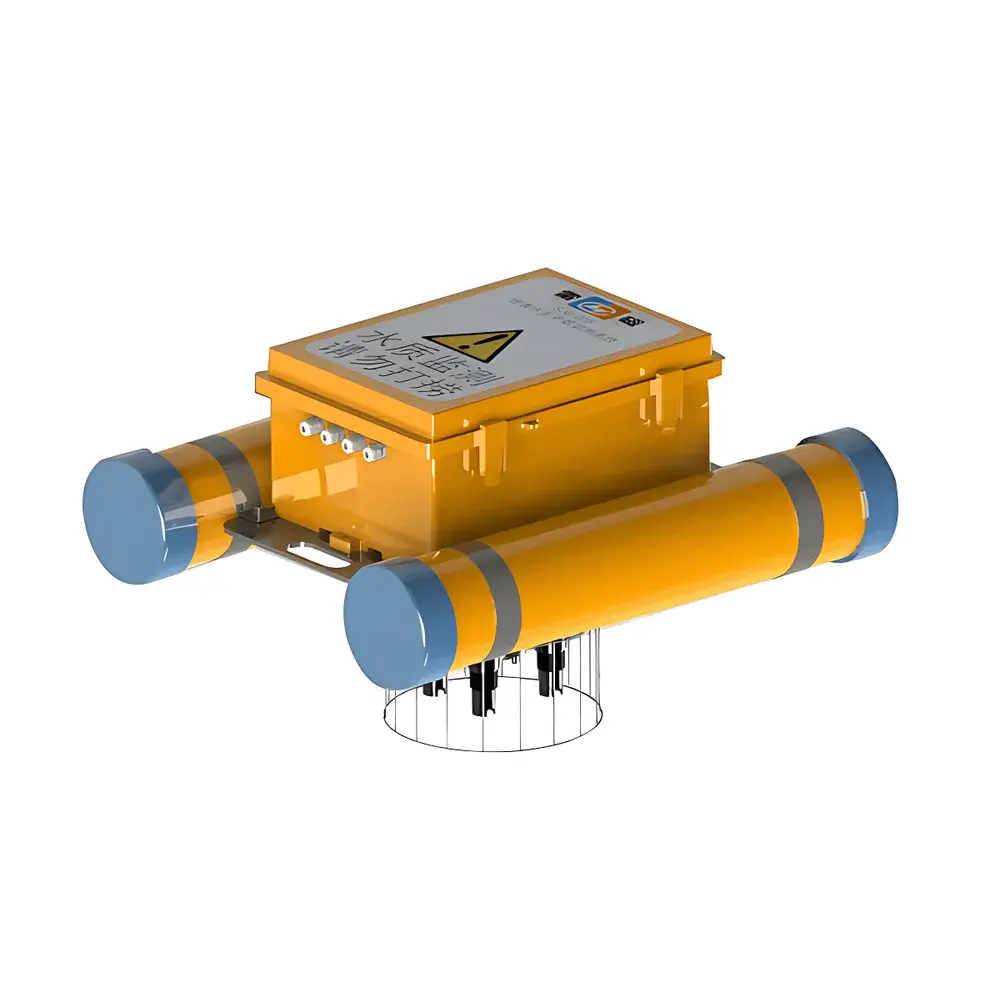
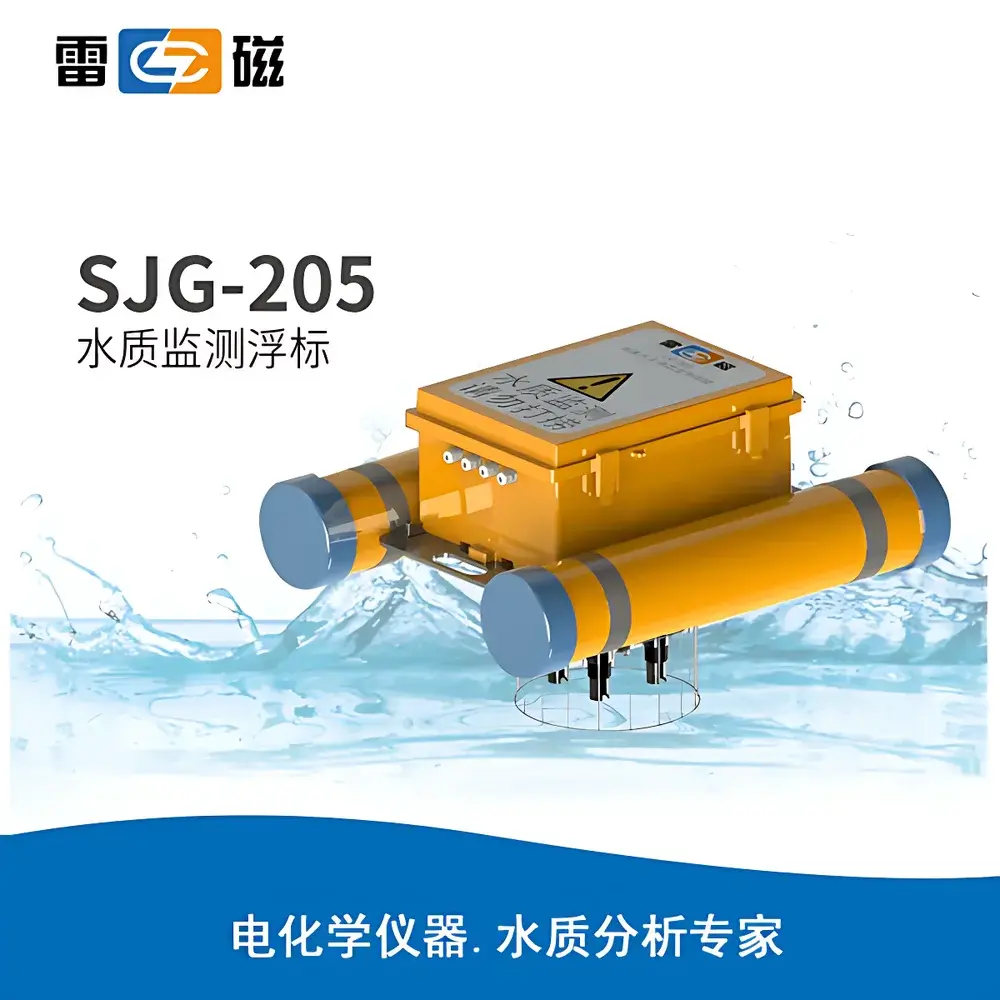
Leici SJG-205 Online Autonomous Water Quality Monitoring Buoy
| Brand | Leici |
|---|---|
| Origin | Shanghai, China |
| Manufacturer Type | Original Equipment Manufacturer (OEM) |
| Country of Origin | China |
| Model | SJG-205 |
| Price | USD 139,800 (FOB Shanghai) |
| Power Options | Shore-based AC, Rechargeable Battery Bank, or Solar Photovoltaic System |
| Communication | LTE-M / NB-IoT / 4G Cellular + Optional LoRaWAN Gateway Integration |
| Weight | ≤ 45 kg (fully configured) |
| Buoy Hull Material | UV-stabilized HDPE with Marine-grade Stainless Steel Mounting Frame |
| Sensor Interface | RS-485 Modbus RTU / SDI-12 / Analog 4–20 mA (configurable per probe) |
| Data Transmission Interval | Adjustable from 1 min to 24 h |
| GPS Accuracy | < 5 m CEP (with GLONASS/Galileo support) |
| Self-Cleaning Mechanism | Brush-based or Ultrasonic (sensor-specific) |
| Remote Calibration Support | Two-point (zero/span) via encrypted OTA command |
| Battery Runtime | Up to 180 days (typical, solar-assisted mode) |
| Compliance | IP68 Submersion Rating, CE EMC Directive 2014/30/EU, RoHS 2011/65/EU, ISO 17025 Traceability (calibration certificate optional) |
Overview
The Leici SJG-205 is an autonomous, solar-ready water quality monitoring buoy engineered for long-term, unattended deployment in rivers, canals, reservoirs, and estuarine environments. It operates on the principle of in-situ multi-parameter electrochemical and optical sensing, enabling real-time acquisition of physicochemical and biological water quality indicators directly within the water column. Unlike fixed-station analyzers requiring infrastructure, the SJG-205 functions as a mobile node within a distributed sensor network—supporting dynamic spatial monitoring, early warning of contamination events, and empirical modeling of pollutant dispersion patterns. Its architecture integrates environmental resilience with data integrity: the buoy’s hull is constructed from UV-resistant high-density polyethylene (HDPE), while all submerged sensor housings comply with ISO 14688-1 for aquatic exposure durability. Designed for operational continuity under variable hydrological conditions—including tidal fluctuations, sediment-laden flows, and seasonal algal blooms—the system maintains measurement stability through temperature-compensated transducers and pressure-tolerant electronics rated to 10 m submersion depth.
Key Features
- Modular sensor payload architecture supporting up to 12 simultaneous parameters via hot-swappable probe bays;
- Triple power redundancy: integrated lithium-iron-phosphate (LiFePO₄) battery bank, monocrystalline solar panel (20 W nominal), and optional shore-based AC input with surge protection;
- Real-time residual power telemetry with predictive maintenance alerts based on charge cycle history and ambient irradiance;
- Onboard microcontroller with dual-mode calibration capability—manual field calibration via Bluetooth interface or over-the-air (OTA) remote calibration using authenticated command protocols;
- Automated mechanical brush cleaning or ultrasonic de-fouling modules for turbidity, chlorophyll-a, and blue-green algae sensors—reducing manual intervention intervals by ≥70% compared to non-cleaned configurations;
- Embedded GNSS receiver (GPS/GLONASS/Galileo) with geofence-enabled deviation alerting—triggering SMS/email notifications if positional drift exceeds user-defined thresholds (e.g., >15 m over 30 min);
- Lightweight structural design (≤45 kg fully equipped) facilitating single-person deployment from small vessels or banks without cranes;
- Secure wireless communication stack compliant with TLS 1.2 encryption and configurable data transmission intervals (1 min to 24 h) to balance bandwidth usage and temporal resolution.
Sample Compatibility & Compliance
The SJG-205 is validated for continuous immersion in freshwater, brackish, and low-salinity marine environments (up to 15 ppt). All wetted materials meet NSF/ANSI Standard 61 for drinking water system components. Sensor outputs adhere to ISO 5667-22 (water quality sampling — Part 22: Guidance on use of online sensors) and ASTM D8083 – 21 (Standard Guide for Use of In Situ Sensors in Surface Water Monitoring). The system supports traceable calibration against NIST-traceable reference standards, and optional calibration certificates are issued per ISO/IEC 17025:2017 requirements. Electromagnetic compatibility conforms to EN 61000-6-2 (immunity) and EN 61000-6-4 (emissions), ensuring stable operation near industrial infrastructure or radio-frequency sources.
Software & Data Management
Data acquisition and visualization are managed through Leici’s cloud-native platform, AquaInsight™, accessible via web browser or dedicated iOS/Android application. The platform provides time-series dashboards, anomaly detection algorithms (based on moving-window statistical thresholds), and export-ready CSV/JSON formats compatible with third-party GIS (e.g., QGIS, ArcGIS) and statistical analysis tools (R, Python pandas). Audit trails record all configuration changes, calibration events, firmware updates, and GPS position logs—meeting FDA 21 CFR Part 11 requirements for electronic records when enabled with user-role authentication and digital signature modules. Historical datasets may be archived locally on removable microSD cards (up to 128 GB) as a fail-safe during extended cellular outages.
Applications
- River basin management: longitudinal profiling of nutrient loading (NH₄⁺-N, NO₃⁻-N, NO₂⁻-N) and organic carbon (COD, TOC) across tributary confluences;
- Urban wastewater impact assessment: real-time tracking of pH shifts, ORP anomalies, and dissolved oxygen sag zones downstream of CSO outfalls;
- Ecological monitoring: correlating chlorophyll-a and phycocyanin fluorescence with cyanobacterial bloom dynamics under varying light and thermal regimes;
- Regulatory compliance reporting: automated generation of monthly summary reports aligned with China’s HJ/T 91–2019 and EU WFD Annex V reporting templates;
- Emergency response coordination: rapid redeployment to suspected contamination sites with pre-loaded sensor configurations and geo-tagged alert dissemination.
FAQ
What is the maximum depth rating for submerged sensor deployment?
The SJG-205 buoy body and standard sensor housings are rated to 10 meters static submersion depth (IP68), with optional deep-water probes available for up to 30 m (requires custom pressure compensation module).
Can the system operate continuously during prolonged cloudy periods?
Yes—battery autonomy is ≥180 days under typical solar insolation (≥3 kWh/m²/day); low-light performance is enhanced by MPPT charge controllers and adaptive sleep modes that reduce idle power consumption to <15 mW.
Is sensor cross-sensitivity compensated in firmware?
Yes—temperature, salinity, and pressure cross-effects are corrected in real time using embedded polynomial coefficients derived from factory characterization matrices per sensor type.
How is data security ensured during wireless transmission?
All cellular communications use TLS 1.2 encryption; device authentication employs X.509 certificates, and firmware updates require signed cryptographic signatures verified prior to installation.
Does the system support integration with SCADA or existing municipal monitoring platforms?
Yes—via Modbus TCP gateway or RESTful API endpoints; JSON schema documentation and sample Python SDK are provided for seamless middleware integration.







