
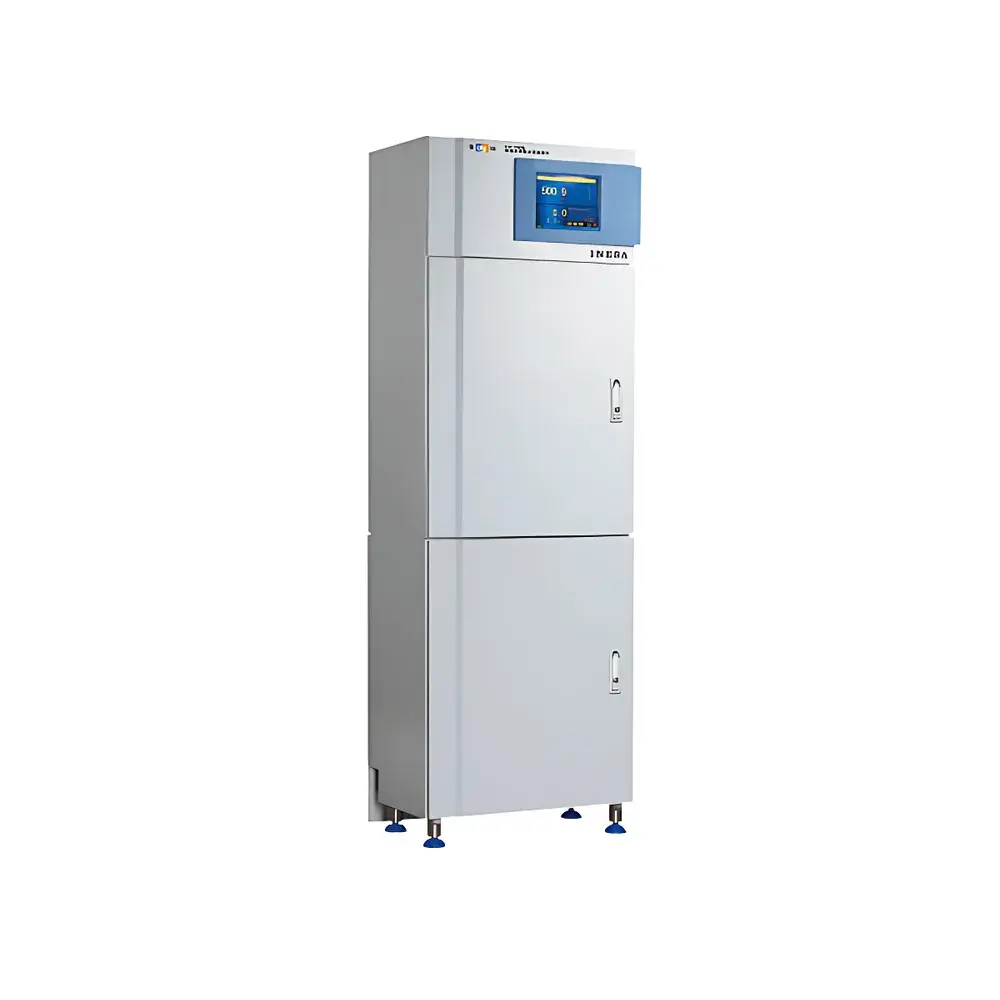
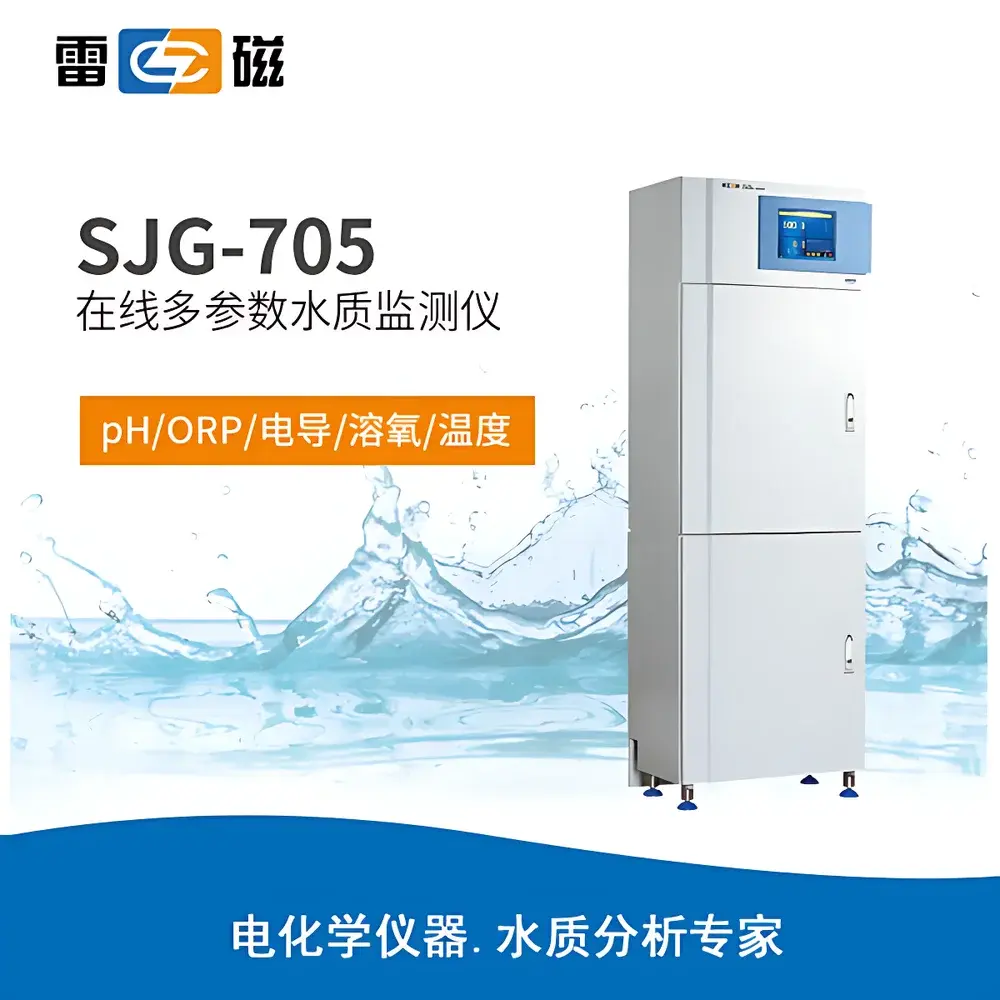
Leici SJG-705 Online Multi-parameter Water Quality Monitor
| Brand | Leici |
|---|---|
| Origin | Shanghai, China |
| Manufacturer Type | Direct Manufacturer |
| Country of Origin | China |
| Model | SJG-705 |
| Price Range | USD 7,000 – 14,000 |
| Display | 7-inch color TFT touchscreen (Chinese UI) |
| Communication Interfaces | RS-232 OR RS-485 OR Ethernet (user-selectable) |
| Measurement Modes | Continuous & programmable interval logging |
| Data Storage | Internal non-volatile memory supporting >100,000 records |
| Optional | Automated cleaning module for sensors and flow cell |
| Parameters Supported | pH, ORP, Conductivity/TDS, Dissolved Oxygen (DO), Turbidity (NTU), Temperature |
Overview
The Leici SJG-705 Online Multi-parameter Water Quality Monitor is an industrial-grade, fixed-station environmental monitoring system engineered for continuous, real-time assessment of critical water quality parameters in diverse aquatic environments. Based on standardized electrochemical, optical, and thermal measurement principles—including potentiometric pH/ORP detection, four-electrode conductivity sensing with temperature compensation, luminescence-based dissolved oxygen (LDO) measurement, and 90° scattered-light turbidity analysis—the SJG-705 delivers stable, traceable, and field-validated performance under fluctuating hydraulic and ambient conditions. Designed for deployment in unattended or semi-attended settings—including surface water stations, groundwater wells, drinking water distribution networks, aquaculture ponds, municipal wastewater treatment plants, and industrial effluent discharge points—the instrument complies with foundational metrological requirements for environmental monitoring per Chinese HJ/T 96–2013 (pH), HJ/T 92–2002 (COD/DO/turbidity), and GB/T 5750.5–2023 (drinking water standards). Its robust architecture supports long-term operation in Class II–IV environmental enclosures (IP65-rated cabinet), with integrated thermal management and power conditioning for AC mains stability.
Key Features
- Modular sensor architecture enabling flexible configuration of up to six core parameters—pH, ORP, conductivity/TDS, dissolved oxygen, turbidity, and temperature—without hardware rework or firmware modification.
- 7-inch high-resolution TFT touchscreen with intuitive Chinese-language GUI, supporting multi-level user access control (operator, technician, administrator) and context-sensitive help prompts.
- Dual operational modes: continuous real-time acquisition at configurable intervals (1 sec–24 hr) and scheduled periodic sampling synchronized with external triggers or clock-based events.
- Onboard data integrity safeguards including automatic timestamping, sensor calibration logging with operator ID tagging, and cyclic buffer storage retaining ≥100,000 measurement records with full audit trail.
- Standardized communication interfaces—RS-232, RS-485 (Modbus RTU), or Ethernet (TCP/IP Modbus TCP)—allow seamless integration into SCADA, DCS, or cloud-based IoT platforms without protocol gateways.
- Optional automated cleaning module utilizes timed pneumatic or ultrasonic actuation to maintain optical window clarity and electrode surface integrity, extending maintenance cycles to ≥30 days in high-fouling applications.
Sample Compatibility & Compliance
The SJG-705 is validated for use with natural waters (freshwater, brackish, and low-salinity estuarine), treated potable water, activated sludge effluents, and recirculating aquaculture systems. It meets mechanical and electrical safety requirements per GB 4793.1–2019 (IEC 61010-1), electromagnetic compatibility per GB/T 18268.1–2010 (IEC 61326-1), and environmental protection compliance per RoHS Directive 2011/65/EU. While not certified to ISO/IEC 17025 for accredited laboratory testing, its measurement uncertainty profiles align with EPA Method 150.1 (conductivity), EPA Method 360.1 (pH), and ISO 5815-1:2016 (dissolved oxygen) for field-deployed instrumentation. Calibration traceability is supported via NIST-traceable reference solutions (pH 4.01/7.00/10.01, conductivity KCl 1413 µS/cm, DO zero and saturation standards).
Software & Data Management
Data acquisition and system configuration are managed through embedded firmware with dual-layer security: password-protected parameter editing and encrypted local database storage. Raw sensor outputs undergo real-time linearization, temperature compensation (per DIN EN 27888 for conductivity; Stern-Volmer for DO), and outlier rejection using IQR-based filtering. Export formats include CSV and XML, compatible with LIMS, EPA STORET, and WQX ingestion pipelines. Remote diagnostics support includes live sensor status reporting, calibration due alerts, and fault-code logging (e.g., “Turbidity window soiling,” “pH electrode drift exceeding 0.1 pH/24h”). The system logs all user-initiated actions—including calibrations, configuration changes, and manual overrides—in a tamper-evident audit trail compliant with GLP documentation principles.
Applications
- Surface and groundwater surveillance networks operated by provincial environmental monitoring centers and river basin authorities.
- Early-warning systems for source water protection zones, particularly where algal bloom risk or agricultural runoff may impact pH, DO, and turbidity dynamics.
- Process control in drinking water treatment plants—monitoring coagulation efficiency (via turbidity), disinfection residual stability (via ORP/pH), and distribution system corrosion potential.
- Regulatory compliance reporting for industrial discharge permits (e.g., China’s “Discharge Permit Management Regulation”), with automated generation of daily summary reports meeting MEE Form 12 requirements.
- Research-grade longitudinal studies in aquaculture, where synchronized DO–temperature–pH trends inform feeding schedules and aeration control logic.
FAQ
What calibration standards are required for routine maintenance?
Primary calibration requires NIST-traceable pH buffer solutions (4.01, 7.00, 10.01), KCl conductivity standard (1413 µS/cm), zero-oxygen solution (sodium sulfite), air-saturated water for DO span, and formazin or AMCO AEPA-1 turbidity standards.
Can the SJG-705 be integrated with third-party SCADA systems?
Yes—via Modbus RTU over RS-485 or Modbus TCP over Ethernet, with register mapping documentation provided in the Engineering Integration Manual (Rev. 3.2).
Is remote firmware update supported?
Firmware updates are performed via USB flash drive or secure FTP upload; over-the-air (OTA) updates are not implemented for cybersecurity hardening per IEC 62443-3-3.
What is the recommended maintenance interval for the optional cleaning module?
Cleaning cycle frequency is programmable from 1–72 hours; typical deployment in municipal wastewater channels uses 6-hour intervals, verified by turbidity baseline stability monitoring.
Does the instrument meet FDA 21 CFR Part 11 requirements?
No—while audit trails and user authentication are implemented, the SJG-705 is not validated for pharmaceutical-grade electronic records; it is intended for environmental compliance, not GMP process monitoring.







