
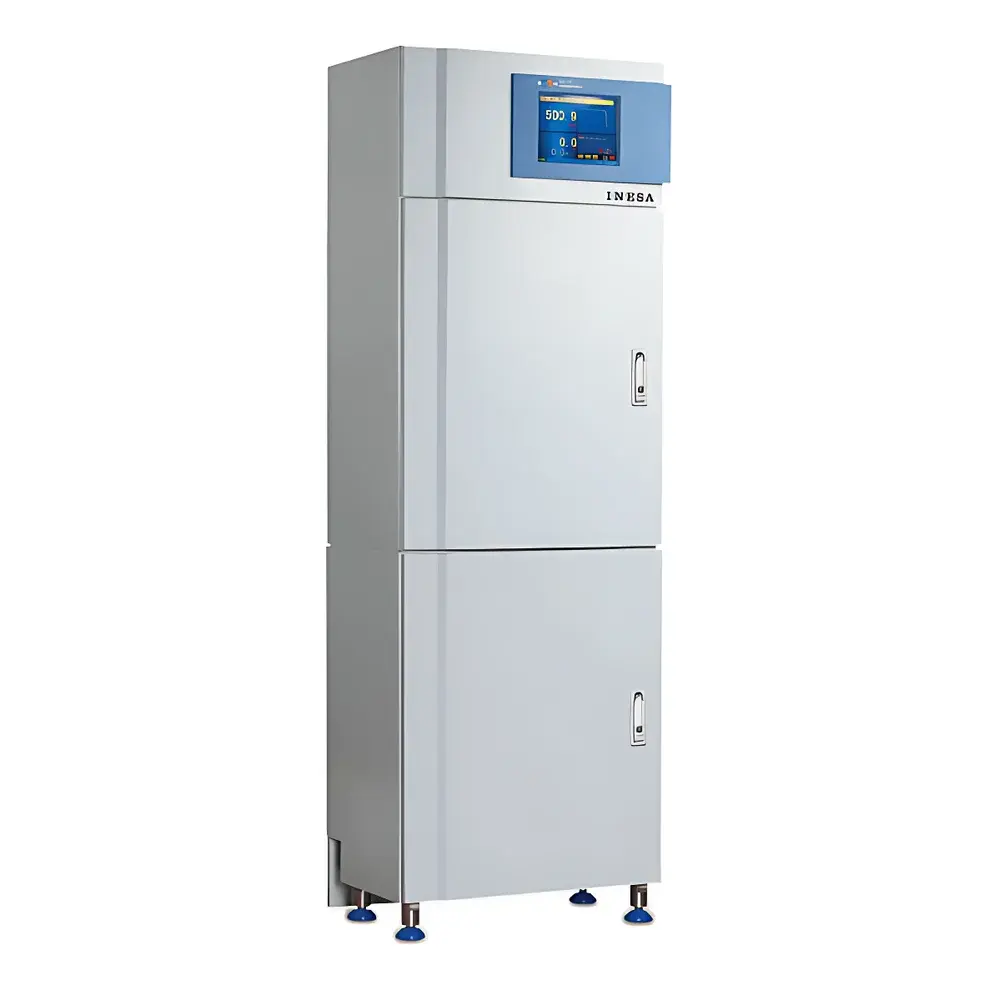
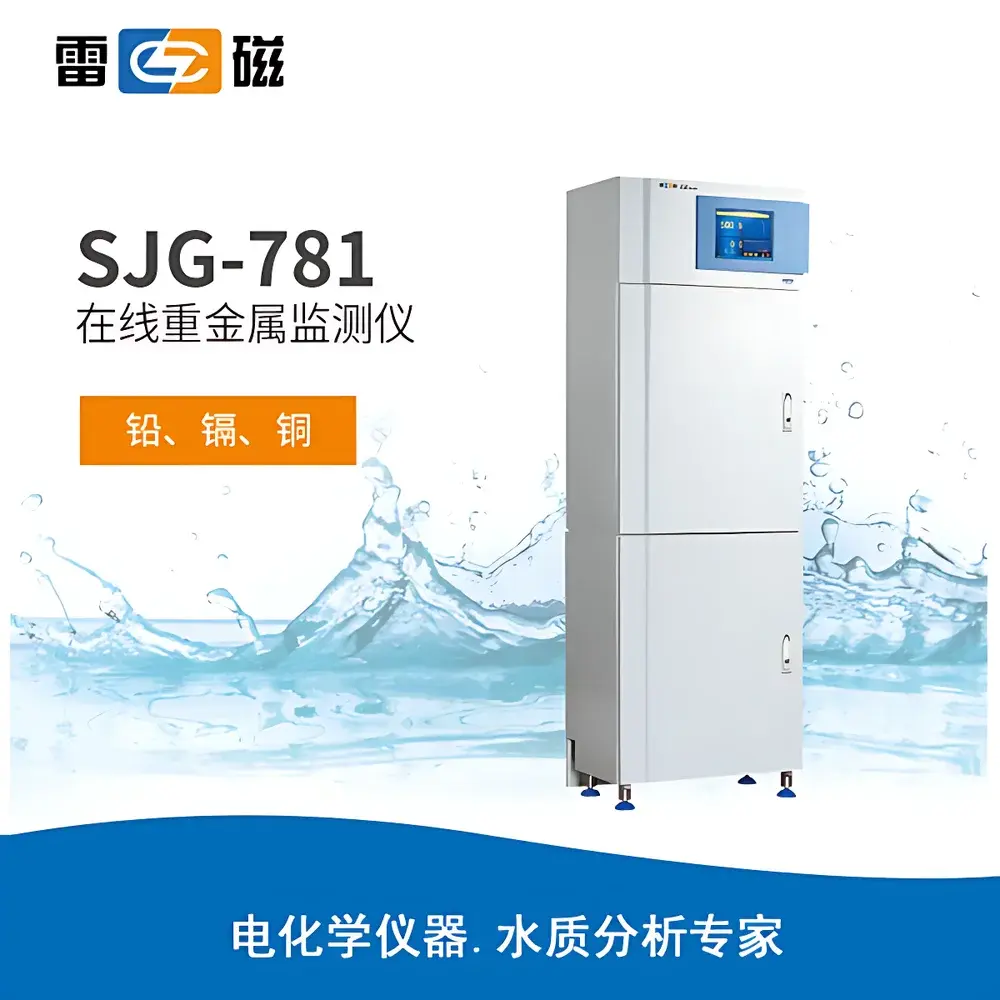
Leici SJG-781 Online Heavy Metals Analyzer
| Brand | Leici |
|---|---|
| Origin | Shanghai, China |
| Manufacturer Type | Original Equipment Manufacturer (OEM) |
| Country of Origin | China |
| Model | SJG-781 |
| Instrument Type | Online Analytical System |
| Detection Principle | Anodic Stripping Voltammetry (ASV) |
| Target Metals | Pb, Cd, Cu (dual- or multi-parameter configuration) |
| Accuracy | ±10% or ±5 µg/L (at concentrations ≤50 µg/L) |
| Resolution | 0.01 µg/L |
| Detection Limit | 1 µg/L |
| Measurement Range | 0–100 µg/L and 100–1000 µg/L per metal (extendable to 10 mg/L) |
| Repeatability | ≤5% RSD |
| Zero Drift | ±5 µg/L/24 h |
| Span Drift | ±5%/24 h |
| Power Supply | AC 220 V ±10%, 50 Hz |
| Dimensions | 400 × 550 × 168 mm |
| Weight | 50 kg |
Overview
The Leici SJG-781 Online Heavy Metals Analyzer is an industrial-grade, fully automated electrochemical monitoring system engineered for continuous, real-time quantification of trace-level heavy metals—including lead (Pb), cadmium (Cd), and copper (Cu)—in aqueous environmental and process streams. It operates on the well-established principle of anodic stripping voltammetry (ASV), a highly sensitive electroanalytical technique that combines controlled pre-concentration of metal ions onto a mercury-film or bismuth-film working electrode with subsequent oxidative stripping under a precisely ramped potential scan. This method delivers sub-ppb detection capability and high selectivity in complex matrices without requiring chromatographic separation. Designed for unattended operation in demanding field environments—from drinking water intakes and surface water monitoring stations to wastewater treatment plants and industrial effluent discharge points—the SJG-781 meets the analytical rigor required for regulatory compliance and process optimization.
Key Features
- Triple-metal simultaneous or sequential ASV analysis (Pb, Cd, Cu) with configurable measurement cycles and independent calibration protocols per analyte
- Integrated mercury-free bismuth-film electrode option compliant with EU RoHS and EPA Method 7000B guidelines for environmentally responsible deployment
- 7-inch color TFT-LCD touchscreen interface with intuitive Chinese-language HMI; firmware supports English language pack via software update
- Precision photometric liquid-level sensing for reagent dosing accuracy within ±1% volumetric error across full operational temperature range (5–40 °C)
- Automated three-stage operational sequence: self-calibration (standard addition or multi-point), sample analysis, and electrode regeneration with integrated ultrasonic cleaning
- Flexible scheduling modes: manual trigger, time-based interval (1–1440 min), or event-driven measurement synchronized with external PLC or SCADA signals
- Onboard data management with non-volatile flash memory supporting ≥100,000 timestamped records, including raw voltammograms, calibration logs, and maintenance events
- Configurable dual-threshold alarm system with relay output (dry contact) and visual/audio alerts; alarm status exportable via serial protocol
- Dual communication interface: selectable RS-232 (for local diagnostics and firmware updates) or RS-485 (Modbus RTU protocol) for integration into centralized supervisory control systems
Sample Compatibility & Compliance
The SJG-781 is validated for direct analysis of low-turbidity, low-salinity aqueous samples with total suspended solids (TSS) < 20 mg/L and chloride concentration < 500 mg/L. For high-conductivity or particulate-rich influents (e.g., municipal wastewater, electroplating rinse water), optional inline filtration (5 µm) and dilution modules are available. The analyzer conforms to GB/T 3914–2008 “General Rules for Anodic Stripping Voltammetry of Chemical Reagents” and supports traceability in accordance with ISO/IEC 17025:2017 requirements for testing laboratories. Its measurement uncertainty budget has been characterized per ISO 5725-2:2019, and the system architecture enables audit-ready data logging suitable for GLP-aligned environmental monitoring programs.
Software & Data Management
Firmware v3.2+ includes embedded data integrity safeguards: write-protected memory partitions, cyclic redundancy check (CRC) validation for all stored spectra, and tamper-evident timestamps synchronized via NTP client support (when connected to Ethernet-enabled gateway). Export formats include CSV (with ISO 8601 timestamps), PDF reports (calibration certificates, daily QC summaries), and binary .DAT files for third-party electrochemical data processing (e.g., Thales, NOVA). Remote access is enabled through optional 4G LTE or Ethernet add-on modules—supporting secure HTTPS API endpoints for integration with cloud-based environmental dashboards (e.g., AWS IoT Core, Microsoft Azure IoT Hub). All data exports retain full metrological traceability, including electrode history, temperature-compensated baseline correction parameters, and peak deconvolution metadata.
Applications
- Regulatory compliance monitoring at drinking water source intakes (WHO guideline values for Pb: 10 µg/L; Cd: 3 µg/L; Cu: 2000 µg/L)
- Real-time effluent tracking for electroplating, battery manufacturing, and metal finishing facilities subject to local discharge permits (e.g., China’s GB 8978–1996, US EPA NPDES)
- Early-warning detection in river basin surveillance networks for transboundary contamination events
- Process control feedback in membrane bioreactor (MBR) and advanced oxidation process (AOP) trains where metal catalyst leaching must be quantified
- QA/QC verification of reclaimed water quality prior to agricultural reuse or industrial cooling applications
FAQ
What electrode materials are supported, and is mercury required?
The standard configuration uses a renewable bismuth-film electrode (BiFE), eliminating mercury handling while maintaining equivalent sensitivity for Pb, Cd, and Cu. A mercury-film electrode option is available upon request for laboratories requiring direct comparability with legacy EPA Method 7000B datasets.
Can the SJG-781 be integrated into an existing SCADA system?
Yes—via RS-485 Modbus RTU (slave mode), it provides register-mapped access to live concentrations, instrument status flags, calibration due dates, and fault codes. Configuration files and firmware updates may be pushed remotely using Modbus function code 16 (Write Multiple Registers).
How often does the system require maintenance, and what consumables are needed?
Electrode renewal is recommended every 6 months under continuous operation; electrolyte solution (0.1 M acetate buffer + 0.01% Bi³⁺) and supporting electrolyte cartridges are consumables with a typical shelf life of 12 months when stored at 4–25 °C.
Is the analyzer suitable for seawater or brackish water applications?
Not without pretreatment. High chloride interferes with ASV peak resolution; users must deploy optional desalination (electrodialysis) or dilution modules to reduce salinity below 500 mg/L Cl⁻ prior to analysis.
Does the system comply with FDA 21 CFR Part 11 requirements for electronic records?
While the base firmware does not include full Part 11 functionality (e.g., digital signatures, role-based access control), the optional Leici LMS-Cloud Connect module adds ALCOA+ compliant audit trails, electronic signature workflows, and secure user authentication—validated for pharmaceutical-grade water system monitoring per USP and EP 2.2.48.
Related Products







