
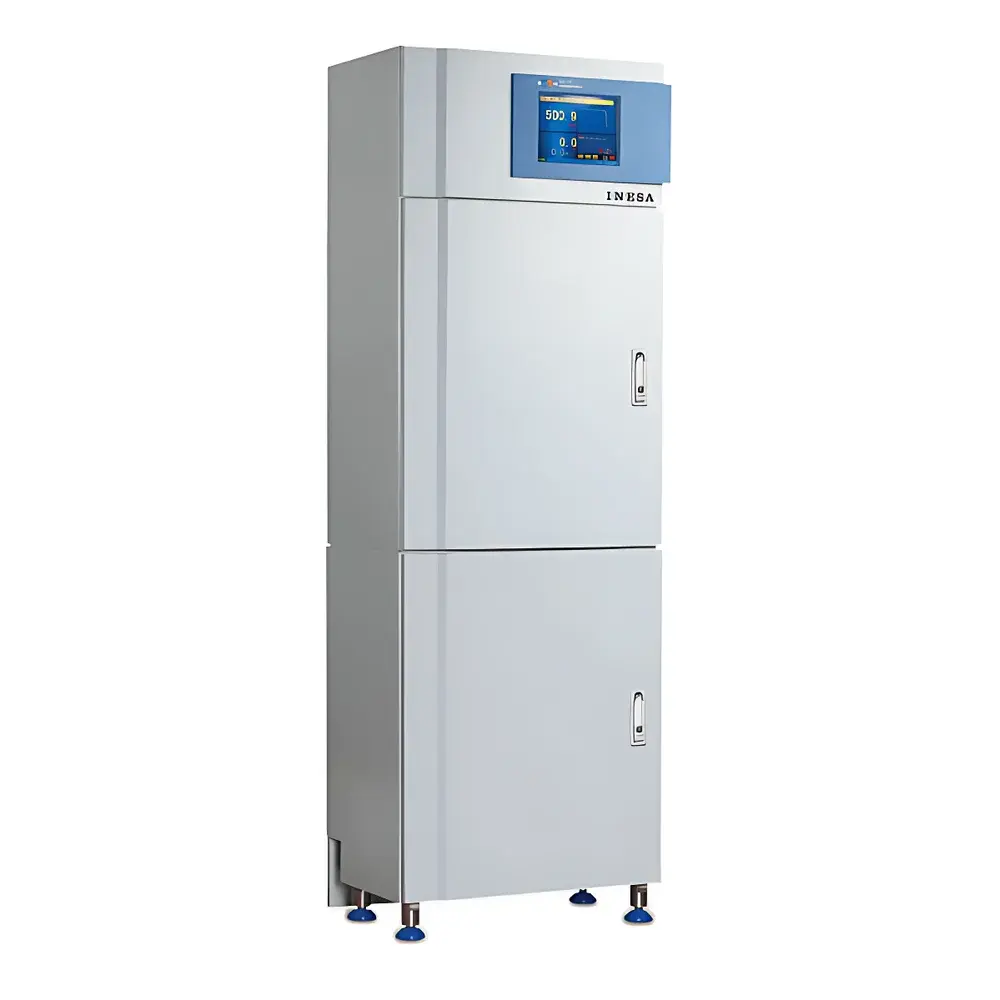
Leici SJG-782 Online Hexavalent Chromium (Cr(VI)) Monitor
| Brand | Leici |
|---|---|
| Origin | Shanghai, China |
| Manufacturer Type | Direct Manufacturer |
| Origin Category | Domestic (China) |
| Model | SJG-782 |
| Instrument Type | Online Analyzer |
| Detection Principle | Spectrophotometry (DPC Method) |
| Target Analyte | Hexavalent Chromium (Cr(VI)) |
| Accuracy | ±10% |
| Resolution | 0.001 mg/L |
| Measurement Range | 0.00–5.00 mg/L |
| Repeatability | ≤5% |
| Stability | ≤10% / 4 h |
| Zero Drift | ±5% FS / 24 h |
| Span Drift | ±5% FS |
| LOD | 0.01 mg/L |
| MTBF | ≥720 h |
| Power Supply | AC (220 ± 22) V, (50 ± 1) Hz |
| Dimensions (W×D×H) | 400 × 550 × 1680 mm |
| Weight | 50 kg |
| Display | 7-inch color TFT touchscreen (Chinese UI) |
| Calibration Modes | Manual / Cyclic / Timed / Continuous |
| Measurement Modes | Manual / Cyclic / Timed / Continuous |
| Communication Interface | RS-232 or RS-485 (user-selectable) |
| Data Storage | Internal non-volatile memory with timestamped logging |
| Alarm Output | Configurable high/low concentration thresholds |
Overview
The Leici SJG-782 Online Hexavalent Chromium (Cr(VI)) Monitor is an industrial-grade, continuous water quality analyzer engineered for real-time quantification of hexavalent chromium in aqueous matrices using standardized spectrophotometric methodology. It implements the diphenylcarbazide (DPC) colorimetric reaction—fully compliant with GB 7467–1987, the Chinese national standard equivalent to EPA Method 7196A and ISO 11083—where Cr(VI) forms a stable violet-colored complex with DPC under acidic conditions, measurable at 540 nm. Designed for unattended operation in demanding environmental and industrial settings, the SJG-782 delivers trace-level detection (LOD: 0.01 mg/L) across a calibrated range of 0.00–5.00 mg/L, supporting regulatory compliance monitoring for wastewater discharge permits, source water protection, and process effluent control.
Key Features
- Optically optimized flow cell with dual-beam photometric architecture to minimize lamp drift and enhance long-term signal stability.
- 7-inch high-resolution TFT touchscreen interface with intuitive Chinese-language navigation—designed for on-site operator accessibility without external PCs.
- Four configurable calibration strategies: manual point calibration, cyclic multi-point calibration, time-scheduled calibration, and continuous auto-zero/span verification.
- Flexible measurement scheduling: supports manual-triggered analysis, fixed-interval sampling (1–240 min), scheduled daily runs, or true continuous mode with integrated peristaltic dosing and reagent mixing.
- Onboard hardware diagnostic mode enabling stepwise actuator testing (pump activation, valve sequencing, heater status, LED intensity check) for rapid field commissioning and maintenance.
- Configurable analytical parameters—including reaction time, temperature setpoint (37 °C default), sample volume, and reagent dosage—allow method adaptation to matrix-specific interferences.
- Automatic data logging with embedded real-time clock; stores >100,000 timestamped measurement records, calibration events, and alarm triggers in internal flash memory.
- Dual digital communication options: selectable RS-232 (for local PC connection) or RS-485 (for Modbus RTU integration into SCADA or DCS systems up to 1,200 m).
Sample Compatibility & Compliance
The SJG-782 is validated for use with potable water, surface water, groundwater, and industrial wastewater streams exhibiting turbidity ≤50 NTU and suspended solids ≤100 mg/L. Pre-filtration (5–10 µm) is recommended for high-particulate effluents. Its analytical protocol satisfies requirements under China’s Environmental Quality Standard for Surface Water (GB 3838–2002), Integrated Wastewater Discharge Standard (GB 8978–1996), and aligns with internationally recognized frameworks including ISO/IEC 17025 for testing laboratory competence. While not FDA 21 CFR Part 11–certified out-of-the-box, audit-ready data integrity features—including immutable event logs, user-access levels (admin/operator/guest), and password-protected configuration changes—support GLP/GMP-aligned deployment in regulated manufacturing environments.
Software & Data Management
Data output is structured in ASCII-formatted CSV packets via serial interface, containing fields: timestamp (YYYY-MM-DD HH:MM:SS), measured Cr(VI) concentration (mg/L), instrument status flags, calibration reference value, and error codes. Optional Leici DataBridge software (Windows-based) enables remote configuration, historical trend visualization, report generation (PDF/Excel), and alarm history export. All stored records include metadata such as operator ID, calibration type, reagent batch number (manually entered), and ambient temperature—facilitating traceability during regulatory audits. No cloud connectivity or proprietary cloud platform is embedded; data sovereignty remains fully under end-user control.
Applications
- Regulatory compliance monitoring at municipal drinking water intakes and wastewater treatment plant outfalls subject to Cr(VI) discharge limits.
- Real-time process control in electroplating rinse lines, anodizing baths, and passivation tanks where Cr(VI) breakthrough indicates bath exhaustion or rinsing inefficiency.
- Effluent surveillance in chromium chemical manufacturing (e.g., chromic acid, sodium dichromate), pigment synthesis, and leather tanning operations.
- Environmental monitoring networks tracking seasonal Cr(VI) mobilization in mining-impacted watersheds or legacy industrial sites.
- QA/QC support for laboratories performing batch-wise validation of offline ICP-MS or AAS results via parallel online correlation studies.
FAQ
Does the SJG-782 require daily manual intervention?
No—once commissioned and calibrated, it operates autonomously for ≥720 hours (MTBF) with only periodic reagent replenishment (typically every 7–14 days depending on cycle frequency) and quarterly maintenance (flow path cleaning, lamp inspection).
Can it detect total chromium, or only hexavalent chromium?
Exclusively Cr(VI); no built-in digestion module for Cr(III) oxidation. Total chromium determination requires upstream UV/persulfate digestion—a separate pretreatment system must be integrated externally.
Is third-party certification available for international standards such as ISO 10566 or EN 15237?
The instrument meets functional and performance criteria outlined in those standards; however, formal conformity assessment and certificate issuance require engagement with an ILAC-accredited body conducting on-site verification per ISO/IEC 17025.
What reagents are consumed during operation, and what are their shelf lives?
Primary reagents: sulfuric acid solution (pH ~2), diphenylcarbazide (DPC) in acetone, and phosphoric acid stabilizer. Unopened, DPC stock retains efficacy for 12 months at 4 °C; prepared working solutions are stable for 7 days at room temperature.
How does the system handle chloride or nitrate interference?
The DPC method exhibits known susceptibility to oxidants (e.g., Fe³⁺, NO₂⁻) and reducing agents. The SJG-782 incorporates a pre-reduction compensation algorithm and recommends sample pretreatment (e.g., masking with NaF for Fe³⁺) when matrix interferences exceed 5% relative error—detailed in the technical appendix.
Related Products







