
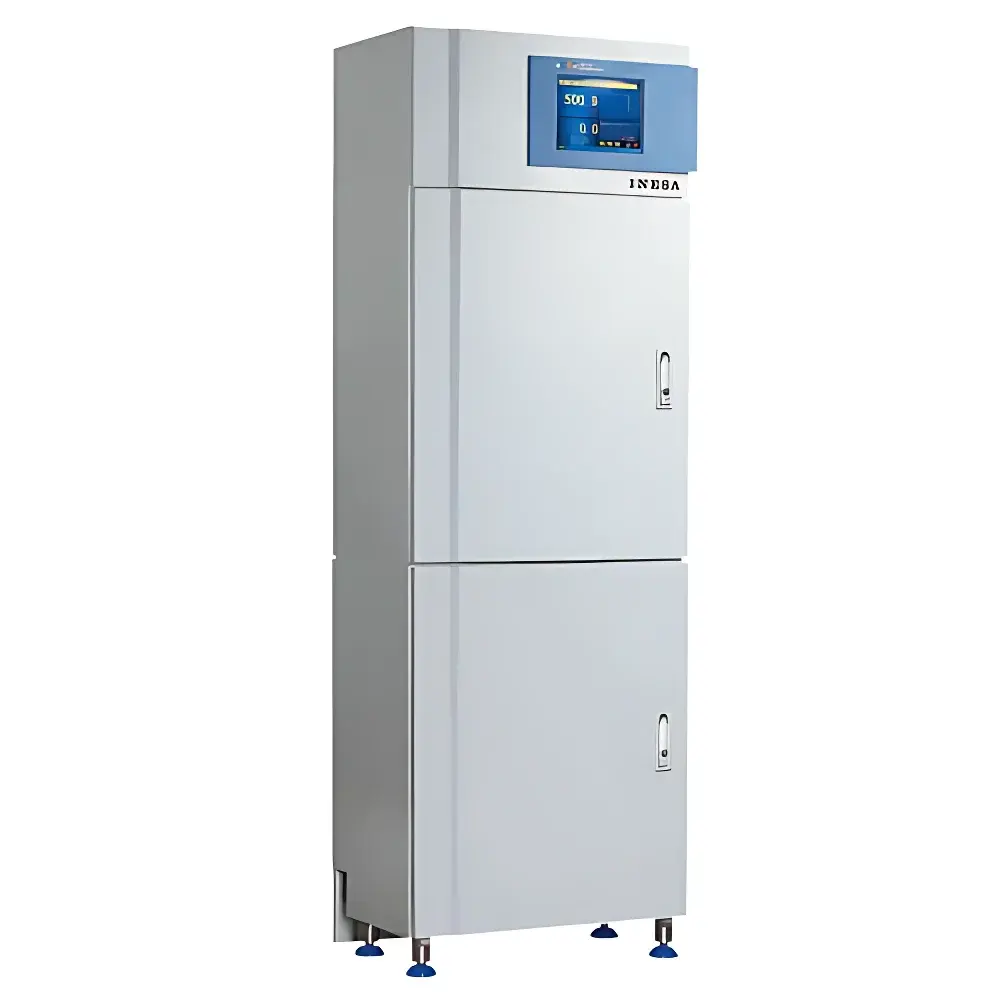
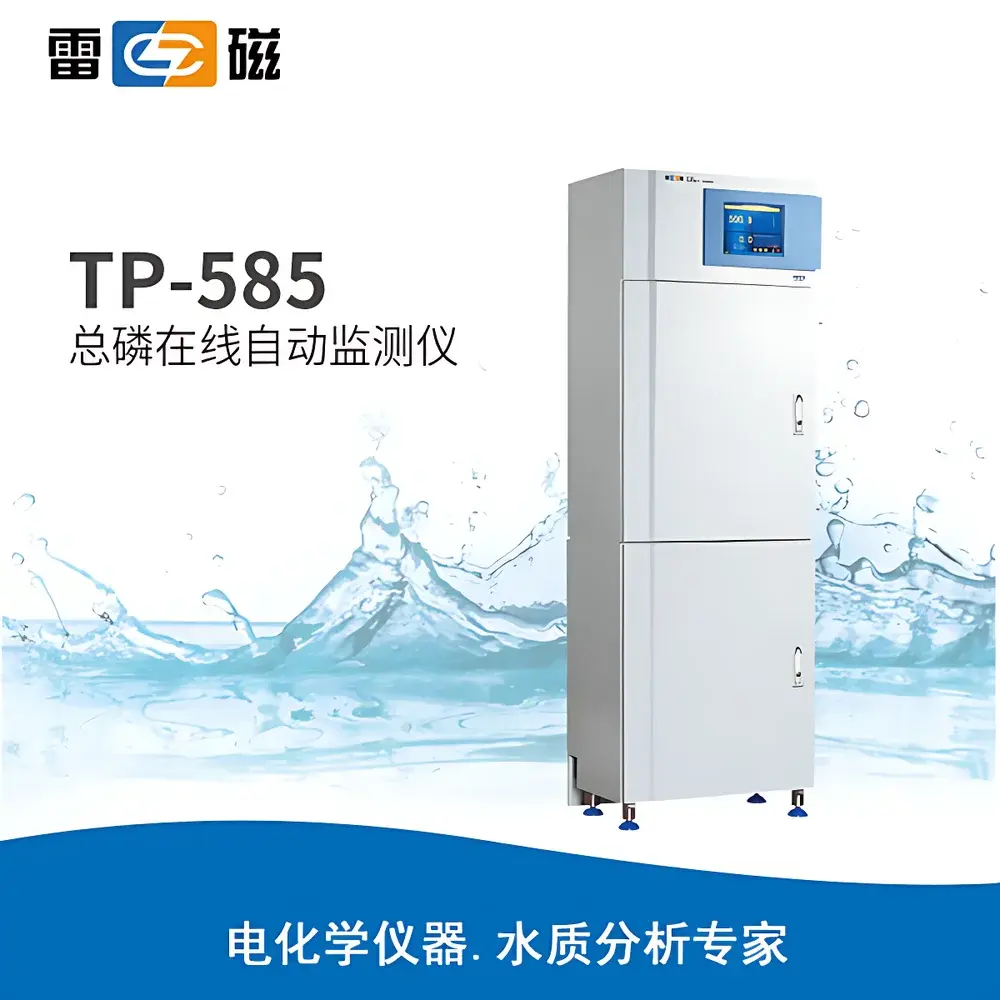
LeiCi TP-585 Total Phosphorus Online Automatic Monitor
| Brand | LeiCi |
|---|---|
| Model | TP-585 |
| Origin | Shanghai, China |
| Manufacturer Type | Direct Manufacturer |
| Instrument Type | Online Analyzer |
| Measured Parameter | Total Phosphorus (TP) |
| Measurement Range | 0–50 mg/L |
| Accuracy | ±10% of reading (as per actual water sample comparison) |
| Repeatability | ≤±10% |
| Minimum Measurement Cycle | 40 min (adjustable from 5–120 min) |
| Digestion Time | Configurable |
| Sampling Interval | 20–9999 min, with on-the-hour measurement option |
| Calibration Frequency | 1–99 days, user-definable start time |
| Maintenance Interval | ~30 min per month |
| Analog Output | 1 × 4–20 mA (optional 2-channel) |
| Communication Interface | RS232 or RS485 |
| Digital I/O | 1–6 relay outputs (220 VAC / 2 A) |
| Operating Environment | +5 to +28 °C, ≤99% RH (non-condensing) |
| MTBF | ≥720 h |
| Dimensions (W×D×H) | 1430 × 500 × 403 mm |
| Display & Control | Touchscreen interface with local command input |
| Data Retention | Non-volatile memory preserves configuration and logs during power loss |
| Auto-Recovery | Full system reset and residual reagent purge upon power restoration or fault recovery |
Overview
The LeiCi TP-585 Total Phosphorus Online Automatic Monitor is an industrial-grade, fully automated analyzer engineered for continuous, unattended quantification of total phosphorus (TP) in aqueous environmental and wastewater streams. Total phosphorus—defined as the sum of dissolved and particulate organic and inorganic phosphorus compounds—is a critical regulatory parameter under national and international water quality frameworks, including China’s Environmental Quality Standards for Surface Water (GB 3838–2002), EU Water Framework Directive (WFD) monitoring requirements, and U.S. EPA Method 365.4–compliant reporting protocols. The TP-585 employs a validated colorimetric methodology based on the molybdenum blue reaction, following high-temperature acid digestion (≥120 °C, 30 min typical) to convert all phosphorus species into orthophosphate, which then forms a measurable blue complex with ammonium molybdate and ascorbic acid. This principle ensures compliance with ISO 15681-1:2003 and DIN 38405-26 for total phosphorus determination in natural and waste waters.
Key Features
- Integrated digestion and colorimetric detection in a single flow cell—eliminating inter-stage transfer errors and reducing mechanical complexity.
- Corrosion-resistant fluidic path using imported modified PTFE transparent tubing (ID ≥1.5 mm), minimizing clogging from suspended solids or biofilm accumulation.
- Programmable automatic line flushing cycle to inhibit algal growth and biofouling in sampling tubing—critical for long-term deployment in reservoirs, rivers, and intake channels.
- Intelligent fault self-diagnosis with real-time alarm logging via touchscreen HMI; error codes map directly to maintenance action items (e.g., “Valve Timeout,” “Digestion Temp Fault”).
- Multi-port corrosion-resistant solenoid valve manifold (ceramic-coated stainless steel body) rated for >500,000 actuation cycles, compatible with aggressive reagents (e.g., sulfuric acid, potassium persulfate).
- Power-loss resilience: non-volatile flash memory retains calibration coefficients, operational logs, and method parameters; auto-purge sequence clears residual reagents and samples upon restart.
- Low reagent consumption design—typical daily usage: ≤30 mL of digestant, ≤25 mL of color reagent—reducing operational cost and hazardous waste generation.
Sample Compatibility & Compliance
The TP-585 is validated for use with municipal wastewater, industrial effluents (e.g., food processing, fertilizer plants, textile dyeing), surface water (rivers, lakes, reservoirs), groundwater, and drinking water treatment influent/effluent streams. It meets interference tolerance thresholds specified in ISO 15681-1:2003: common ions—including Cl⁻ (≤2000 mg/L), SO₄²⁻ (≤500 mg/L), NO₃⁻ (≤100 mg/L), and Ca²⁺ (≤200 mg/L)—do not significantly affect accuracy. However, samples with high dissolved organic carbon (>50 mg/L DOC) or turbidity (>100 NTU) may require pre-filtration or dilution to maintain ≤±10% measurement uncertainty. The instrument supports GLP-aligned data integrity through timestamped audit trails, user-access-level controls (admin/operator), and optional 21 CFR Part 11-compliant software modules for regulated laboratories.
Software & Data Management
Embedded firmware provides full local control via 7-inch capacitive touchscreen with intuitive icon-driven navigation. All method parameters—including measurement interval, digestion duration, calibration schedule, and relay trigger logic—are configurable without external PC. Data output includes real-time concentration (mg/L), status flags (e.g., “Calibrating,” “Under Maintenance”), and diagnostic events. Standard analog output (4–20 mA) interfaces seamlessly with SCADA, DCS, or PLC systems. Optional RS485 Modbus RTU protocol enables integration into centralized telemetry networks. Internal storage retains ≥30 days of 15-minute averaged data with timestamps; USB export supports CSV format for QA/QC review. Remote firmware updates and configuration backup are supported via secure FTP over Ethernet.
Applications
- Continuous compliance monitoring at municipal wastewater treatment plant (WWTP) influent, secondary effluent, and discharge points per local discharge permits.
- Early-warning detection of phosphorus loading spikes in river basins and lake tributaries to support adaptive nutrient management strategies.
- In-process monitoring in industrial pretreatment facilities subject to NPDES or equivalent discharge authorizations.
- Long-term trend analysis for eutrophication assessment in drinking water source protection zones.
- Validation of phosphorus removal efficiency across tertiary treatment units (e.g., alum coagulation, iron salt dosing, biological P-removal).
FAQ
What digestion method does the TP-585 use, and is it compliant with standard methods?
The TP-585 implements high-temperature acid digestion using potassium persulfate in sulfuric medium at ≥120 °C, consistent with ISO 15681-1:2003 and EPA Method 365.4 for total phosphorus oxidation.
Can the instrument operate unattended for extended periods?
Yes—designed for ≥720 h mean time between failures (MTBF), with monthly maintenance requiring ~30 minutes for reagent replacement, tubing inspection, and optical window cleaning.
How does the system handle power interruptions?
Upon power restoration, the instrument automatically executes a full purge sequence, reinitializes sensors and valves, reloads last-known calibration, and resumes scheduled measurements without manual intervention.
Is remote access or cloud connectivity available?
Local Ethernet port supports Modbus TCP and secure FTP; cloud integration requires third-party middleware or optional OEM gateway module (sold separately).
Does the TP-585 support multi-point calibration or drift correction?
Yes—it supports up to three-point calibration (zero, low, high) and scheduled zero/sensitivity checks at user-defined intervals (1–99 days), with automatic flagging of drift exceeding ±5% of span.
Related Products







