
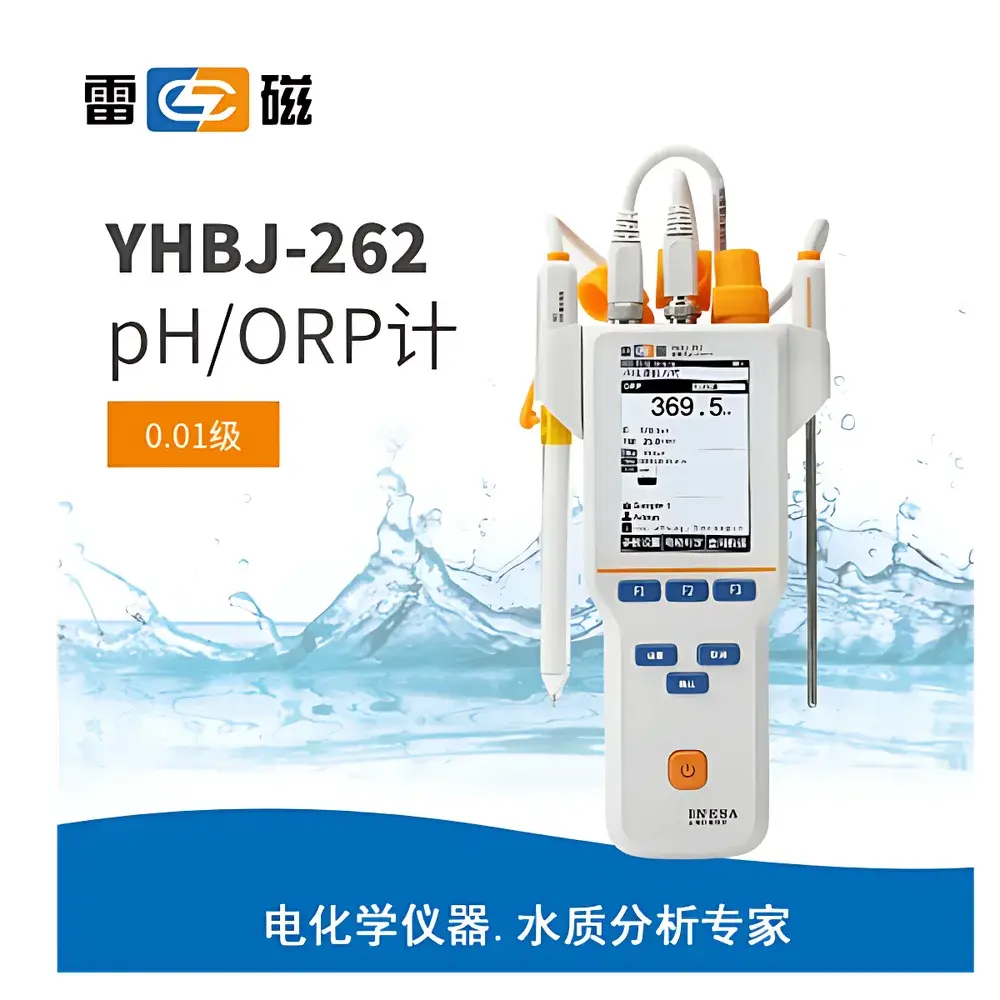
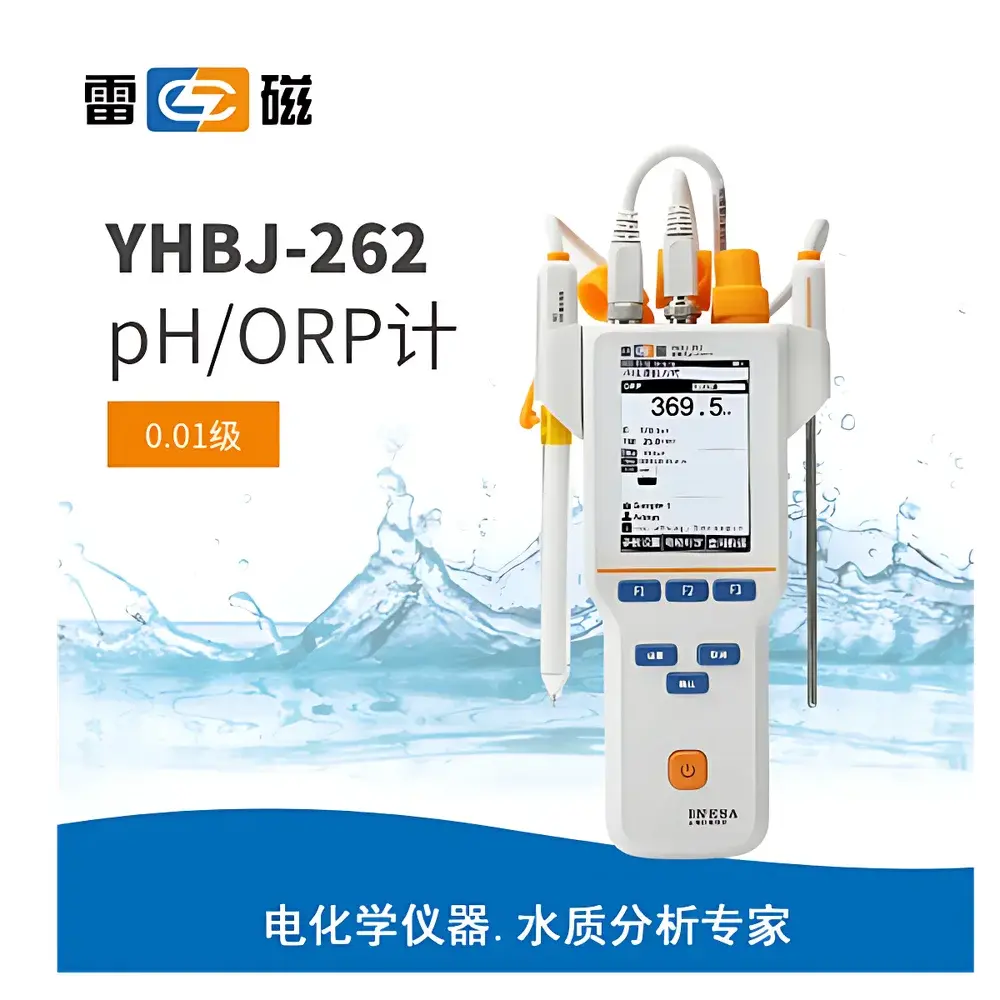
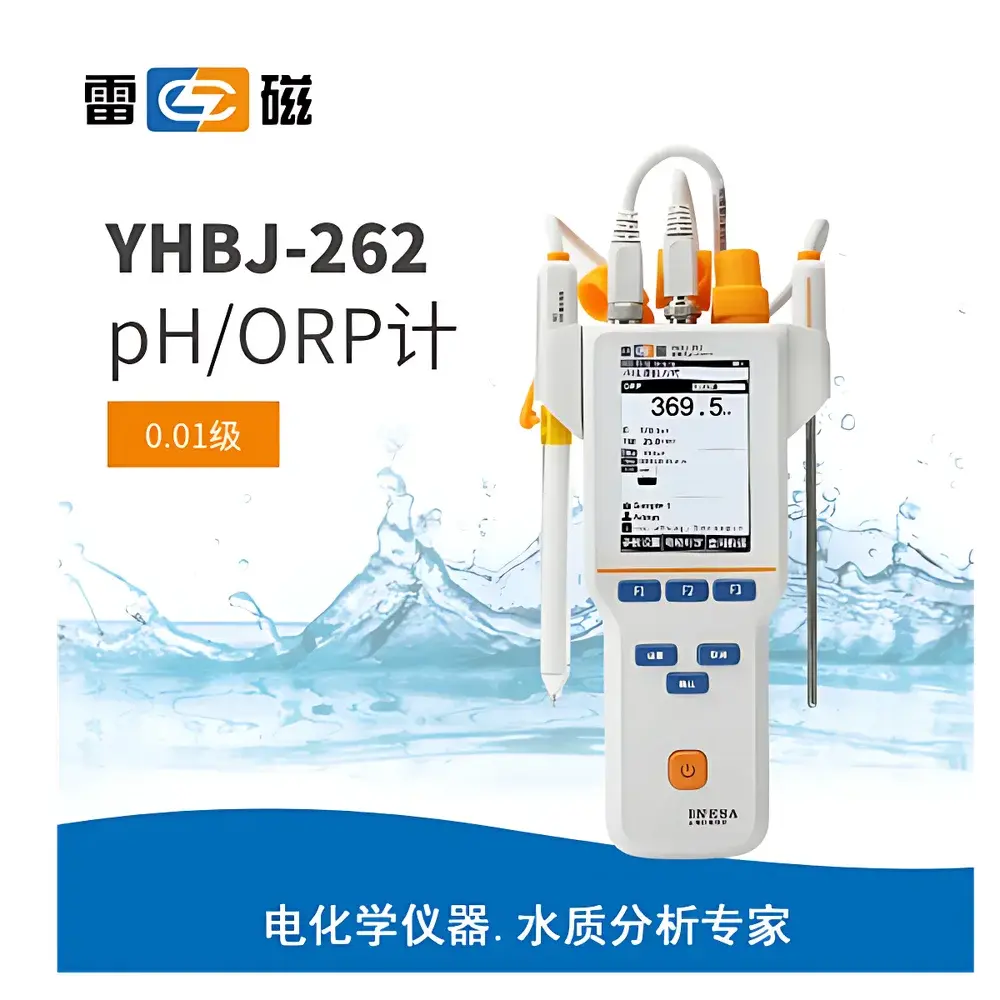
Leici YHBJ-262 Portable pH/ORP Meter
| Brand | Leici |
|---|---|
| Origin | Shanghai, China |
| Instrument Type | Portable |
| Parameter Types | Multi-parameter (pH, ORP, mV, Temperature) |
| pH Measurement Range | –2.00 to 20.00 pH |
| pH Resolution | 0.01 pH |
| pH Accuracy | ±0.02 pH |
| Calibration | Automatic recognition of GB, DIN, NIST, and other standard pH buffer solutions |
| Data Storage | 500 measurement records with GLP-compliant metadata |
| Environmental Rating | IP65 |
| Connectivity | RS232 printer port, USB interface for PC communication and firmware updates |
| Calibration Options | 1–5 point pH calibration, 1-point ORP calibration |
| Measurement Modes | Continuous, equilibrium-based, and programmable timed (interval or continuous timing) |
| User Management | Configurable user ID and sample ID fields |
| Display | Backlit LCD with graphical curve visualization |
Overview
The Leici YHBJ-262 Portable pH/ORP Meter is a field-deployable electrochemical analyzer engineered for high-reproducibility measurements of hydrogen ion activity (pH), oxidation-reduction potential (ORP), millivolt (mV) response, and temperature in diverse aqueous matrices. Based on potentiometric measurement principles—employing a glass pH electrode and a noble-metal (typically platinum or Ag/AgCl) reference system—the instrument delivers traceable, stable readings compliant with fundamental electrochemical theory. Its design prioritizes operational robustness in non-laboratory environments: the sealed housing meets IP65 ingress protection standards, ensuring reliable performance during field surveys in environmental monitoring, industrial effluent assessment, and emergency response scenarios. Unlike benchtop counterparts, the YHBJ-262 integrates real-time equilibrium detection logic—automatically identifying signal stabilization per user-defined thresholds—thereby minimizing subjective endpoint judgment and enhancing inter-operator consistency.
Key Features
- Multi-parameter capability: Simultaneous display and logging of pH, ORP (mV), temperature (°C), and measurement status indicators.
- Intelligent calibration architecture: Auto-recognition of internationally standardized pH buffers (NIST-traceable, DIN 19266, GB/T 604–2002) eliminates manual buffer selection errors; integrated 462 mV ORP standard solution enables rapid field verification.
- GLP-compliant data governance: Each stored record embeds timestamp, operator ID, sample ID, electrode serial number, calibration history, and ambient temperature—supporting audit readiness under ISO/IEC 17025 and FDA 21 CFR Part 11 requirements when paired with validated software.
- Adaptive measurement logic: Three configurable acquisition modes—continuous real-time logging, equilibrium-triggered capture (with adjustable stability window), and programmable timed intervals (e.g., 15 s, 1 min, 5 min)—accommodate dynamic sampling protocols.
- Dual-interface connectivity: RS232 output supports direct thermal printing of raw data; USB interface enables bidirectional data exchange with Windows-based Leici communication software for post-acquisition analysis, report generation, and firmware updates.
- Human-centered interface: High-contrast backlit LCD with graphical trend visualization (pH vs. time curves), intuitive icon-driven navigation, and context-sensitive prompts reduce training overhead for field technicians.
Sample Compatibility & Compliance
The YHBJ-262 is validated for use with aqueous samples across conductivity ranges typical of natural waters (e.g., rainwater, surface water, groundwater), municipal and industrial wastewater, food/beverage extracts, pharmaceutical process streams, and cosmetic formulations. It is not intended for non-aqueous solvents, highly viscous media, or samples containing suspended solids that may foul the junction. Electrode compatibility follows IUPAC-recommended configurations: combination pH electrodes with double-junction reference systems are recommended for high-ionic-strength or sulfide-rich matrices. The instrument’s calibration algorithms conform to ISO 3696 (water purity for analytical use) and ASTM D1293 (standard test method for pH of water), while its data structure aligns with GLP documentation requirements for environmental field studies (e.g., EPA Method 150.1).
Software & Data Management
Leici’s proprietary PC software (compatible with Windows 10/11) provides secure data import, spectral overlay of time-series pH/ORP traces, statistical summary (mean, SD, min/max), and export to CSV or PDF formats. Audit trails record all user-initiated actions—including calibration edits, record deletions, and parameter changes—with timestamps and operator IDs. Firmware updates preserve existing calibration coefficients and stored data, ensuring continuity during regulatory inspections. Data encryption and password-protected access controls satisfy baseline cybersecurity expectations for field-deployed instruments operating under institutional IT policies.
Applications
- Environmental fieldwork: Acid rain monitoring (pH < 5.6), wetland redox profiling, landfill leachate characterization.
- Water quality compliance: Routine checks of drinking water distribution systems (WHO Guideline Values), wastewater treatment plant influent/effluent monitoring (ISO 5667 series).
- Industrial process control: pH drift detection in cooling towers, ORP trending in chlorine disinfection systems, fermentation broth monitoring in biopharma.
- Academic instruction: Undergraduate electrochemistry labs emphasizing Nernst equation validation, buffer capacity analysis, and electrode kinetics.
- Regulatory sampling: Field verification prior to laboratory submission per ISO 5667-3 (sampling guidance) and USP (pH measurement).
FAQ
What calibration standards are required for daily field use?
A minimum of two certified pH buffers (e.g., pH 4.01 and 7.00 NIST SRM) and the supplied 462 mV ORP standard solution are sufficient for routine verification. Three-point pH calibration is recommended before critical measurements.
Can the instrument store calibration data between sessions?
Yes—calibration coefficients, date/time stamps, and buffer IDs are retained in non-volatile memory for up to 30 days without battery power.
Is temperature compensation automatic or manual?
Automatic temperature compensation (ATC) is enabled by default when a compatible temperature probe is connected; manual input is available if ATC is disabled.
Does the USB interface support mass storage mode?
No—it operates exclusively in device-mode for controlled data transfer via Leici’s authenticated software to prevent unauthorized data extraction.
How is electrode condition diagnosed?
The instrument calculates and displays electrode slope (% of theoretical 59.16 mV/pH at 25°C) and offset (mV) post-calibration, enabling proactive maintenance scheduling per ISO 17025 clause 6.4.3.
Related Products





