
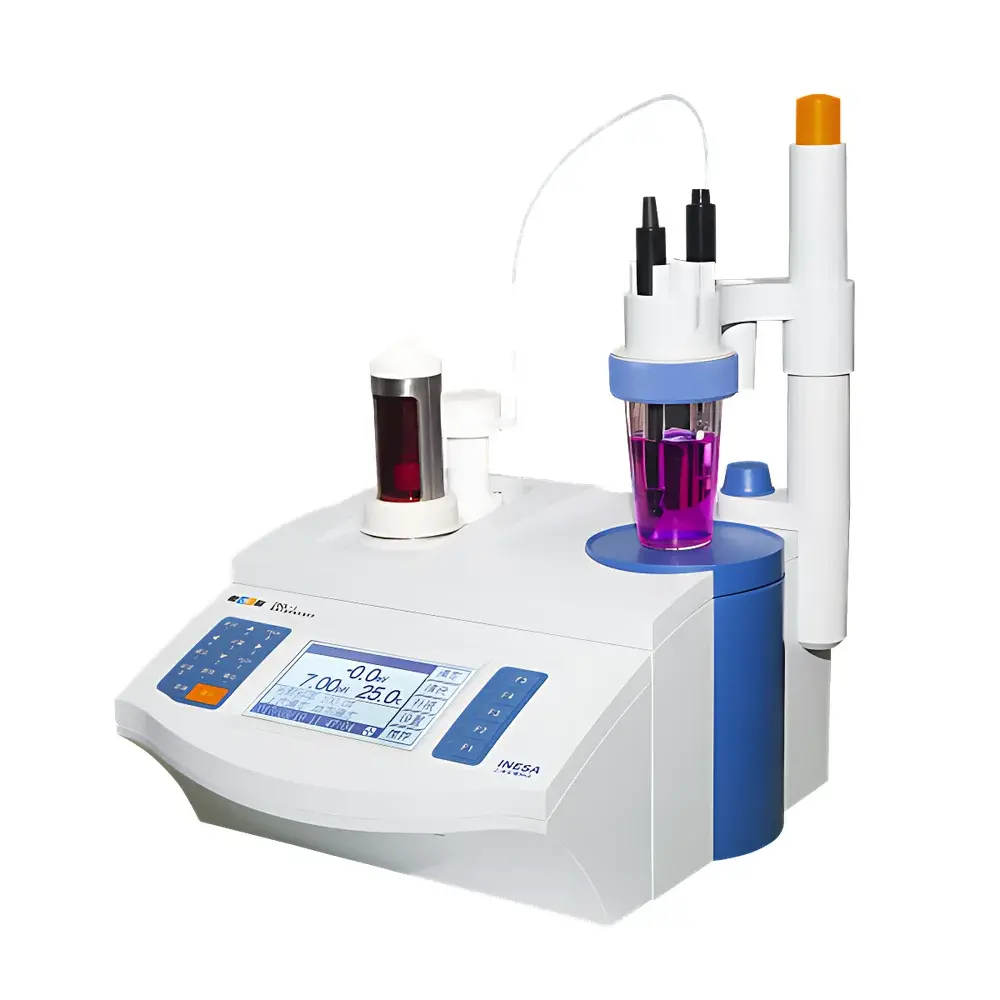
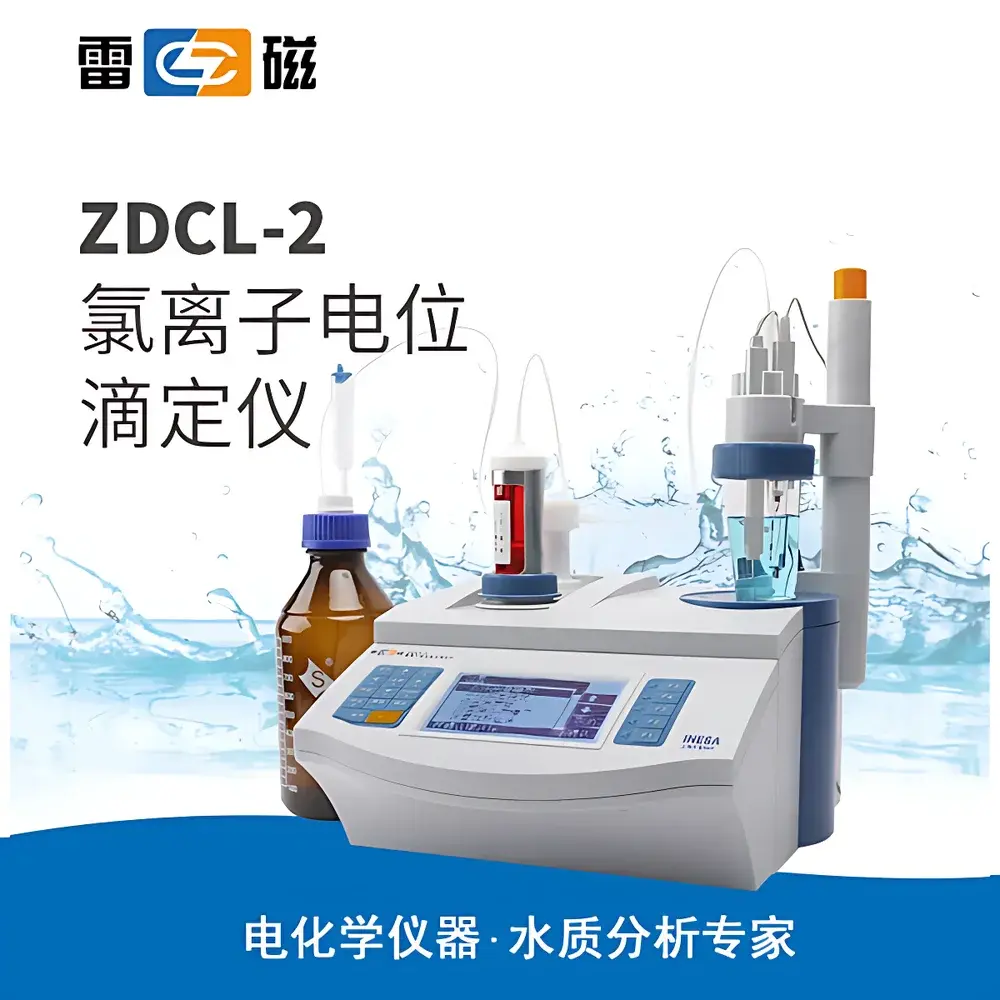
Leici ZDCL-2 Chloride Ion Potentiometric Titrator
| Brand | Leici |
|---|---|
| Origin | Shanghai, China |
| Manufacturer Type | Direct Manufacturer |
| Regional Classification | Domestic (China) |
| Model | ZDCL-2 |
| Instrument Category | General-Purpose Potentiometric Titrator |
| Application Specificity | Dedicated for Chloride Ion Analysis |
| Measurement Range | (−1800.0 to +1800.0) mV |
| Meter Accuracy | ±0.20% of full scale |
| Meter Resolution | 0.1 mV |
| Titration Accuracy | (±0.3 mV ±1 digit) over 3 hours |
| Titration Resolution | 1/10,000 |
| Titration Repeatability | ≤0.20% |
| Burette Error | ±0.025 mL (10 mL burette), ±0.035 mL (20 mL burette) |
| Stability | ±0.3 mV / 3 h |
| Operating Environment | 0–40 °C, ≤85% RH |
| Dimensions & Weight | 340 × 400 × 400 mm, ~10 kg |
| Power Supply | AC 220 V ±10%, 50 Hz ±1 Hz |
Overview
The Leici ZDCL-2 Chloride Ion Potentiometric Titrator is a dedicated electrochemical analytical instrument engineered for precise, trace-level quantification of chloride ions (Cl⁻) in construction materials—including cement, concrete admixtures, fresh and hardened concrete—using potentiometric titration with silver nitrate (AgNO₃) as the titrant. It operates on the principle of monitoring the potential shift across a silver/silver chloride (Ag/AgCl) indicator electrode versus a reference electrode during titration, detecting the stoichiometric endpoint via the inflection point of the E–V curve (potential vs. titrant volume). Designed in strict alignment with Chinese national standards—including GB/T 176–2017 (Chemical Analysis of Cement), GB/T 8077–2012 (Uniformity Testing of Concrete Admixtures), GB 50344–2004 (Technical Standard for Inspection of Building Structures), and JGJ/T 322–2013 (Technical Specification for Chloride Ion Content Testing in Concrete)—the ZDCL-2 delivers method-compliant, reproducible results essential for structural durability assessment and corrosion risk mitigation in reinforced concrete infrastructure.
Key Features
- Integrated microprocessor-based control system with real-time display of titration curves, method parameters, live potential values (mV), and volumetric delivery data
- Dedicated operational modes: chloride ion determination, standardization of AgNO₃ titrant, and blank correction—each with configurable endpoint detection algorithms (e.g., first derivative, fixed potential, or Gran plot)
- High-resolution potentiometric measurement module with 0.1 mV resolution and ≤0.20% repeatability in titration volume delivery
- Two precision burette options: 10 mL (±0.025 mL tolerance) and 20 mL (±0.035 mL tolerance), both manufactured to ISO 385 Class A specifications
- RS232 serial interface supporting direct connection to external printers for GLP-compliant hardcopy output of titration reports
- Onboard data storage for up to 200 complete titration records—including sample ID, date/time stamp, electrode calibration history, titrant concentration, and raw E–V data points—with timestamped audit trail
Sample Compatibility & Compliance
The ZDCL-2 is optimized for aqueous extracts and acid-digested samples derived from cementitious matrices per GB/T 176–2017 Section 9 and JGJ/T 322–2013 Annex A. It accommodates heterogeneous suspensions after filtration (e.g., 0.45 µm membrane) and tolerates moderate ionic strength (up to 0.5 mol/L NaNO₃ background) without significant junction potential drift. All measurement protocols adhere to the metrological requirements of ISO/IEC 17025 for testing laboratories, and the instrument’s data retention architecture supports basic GLP (Good Laboratory Practice) documentation needs—including user-defined operator IDs, editable method names, and immutable result archiving. While not certified to FDA 21 CFR Part 11, its audit trail structure (time-stamped entries, no overwrite capability for stored results) facilitates internal validation for quality-controlled construction material testing labs.
Software & Data Management
The embedded firmware provides intuitive menu navigation via a high-contrast LCD interface with tactile keypad input. All titration methods are stored in non-volatile memory and support parameter locking to prevent accidental modification during routine analysis. Each saved result includes: sample identifier, start/end time, ambient temperature, electrode calibration slope (mV/decade), final titrant volume, calculated Cl⁻ concentration (mg/kg or % w/w), and statistical summary (n = 3 replicates, RSD%). Data export is limited to RS232-printer output; no USB or PC connectivity is provided. However, printed reports contain sufficient metadata—including instrument ID (ZDCL-2), firmware version, and operator initials—to satisfy internal QA documentation requirements under ISO 9001 Clause 8.2.4.
Applications
- Quantitative determination of water-soluble chloride content in Portland cement and blended cements per GB/T 176–2017
- Chloride ion assay in liquid and powdered concrete admixtures to verify compliance with GB 8076–2008 limits
- Extraction and titrimetric analysis of acid-soluble chlorides from core-drilled hardened concrete specimens
- Verification of chloride ingress depth profiles in service-exposed structural elements
- Calibration verification of AgNO₃ titrant solutions using high-purity NaCl reference standards (≥99.99%)
- Blank correction for chloride contamination from reagents, glassware, or extraction solvents
FAQ
What electrode configuration is required for chloride titration on the ZDCL-2?
Standard operation requires a dual-electrode setup: a silver/silver chloride (Ag/AgCl) indicator electrode and a double-junction reference electrode filled with saturated KNO₃ electrolyte to minimize liquid junction potential in high-ionic-strength concrete extracts.
Can the ZDCL-2 perform non-chloride potentiometric titrations (e.g., pH, redox)?
No. The ZDCL-2 is functionally restricted to chloride-specific potentiometric titration. Its firmware, electrode input conditioning, and endpoint algorithms are hard-coded for Ag⁺/Cl⁻ precipitation chemistry and do not support generic pH or redox mode selection.
Is firmware upgrade supported via external media?
Firmware updates are not user-accessible. Updates—when released—are performed exclusively by Leici authorized service centers using proprietary diagnostic hardware and require physical instrument return.
What is the recommended maintenance interval for the burette and electrode system?
Burette piston seals should be inspected every 500 titrations or quarterly (whichever occurs first); Ag/AgCl electrodes require daily rinsing with deionized water and weekly reconditioning in 0.1 mol/L KCl solution. Reference electrode filling solution must be refreshed before each batch of 10 samples.
Related Products





