
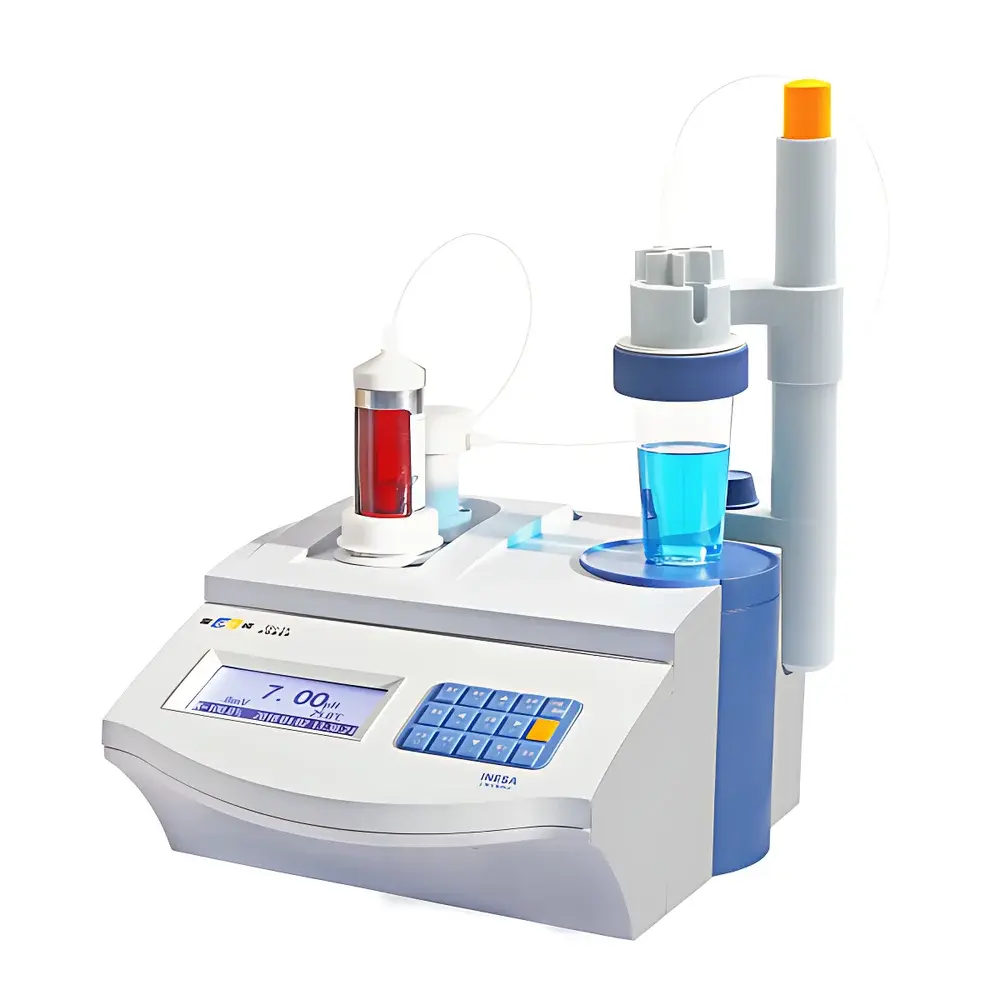
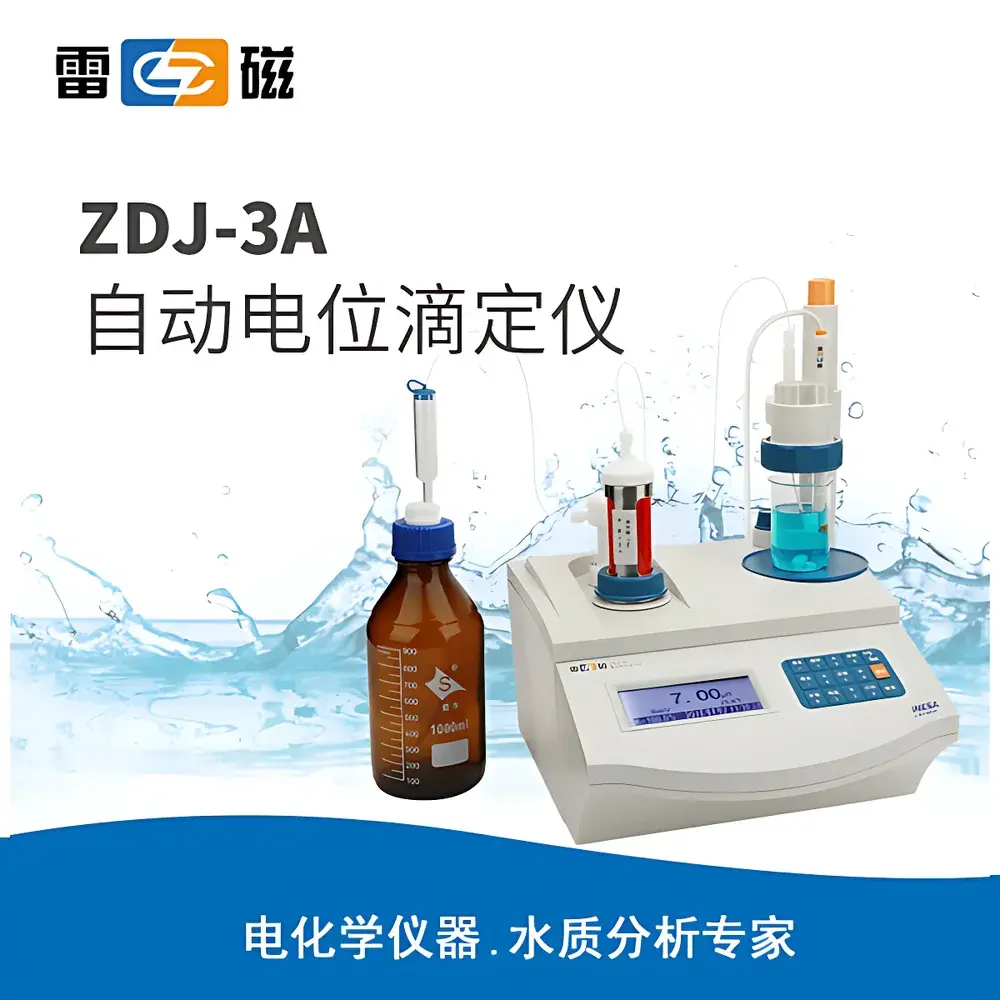
Leici ZDJ-3A Automatic Potentiometric Titrator
| Brand | Leici |
|---|---|
| Origin | Shanghai, China |
| Manufacturer Type | Direct Manufacturer |
| Regional Classification | Domestic (China) |
| Model | ZDJ-3A |
| Instrument Type | General-Purpose Potentiometric Titrator |
| Application Scope | Universal |
| Measurement Range | (−1999 to +1999) mV, (0.00 to 14.00) pH |
| Meter Accuracy | ±0.3% of full scale |
| Meter Resolution | 1 mV, 0.01 pH |
| Titration Stability | ±1 mV / 3 h |
| Burette Resolution | 10 mL burette: 1/20000 |
| 20 mL burette | 1/10000 |
| Burette Accuracy | 10 mL: ±0.05 mL |
| 20 mL | ±0.07 mL |
| Titration Repeatability | 0.3% |
| Power Supply | AC (220 ± 22) V, (50 ± 1) Hz |
| Dimensions (W×D×H) | 340 × 400 × 400 mm |
| Weight | 10 kg |
Overview
The Leici ZDJ-3A Automatic Potentiometric Titrator is a benchtop electrochemical analyzer engineered for precision and reliability in routine and method-developed titrimetric analysis. It operates on the fundamental principle of potentiometric endpoint detection—measuring the potential difference between a reference electrode and an indicator electrode as titrant is incrementally delivered. The system identifies stoichiometric endpoints by detecting inflection points in the E–V (potential vs. volume) curve, enabling quantitative determination of analytes in acid-base, redox, precipitation, complexometric, and non-aqueous titrations. Designed for laboratory environments requiring traceable, repeatable, and operator-independent results, the ZDJ-3A integrates a high-stability potentiometric measurement circuit with motor-driven burette control and real-time data acquisition—making it suitable for QC laboratories, academic teaching labs, and R&D facilities where compliance with analytical rigor is essential.
Key Features
- Dot-matrix LCD display with intuitive keypad interface, providing real-time visualization of titration curves, method parameters, current electrode potential, pH, volume dispensed, and endpoint status.
- Dual operational modes: preset endpoint titration (for standardized methods) and manual titration (for exploratory or method optimization workflows).
- Multi-mode titration support—including acid-base, redox, argentometric, complexometric (e.g., EDTA), and non-aqueous titrations—with built-in pH measurement capability for direct electrode calibration and sample characterization.
- GLP-compliant data handling: stores up to 20 complete titration records, each containing timestamp, operator ID (manual entry), method name, electrode serial number, initial/final potentials, equivalence point volume, calculated concentration, and raw E–V data points.
- Power-failure protection: automatically saves current titration state upon interruption, allowing resumption without loss of volumetric or potential integrity.
- RS-232 serial interface compliant with EIA/TIA-232-E standards, enabling direct connection to dot-matrix or thermal printers for audit-ready hardcopy output of reports and raw data logs.
Sample Compatibility & Compliance
The ZDJ-3A accommodates standard double-junction reference electrodes (e.g., Ag/AgCl/KCl sat.) and common indicator electrodes—including glass pH, platinum redox, silver wire (for halides), and ion-selective variants—via universal BNC and banana-jack inputs. Its measurement range (−1999 to +1999 mV; 0.00–14.00 pH) covers typical aqueous and low-ionic-strength non-aqueous systems. While not certified to IEC 61000-4 immunity standards, its analog front-end design minimizes electromagnetic interference in shared lab environments. Data storage and user-access protocols align with core GLP principles (21 CFR Part 58), supporting retrospective review of analyst actions, instrument settings, and raw sensor outputs—critical for internal audits and regulatory submissions where traceability is mandated.
Software & Data Management
The instrument operates autonomously without external PC software; all configuration, execution, and reporting occur onboard. Stored titration records include full metadata: date/time stamp, method identifier, electrode calibration history (if entered), volume increments, measured potential at each step, first- and second-derivative calculations for endpoint verification, and final concentration derived using user-defined stoichiometry and standard concentration. Data export via RS-232 follows ASCII-delimited format (tab- or comma-separated), compatible with spreadsheet applications and LIMS import modules. No proprietary drivers or closed-format binaries are used—ensuring long-term readability and interoperability across IT infrastructure upgrades.
Applications
- Quantification of total acidity or alkalinity in food extracts, beverages, and pharmaceutical excipients (ASTM D974, USP <771>).
- Determination of chloride in water and wastewater per EPA Method 325.1 (argentometric titration).
- Redox titration of iron(II) with ceric sulfate or potassium permanganate in metallurgical assays.
- Complexometric determination of calcium and magnesium hardness in drinking water (ISO 6059).
- pH-controlled titrations for pKa estimation and buffer capacity analysis in formulation development.
- Teaching laboratories: demonstration of endpoint detection theory, Nernst equation validation, and method robustness assessment under variable ionic strength.
FAQ
Does the ZDJ-3A support automatic electrode calibration?
No—it requires manual calibration using standard buffer solutions (for pH) or redox standards (e.g., quinhydrone, Fe²⁺/Fe³⁺). Calibration values are entered by the operator and stored per method.
Can the instrument perform back-titrations?
Yes—users can define reverse titration sequences manually by entering excess reagent volume and subsequent titrant addition steps within the same method framework.
Is USB connectivity available?
No—only RS-232 serial interface is provided. A USB-to-serial adapter may be used with compatible host systems, though native USB device mode is not supported.
What maintenance is required for long-term accuracy?
Regular cleaning of burette tips and piston seals, periodic verification of burette delivery accuracy using certified weights and water density tables (per ISO 8655-3), and annual electrode performance checks using certified reference materials are recommended.
Does the ZDJ-3A comply with 21 CFR Part 11?
It does not implement electronic signatures, audit trails, or role-based access control required for full Part 11 compliance. However, its GLP-aligned data structure supports manual audit trail reconstruction when combined with lab SOPs and analyst logbooks.



