
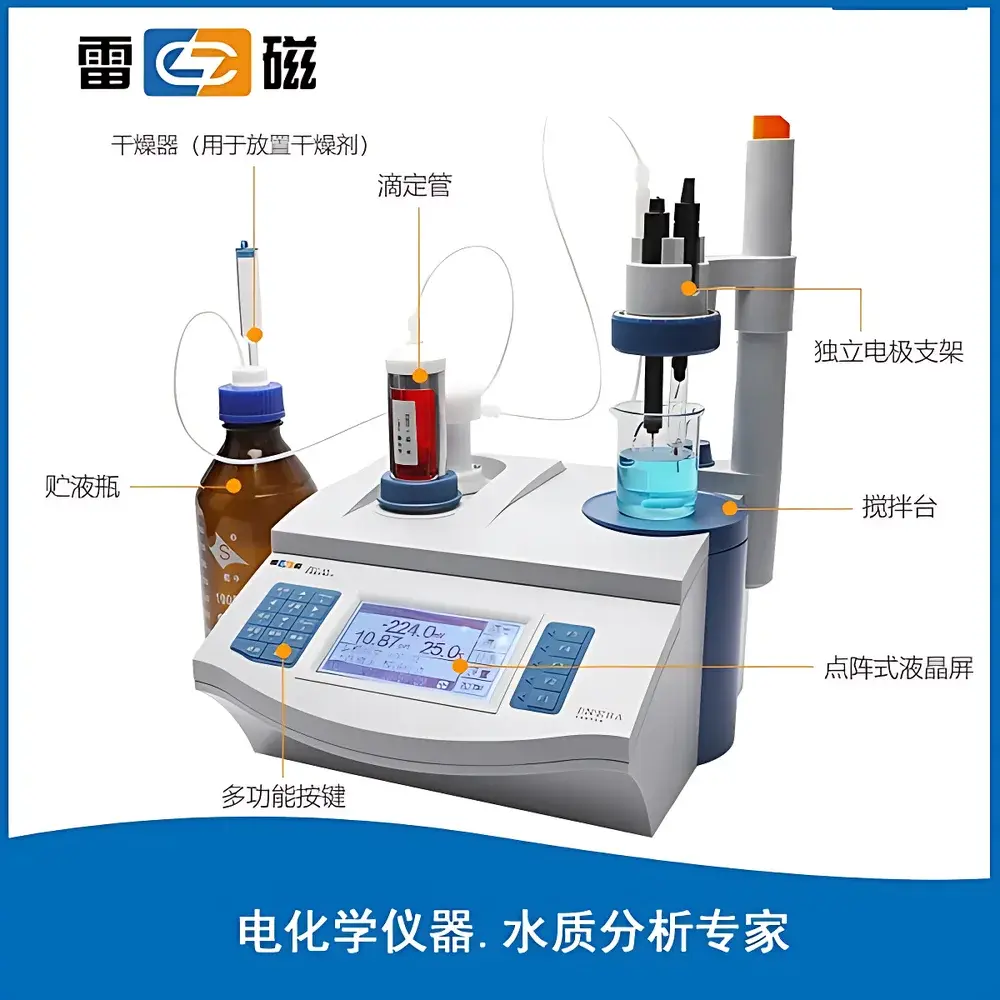
Leici ZDJ-4A Automatic Potentiometric Titrator
| Brand | Leici |
|---|---|
| Origin | Shanghai, China |
| Model | ZDJ-4A |
| Instrument Type | General-purpose Potentiometric Titrator |
| Application Scope | Universal |
| Measurement Range | pH: 0.00–14.00 |
| mV | −1800.0–+1800.0 mV |
| Temperature | −5.0–105.0 °C |
| Meter Accuracy | ±0.01 pH / ±0.03% FS (mV) |
| Meter Resolution | pH: 0.01 pH |
| mV | 0.1 mV |
| Temperature | 0.1 °C |
| Stability | (±0.3 mV ±1 digit)/3 h |
| Titration Repeatability | 0.2% |
| Burette Accuracy | ±0.025 mL (10 mL burette), ±0.035 mL (20 mL burette) |
| Burette Resolution | 1/10000 (10 mL), 2/10000 (20 mL) |
| Burette Fill/Dispense Time | (55 ± 10) s (at full scale) |
| Power Supply | AC 220 V ±10%, 50 Hz |
| Dimensions (W×D×H) | 340 × 400 × 400 mm |
| Weight | 10 kg |
Overview
The Leici ZDJ-4A Automatic Potentiometric Titrator is a benchtop electrochemical analytical instrument engineered for precision and operational flexibility in routine and method-development titrations. It operates on the fundamental principle of potentiometric endpoint detection—measuring the potential difference between a reference electrode and an indicator electrode as a function of titrant volume added. This enables accurate, reproducible quantification of analytes in acid-base, redox, precipitation, complexometric, and non-aqueous titrations. Designed for laboratories requiring regulatory-compliant workflows without premium-tier pricing, the ZDJ-4A delivers traceable measurement integrity, robust hardware architecture, and intuitive method programming—all within a compact, CE-marked enclosure meeting IEC 61010-1 safety requirements.
Key Features
- High-resolution graphical LCD display with keypad navigation—enables real-time visualization of titration curves, current pH/mV/temperature readings, and active method parameters.
- Multi-mode titration capability: dynamic titration (with variable addition rate based on signal slope), preset endpoint titration, fixed-volume (equivalent) titration, and manual stepwise titration—each configurable via embedded menu system.
- Dual burette support (10 mL and 20 mL options) with motorized drive, calibrated volumetric accuracy per ISO 8655-3, and resolution up to 1/10000 full scale for precise reagent delivery.
- PWM-controlled magnetic stirrer with software-adjustable speed (0–1200 rpm), ensuring homogeneous mixing across sample volumes from 10 to 250 mL while minimizing vibration-induced noise and electrode drift.
- Integrated temperature compensation using a Pt1000 sensor, supporting automatic correction of electrode response in accordance with Nernst equation assumptions over −5.0 to 105.0 °C.
- Firmware-upgradable architecture—facilitates future protocol expansion, calibration algorithm updates, and compliance with evolving internal SOPs or external audit requirements.
- Built-in power-fail recovery: automatically saves current titration state upon interruption and resumes from last valid point after reboot—critical for unattended overnight analyses.
Sample Compatibility & Compliance
The ZDJ-4A accommodates aqueous and non-aqueous matrices, including ethanol-, acetonitrile-, and chloroform-based systems, when paired with compatible electrodes (e.g., Ag/AgCl reference, glass pH, platinum redox, or silver indicator electrodes). Its measurement electronics comply with IEC 61326-1 (EMC) and IEC 61010-1 (safety), and its data handling architecture supports GLP/GMP-aligned practices: all stored results include timestamp, operator ID (user-defined), method name, electrode serial number, ambient temperature, and raw mV/pH vs. volume datasets. While not natively 21 CFR Part 11 compliant, audit trails and electronic signatures can be implemented via optional third-party LIMS integration through RS-232.
Software & Data Management
The instrument includes dedicated PC software (ZDJ-4A Data Manager v2.x) for post-run analysis, curve overlay, derivative peak identification, and report generation in PDF or CSV format. Each session stores one active titration method and up to 50 result records locally—retaining full metadata (including raw potential values at each addition step). Data export supports ASTM E1382-compliant formatting for inter-laboratory comparison. All stored entries are individually addressable, deletable, printable, or transferable via RS-232 to serial printers or legacy lab PCs—no proprietary drivers required.
Applications
The ZDJ-4A serves quality control labs in pharmaceutical manufacturing (e.g., assay of active ingredients per USP <541>), food & beverage testing (titratable acidity, chloride, SO₂), water/wastewater analysis (alkalinity, hardness, cyanide), and academic research (kinetic studies, equilibrium constant determination). Its versatility extends to teaching laboratories where students perform classical volumetric experiments under instructor-defined constraints—leveraging its preloaded templates for HCl–NaOH, KMnO₄–Fe²⁺, EDTA–Ca²⁺, and AgNO₃–Cl⁻ systems.
FAQ
Does the ZDJ-4A support GLP-compliant data storage?
Yes—it retains full traceability: date/time stamp, operator ID, method configuration, electrode calibration history, and raw titration data points for every completed run.
Can I connect the ZDJ-4A to modern laboratory networks?
It features native RS-232 serial output only; Ethernet or USB connectivity requires external serial-to-Ethernet converters certified for industrial lab environments.
What electrode types are compatible with the ZDJ-4A?
Standard BNC-input electrodes: combination pH, single-junction reference, redox (Pt or Au), ion-selective (e.g., fluoride, nitrate), and non-aqueous pH sensors—with impedance matching verified per manufacturer specifications.
Is temperature compensation mandatory during titration?
Not mandatory, but strongly recommended for sub-0.02 pH unit accuracy; the built-in Pt1000 sensor enables automatic Nernstian correction across the full −5.0–105.0 °C range.
How often does the burette require recalibration?
Per ISO 8655-5, volumetric verification is advised before first use, after maintenance, and at intervals defined by internal QA protocols—typically quarterly for routine QC applications.




