
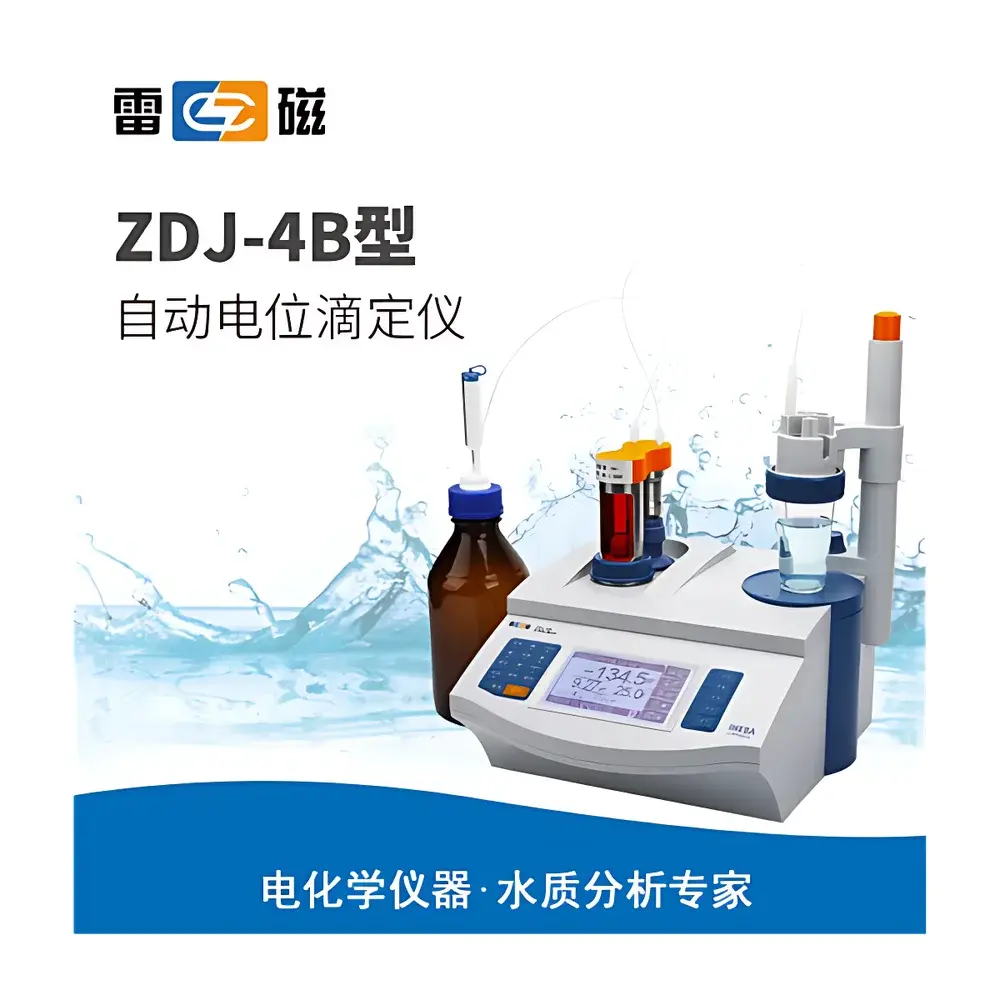
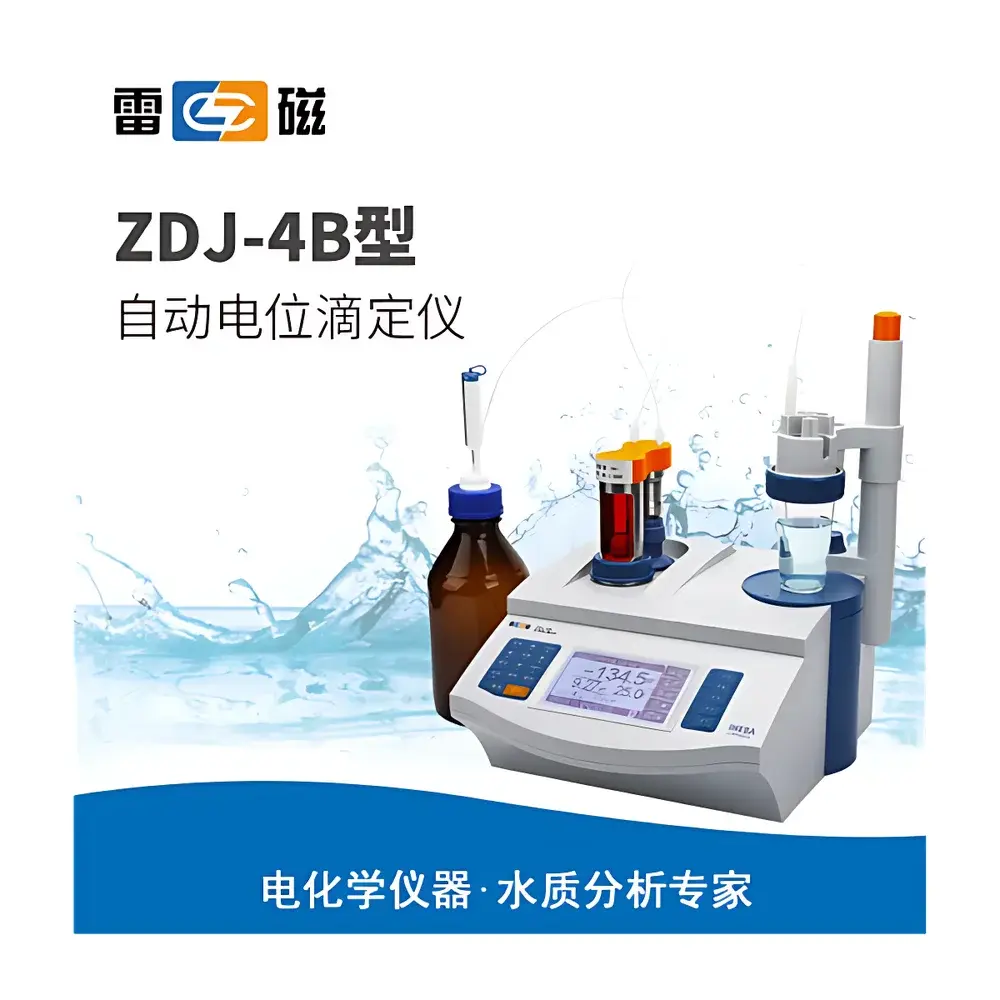
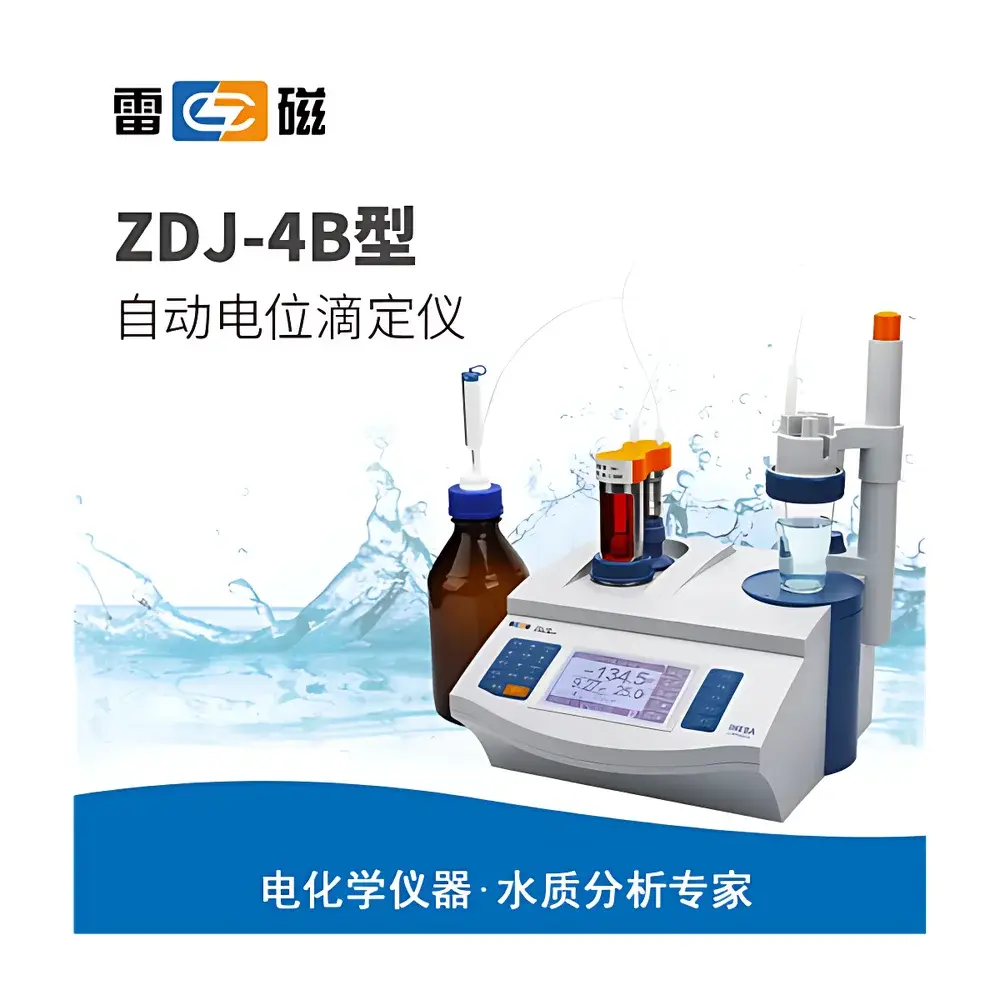
Leici ZDJ-4B Automatic Potentiometric Titrator
| Brand | Leici |
|---|---|
| Origin | Shanghai, China |
| Model | ZDJ-4B |
| Instrument Type | General-purpose Potentiometric Titrator |
| Application Scope | Universal |
| Measurement Range | (0.00–14.00) pH |
| Meter Accuracy | ±0.2% of full scale |
| Meter Resolution | 0.01 pH |
| Titration Accuracy | ±0.3 mV ±1 digit over 3 h |
| Titration Resolution | 1/20,000 for 10 mL burette |
Overview
The Leici ZDJ-4B Automatic Potentiometric Titrator is a benchtop electrochemical analysis system engineered for precision and reproducibility in volumetric titrimetric analysis. It operates on the fundamental principle of potentiometric endpoint detection—measuring the potential difference between a reference electrode and an indicator electrode as titrant is incrementally delivered. The instrument identifies stoichiometric endpoints by detecting inflection points in the E–V (potential vs. volume) curve, enabling quantitative determination of analytes across acid-base, redox, precipitation, complexometric, and non-aqueous titration protocols. Designed for routine QC/QA laboratories, academic teaching labs, and R&D environments, the ZDJ-4B delivers robust architecture, intuitive dual-control operation (front-panel keypad + PC software), and compliance-ready data handling without requiring dedicated infrastructure or specialized training.
Key Features
- High-contrast dot-matrix LCD display with real-time visualization of titration curves, method parameters, and final results—including first- and second-derivative plots for precise endpoint discrimination.
- Integrated valve-burette module constructed from chemically inert fluoropolymer components (e.g., PTFE, FEP, and ETFE), ensuring long-term stability during aggressive titrations involving perchloric acid, concentrated alkalis, or organic solvents (e.g., glacial acetic acid, methanol, DMF).
- Multi-mode titration capability: dynamic pre-titration (for rapid sample screening), preset-endpoint titration (for fixed-pH or fixed-potential targets), pattern-based titration (user-defined volume increments), blank titration, manual override, and customizable method templates—each stored with metadata including operator ID, date/time stamp, and electrode calibration history.
- Dual-language interface (English/Chinese) with firmware-upgradable architecture via USB or RS232, supporting field-deployable updates to expand method libraries or enhance algorithmic precision.
- Integrated pH meter functionality compliant with IUPAC pH measurement standards, enabling standalone electrode characterization, buffer calibration (up to 5-point), and direct pH reporting alongside titration outputs.
- Automatic power-loss recovery: system state and partial titration data are preserved in non-volatile memory, allowing resumption after unexpected interruption without result corruption.
Sample Compatibility & Compliance
The ZDJ-4B accommodates aqueous and non-aqueous matrices across diverse sample types—including pharmaceutical actives, food acids (e.g., citric, lactic), water hardness ions (Ca2+, Mg2+), oxidants (e.g., permanganate, iodine), and weak bases (e.g., amines in solvent extraction). Its electrode input supports standard Ag/AgCl, calomel, glass pH, platinum, and redox-specific sensors. Data management conforms to Good Laboratory Practice (GLP) requirements: each stored result (up to 200 complete titrations + 1 full curve) includes audit-trail elements—operator name, method version, electrode serial number, calibration log, environmental temperature, and timestamped event markers. While not natively 21 CFR Part 11-compliant, the system supports export of ASCII/CSV files for integration into validated LIMS or ELN platforms where electronic signatures and access controls are enforced externally.
Software & Data Management
The included Windows-based titration software provides comprehensive method development, execution control, and post-run analysis. Users define titrant concentration, equivalence point algorithms (e.g., derivative threshold, inflection search window), safety limits (max volume, max time), and report formatting (PDF, Excel, printer-ready layouts). All raw potential/volume data are archived with 16-bit resolution, permitting retrospective reprocessing using alternative endpoint models. Data export supports ISO/IEC 17025 traceability workflows: each file embeds instrument ID, firmware revision, and calibration certificate references. USB and RS232 interfaces enable bidirectional communication—allowing remote start/stop, real-time curve streaming, and batch method deployment across multi-unit installations.
Applications
- Pharmaceutical QC: assay of active ingredients (e.g., aspirin hydrolysis, amine salt titration), chloride impurity quantification per USP .
- Environmental testing: alkalinity and acidity titrations in wastewater per ASTM D1093 and ISO 9965.
- Food & beverage: total acidity (TA) in wines and juices (AOAC 942.05), free fatty acid (FFA) content in oils (ISO 660).
- Chemical manufacturing: Karl Fischer water content validation (when coupled with coulometric KF reagents), purity assessment of inorganic salts (e.g., NaOH, HCl standardization).
- Academic instruction: hands-on demonstration of titration theory, Nernst equation validation, and electrode response kinetics under controlled lab conditions.
FAQ
What electrode types are compatible with the ZDJ-4B?
The instrument accepts standard BNC-input electrodes—including combination pH electrodes, double-junction reference electrodes, platinum redox sensors, and silver/silver chloride titration electrodes—with automatic recognition of electrode type via software configuration.
Can the ZDJ-4B perform thermometric or conductometric titrations?
No. The ZDJ-4B is strictly a potentiometric titrator and does not support temperature or conductivity transducers. Endpoint detection relies exclusively on potential change across the indicator/reference electrode pair.
Is method validation documentation provided?
Leici supplies a basic instrument qualification protocol (IQ/OQ template) and metrological verification checklist aligned with JJG 814–2015 (Chinese national standard for titrators); full GMP validation packages require site-specific risk assessment and third-party support.
How is滴定管 calibration performed?
Burette calibration follows gravimetric procedures per ISO 8655-3: users dispense deionized water at defined temperatures, record mass changes on an analytical balance, and enter correction factors directly into the software’s burette calibration table.
Does the system support automated sample changers?
The ZDJ-4B does not include native autosampler integration; however, its RS232/USB command set allows OEM-level scripting for external robotic liquid handlers via TTL or relay-triggered start signals.






