
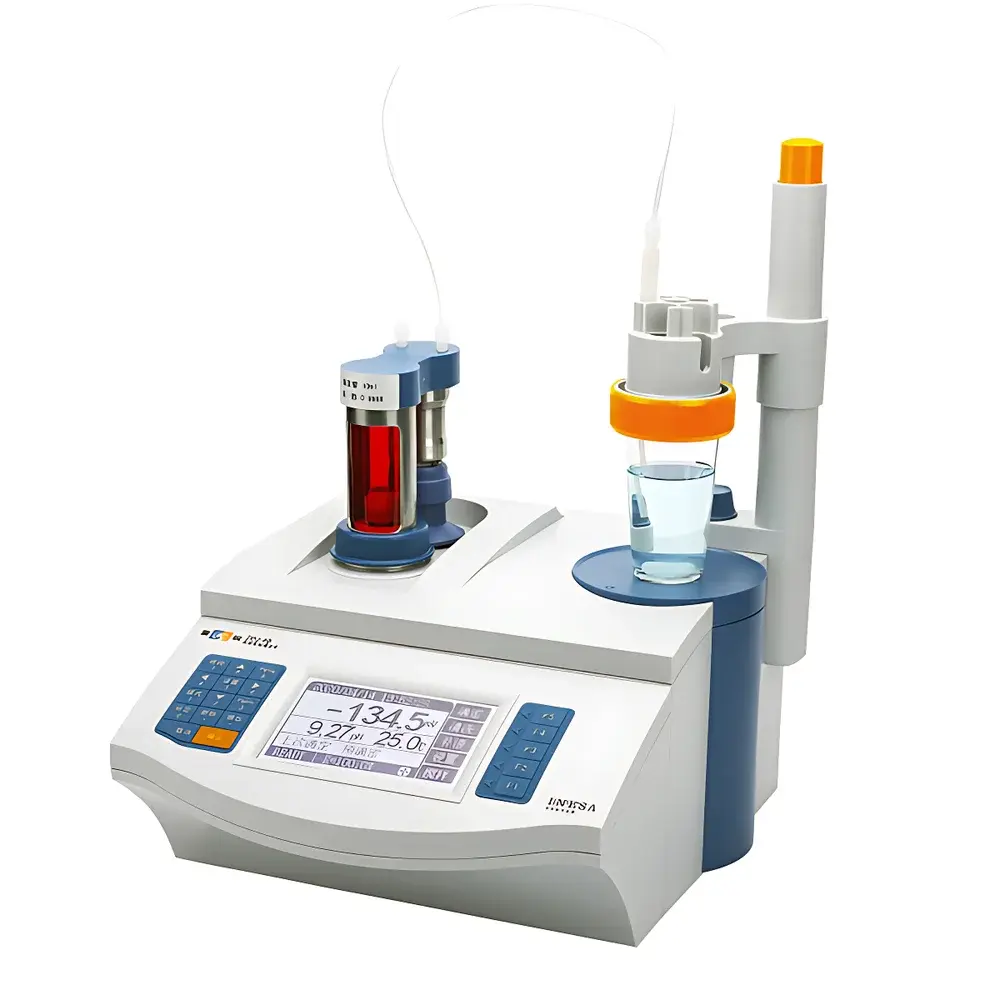
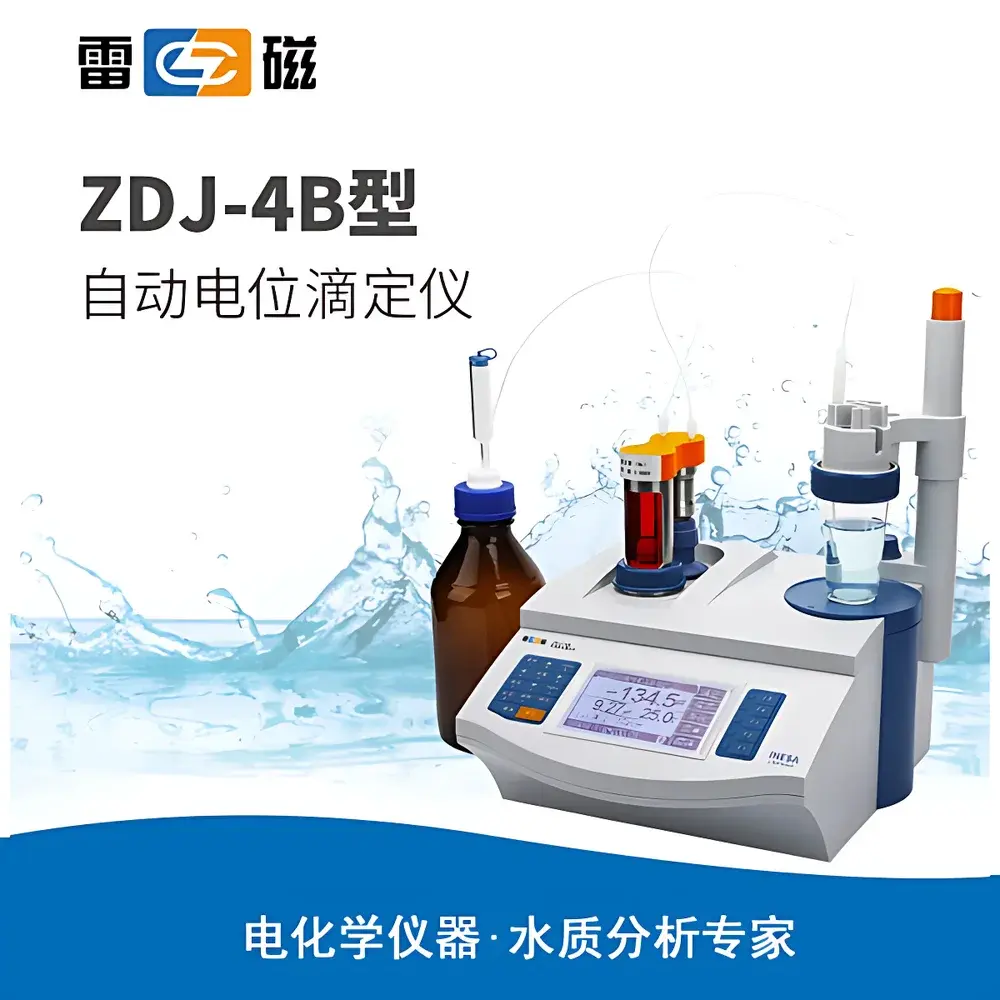
Leici ZDJ-4B Automatic Potentiometric Titrator
| Brand | Leici |
|---|---|
| Origin | Shanghai, China |
| Manufacturer Type | Direct Manufacturer |
| Regional Classification | Domestic (China) |
| Model | ZDJ-4B |
| Instrument Type | General-Purpose Potentiometric Titrator |
| Application Scope | Universal |
| Measurement Range | (0.00–14.00) pH |
| Meter Accuracy | ±0.2% of full scale |
| Meter Resolution | 0.01 pH |
| Titration Stability | (±0.3 mV ±1 digit)/3 h |
| Titration Resolution | 10 mL burette: 1/20000 |
| 20 mL burette | 1/10000 |
| Burette Accuracy | 10 mL: ±0.025 mL |
| 20 mL | ±0.035 mL |
| Temperature Compensation Range | (−5.0–105.0) °C |
| Resolution | 0.1 °C |
| Accuracy | ±0.3 °C |
| Power Supply | AC (220 ± 22) V, (50 ± 1) Hz |
| Dimensions (W×D×H) | 340 × 400 × 400 mm |
| Weight | 10 kg |
Overview
The Leici ZDJ-4B Automatic Potentiometric Titrator is a benchtop electrochemical analyzer engineered for precision and reproducibility in volumetric titrimetric analysis. It operates on the fundamental principle of potentiometric endpoint detection—measuring the potential difference between a reference electrode and an indicator electrode as titrant is incrementally added to the analyte solution. The inflection point in the resulting E–V (potential vs. volume) curve identifies the stoichiometric equivalence point with high resolution, enabling accurate quantification across acid-base, redox, precipitation, complexometric, and non-aqueous titration reactions. Designed for routine QC laboratories, academic teaching labs, and R&D environments, the ZDJ-4B delivers robust architecture, modular fluidics, and dual-control capability—supporting both standalone operation via its integrated dot-matrix LCD interface and remote supervision through dedicated PC software.
Key Features
- Integrated valve-burette assembly with chemically resistant tubing—compatible with strong acids, alkalis, perchloric acid, and organic solvents—enabling safe non-aqueous titrations without cross-contamination.
- Dual-resolution burette options: selectable 10 mL (1/20000 resolution) or 20 mL (1/10000 resolution) glass burettes, each meeting ISO 385 tolerances for Class A volumetric accuracy (±0.025 mL and ±0.035 mL respectively).
- Multi-mode titration engine supporting dynamic (incremental), preset-endpoint, constant-dose, blank, manual, and user-defined custom methods—with real-time E–V and dE/dV curve visualization during analysis.
- High-stability potentiometric measurement module: ±0.01 pH and ±0.03% FS mV basic error; long-term drift stability maintained at (±0.3 mV ±1 digit) over 3 hours—critical for extended batch analyses.
- Full temperature compensation from −5.0 to 105.0 °C (0.1 °C resolution, ±0.3 °C accuracy), ensuring thermally corrected electrode response in variable ambient or heated-cell applications.
- Built-in GLP-compliant data management: stores up to 200 complete titration reports—including method parameters, raw potential/volume data, derivative curves, and operator metadata—with timestamped audit trails.
Sample Compatibility & Compliance
The ZDJ-4B accommodates aqueous and non-aqueous matrices across diverse sample types—including pharmaceutical intermediates, food extracts, environmental water samples, petrochemicals, and metallurgical leachates. Its corrosion-resistant fluid path supports titrants such as NaOH, HCl, KMnO₄, AgNO₃, EDTA, and perchloric acid in acetic anhydride. The instrument complies with core regulatory expectations for analytical instrumentation: data integrity aligns with FDA 21 CFR Part 11 principles (via secure USB/RS232 transfer and software-based electronic signatures); measurement traceability satisfies ISO/IEC 17025 documentation requirements; and titration repeatability (≤0.2% RSD) meets ASTM E2086 and USP guidelines for volumetric assay validation.
Software & Data Management
The included Windows-based titration software provides full bidirectional control—method setup, real-time monitoring, post-run curve analysis (including first-derivative peak identification), and report generation. Data export supports CSV, PDF, and XML formats for LIMS integration. All stored results include mandatory GLP fields: operator ID, date/time stamp, method version, electrode calibration history, and raw sensor output. Firmware updates are performed via USB drive with checksum verification, ensuring system integrity and version control. Language switching between English and Chinese is supported at both UI and report levels without reinstallation.
Applications
- Pharmaceutical QC: Assay of active ingredients (e.g., ibuprofen via non-aqueous titration), chloride content in APIs, and residual catalyst quantification.
- Food & Beverage: Total acidity (TA) in wines and juices, salt content in dairy products, and preservative (sorbate/benzoate) determination.
- Environmental Testing: Alkalinity and hardness profiling in surface waters per APHA 2320B; cyanide speciation using silver nitrate titration.
- Chemical Manufacturing: Purity assessment of sodium hydroxide pellets, HCl concentration in pickling baths, and EDTA chelating capacity in cleaning formulations.
- Academic Research: Teaching fundamental electrochemistry concepts—Nernst equation validation, electrode kinetics, and titration curve simulation.
FAQ
Does the ZDJ-4B support Good Laboratory Practice (GLP) documentation requirements?
Yes—it records full audit trails including operator ID, method name, calibration logs, raw titration data, and timestamps for every analysis, with exportable reports compliant with internal QA and external inspection standards.
Can the instrument perform Karl Fischer titration?
No—the ZDJ-4B is designed for potentiometric endpoint detection only and does not include coulometric or volumetric KF hardware, reagent delivery modules, or moisture-specific electrodes.
Is external burette expansion supported?
Yes—the system features auxiliary ports for optional external burette modules, enabling simultaneous multi-titrant workflows (e.g., sequential acid and base addition) under synchronized software control.
What electrode types are compatible?
Standard single-junction and double-junction pH electrodes, redox (Pt or Ag/AgCl) electrodes, ion-selective electrodes (e.g., F⁻, Cl⁻), and specialized non-aqueous electrodes—all with BNC or DIN connectors and automatic recognition via software configuration.
How is firmware updated?
Via USB flash drive: download verified firmware from Leici’s authorized support portal, copy to FAT32-formatted drive, insert into instrument, and initiate update through the system maintenance menu with built-in checksum validation.
Related Products




