
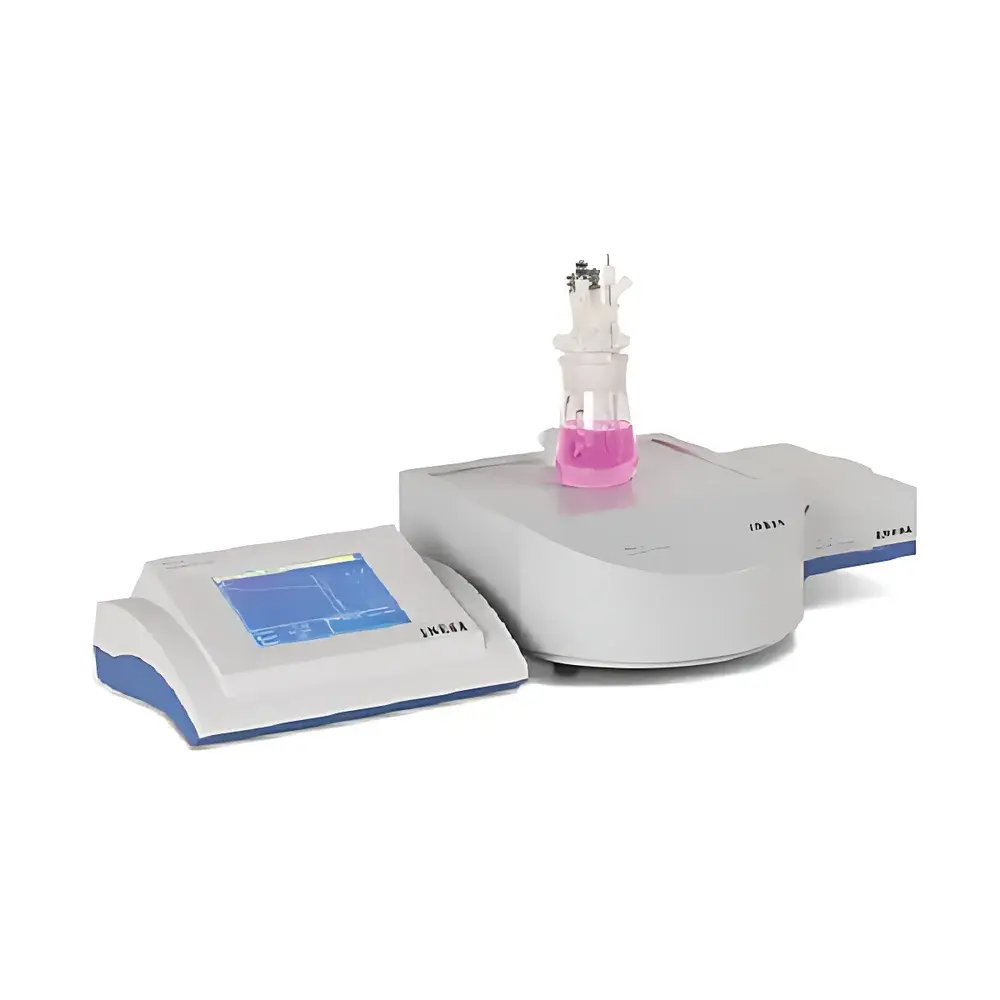
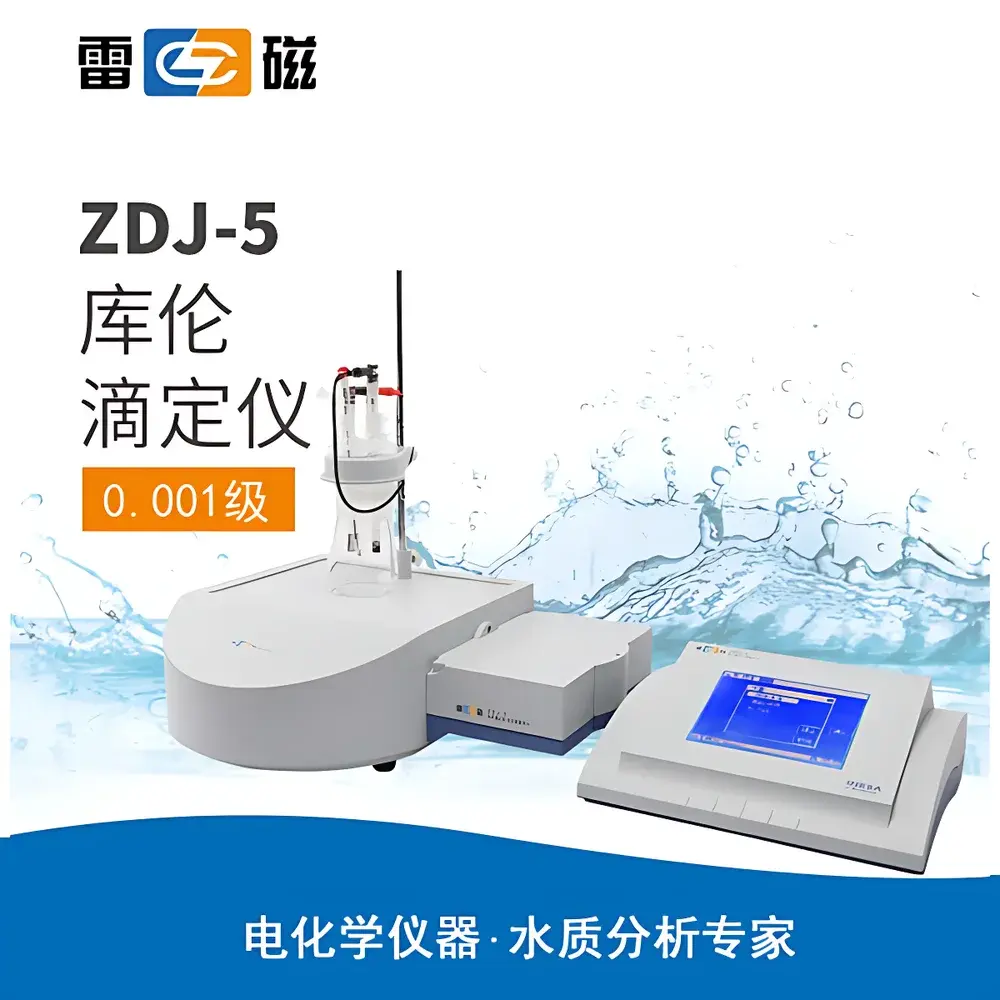
Leici ZDJ-5 Coulometric Titrator
| Brand | Leici |
|---|---|
| Origin | Shanghai, China |
| Manufacturer Type | Direct Manufacturer |
| Regional Classification | Domestic (China) |
| Model | ZDJ-5 Coulometric Titrator |
| Price Range | USD 700 – 7,000 |
| Instrument Type | General-Purpose Potentiometric Titrator |
| Application Scope | Universal |
| Measurement Range | (−1999.9 to +1999.9) mV |
| Meter Accuracy | ≤0.5% of full scale (minimum integration time: 3 s) |
| Electrolysis Current Settings | 1 mA, 10 mA, 50 mA |
| Electrolysis Current Accuracy | ±0.25% of reading (max. load: 500 Ω) |
| Repeatability in Titration | ≤0.5% (min. integration time: 3 s) |
| Power Supply | AC (220 ± 22) V, (50 ± 1) Hz |
| Dimensions (L×W×H) | 360 × 300 × 300 mm |
| Weight | 10 kg |
Overview
The Leici ZDJ-5 Coulometric Titrator is a precision-engineered electrochemical analysis system designed for high-reproducibility coulometric titrations based on controlled-current electrolysis and potentiometric endpoint detection. Unlike volumetric titrators that rely on standardized reagent addition, the ZDJ-5 generates titrant electrochemically at the working electrode—ensuring stoichiometric accuracy without reagent standardization or calibration drift. It operates on the principle of Faraday’s law: the amount of substance consumed or produced during electrolysis is directly proportional to the total charge passed (Q = I × t). This enables absolute quantification of analytes such as chloride, bromide, iodide, thiocyanate, and hydrazine derivatives in pharmaceutical, environmental, and quality control laboratories. The instrument integrates three modular subsystems—electrolysis unit, potentiometric measurement unit (pH/mV), and control unit—allowing flexible configuration while maintaining traceable signal integrity across all operational modes.
Key Features
- 5.7-inch resistive touchscreen LCD with intuitive Chinese/English bilingual interface—designed for laboratory personnel with minimal software training; supports Office-style navigation and real-time parameter editing.
- Modular architecture enabling independent maintenance and functional expansion: electrolysis module (with selectable current outputs: 1 mA, 10 mA, 50 mA), potentiometric measurement module (±1999.9 mV range, resolution 0.1 mV), and microprocessor-based control module.
- Multi-mode titration capability: dynamic titration (real-time slope monitoring), preset endpoint titration, constant-current manual titration, and user-defined custom methods—including programmable pause points, variable current switching, and conditional termination logic.
- Dual-control operation: local panel control with live display of E-t (potential vs. time), dE/dt (first derivative), and d²E/dt² (second derivative) curves—or remote PC control via RS-232 serial interface using proprietary ZDJ-5 Titration Software.
- PWM-controlled magnetic stirrer with software-adjustable speed (0–1200 rpm), low acoustic emission (<45 dB), and anti-vibration mounting to minimize mechanical interference with potentiometric stability.
- Comprehensive data handling: onboard storage for up to 200 titration records; export via USB or RS-232 to CSV, TXT, or proprietary .ZDT formats; optional thermal printer compatibility (TP-16/TP-24/TP-40 series).
Sample Compatibility & Compliance
The ZDJ-5 accommodates aqueous and mixed-solvent samples compatible with standard non-aqueous coulometric cells (e.g., platinum working electrodes, Ag/AgCl reference electrodes, and glass frit separators). It meets core performance requirements outlined in ISO 8587:2021 (Sensory analysis — Methodology — General guidance), ASTM E2081-20 (Standard Guide for Coulometric Titrations), and Chinese Pharmacopoeia 2020 Edition (Section 0401, “Potentiometric Titration”). Its ≤0.5% repeatability (at ≥3 s integration time) satisfies routine QC/QA acceptance criteria per USP and EP 2.2.20. While not pre-certified for FDA 21 CFR Part 11, the system supports audit-trail-ready operation when used with validated ZDJ-5 software configurations—including electronic signatures, method versioning, and immutable raw data logs.
Software & Data Management
The included ZDJ-5 Titration Software (v3.2+) runs on Windows 7–11 (32/64-bit) and provides a virtual instrument interface mirroring hardware controls. Users may define multi-step titration protocols with conditional logic (e.g., “if dE/dt > X, switch current to 10 mA”), assign calculation formulas (e.g., % purity = (Q × M × 1000) / (n × F × W)), and apply statistical post-processing (mean, RSD, confidence intervals). All raw potential/time datasets are stored with metadata (date/time, operator ID, method name, electrode IDs). Export options include PDF reports with embedded derivative plots, Excel-compatible tables, and SQL-compatible database dumps for LIMS integration. Firmware updates are delivered via USB stick with SHA-256 checksum verification.
Applications
The ZDJ-5 is routinely deployed in regulated environments for: determination of residual chlorine in drinking water (ISO 9297); assay of sodium thiosulfate in ophthalmic solutions (USP-NF); quantification of iodine value in edible oils (AOCS Cd 1d-92); trace bromide in semiconductor-grade hydrochloric acid (SEMI F57); and Karl Fischer–compatible coulometric water determination in solvents (when paired with dual-platinum generator electrodes). Its modular design permits adaptation to specialized workflows—such as sequential multi-analyte titration using automated valve switching or integration with autosamplers (via optional TTL trigger I/O).
FAQ
What electrolyte systems are compatible with the ZDJ-5?
The instrument supports standard coulometric cells using aqueous KBr/KCl media, non-aqueous LiClO₄/acetonitrile, and acidic electrolytes (e.g., H₂SO₄/H₃PO₄ mixtures) depending on electrode material selection.
Can the ZDJ-5 perform both coulometric and conventional potentiometric titrations?
Yes—the measurement unit functions independently as a high-precision mV/pH meter; however, true coulometric mode requires activation of the electrolysis module and proper cell setup.
Is GLP-compliant data archiving supported?
When operated with validated software settings and external backup procedures, the system supports ALCOA+ principles (Attributable, Legible, Contemporaneous, Original, Accurate) for raw data retention.
What is the maximum allowable cell resistance for stable 50 mA operation?
The electrolysis module maintains specified accuracy up to 500 Ω total cell resistance, including solution resistance, electrode polarization, and contact impedance.
Does the ZDJ-5 support automatic electrode diagnosis or calibration verification?
No—it does not include built-in electrode health diagnostics; users must perform manual open-circuit potential checks and slope verification using standard buffer/reference solutions prior to critical assays.




