
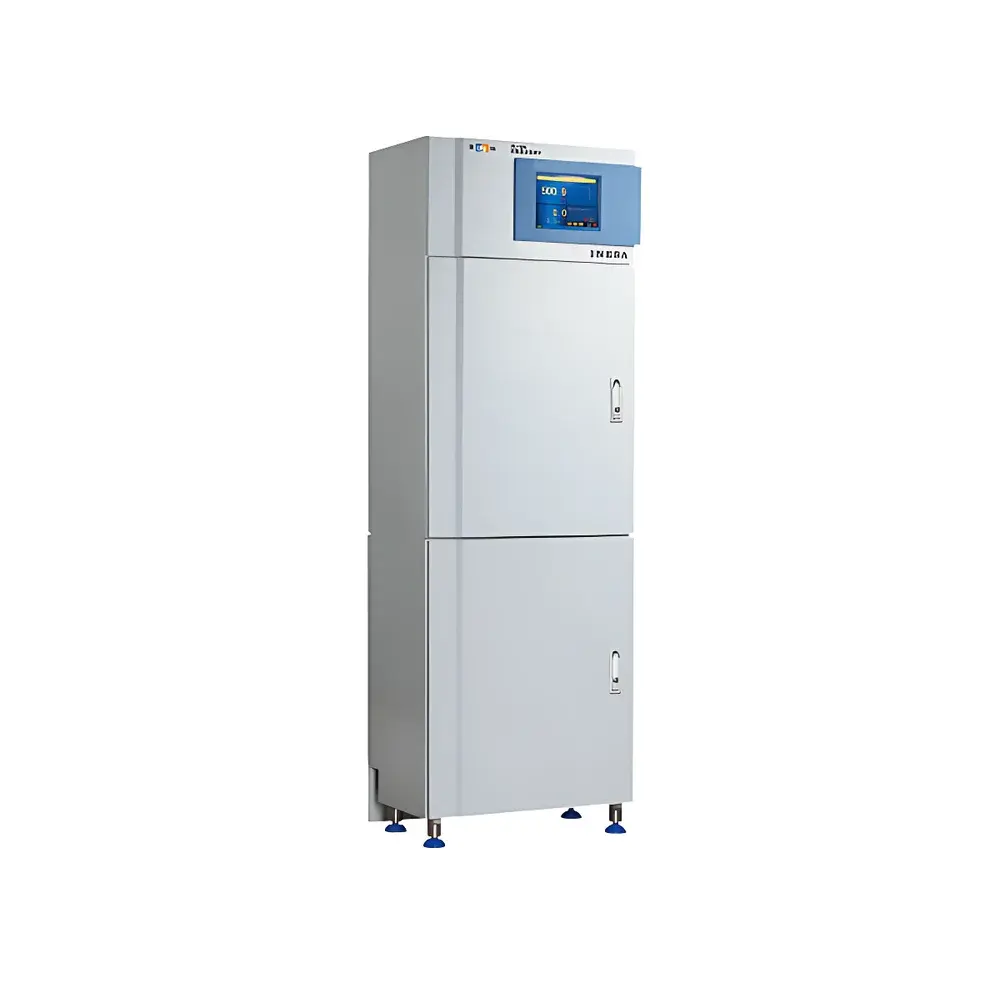
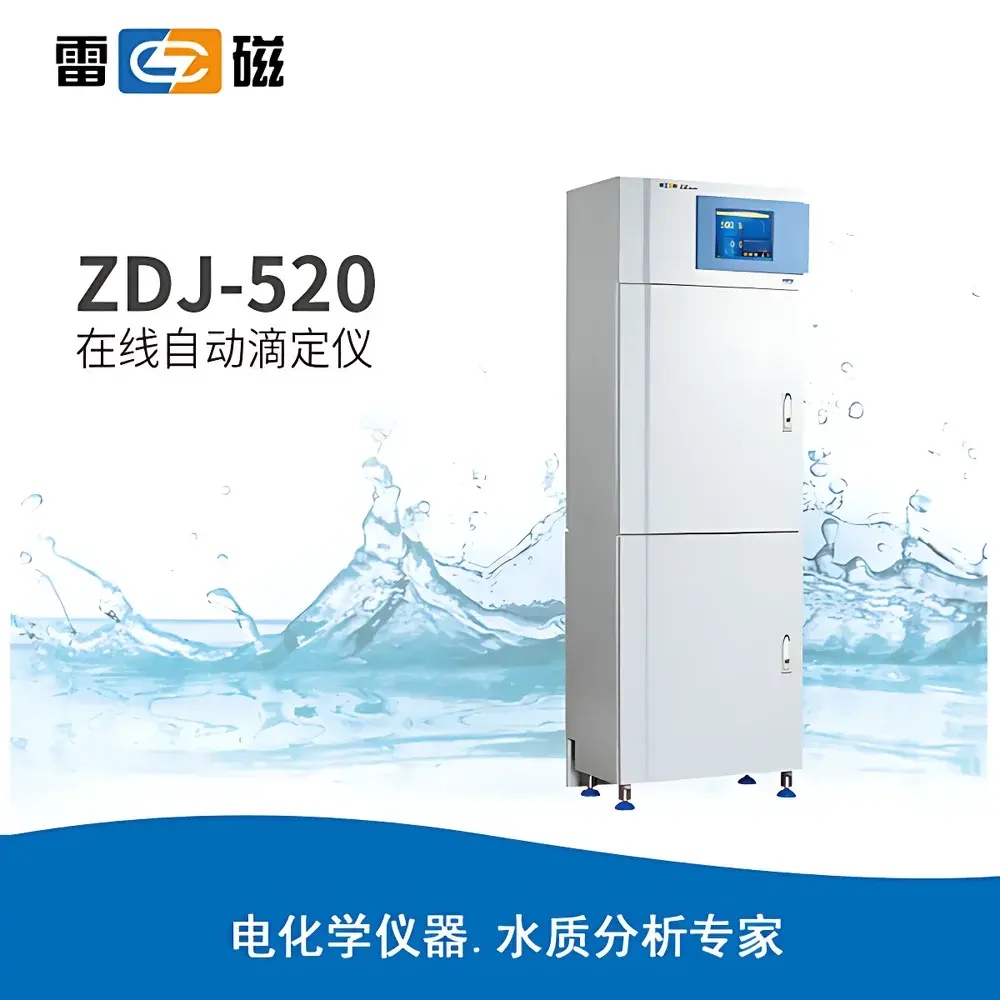
Leici ZDJ-520 Online Automatic Potentiometric Titrator
| Brand | Leici |
|---|---|
| Origin | Shanghai, China |
| Manufacturer Type | Direct Manufacturer |
| Regional Classification | Domestic (China) |
| Model | ZDJ-520 |
| Instrument Type | General-Purpose Potentiometric Titrator |
| Application Scope | Universal |
| Measurement Range | pH (0.00–14.00) |
| Electronic Unit Display | pH (−2.00–20.00), mV (0.0–±1999.9), Temperature (−5.0–105.0)°C |
| Electrode Unit Accuracy | ≤1.0% |
| Electrode Unit Resolution | 0.01 pH, 0.1 mV, 0.1°C |
| Repeatability (Burette Delivery) | ≤1.0% |
| pH Accuracy | ±0.01 pH ±1 digit |
| mV Accuracy | ±0.03% FS |
| Temperature Accuracy | ±0.3°C |
| Power Supply | AC (220 ± 22) V, (50 ± 1) Hz |
| Dimensions (W × D × H) | 600 × 455 × 720 mm |
| Weight | 50 kg |
Overview
The Leici ZDJ-520 Online Automatic Potentiometric Titrator is an industrial-grade, benchtop-compatible electrochemical analyzer engineered for high-reproducibility potentiometric titrations in both laboratory and continuous process environments. It operates on the fundamental principle of monitoring potential change (mV) across a reference–indicator electrode pair as titrant is incrementally delivered, enabling precise endpoint detection via first-derivative or inflection-point algorithms. Unlike manual or semi-automated systems, the ZDJ-520 integrates real-time electrode potential feedback with programmable fluidic control, supporting dynamic response to varying sample matrix complexity—critical for applications where pH drift, redox instability, or complexing agents influence equivalence point sharpness. Its design accommodates routine compliance with ASTM E2087 (Standard Practice for Potentiometric Titration), ISO 8289 (Water Quality – Determination of Total Hardness), and USP (Acid–Base Titrations), making it suitable for GLP- and GMP-aligned quality control laboratories.
Key Features
- 7-inch full-color capacitive touchscreen interface with intuitive Chinese–English bilingual navigation and real-time graphical display of titration curves, equivalence volumes, calculated concentrations, and derivative plots;
- Modular hardware architecture with motor-driven burette (10 mL or 20 mL optional), precision peristaltic pump for reagent delivery, and integrated electrode holder with automatic cleaning station;
- Three operational modes: Continuous titration (for rapid batch analysis), Time-based titration (for kinetic studies), and Periodic titration (for scheduled in-line monitoring at fixed intervals);
- Automated sequence execution: auto-calibration (single- or multi-point pH/mV), auto-titration (with configurable stop criteria), auto-rinse (using deionized water or solvent), and auto-zeroing;
- Customizable titration protocols: user-defined endpoint detection thresholds, slope sensitivity, delay times, and volume increments; editable calculation formulas support stoichiometric conversions, dilution factors, and unit normalization;
- Dual communication interfaces: RS-232 (standard) or RS-485 (optional), compliant with Modbus RTU protocol for integration into SCADA, DCS, or LIMS platforms;
- Robust mechanical construction: stainless-steel chassis, chemical-resistant fluid path materials (PTFE, PEEK, borosilicate glass), and IP20-rated enclosure for controlled lab or clean utility room deployment.
Sample Compatibility & Compliance
The ZDJ-520 accepts aqueous and low-viscosity non-aqueous samples (e.g., ethanol/water mixtures, acetic acid solutions) within temperature range −5.0 to 105.0°C. It supports standard combination pH electrodes, redox (Pt or Ag/AgCl) electrodes, ion-selective electrodes (e.g., fluoride, chloride), and custom sensor configurations via universal BNC and mini-DIN inputs. All measurement data—including raw mV/pH/time stamps, calibration logs, and titration metadata—are timestamped and stored with audit-trail capability. The system meets essential requirements for FDA 21 CFR Part 11 compliance when deployed with validated software configuration and access-controlled user accounts (administrator, analyst, operator roles). It conforms to IEC 61000-4 electromagnetic compatibility standards and is CE-marked for safe operation in industrial laboratories.
Software & Data Management
Embedded firmware provides local data storage for ≥10,000 complete titration records, each containing raw sensor traces, intermediate calculations, operator ID, and environmental conditions. Data export is supported via USB flash drive (CSV, PDF report templates) or serial transmission to external databases. Optional PC-based Leici TitraLink™ software enables advanced curve fitting, statistical trend analysis (e.g., Shewhart X-bar/R charts), method validation (ICH Q2(R2)-aligned precision/repeatability assessment), and electronic signature capture. All data files are structured with embedded metadata (ISO/IEC 11179-compliant), facilitating traceability during regulatory inspections or internal QA audits.
Applications
- Environmental monitoring: COD determination, alkalinity/acidity profiling, chloride and sulfate quantification in wastewater effluents;
- Chemical manufacturing: assay of organic acids (e.g., citric, oxalic), amine content in catalysts, peroxide value in surfactants;
- Pharmaceutical QC: assay of active pharmaceutical ingredients (APIs) per USP monographs, residual alkali in excipients, dissolution endpoint verification;
- Food & beverage: titratable acidity in dairy and fruit products, salt content via argentometric titration, preservative (sorbate/benzoate) quantification;
- Power generation: hydrazine and phosphate monitoring in boiler feedwater, silica scavenger dosing control;
- Electroplating & surface treatment: free cyanide and total metal ion concentration (Ni²⁺, Cu²⁺, Zn²⁺) in plating baths.
FAQ
Does the ZDJ-520 support remote calibration verification?
Yes—via RS-485 Modbus, users can trigger calibration routines, retrieve calibration coefficients, and log verification results directly from a central SCADA system.
Can the instrument be integrated into a 21 CFR Part 11–compliant workflow?
Yes—when configured with role-based authentication, electronic signatures, and audit-trail enabled firmware, it satisfies core ALCOA+ data integrity principles.
What electrode types are natively supported?
pH combination electrodes (glass membrane), redox electrodes (platinum or silver/silver chloride), and select ISEs with BNC output; custom electrode adapters available upon request.
Is periodic maintenance required for the burette and pump system?
Yes—burette piston seals and tubing should be inspected every 6 months under continuous operation; Leici provides certified service kits and factory recalibration certificates.
How is temperature compensation applied during titration?
The integrated Pt1000 sensor measures solution temperature in real time; Nernst equation corrections are applied automatically to electrode potential readings per ISO 3696 and ASTM D129.
Related Products




