
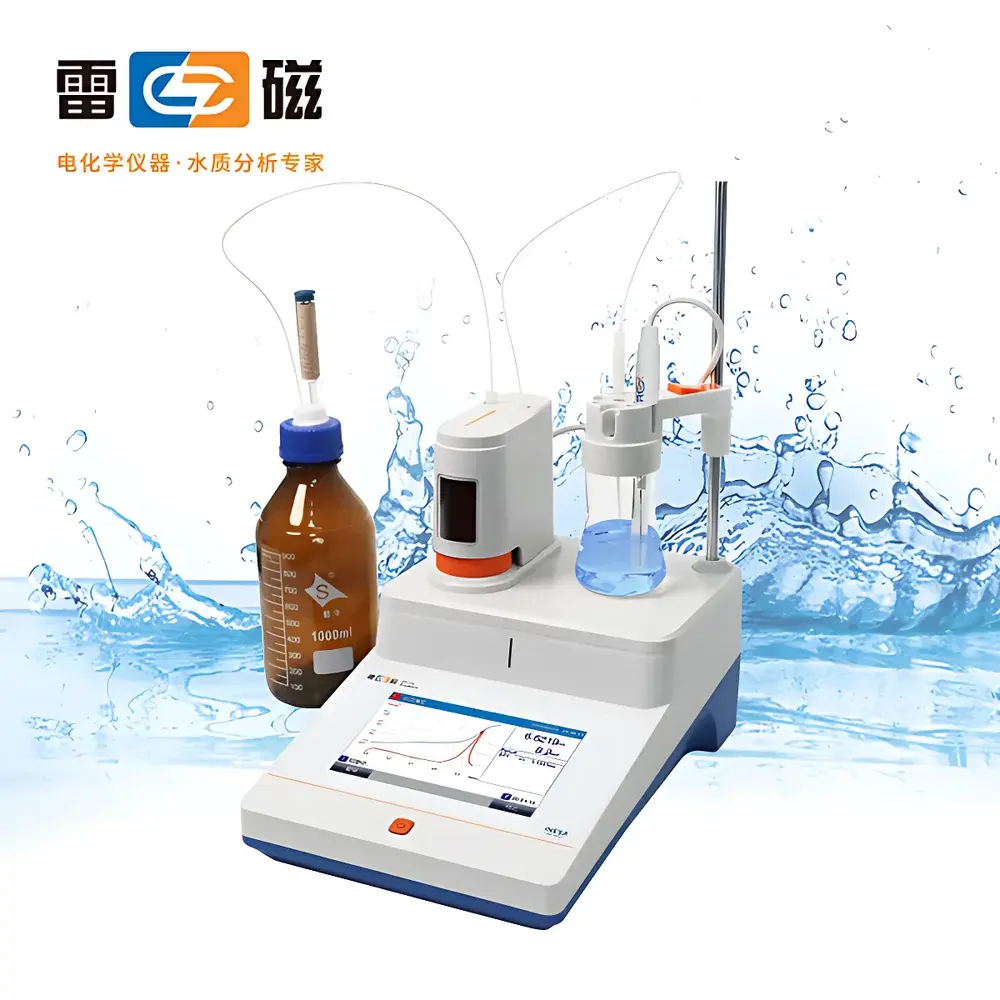
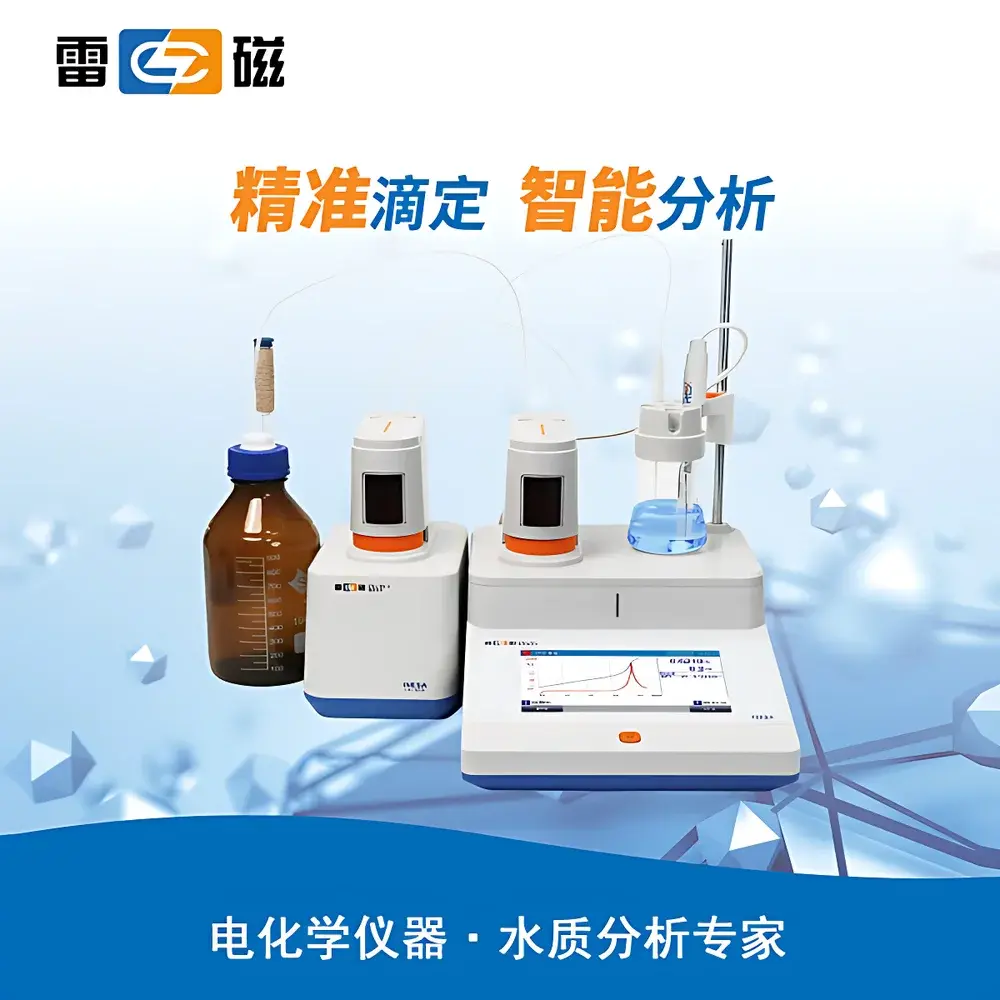
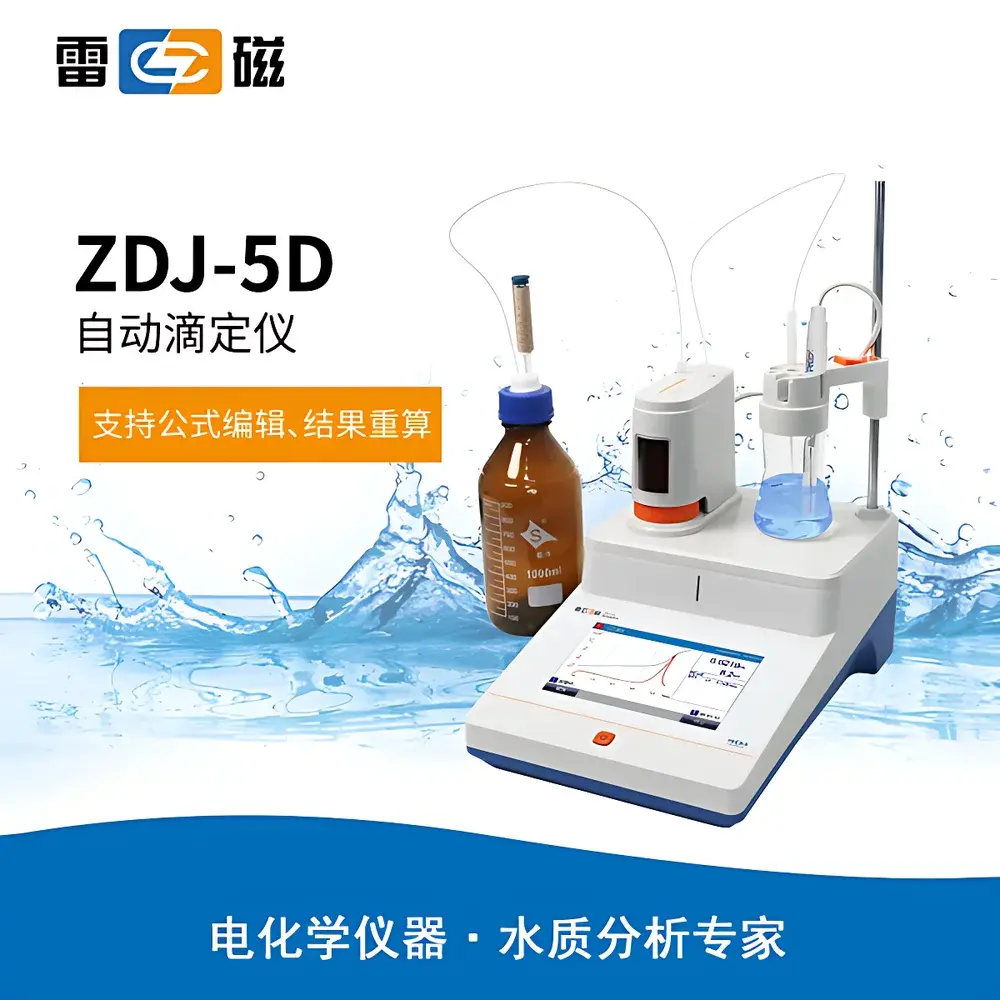
Leici ZDJ-5D Automatic Potentiometric Titrator
| Brand | Leici |
|---|---|
| Origin | Shanghai, China |
| Manufacturer Type | Direct Manufacturer |
| Product Category | Domestic (China-Made) |
| Model | ZDJ-5D |
| Instrument Type | General-Purpose Potentiometric Titrator |
| Application Scope | Universal |
| Measurement Range | (-2000.00 to +2000.00) mV, (-5.000 to +20.000) pH |
| Electrode Meter Accuracy | pH: ±0.002 pH |
| pX | ±0.002 pX (pX1), ±0.005 pX (pX2) |
| Concentration | ±0.3% |
| mV | ±0.03% or ±0.2 mV |
| Electrode Meter Resolution | pH: 0.001 pH |
| pX | 0.001 pX |
| Ion Concentration | 4 significant digits |
| mV | 0.01 mV |
| Titration Repeatability | 0.2% |
| Titration Resolution | 1/480,000 |
Overview
The Leici ZDJ-5D Automatic Potentiometric Titrator is a high-precision, modular electrochemical platform engineered for quantitative volumetric analysis based on potentiometric endpoint detection. It operates on the fundamental principle of monitoring potential change (mV) across a reference–indicator electrode pair during titrant addition, enabling precise stoichiometric determination of analytes in aqueous and non-aqueous media. Designed for routine and regulated laboratory environments—including QC labs in pharmaceuticals, food & beverage, environmental testing, and industrial chemistry—the ZDJ-5D supports classical acid-base, redox, precipitation, complexometric, and non-aqueous titrations, as well as ion-selective electrode (ISE)-based pX and concentration measurements. Its architecture complies with core analytical workflow requirements for traceability, reproducibility, and method integrity under GLP and GMP frameworks.
Key Features
- 7-inch full-color capacitive touchscreen with intuitive, menu-driven navigation—no external keyboard or mouse required
- Dual-function capability: simultaneous potentiometric titration and direct electrode-based measurement (pH, pX, ion concentration)
- Modular detection expansion: supports optional integration of amperometric (dead-stop), conductometric, photometric, and thermometric titration modules
- Valve-integrated burette system with tool-free replacement—compatible with 5 mL, 10 mL, and 20 mL glass burettes; certified accuracy per ISO 8655-3 (e.g., ±0.010 mL for 5 mL burette)
- Dual burette configuration support: primary internal system + optional external secondary line for auxiliary reagent addition or parallel titration sequences
- Chemically inert fluid path: PTFE, ETFE, and ceramic components resistant to concentrated acids, perchloric acid, strong bases, and organic solvents (e.g., acetonitrile, glacial acetic acid)
- Programmable stirring: independent upper and lower magnetic stirrers with adjustable speed and torque control
- Multi-mode titration algorithms: dynamic (derivative-based), fixed-volume, preset-endpoint, constant-pH, constant-rate, blank correction, and manual override
- Advanced calculation engine: built-in formula editor for custom stoichiometric expressions; real-time recalculation of raw titration data without re-running experiments
Sample Compatibility & Compliance
The ZDJ-5D accommodates liquid samples across wide pH (−5.000 to 20.000), redox (−2000 to +2000 mV), and ionic activity ranges. It supports ISE measurements for Ag⁺, Na⁺, K⁺, NH₄⁺, Cl⁻, F⁻, NO₃⁻, BF₄⁻, CN⁻, Cu²⁺, Pb²⁺, Ca²⁺, and user-defined ions—with concentration reporting in μg/L, mg/L, g/L, mol/L, mmol/L, ppm, and ppb. Temperature compensation is active from −10.0 °C to +135.0 °C (±0.1 °C resolution). The instrument meets essential regulatory design criteria: data storage adheres to GLP audit trail requirements (1000+ titration records, pH/pX/ion datasets); electronic signatures, user-level access control (four-tier permission hierarchy), and method versioning satisfy FDA 21 CFR Part 11 readiness when paired with validated PC software. Calibration routines auto-recognize GB, DIN, and NIST pH standard buffers.
Software & Data Management
Data integrity is enforced via embedded GMP-compliant logging: all operator actions, method parameters, calibration events, and raw sensor outputs are timestamped and immutably stored. Results export in CSV (for LIMS ingestion) and PDF (for audit-ready reports) via USB drive; RS-232 enables direct printing to serial-compatible thermal or dot-matrix printers. Network connectivity includes RJ45 Ethernet and Wi-Fi (IEEE 802.11 b/g/n), allowing secure upload to on-premise servers or validated cloud repositories. PC communication uses Leici’s proprietary Windows-based TitraLink™ software—supporting remote method deployment, batch result review, statistical analysis (e.g., RSD, confidence intervals), and electronic signature workflows. U disk import/export extends method portability across instruments within multi-site laboratories.
Applications
The ZDJ-5D delivers validated performance in diverse applications: chloride quantification in drinking water (ISO 9297), total acidity in edible oils (AOAC 940.28), peroxide value in fats (AOAC 965.33), calcium/magnesium hardness in wastewater (APHA 3111B), sodium hydroxide assay in caustic soda (ASTM D4294), and fluoride in toothpaste (USP ). Its non-aqueous compatibility enables Karl Fischer moisture equivalence via coulometric titration adaptation, while GRAN plot analysis ensures robust weak-acid titrations (e.g., phosphoric acid speciation). In pharmaceutical QC, it supports USP and EP 2.2.20 monographs for assay of active ingredients requiring potentiometric endpoint confirmation.
FAQ
Does the ZDJ-5D comply with 21 CFR Part 11 for electronic records and signatures?
Yes—when operated with TitraLink™ v3.2+ under validated network and user management configurations, it provides audit trails, role-based access, and electronic signature capture meeting Part 11 predicate rule expectations.
Can the instrument perform thermometric titrations out of the box?
No—thermometric titration requires optional hardware (temperature-sensing probe + dedicated module), which mounts externally and integrates via the same communication bus.
What is the maximum allowable ambient temperature for continuous operation?
The unit is rated for continuous use at 5–40 °C and ≤80% RH (non-condensing); extended operation above 35 °C requires active ventilation to maintain electronics stability.
Is method validation support documentation available?
Leici provides IQ/OQ protocol templates, metrological traceability statements for burette certification, and uncertainty budgets for pH/mV measurement per ISO/IEC 17025 guidelines.
How is firmware updated?
Firmware updates are delivered via encrypted USB stick; update process includes pre-checksum verification and automatic rollback on failure to ensure instrument state integrity.






