
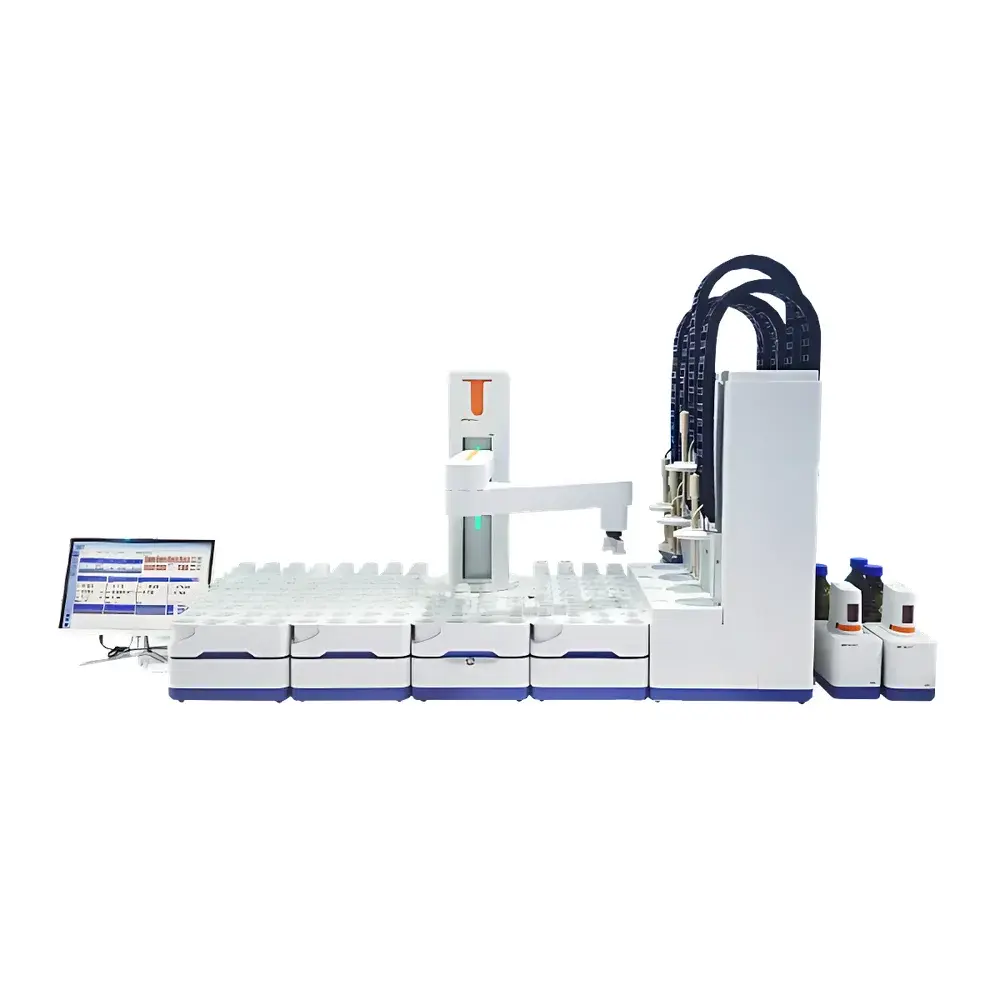
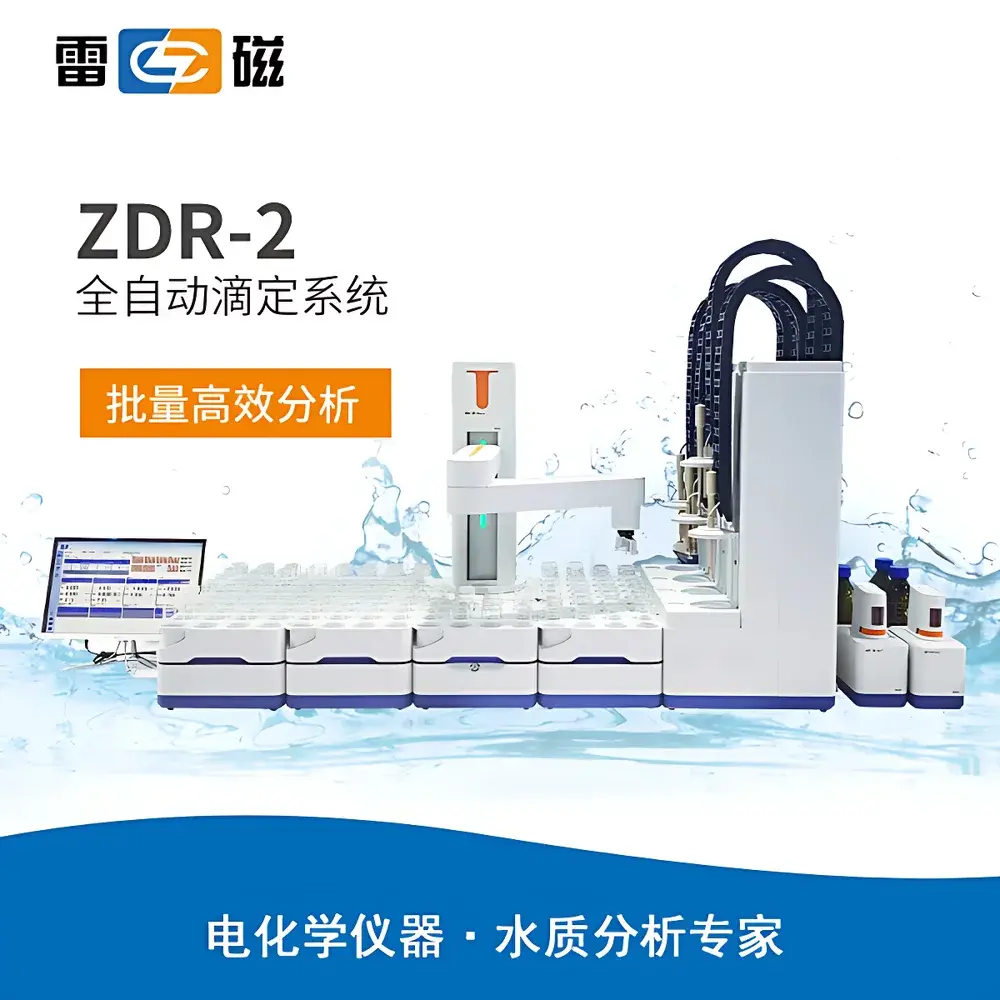
Leici ZDR-2 Fully Automated Potentiometric Titrator
| Brand | Leici |
|---|---|
| Origin | Shanghai, China |
| Manufacturer Type | Manufacturer |
| Product Origin | Domestic (China) |
| Model | ZDR-2 Fully Automated Potentiometric Titrator |
| Instrument Type | General-purpose Potentiometric Titrator |
| Application Scope | Universal |
| Potential Measurement Range | (−2000.00 to +2000.00) mV, pH Range: (−2.000 to 20.000) |
| Potentiometer Accuracy | ±0.03% or ±0.2 mV, ±0.002 pH |
| Potentiometer Resolution | 0.01 mV, 0.001 pH |
| Titration Accuracy (10 mL burette) | ±0.020 mL |
| Titration Resolution | 1/50000 |
| Repeatability | ≤0.2% RSD |
| Temperature Measurement Range | (−5.0 to 105.0) °C, Resolution: 0.1 °C, Accuracy: ±0.3 °C (0–60 °C), ±1.0 °C (other ranges) |
| Power Supply | AC (220 ± 22) V, (50 ± 0.5) Hz |
Overview
The Leici ZDR-2 Fully Automated Potentiometric Titrator is an integrated electrochemical analysis platform engineered for precision, reproducibility, and regulatory compliance in routine and high-throughput titration workflows. Based on potentiometric endpoint detection—measuring the potential difference between a reference electrode and an indicator electrode as titrant is incrementally added—the system enables quantitative determination of analytes across acid-base, redox, precipitation, complexometric, and non-aqueous titrations. Its architecture supports multi-parameter electrochemical monitoring (mV, pH, temperature) with real-time curve acquisition, derivative analysis, and endpoint recognition via first- or second-derivative algorithms. Designed for laboratories operating under GLP, ISO/IEC 17025, and FDA-regulated environments, the ZDR-2 delivers traceable, auditable results without manual intervention.
Key Features
- Modular hardware architecture with automatic recognition of interconnected units: robotic autosampler, potentiometric measurement module, titration module, reagent delivery module, and solvent manager.
- 112-position fully automated sample handling: robotic arm performs barcode scanning, lid removal, sample positioning, titration, post-analysis electrode rinsing, waste disposal, and lid resealing—eliminating operator variability.
- Up to four parallel titration channels supported, each with independent 10 mL burettes featuring valve-buret integration for rapid, contamination-free replacement.
- Potentiometric measurement unit supports up to four simultaneous electrodes; includes integrated top- and bottom-mounted stirrers and auto-cleaning cycles after each measurement.
- Chemically resistant fluidic path compatible with strong acids, bases, perchloric acid, and organic solvents—validated for non-aqueous titrations per ASTM E2087 and ISO 8287.
- High-resolution titration control: 1/50000 burette resolution (0.0001 mL volumetric resolution) and ≤0.2% repeatability (RSD) across repeated standardizations.
- Temperature-compensated measurements with built-in Pt100 sensor (−5.0 to 105.0 °C), calibrated to ±0.3 °C accuracy within physiological and common laboratory ranges.
Sample Compatibility & Compliance
The ZDR-2 accommodates diverse sample matrices—including aqueous solutions, pharmaceutical suspensions, food extracts, petrochemical distillates, and environmental water samples—without modification to core hardware. Its modular design allows configuration-specific validation: e.g., 48-, 80-, or 112-position sample trays accommodate vial formats from 10 mL glass to 50 mL polypropylene. All electrochemical measurements comply with IUPAC recommendations for potentiometric titration and meet essential performance criteria outlined in USP , EP 2.2.29, and ISO 7870-2 for control chart applications. The system’s electronic record architecture conforms to FDA 21 CFR Part 11 requirements through user authentication, audit trail logging, electronic signatures, and immutable data storage—enabling full traceability from raw signal to final report.
Software & Data Management
- Windows-based PC software with role-based access control: administrator, analyst, and reviewer profiles support configurable permissions for method editing, task execution, and data export.
- Method library supporting creation, versioning, and validation of custom titration protocols—including dynamic, preset-endpoint, constant-pH, blank, and manual modes.
- Task scheduler enabling up to five concurrent task groups; uninterrupted batch processing with automatic recovery after power interruption or error condition.
- Integrated formula editor for real-time calculation of concentration, purity, acidity number, saponification value, and other derived parameters—displayed alongside titration curves.
- GLP-compliant data management: all raw mV/pH/time points, metadata (operator ID, timestamp, instrument ID, electrode lot), and audit logs stored in encrypted SQLite database with optional network backup.
- Report generation engine supporting customizable templates; export to PDF (with digital signature embedding) and Excel (.xlsx) with full traceability of intermediate calculations and calibration history.
Applications
The ZDR-2 serves as a primary analytical tool in quality control laboratories across pharmaceuticals (e.g., assay of active ingredients per USP monographs), food & beverage (titratable acidity, salt content, vitamin C), chemicals (acid number, base number, chloride content), and environmental testing (alkalinity, hardness, cyanide). Its non-aqueous capability supports Karl Fischer coulometric and volumetric water determination when paired with appropriate reagents and electrodes. In R&D settings, the system facilitates method development for novel endpoints—such as potentiometric detection of metal ion complexes using ion-selective electrodes—or kinetic titrations requiring precise time-resolved additions. Regulatory submissions routinely include ZDR-2-generated datasets validated per ICH Q2(R2) guidelines for analytical procedure verification.
FAQ
Does the ZDR-2 support FDA 21 CFR Part 11 compliance?
Yes—the system implements electronic signatures, audit trails with immutable timestamps, user authentication, and permission-based workflow controls aligned with Part 11 Annex A expectations.
Can the ZDR-2 perform thermometric or conductometric titrations?
No—it is dedicated to potentiometric detection only. Thermometric and conductometric modules are not part of the ZDR-2 architecture.
What electrode types are compatible with the measurement unit?
Standard single-junction and double-junction pH electrodes, redox electrodes (Pt, Ag/AgCl), ion-selective electrodes (e.g., fluoride, nitrate), and combination electrodes with BNC or DIN connectors.
Is remote monitoring or cloud-based data synchronization available?
Local network access is supported via TCP/IP; however, cloud connectivity or SaaS-based data hosting is not natively implemented—data export remains file-based (PDF, Excel, CSV) or via secure local server backup.
How often does the system require calibration verification?
Per GLP practice, daily verification using certified pH and mV standards is recommended; full calibration (electrode slope, asymmetry potential, temperature sensor) should be performed before each analytical campaign or at least every 24 hours of continuous operation.






