
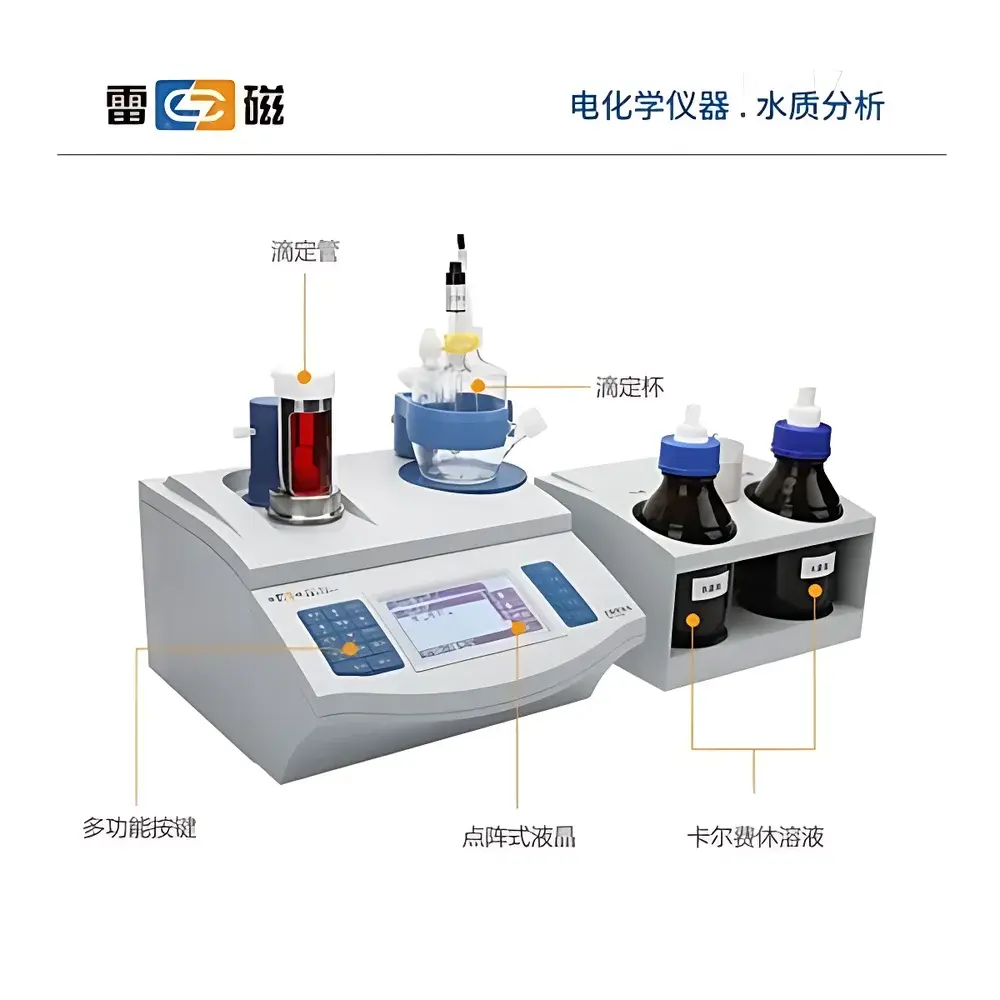
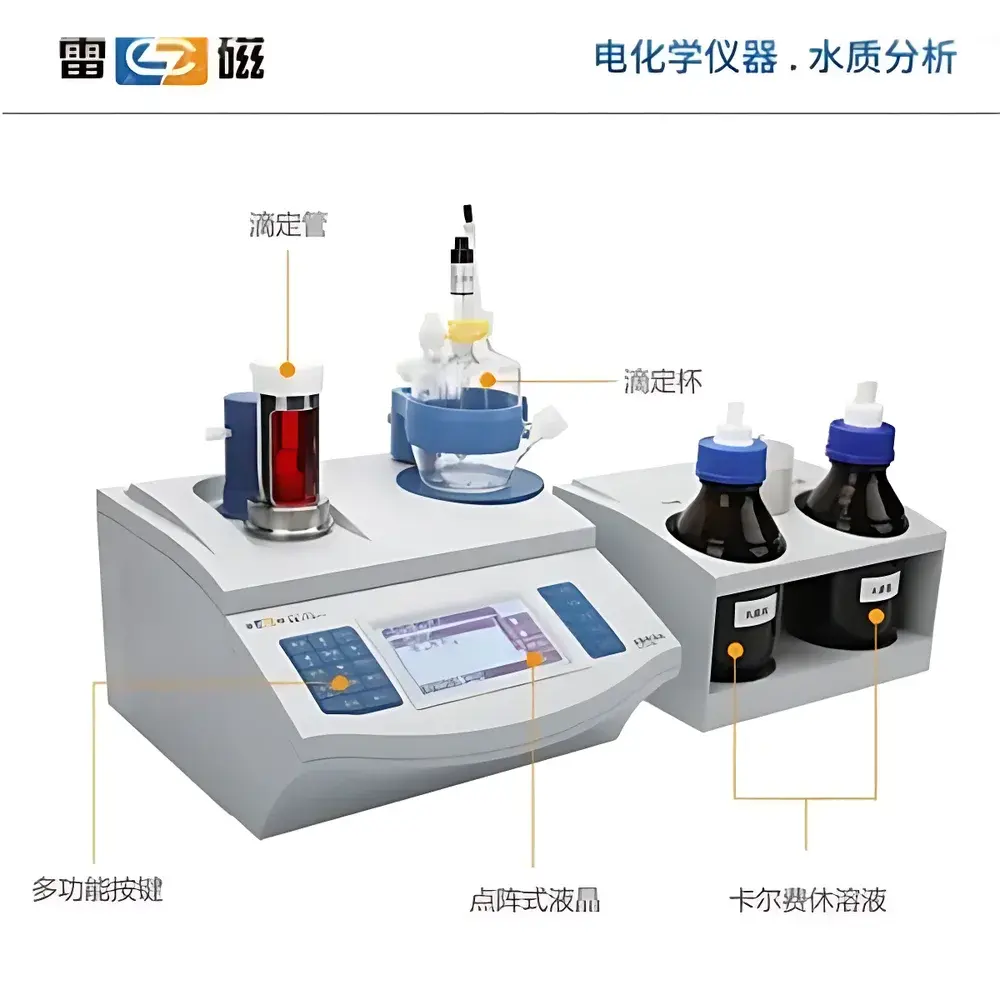
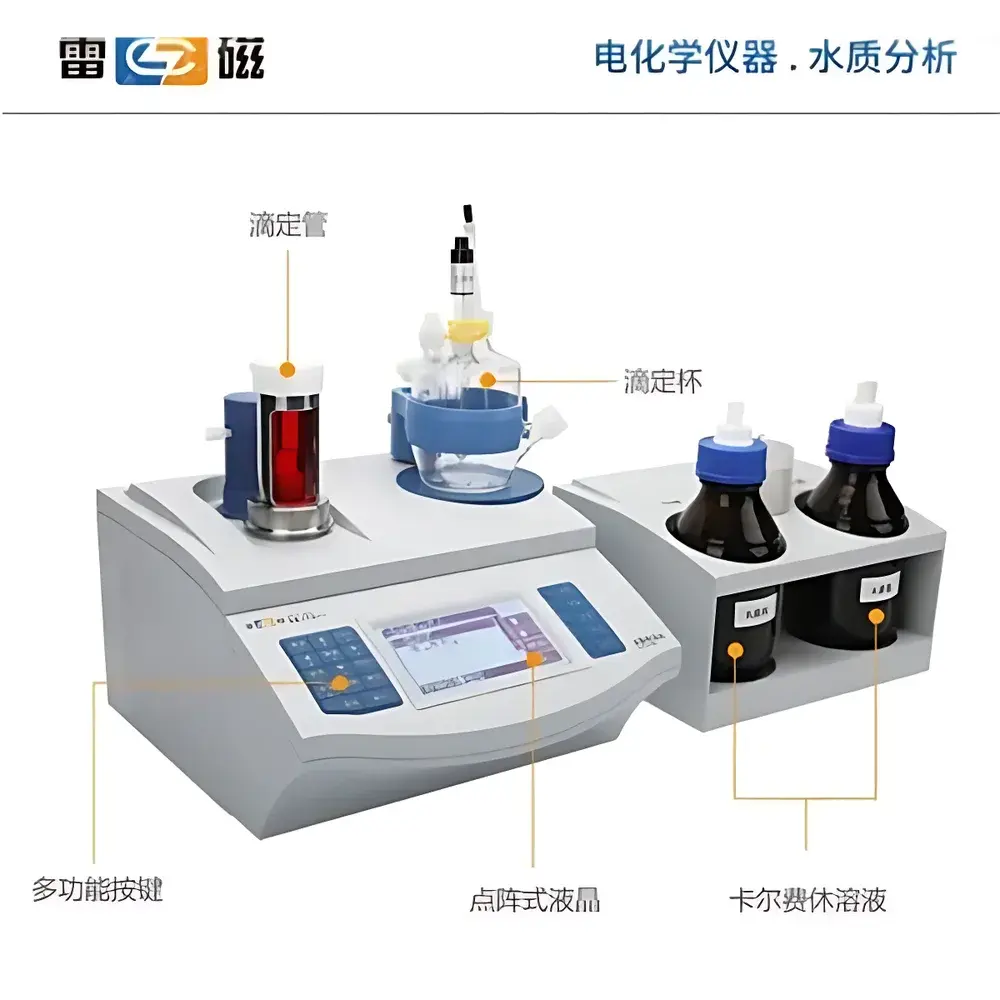
Leici ZDY-502 Coulometric Karl Fischer Moisture Titrator
| Brand | Leici |
|---|---|
| Origin | Shanghai, China |
| Manufacturer Type | Authorized Distributor |
| Origin Category | Domestic (China) |
| Model | ZDY-502 |
| Pricing | Upon Request |
| Translation Stage | Contact Manufacturer |
| Measurement Range | 0.1–250 mg H₂O |
| Resolution | 0.1 mg |
| Polarization Current Accuracy | 1 μA ± 0.2 μA |
| Repeatability | ±0.5% RSD |
| Power Supply | (220 ± 22) V, (50 ± 1) Hz |
| Dimensions (W×D×H) | 340 × 400 × 400 mm |
| Weight | 10 kg |
| Data Storage Capacity | 200 methods/results |
| Interface | USB + RS232 |
| GLP Compliance | Yes |
| Safety Features | Anti-spill, anti-siphon waste bottle, KF reagent isolation, auto-cleaning, overflow protection |
Overview
The Leici ZDY-502 Coulometric Karl Fischer Moisture Titrator is a precision-engineered analytical instrument designed for quantitative determination of trace to moderate water content in solid, liquid, and gaseous samples using coulometric titration according to the ASTM D6304, ISO 12937, and USP principles. Unlike volumetric KF systems, the ZDY-502 generates iodine electrochemically at the anode via controlled current, enabling high sensitivity and exceptional accuracy in the low-microgram range (0.1–250 mg H₂O). Its coulometric architecture eliminates volumetric calibration drift and reagent standardization errors, making it particularly suitable for quality control laboratories requiring stringent batch-to-batch reproducibility in pharmaceutical excipients, polymers, lithium battery materials, and fine chemicals.
Key Features
- Coulometric generation of iodine with dual-range polarization current control (1 μA and 50 μA), optimized for both ultra-trace and higher moisture levels
- Integrated safety architecture: sealed reagent handling system, anti-backflow waste bottle, drip cup overflow protection, and automated rinsing cycle to prevent operator exposure to toxic KF reagents (e.g., SO₂, pyridine-free alternatives)
- Intuitive human-machine interface featuring dot-matrix LCD with Chinese-language prompts and step-by-step “dialogue-style” operation guidance—no prior titration expertise required
- Multi-mode titration support: pre-titration, automatic endpoint detection, manual override, constant-current titration, and KF titer calibration mode
- Flexible result reporting: selectable units including mg, mg/L, % (w/w), and ppm, with real-time display of method parameters, titration curve, and endpoint stability indicators
- Robust data governance: 200 method/result sets stored internally with timestamp, operator ID (if configured), and audit-ready metadata; supports export via USB or RS232 to external printers or LIMS
Sample Compatibility & Compliance
The ZDY-502 accommodates diverse sample matrices—including hygroscopic powders (e.g., cellulose derivatives), viscous oils (e.g., transformer fluids), solvents (e.g., acetonitrile, methanol), and packaged solids—when used with appropriate sample preparation kits (e.g., oven couplers, headspace samplers, or dry gas purging modules). All operational logic adheres to Good Laboratory Practice (GLP) requirements: full electronic record retention, user-accessible audit trails, password-protected method editing, and configurable data integrity safeguards. The system meets essential electromagnetic compatibility (EMC) and electrical safety standards per GB/T 18268.1–2010 (equivalent to IEC 61326-1) and supports traceability under ISO/IEC 17025-accredited workflows.
Software & Data Management
The instrument ships with dedicated Windows-based titration software supporting dual-control mode: standalone instrument operation or synchronized PC-driven acquisition. Software functions include method library management, customizable report templates (PDF/CSV), statistical evaluation (mean, SD, RSD), trend analysis across batches, and secure export with digital signature options. Data files retain raw current-time profiles, endpoint detection logs, and environmental metadata (ambient temperature/humidity if externally logged). For regulated environments, the software architecture permits configuration to align with FDA 21 CFR Part 11 requirements—including electronic signatures, role-based access control, and immutable audit trails—when deployed on validated IT infrastructure.
Applications
- Pharmaceutical manufacturing: moisture verification of active pharmaceutical ingredients (APIs), excipients (lactose, microcrystalline cellulose), and lyophilized products per USP
- Electrochemical materials: residual moisture quantification in cathode/anode powders and electrolyte solvents for Li-ion battery production
- Polymer industry: monitoring hydrolytic degradation risk in polyamide (PA6, PA66), polybutylene terephthalate (PBT), and polycarbonate resins
- Fuel and lubricant testing: water content assessment in aviation turbine fuels (ASTM D6304), biodiesel (EN 14971), and synthetic ester-based insulating oils
- Food and feed analysis: validation of drying efficiency in starches, whey protein isolates, and pet food formulations
FAQ
What is the difference between coulometric and volumetric Karl Fischer titration?
Coulometric KF (used by ZDY-502) electrochemically generates iodine in situ, offering superior precision below 100 µg water. Volumetric KF delivers standardized iodine solution from a burette and is preferred for samples containing >1000 µg water.
Does the ZDY-502 support compliance with FDA 21 CFR Part 11?
Yes—when operated with validated PC software, configured user roles, electronic signatures, and audit-trail-enabled data storage, it supports Part 11 readiness in GxP environments.
Can the instrument detect KF reagent exhaustion automatically?
Yes—the system continuously monitors electrode response stability and current efficiency; it triggers visual and audible alerts when reagent activity falls below defined thresholds.
Is method transfer possible between ZDY-502 units?
Yes—methods and calibration data can be exported/imported via USB drive in standardized binary format, ensuring consistent performance across multiple instruments in multi-site labs.
What maintenance is required for long-term reliability?
Routine maintenance includes daily electrode cleaning with solvent, monthly diaphragm inspection, annual replacement of generator cathode membrane (if applicable), and biannual verification using certified water standards (e.g., 1.00 ± 0.02 mg H₂O/mg standard).
Related Products



