
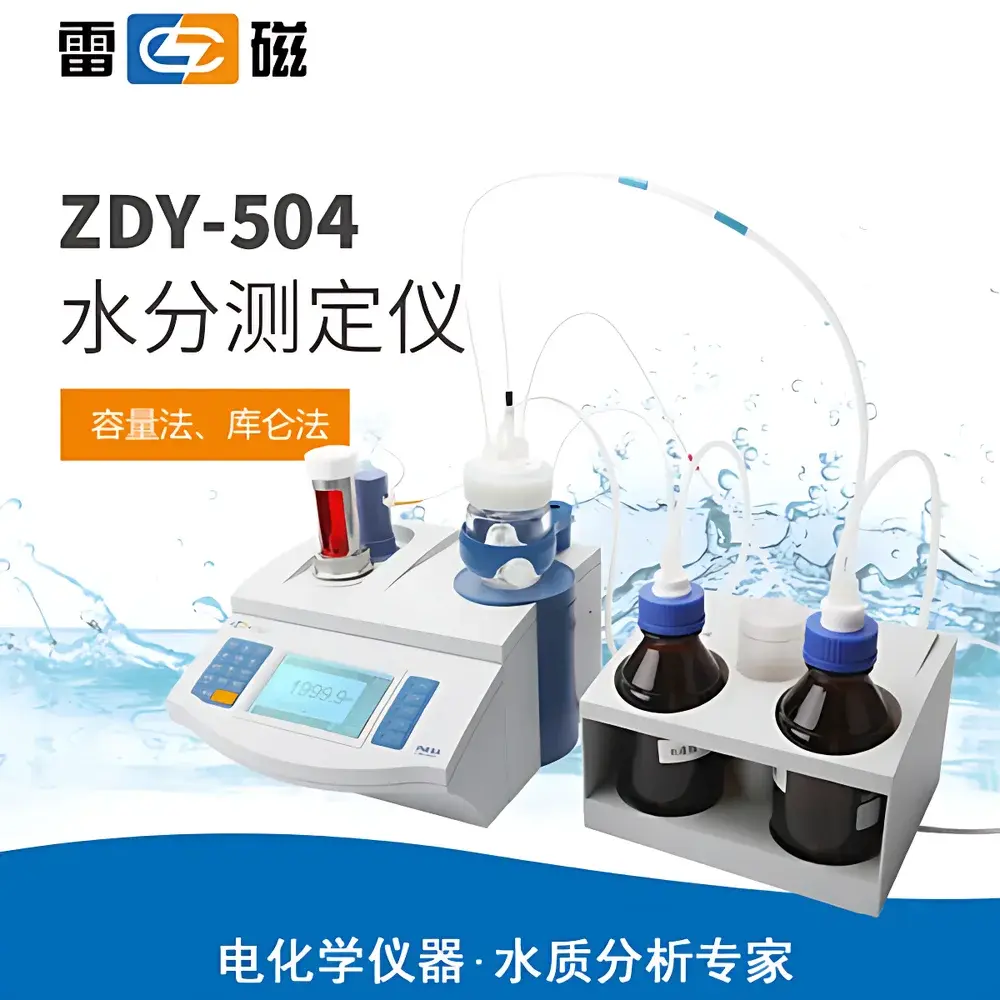
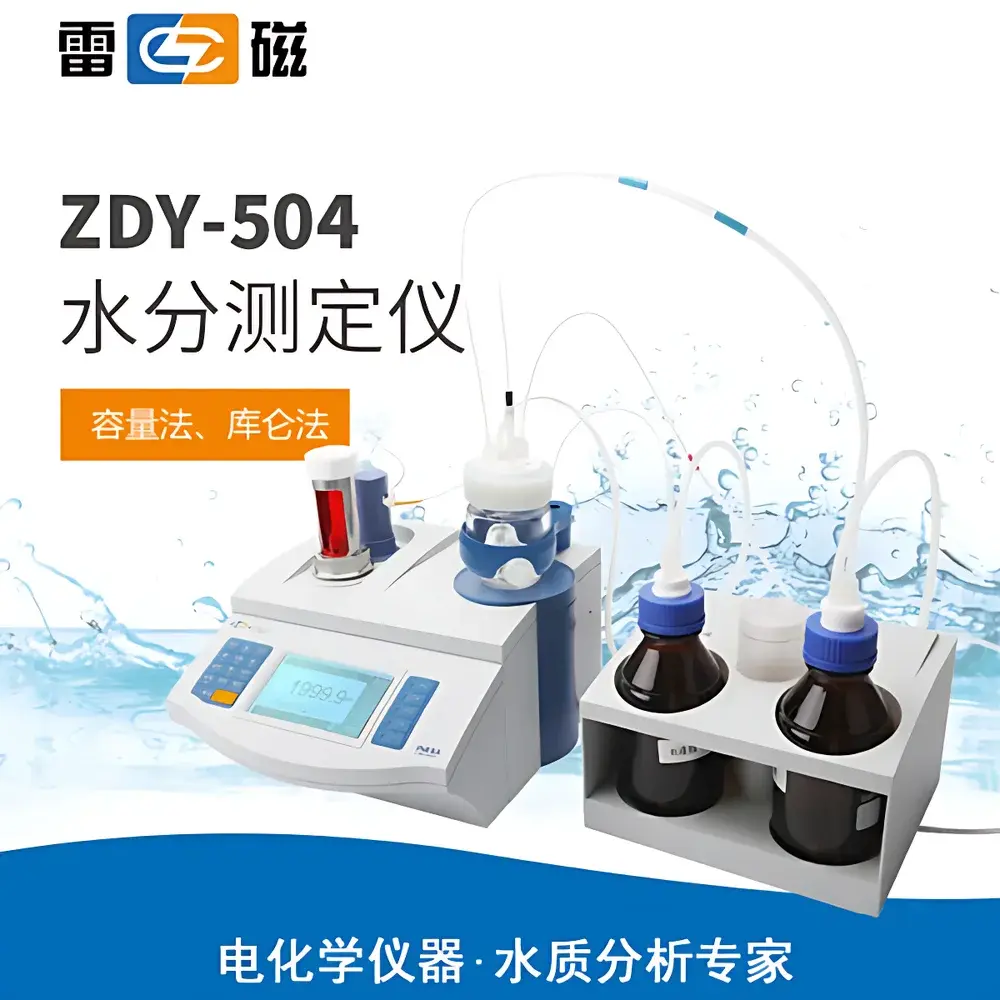
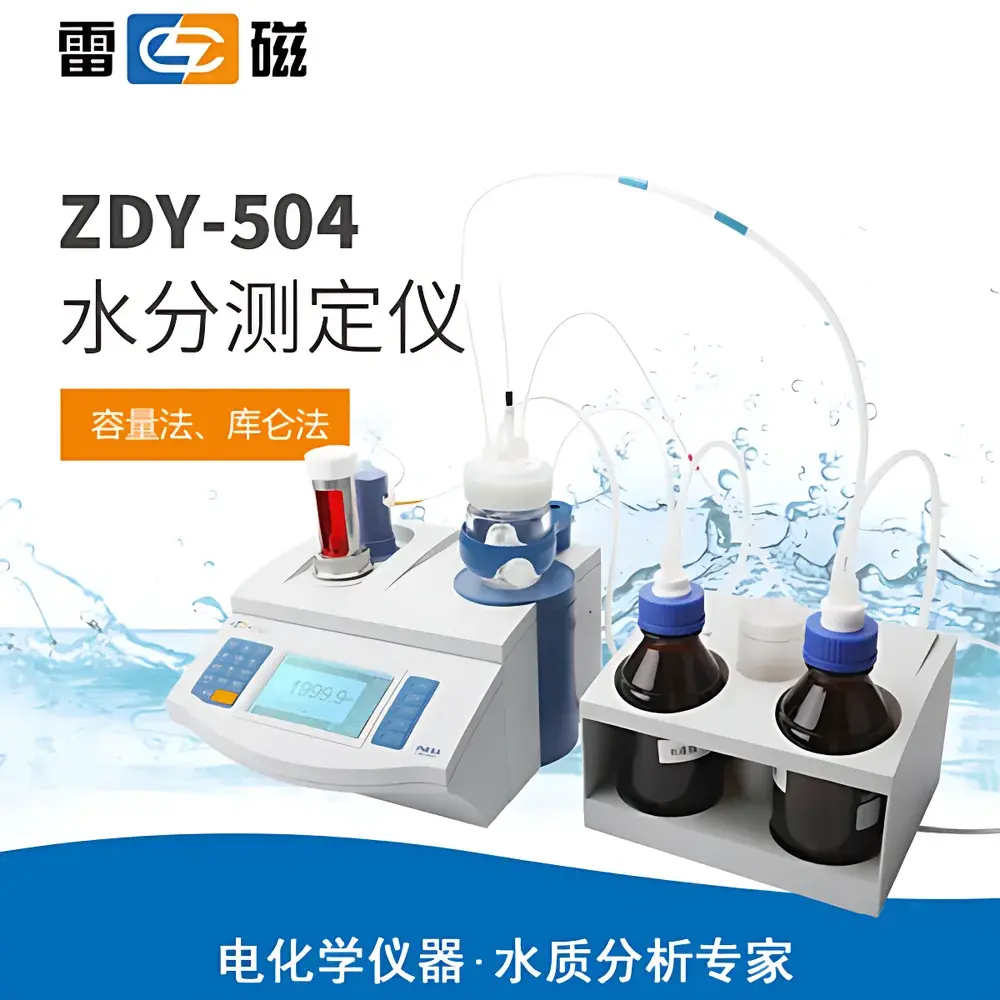
Leici ZDY-504 Karl Fischer Moisture Titrator
| Brand | Leici |
|---|---|
| Origin | Shanghai, China |
| Manufacturer Type | Authorized Distributor |
| Regional Classification | Domestic (PRC) |
| Model | ZDY-504 |
| Pricing | Available Upon Request |
| Instrument Type | Portable Karl Fischer Coulometric & Volumetric Titrator |
| Measurement Range | 0.1 – 250.0 mg H₂O |
| Repeatability | ≤0.5% RSD |
Overview
The Leici ZDY-504 Karl Fischer Moisture Titrator is a dual-mode (coulometric and volumetric) analytical instrument engineered for precise, trace-level moisture quantification in solid, liquid, and gaseous samples across pharmaceutical, chemical, petrochemical, polymer, and food quality control laboratories. It operates on the electrochemical principle of Karl Fischer titration—where iodine generated electrochemically (in coulometric mode) or delivered via standardized titrant (in volumetric mode) reacts stoichiometrically with water according to the Bunsen reaction: I₂ + SO₂ + H₂O + 3RN + CH₃OH → 2RN·HI + RN·HSO₄CH₃. The ZDY-504 enables accurate determination of water content from 0.1 mg to 250.0 mg, supporting both routine QC testing and method development for materials with low (1%) moisture content. Its portable form factor integrates full titration automation without compromising metrological integrity—making it suitable for on-site analysis, mobile labs, or space-constrained environments where benchtop systems are impractical.
Key Features
- Dual operational modes: switch seamlessly between coulometric (for trace moisture, <100 µg) and volumetric (for higher moisture levels, up to 250 mg) titration within a single platform.
- Integrated safety architecture: built-in anti-leak reagent delivery system, anti-siphon waste bottle design, overflow protection for titration cell, and automated reagent mixing—minimizing operator exposure to hazardous KF reagents (e.g., pyridine-free or methanol-based solutions).
- Full process automation: automatic solvent dispensing, titrant dosing, endpoint detection, cell rinsing, and post-analysis cleaning—all programmable and repeatable per sample batch.
- Flexible endpoint recognition: adaptive polarization current detection with adjustable sensitivity thresholds ensures robust endpoint identification across diverse sample matrices (e.g., viscous oils, hygroscopic powders, or solvents with high background conductivity).
- Multi-unit reporting: results exportable in mg, mg/L, % (w/w), % (w/v), and ppm—configurable per method to align with internal SOPs or regulatory submission requirements.
- Embedded data integrity safeguards: power-failure recovery preserves active titration state; all measurements timestamped and logged with operator ID, method name, and environmental metadata (ambient temperature/humidity if externally interfaced).
Sample Compatibility & Compliance
The ZDY-504 accommodates a broad spectrum of sample types—including pharmaceutical excipients (e.g., lactose, microcrystalline cellulose), organic solvents (acetone, THF), lubricants, polymers (PVC, PET), and packaged foods—via optional sample changers or direct injection adapters. All measurement protocols adhere to internationally recognized standards: ASTM E203 (Standard Test Method for Water Using Volumetric Karl Fischer Titration), ISO 760 (Determination of Water—Volumetric Karl Fischer Titration Method), and USP (Water Determination). Instrument firmware supports GLP-compliant operation: audit trails record user actions, method modifications, calibration events, and data exports. Data files are stored in non-proprietary CSV format for third-party LIMS integration and satisfy basic FDA 21 CFR Part 11 readiness when deployed with controlled access and electronic signature workflows.
Software & Data Management
The ZDY-504 operates via embedded firmware with optional PC-based Chinese/English software for advanced method development, remote control, and comprehensive data review. Up to 200 volumetric and 200 coulometric measurement records are retained onboard with full traceability: each entry includes sample ID, titration curve, endpoint volume/current, calculated water mass, RSD, and pass/fail status against pre-set acceptance criteria. Data export is supported via RS-232 to serial printers or ASCII-formatted USB storage devices. Firmware and application software are field-upgradable—ensuring long-term compatibility with evolving laboratory informatics infrastructure and regulatory expectations.
Applications
- Pharmaceutical manufacturing: verification of residual moisture in lyophilized APIs and final dosage forms per ICH Q5C guidelines.
- Polymer processing: monitoring moisture in PET granules prior to extrusion to prevent hydrolytic degradation.
- Battery electrolyte QC: quantifying trace water in LiPF₆ solutions where >20 ppm H₂O compromises SEI formation.
- Fuel quality assurance: detecting water contamination in aviation turbine fuel (ASTM D6304 compliance support).
- Food stability testing: measuring water activity precursors in dried herbs, spices, and dairy powders.
FAQ
Does the ZDY-504 support both coulometric and volumetric Karl Fischer methods?
Yes—the instrument automatically detects and configures the appropriate electrode configuration, titrant type, and calculation algorithm based on selected mode.
What safety features prevent operator contact with KF reagents?
The system incorporates sealed reagent reservoirs, positive-pressure fluidic control, anti-backflow waste management, and fully enclosed titration cell handling—eliminating manual pipetting or open-cell manipulation.
Can measurement data be exported to LIMS or ELN platforms?
Yes—CSV-formatted reports are generated upon completion and can be transferred via USB or RS-232; optional software provides ODBC connectivity for direct database ingestion.
Is the ZDY-504 compliant with ISO/IEC 17025 documentation requirements?
When operated with defined calibration schedules, documented method validation, and enabled audit trail logging, it meets the technical record-keeping provisions of ISO/IEC 17025:2017 Clause 7.5.
How is repeatability verified during routine operation?
Users may run certified reference materials (e.g., sodium tartrate dihydrate) at three concentration levels; the ≤0.5% RSD specification applies to triplicate determinations under identical instrumental conditions.
Related Products







