
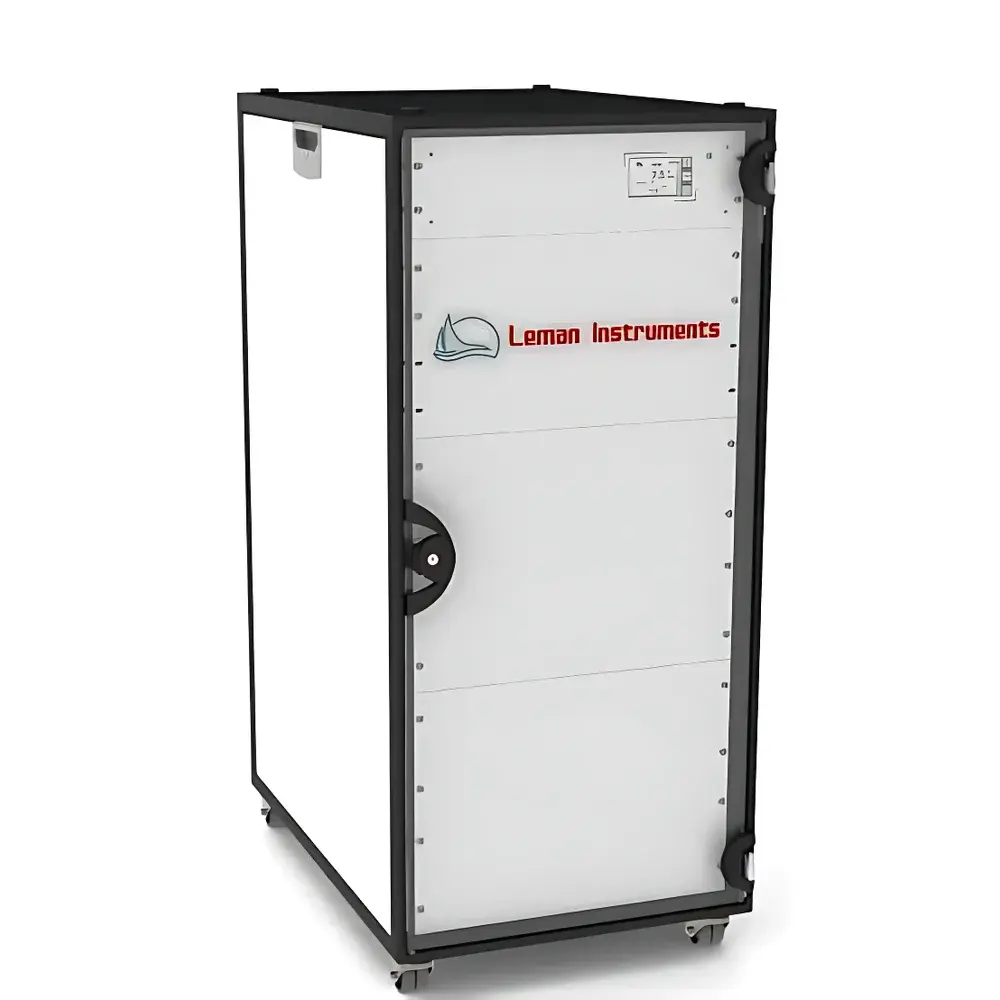
Leman Instruments AERO60LS Zero-Air Generator
| Brand | Leman Instruments |
|---|---|
| Origin | France |
| Model | AERO60LS |
| Hydrocarbon Removal Principle | High-Temperature Catalytic Cracking |
| Output Flow Rates | 40, 80, 100, 120 L/min |
| Maximum Output Pressure | 5 bar |
| Total Hydrocarbons (HCnm) | ≤ 0.01 ppm |
| Dew Point | −70°C |
| Water Content | < 2 ppm (−70°C DP) |
| CO₂ | < 0.5 ppm |
| CO + CH₄ | < 0.03 ppm |
| NOₓ | < 2 ppb |
| O₃, SO₂, NH₃ | < 1 ppb |
| Particulates | < 0.1 µm |
Overview
The Leman Instruments AERO60LS Zero-Air Generator is an engineered solution for laboratories requiring ultra-pure compressed air as a carrier, combustion, or zero-gas source in analytical instrumentation. Designed and manufactured in France, the AERO60LS employs high-temperature catalytic cracking to eliminate hydrocarbons—including methane and non-methane volatile organic compounds (NMVOCs)—down to ≤ 0.01 ppm (HCnm), while simultaneously removing moisture, carbon dioxide, carbon monoxide, nitrogen oxides, ozone, sulfur dioxide, ammonia, and submicron particulates. Its core architecture integrates a multi-stage purification train: compression with oil-free scroll technology, desiccant-based drying to −70°C dew point, dual-stage catalytic oxidation (including a proprietary high-efficiency HC converter), and final ultra-low-particulate filtration (< 0.1 µm). This ensures compliance with stringent specifications for flame ionization detection (FID), photoionization detection (PID), gas chromatography–mass spectrometry (GC–MS), permeation tube calibration systems, and ambient air monitoring reference standards.
Key Features
- Four selectable flow rates: 40, 80, 100, and 120 L/min—each calibrated and validated per ISO 8573-1 Class 1:2010 for solid particles, water, and oil content
- Maximum regulated output pressure of 5 bar (72.5 psi), compatible with high-backpressure GC detectors and automated sampling manifolds
- Integrated full-color touchscreen HMI with real-time status display of dew point, pressure, flow, catalyst temperature, and system health diagnostics
- Standard industrial communication interfaces: USB (for firmware updates and local data export), RS485 (Modbus RTU), and Ethernet (TCP/IP) supporting remote monitoring and integration into LabVantage, Empower, or custom SCADA environments
- True maintenance-free operation: catalyst lifetime rated for ≥ 20,000 hours under nominal load; no scheduled filter replacements or consumables required within first 18 months of continuous use
- CE-marked and compliant with EN 61000-6-2 (immunity) and EN 61000-6-4 (emissions); designed for 24/7 operation in ISO 17025-accredited testing laboratories
Sample Compatibility & Compliance
The AERO60LS delivers air meeting or exceeding the purity requirements defined in ASTM D6216 (Standard Specification for Zero Air Used in Ambient Air Monitoring), EPA Method TO-15 Appendix B (zero-air certification for VOC analysis), and ISO 8573-1:2010 Class 1 for particles, water, and total oil. It is routinely deployed as combustion gas for FID detectors in environmental labs conducting EPA Method 8260/8270 analyses, as zero air for dynamic dilution calibrators (e.g., VICI Valco, Environics), and as carrier gas in GC–FID systems used for residual solvent testing per ICH Q2(R2) and USP . The unit satisfies GLP/GMP audit requirements through built-in event logging, timestamped operational records, and optional 21 CFR Part 11-compliant software modules for electronic signature and audit trail generation.
Software & Data Management
The embedded control firmware supports local data logging (≥ 30 days of 1-minute interval readings) and configurable alarm thresholds for dew point excursion, pressure drop across filters, or catalyst thermal deviation. Via Ethernet, the AERO60LS integrates natively with laboratory information management systems (LIMS) using standard protocols including HTTP RESTful API and OPC UA. Optional Leman Connect™ software provides centralized fleet monitoring for multi-unit installations, predictive maintenance alerts based on cumulative runtime and thermal cycling history, and automated report generation aligned with ISO/IEC 17025 clause 7.7 (equipment records). All configuration changes are logged with user ID, timestamp, and parameter delta—enabling full traceability during regulatory inspections.
Applications
- Flame Ionization Detectors (FID) in gas chromatography systems for hydrocarbon quantification in petrochemical, environmental, and pharmaceutical QC labs
- Zero-air supply for dynamic gas calibration systems, including permeation tube ovens and mass flow controller-based dilutors used in EPA Method 25A and ISO 12039
- Carrier and purge gas in headspace GC analysis of residual solvents per USP and Ph. Eur. 2.4.24
- Reference air source for ambient air quality monitors (e.g., TEOM, beta attenuation, chemiluminescence NOx analyzers)
- Instrument air for FTIR spectroscopy sample compartments and laser cavity purging where hydrocarbon contamination degrades signal-to-noise ratio
FAQ
What analytical standards does the AERO60LS meet for zero-air purity?
It complies with ASTM D6216, EPA Method TO-15 Appendix B, ISO 8573-1:2010 Class 1, and EN 14625 for hydrocarbon-free air used in trace-level VOC analysis.
Can the AERO60LS be integrated into a networked lab infrastructure?
Yes—via native Ethernet (TCP/IP), RS485 (Modbus RTU), and USB, it supports direct integration with LIMS, SCADA, and chromatography data systems without third-party gateways.
Is catalyst replacement required during routine operation?
No—the high-temperature catalytic converter is engineered for ≥ 20,000 hours of continuous service under specified inlet air conditions; no scheduled replacement is needed within the first 18 months.
Does the unit support 21 CFR Part 11 compliance?
When paired with optional Leman Connect™ software and configured with role-based access control, electronic signatures, and immutable audit trails, full Part 11 compliance is achievable.
What is the maximum allowable inlet air temperature and humidity?
Ambient inlet air must be ≤ 35°C and ≤ 80% RH; operation outside this range may affect dew point stability and catalyst longevity—consult technical documentation for derating curves.



